
Preview

Let’s Preview More: SkyCraft

1-99 Players

Publisher: NukaZombee

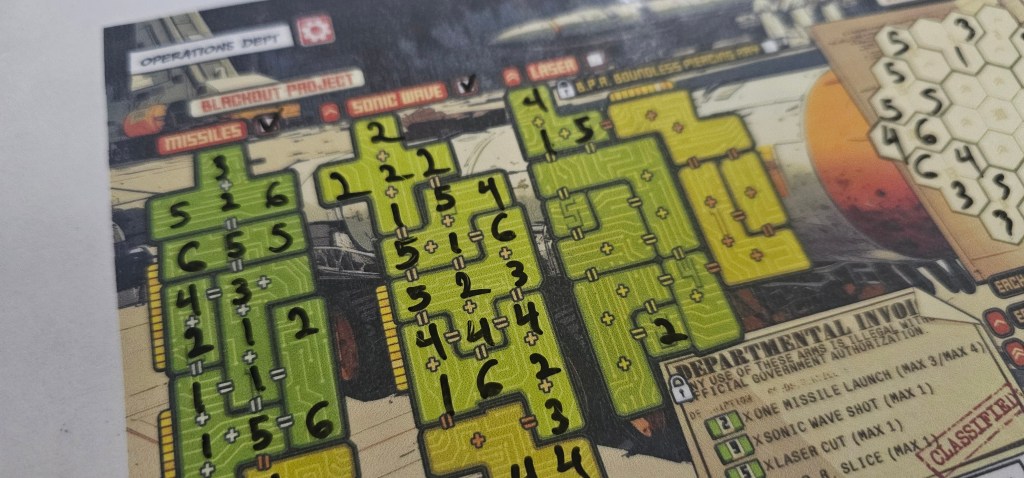
After a few very bleak releases, NukaZombee comes out with a whimsical journey through a land of orcs, alchemy and air balloons. But is this journey going to soar but is the orc’s curse is just too much?

EDIT: A few corrections due to a rules misunderstanding.

How to Play

To setup, put the enemy on the first spot on its path, your character in the middle and gems on the spots on the player sheet and map. Each turn is broken into three steps: move, actions and enemy movement.

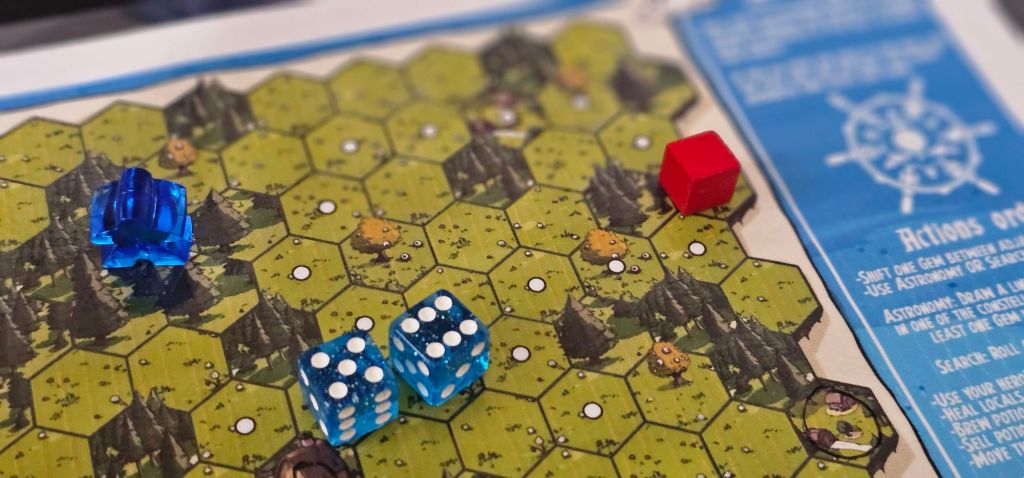
To move, the player rolls two dice, one sets the destination and the other for the move amount. If the player acquired any constellations they can use them to change one or both of the values to get to specific spots.

On the actions, first the player can move one of the gems between the classes to get different bonuses, then getting ingredients or mapping stars. Then, depending on where the player is, they can get more ingredients or heal the villagers . Finally, the player can craft items and brew/sell potions. After that, the orcs advance one space, two if the player went off of the edge of the map.

The player wins if they are able to get the healing skill to max and do one more healing, and lose if the orcs reach the final spot, the King.

Rules and Components

Take this section with a grain of salt, since this is an early preview copy and lots can and will change. As of know, the rules have a great and vibrant layout and use a lot of visuals to show each element of the game. However, as of now, they feel incomplete and a few spots are unclear. Again, early preview copy. The game is perfectly playable, even if a mistake or two are there.

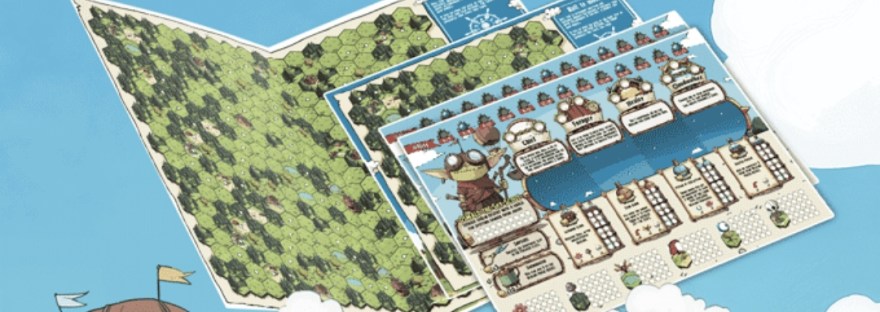
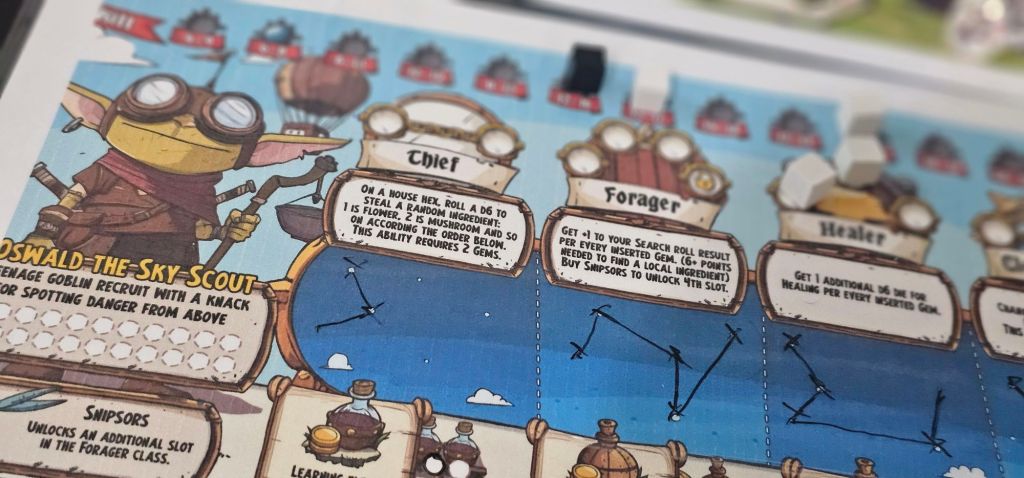
As I mentioned, the visuals are clear, vibrant and rich. There are two sheets, one for the map and one for the player. The player sheet works great, rules are embedded on each spot and they work really well. The map, while beautiful, lacks a bit of usability, specially a spot to clearly see which villages are there.

Gameplay

SkyCraft is not rules heavy, but it’s surprisingly thinky and requires a lot of planning to be successful. Movement is the main challenge, just getting to the right place and getting the right ingredients or skills at the right time. There are four skills, and you can only move laterally and one gem per turn. Having flexibility with the movement will probably mean that you are not healing or foraging as well.

Healing is a bit odd. You have one die, plus one for each gem on the healer class, and you have to roll within a range, not less or more. Whenever you succeed you advance on the skill, if not you move back. The odd part is while you do move towards having more gems as your skills increases, it also requires more dice and a harder roll. It’s not always advantageous to skill up.

Even with these hurdles, as of know the game is fairly forgiving in terms of the challenge of completing the goal before the orc gets to the final spot, specially when there is a potion that moves back the orcs a whopping 20 spots.

Theme and Art

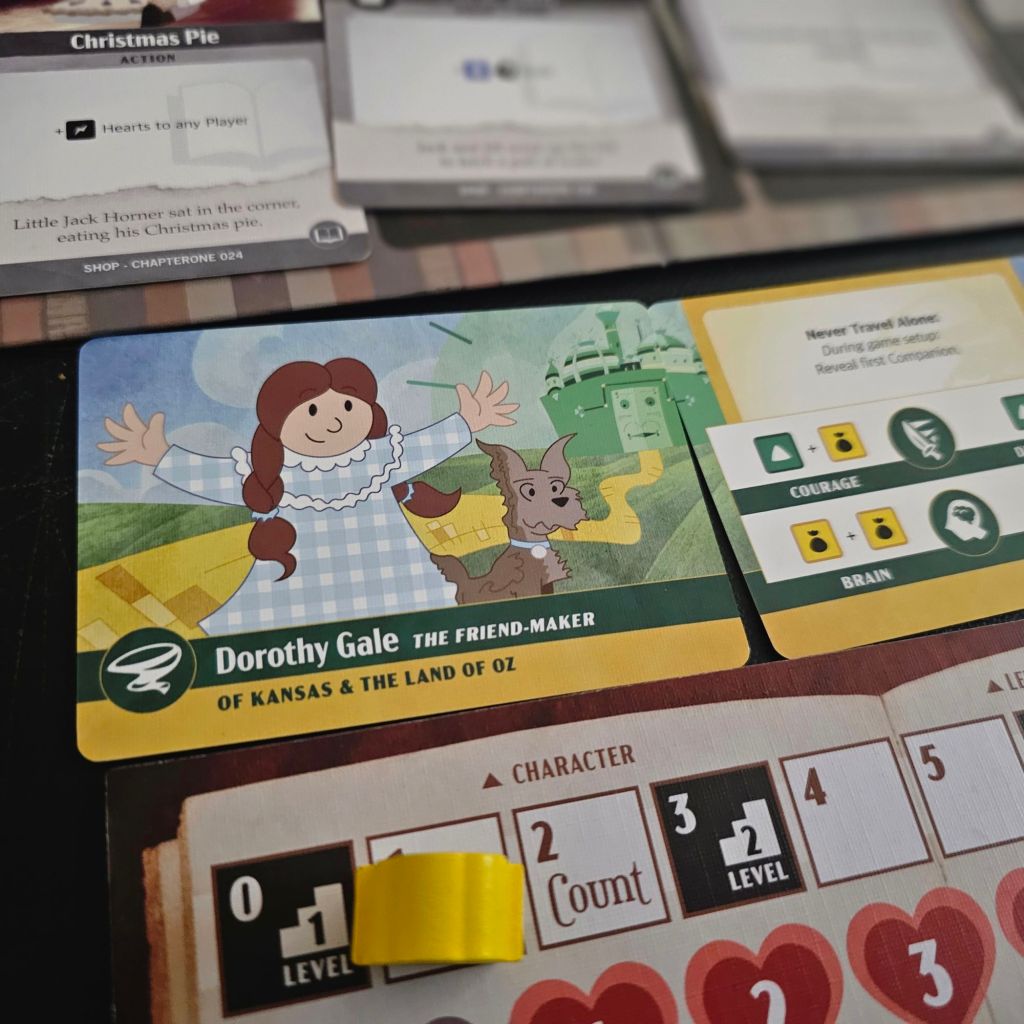
I absolutely love the art for this game! The characters, both the one available on the preview and the ones announced, are goofy and have a lot of personality. The map is also interesting, with even spots that share a type being unique.

The theme for the most part comes through as well, with the character just flying around the land and, in my mind, tossing healing potions right to villagers head. There are a few spots that I feel it could be better.

One, it bothers me to no end that we are stealing from the villagers we are trying to save. It could be donations or something else, but stealing just feels wrong. Also, the orcs as of now feel mostly just like a timer. They are not a looming scary presence that can cause havoc, they are just walking around up until the next step.

Conclusion

Despite my criticisms, I feel like SkyCraft is a blast to play. It’s a game where you take very little to get into, but then slowly start to realize that if you don’t plan right, you will not do well. It’s a game about understanding the odds and planning your turns ahead of time, and when you are able to pull it off you it’s exciting.

Unsurprisingly, there are a few balance issues, but even with those the game feels rewarding and complete. And, on top of it, knowing that there will be extra characters I’m super excited to see what they are going to bring to the skies.

NukaZombee has a knack for making longer roll and writes feel like a breeze, and I feel engaged the whole playthrough. If a thinky but whimsical adventure is up your alley, you will find a great game here!

PnP Review

PnP Review: Lepra

1 Player

Designer: Denis Kurdiukov

Artist: Denis Kurdiukov

Publisher: Nuka Zombee

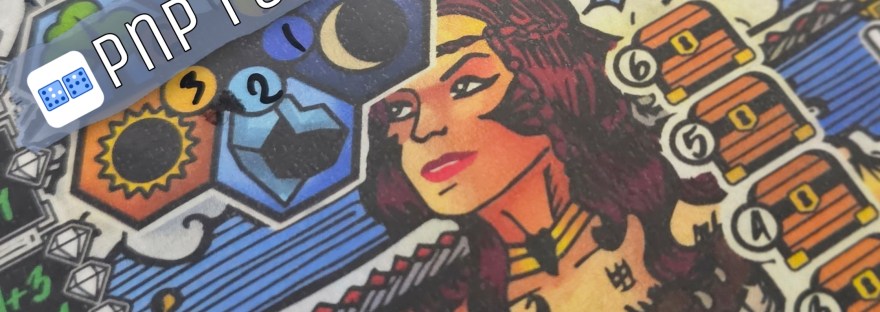
In Lepra, you’re trying to survive a horrible plague and find a cure before your town is consumed. Is your destiny to be the saviour or are you down with the sickness?

How to Play

Harbor Area

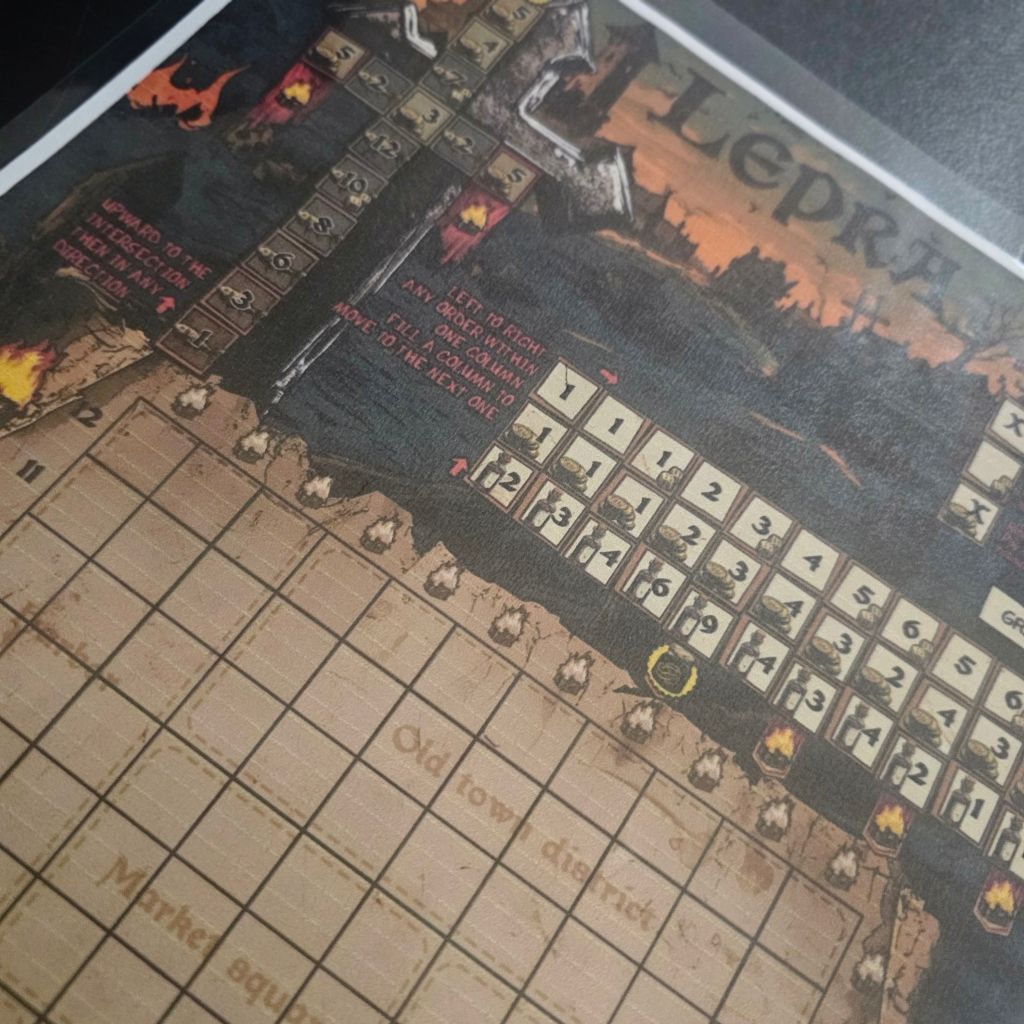
To setup the game, you just need two sheets and two pairs of dice of different colors. First, you roll all 4 dice, with each color being one coordinate. That square on the map is hit by the plague and crossed. If that spot is already taken, you find the first spot without plague in each direction and cross them. Then, for free, you can quarantine one spot on the map. Quarantined squares can take one hit from the plague before succumbing to it.

Then, you can use any of the four dice to take one dice action, and you can also use resources you acquired to take spend actions. Resources other than coins need to be spent in groups, so if to earned 3 food and needs to spend 1, the last one is lost.

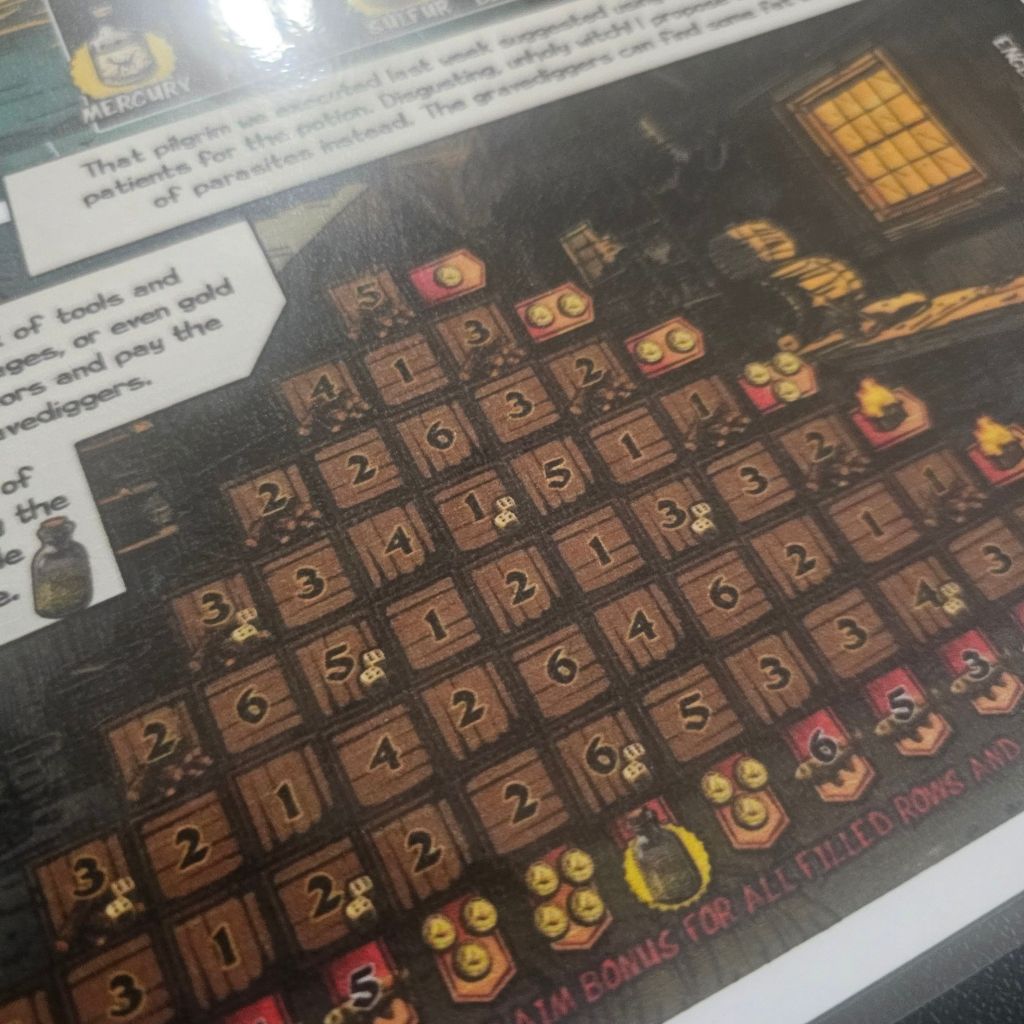
Each of the four areas must be filled in different ways. The cross needs to be filled from the bottom up, and only takes resources, the graveyard needs to be filled one column at a time, the harbor needs to be filled one row at a time and with values summing to a specific value, and the workshops can be filled freely, and give you bonuses for completed rows and columns.

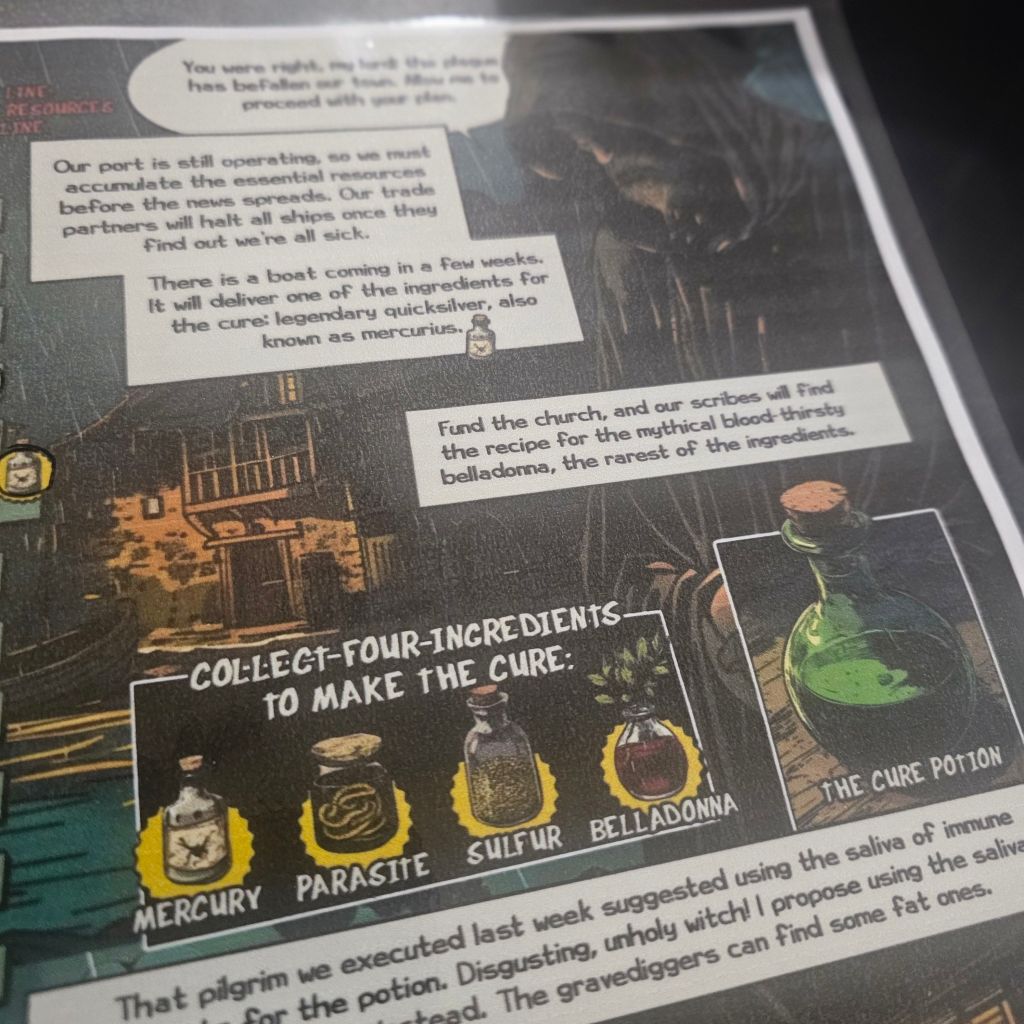
Each area at a certain point gives you an ingredient for the cure. If you find all four you win the game. However, if you ever have a 2×8 area of a 5 square cross, you lose.

Rules and Components

Workshops

I know rules for PnPs, specially ones just released, are in constant evolution, but Lepra already starts with a mostly well written piece. There are a few areas where the wording could have been better, but I do also appreciate the faq in the end. I complained about the layout of Nuka Zombee’s rules for Recycled, and I do feel like it’s much better here.

The sheets, however, are totally too dark. I understand the thematic reason for if, and while I do appreciate it, it gets in the way of good usability. Explanations on how each area works are written near them on the sheet, which is good. But it’s red on a very dark background, and while it is readable on the pdf, when printed it becomes quite hard.

Score: 6.5 / 10

Gameplay

Plague and quarantine

In its essence, Lepra is a games about action economy and “just enough” spending. With a single dice action per turn, you have to be precise on when and where to spend it to get you close to victory. Since you spend resources in bunches, ideally you gather and spend the exact amount, as the surplus could be used elsewhere. That ties in, for example, with the harbor. It’s quite interesting how to obtain a good amount of a certain resource you will earn less of the other.

Some actions gives you purges, which completely burn down a house, preventing the plague from hitting or spreading from there. Obtaining those in the right time and spending them in the exact spots is crucial for victory. However, if you take too long obtaining more purges you can leave yourself unprotected from the lose conditions.

In a practical sense, it’s a very straightforward game, but it’s also one that challenges your decision making to have a chance of wining.

Score: 7.5 / 10

Theme and Art

Ingredients for the Cure

As I mentioned, Lepra is very theme focused. All areas make thematic sense, in a super abstracted sense of course, and the visual is striking and stark, as the theme requires.

There is one area, I few, it’s quite lacking, which is the village itself. It doesn’t feel alive, or meaningful other than the puzzle that the game imposes. But it does feel like a deliberate to keep the game simple and streamlined. And, after exploring the expansions, I feel even more like that’s the case as this issue is addressed on those. In China, we have the wall parts, Africa has the wells and Aztec has the ritual sacrifices, all giving more personality to your people.

But, since we are just considering the base, I feel like it was a missed opportunity to not give meaning to your people, and that makes it trivial in a sense to put them in harm’s way or to sacrifice them. And that is so central to the theme of the game.

Score: 7/10

Conclusion

Cemetery, Church and Town

Lepra is a slow burning and tense game with a very streamlined and elegant set of rules. The challenge is that to win you have to walk on the edge of risk and efficiency, and that is exciting.

But, it’s not groundbreaking or particularly memorable. I will absolutely play this from time to time, and I feel like it rewards replay for the honing of your skills. But it’s not one that will stick with you after you put it away, something I felt on the past couple of Nuka Zombee’s games.

Rules and Components: 6.5/10
Gameplay: 7. 5/10
Theme and Artwork: 7/10
Score: 7/10
PnP Review

PnP Review : Recycled

1 Player

Designer: Nuka Zombee

Artist: Nuka Zombee

Publisher: Nuka Zombee Games

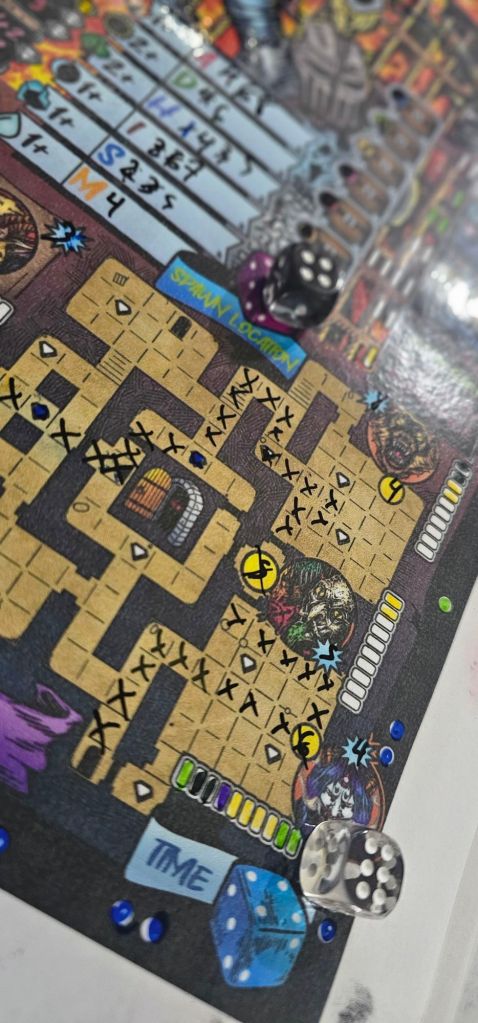
In a distant future, you are a lone scientist left behind in a remote planet, where you have to use your wits and science to survive. But is game mechanically solid or does it make you feel like garbage?

How to Play

Action List

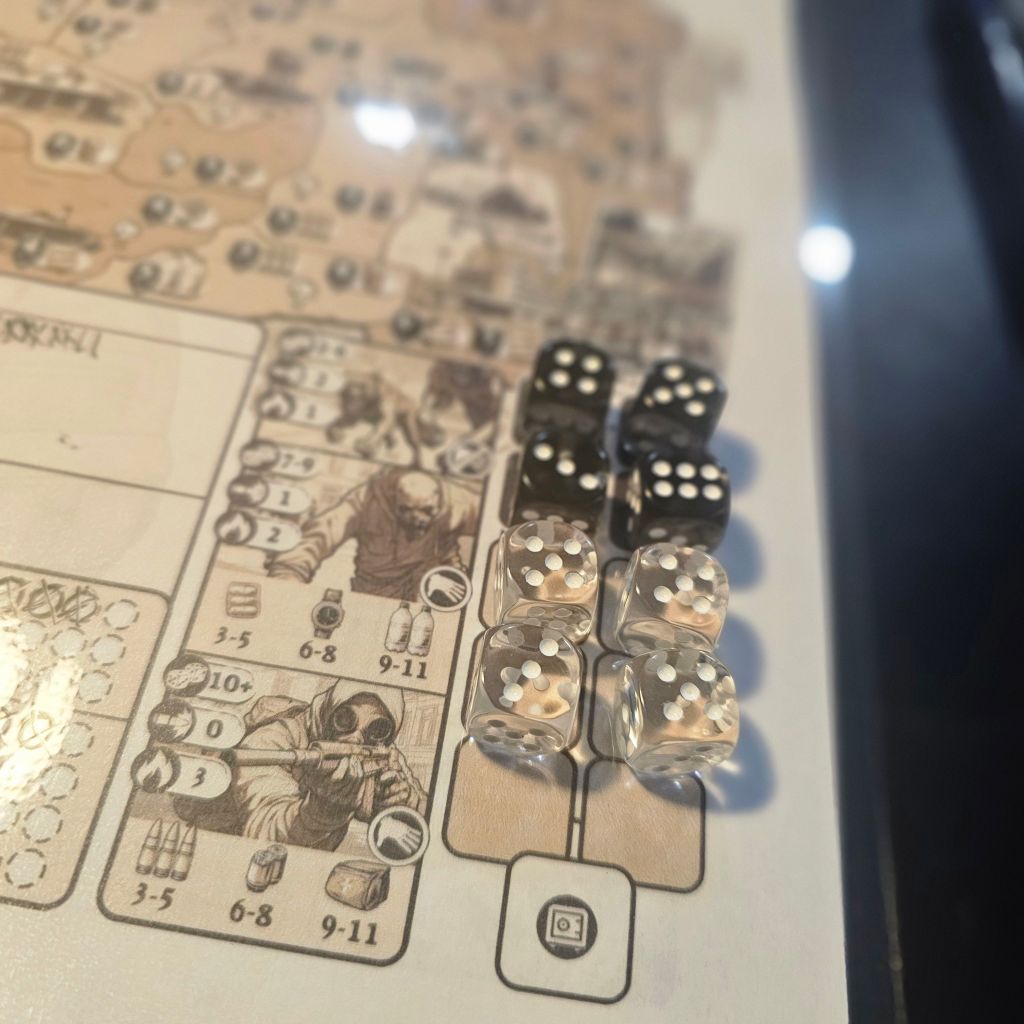
On each turn, you roll 3 dice. Two will be used to take actions, and the last one will be used to check for accidents.

For the action, each dice gives you action points to use for various actions, or you can combine both to take a single action. Excess action points are lost. The actions are basically build building, either directly or through multi phase for some of them, or to generate resources.

Most buildings generate resources locally, meaning that it will be marked and spent from the building itself, and each building has a maximum capacity, usually 6.

The left over dice is combined with another roll to check for accidents, which will usually drain some resources. The lower the roll the worst the loss.

You win the game if you manage to survive 75 rounds, or if you build and produce everything needed for the rescue. You lose if you ever spend your last food, oxygen, sanity or radiation.

Rules and Components

Buildings

While not being a rules heavy game, Recycled does have a lot of nuances to the game flow and actions. Luckily, the rule book does a good job in explaining everything and giving examples. The descriptions could be a little more xkmpl te and the examples a little more extensive, but they do good job.

I am not a big fan of the layout, though. While it looks great and it does use the same style of the components, it is organized in diagrams and tables instead of a regular sequential rule book. That might be a personal issue, but to. my neurodivergent brain it’s just a bit too busy.

The components are great. Both sheets are not only well illustrated, but they are easy to consult, and have all the information needed readily. All resources in this game are circles, and the circles mean something different in each building. However, the building symbols are distinguished enough that you can internalize quickly their meanings.

Score: 8/10

Gameplay

Buildings and resources

Recycled feels very different from most PnP roll and writes. It’s a continuous slow burn where you need to be methodical in your approach and assess the areas of risk and work towards them. Nothing is done quickly and you can’t just turn around and solve an issue in a turn.

The dice mechanism is really interesting. You can either use your big dice to get a lot done, and risk worst accidents, or you can do less actions and be safer. And, what’s best, it’s not a constant choice, it’s all about timing and reading the situation.

This game, interestingly, does not have mitigation. You have to make due with whatever you have. However, double or triple 1s are a safe turn, at least. But that also. mean that you really have to look ahead and plan for worst case scenarios.

The one thing is that 75 turns is quite a lot, and unless I’m required to play for it, like with the pioneer expansion where you cannot build the shuttle, surviving that long does not feel like a good path when compared to the shuttle.

Score: 8.5/10

Theme and Art

Turn tally

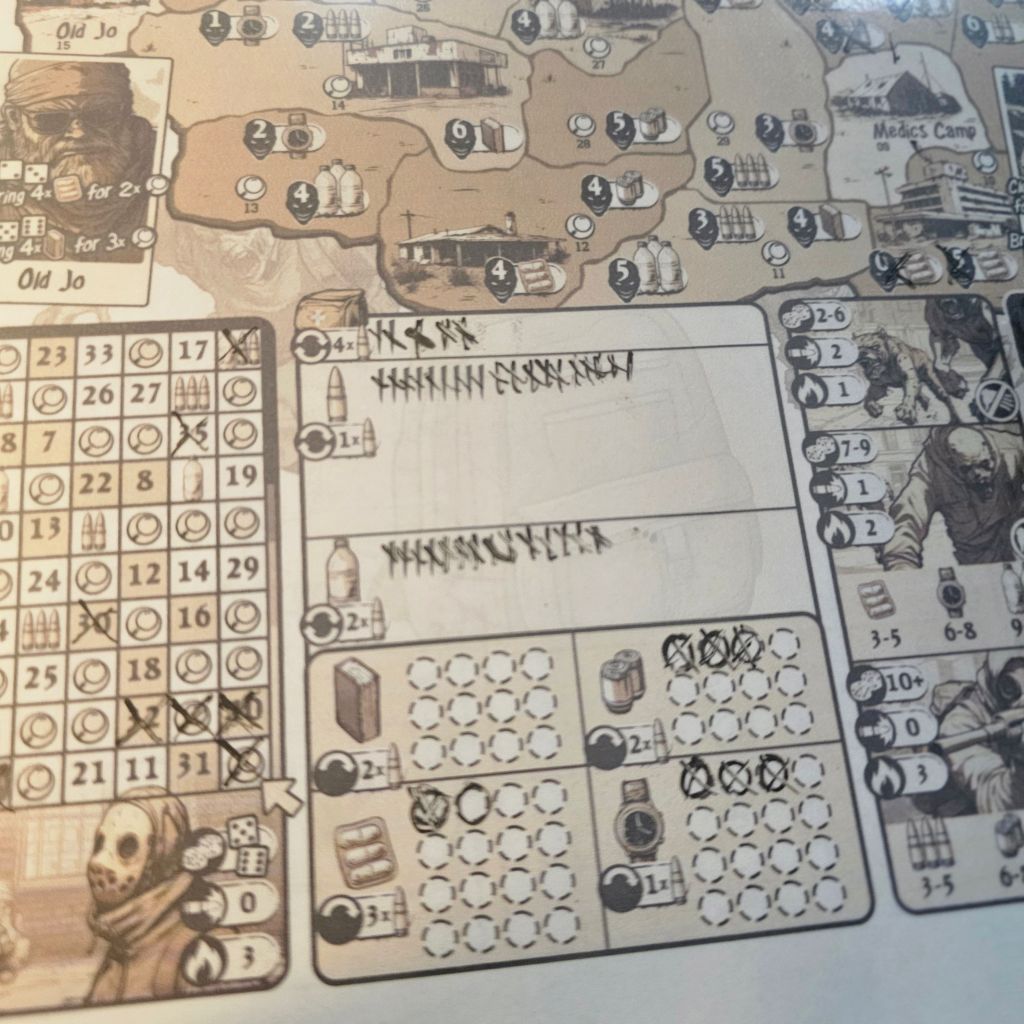
Recycled uses a retro-futuristic aesthetic, full of nobs and dials and switches. It has a very grim, mechanic and barren look, which works perfectly with the theme. Even the tjr a are marked with tallies as if written on a wall. Honestly, you could not read a single. line of description and get exactly what is going on.

One thing that is not an issue so much as it is a missed opportunity, but the additional planets have different setup and different starting resources, but they don’t have particular mechanisms. Infected planet does not feel particularly infected or hot planet does not feel particularly hot. 

Score: 9/10

Conclusion

Shuttle launch

Recycled really stands out from other print and play games. The word that defines this game is methodical, and it wears it on its sleeves the entire time. Despite being just two pages, it fills its longer playtime with meaningful decisions and a intensity thinky game arc that requires attention and planing.

And that whole feel ties with its theme. It is deliberately desolate and scenario scientific, and it reminds me so much of many sci-fi books that go to this more realistic approach.

It is not, I believe, a game for everyone, specially on the PnP realm. It’s slow and long, contrary to the norm. But it is smartly designed and it shows from the first play. It is also tough and quite the nail biter.

Rules and Components: 8/10

Gameplay: 8.5/10

Theme and Art: 9/10

Score: 8.5/10

Preview

Let’s Preview More: Koala Rescue Club

1-100 Players

Designer: Phil Walker-Harding

Artist: Meredith Walker-Harding

Publisher: Joey Games, Postmark Games

Live on Kickstarter on August 13th

In more nature related partnership of Joey and Postmark, we go and try to create forests and rehome our adorable furry friends. But is this a game of good koala-ty?

Disclaimer

The team at Postmark Games very graceously provided me with this first sheet as a preview copy for me to play and analyze. There was no additional compensation.

All components and rules presented here are in prototype form and subject to change as the project develops.

How to Play

Shapes table

Setup is simple, each player needs a sheet, and one single d6 that will be shared by everyone.

The game goes for 2 rounds of 15 turns each. On each turn, a d6 is rolled, and player draw the relative shape either in circling uncircled trees or circling the koalas in already circled trees. You cannot mix both, and the shape needs to be used in full.

After drawing the shape, if the player completes a row or column of koalas (not just trees) they get the bonus, that can be access to new areas, circling hospitals for bonus points, volunteers to manipulate the die or additional circles. The player can also earn merit badges if they complete certain criteria.

At the end of each round, player score for areas full of trees, full of koalas and hospitals. Most on both rounds score plus the merit badges wins.

Rules and Components

Trees and Koalas

The rules have that very specific Postmark look and style, being mostly white, text with a few illustrations as examples. It does mostly require you to have the sheet besides you, but they are clear.

The sheet is big and bright, and icons are clear on what they do. My only problem is that since you have to double circle everything, the circles are a bit small, leading to a messy sheet.

Score: 7.5/10

Gameplay

Rolls and Scoring

I’ll say right away that my analysis is for this first map and rules. I’ll explain why this distinction later on.

Koala Rescue Club is all about fitting the shapes. There is plenty of good decisions of where, when to go for trees or Koalas, and what to invest in to score in each round. But it is undoubtedly a family weight game, very light and fast. It’s not a bad point in any case, as far as simple roll and writes this one is immensely fun and satisfying.

But here’s the thing. This is a Postmark Games, and I know that each additional map. will have its own changes and quirks to make use of this very simple and clean base. I don’t think it will anything but a family weight game, but there will probably be some interesting twists.

Score: 7.5/10

Theme and Art

Merit Badges

I mentioned how the gameplay is very family oriented, and I feel the same for the art. It’s cartoony, colorful and adorable.

That is the second game Postmark and Joey make to not only feature a particular animal (we had Scribbly Gum about moths before), but also to actively bring information and funds to the conservation of said animal, and I fully appreciate that.

Score: 7.5/10

Conclusion

There is just something satisfying about fitting shapes in different manners, and this game features that front and center. It’s a very cute and accessible game that still feels satisfying to more gamer-y brains.

As it is, the replay value is limited, as each game will be mostly the same. But, as I mentioned, this is the first map. Replay and variety will probably come later.

But even just as it is, it’s a game that is fun, inexpensive and helps a cause. What’s not to like about that?

Rules and Components: 7.5 /10

Gameplay: 7.5/10

Theme and Art: 7.5/10

Score: 7.5/10

Preview

Let’s Preview More: Warriors and Writings – Sword, Spell and Squid

1-4 Players

Designer: Nathan Wells

Artists: s0ulafein, Indi Martin

Publisher: Nice @ Dice Games

Check out the Kickstarter Here

On this expansion, Warriors and Writings add in the magic duelist Bladecaster and we venture in the River. But does it add to the flow of the game or is it just a bit fishy?

Disclaimer

I have received an advanced copy of the expansion from the publisher to review, but the opinions expressed here are my own.

This is an advanced copy, so every presented here is subject to change. Also, no stretch goals will be reviewed.

The Bladecaster

The Bladecaster

This character is an agile one, focusing on movement and quick melee hits. It is inspired by one of my favorite specializations from D&D and I do feel like it does it justice.

Comparing to the heroes before, it’s just slightly more complex than the two initial ones, and definitely more straightforward than the ones from the first stand-alone expansion. However, it has very interesting gameplay. To be honest, I think it’s my favorite of them all so far.

The River Rush

The River Map

It’s a long map with a river going through where you’re fighting a huge kraken. The main change is that there is a boat that is only available during certain rounds, and if you don’t move it in time you get stuck.

I like how it forces you into decisions of what to go after, and it adds an element of urgency from the very start.

That being said, I do have one big issue: why are we killing tortoises? Couldn’t it have been anything else?

Conclusion

Kraken Head

If you read my review of Warriors and Writings you will have an idea if the game is for you or not. There is nothing in this expansion that will change your perception on that.

Personally, I love it. The two additions do not add a unnecessary complexity, but they do add a ton in terms of interesting decision space and thematic flair.

Review

Let’s Review More: Deck of Wonders

1-2 Players

Designer: Dennis Furia

Artist: Lauren Brown

Publisher: Furia Games

Deck of Wonders gets the whole idea of dueling TCGs and boils it down to one single deck, shared by the player and the rival. But is this deck really or wonders or does it leave you wondering?

How to Play

Minion card

To setup the game, you first to setup the deck. You get all the cards for the villain you’re facing, then a number of base cards. The base cards have a “suggested color” so the base cards with the green icon go well with the green villain, but they can be mixed in any way.

You then shuffle and deal 4 cards to the player and the game begins. At the player’s turn, they can play any number of cards they want and are able to. Cards are paid by discarding other cards. Creatures you play are ordered by their priority, and cards with the same priority you decide. Then you can use your ready creatures to attack either the villain’s cards or the villain itself freely.

Then it’s the villain’s turn, where you simply draw and resolve the top card (except for the first turn, when 3 are drawn). Then their creatures try to attack your highest priority creature they can kill. Any left over attack you directly.

Game continues until either the player or the villain  are reduced to 0 life. The game comes with a campaign mode where you unlock more cards and modification to cards by achieving certain conditions during the game.

Rules and Components

Minion on Enemy Side

I found the rules clear and well written, but they do lack in examples and illustrations that would make the understanding easier. However, I didn’t find myself lacking for the most part, but there are some doubts regarding specific cards and interactions that deserved an appendix or FAQ.

The game is all based on the cards, and thankfully they are very readable and easy to understand, even being double sided. It helps that the texts are never too wordy.

That being said, the font used is too small. That is noticeable on the minions, but it’s even more so on the villain cards. There is a lot of text regarding setup and gameplay elements, and the font is super tiny. In my opinion it would have been better to have more cards or use it double sided.

Finally, a minor quibble, but I think cards that don’t go on the main deck should not have the same cardback as cards in the main deck.

Score: 7.5/10

Gameplay

Villain Card

The game inspiration is clear, being Magic the Gathering and other dueling TCGs. But it threads a thin line between having all those elements available for the player while simplifying the villain side. And it does so very well. Villain’s cards attack in a predicate manner and are organized by the player, while the spells have very specific targets.

The players decision space is all about resource management and figuring out how to outsmart the villain. The cards on the villain side are both more dangerous and attack immediately, while the player’s minions have to wait a turn. But the player controls its own minions in terms of priority and how the enemies attack.

The decision space is quite interesting, with a lot for the player to decide on the risks they are willing to take. But the game has a steep learning curve, not for the rules, but for its tactics and strategies.

Part of that is because the game can be very swingy. The cards are well balanced for the player in terms of utility and cost, but there are some that are just better. If the villain happen to draw those or draw certain spells at the right time, the game can get to an unwinnable situation, sometimes even from the start.

Score: 7.5/10

Theme and Art

Theme and Art

There is a lot of theme in this game. It takes its time in setting up the world and each villain. Not only that, but as the campaign progresses, each new pack brings in cards that not only add mechanically, but make sense thematically and evolve the characters and scenario presented.

Adding to that, the art on the game is really high quality. And, despite the game being packed with information they need to convey, the art is on full display. Not only that, the art is color coded. Cards from the green base set and green villain have lots of greens, so at a glance you can identify and place them.

All cards are double sided, and each side shows almost the same art, but one for the player and one for the villain side. The change between each side is subtle. It’s not as simple as good side and bad side. It’s things like a wolf just running or running with its teeth bare.

Score: 9/10

Conclusion

Legacy Packs

Deck of Wonders is a small game with big ambitions. Trying to boil down a full game to a single deck is a tall order, but it does so smoothly and successfully. It has, by its own design, a lot of luck involved. It is unmistakably a big factor, sometimes too big. But, then again, it’s a quick game, so it’s forgivable in my view.

In addition to that, the ambition goes beyond just the initial set. It has deck building aspects, cards to unlock, a legacy mechanism to it. This is a small box with a big heart.

Rules and Components: 7.5/10

Gameplay: 7.5/10

Theme and Art: 9/10

Score: 8 /10

Review

Let’s Review More: Dieson Crusoe

1 player

Designer: Jinhee Han, Heewon Kang

Artist: PASIO

Publisher: Best With 1 Games

Crusoe is lost in an island full of danger, dice and rondels, and it’s for him and his friend to overcome this and survive. Is this game a great adventure or should it be fed to the wild animals?

How To Play

Dice and event rondel

To setup the game, put the two cloth mats side by side. Put the meeples on the map on the action rondel, and markers on the event rondel and day tracker. Also get all tools and pick one character, one friend and one mission card.

Every day is split in morning, afternoon and evening. On mornings you roll the 3 available dice and put them in crescent order. The lowest value moves the event marker on the rondel and triggers a new event.

Then on the afternoon, the player chooses one die at a time, advance the meeple in the action rondel and either take the action, advance the marker on your friend or build a tool. Each die value gives the player 0-3 stars to use in certain actions. The actions vary on building your shelter, getting resources, moving on the map or hunting. The stars also determinate which tools you can build.

During night, you first eat a food, then depending on the value of the die placed there on the turn before it’ll trigger the weather (which will damage your shelter or you) and animal ambush (which varies by the area your in).

You win if you achieve the mission on your quest card, which usually is building a specific tool, getting to certain area on the map, hunting a certain animal, etc. You lose if you run out of health or out of days.

Rules and Components

Meeple on the map

This was originally a PnP, and just now got published. I think during this time the rules were tweaked and refined by the designers and it shows. Rules are clear, concise and, for the most part, comprehensive. There is also a big section for individual cards, which I appreciate.

The game comes with two cloth boards, which are super nice, but they are small and that causes a few problems. The map is hard to read from a distance and the spaces for the resources can get cramped and block their information.

All the rest is relayed through icons and they very functional and clear, specially after a few games under your belt.

Score: 8/10

Gameplay

Character and Quest

Dieson Crusoe is an intense game for its duration. It’s an interesting mechanism to have larger numbers on the dice be better for actions, but also more dangerous. Also, I like that every resource has a secondary effect to manipulate the game state in some manner, but it’s also something that you will not use often as things can get tight and you need them for tools and buildings.

It has a nice tension arc, where the danger rises as you progress through the island and through the days. It gets more dangerous, but you also yield more resources for exploration and hunt. I feel like this is a well balanced, albeit tough game. Don’t let quest 1 fool you.

Score: 8.5 /10

Theme and Art

Tool Cards

The artwork and design is fairly simplistic and quite clean, but it does have a very distinctive look. It for the most part favours usability, but the game still looks great on the table.

The map is where you will find the most details, but it is very evocative of illustrations on books. Robinson Crusoe is a story told many times on baord games, so it’s well known. Dieson Crusoe takes that and uses just the right elements to evoke parts of the story without being too complex.

Score: 7.5/10

Conclusion

Resources

I think it’s no secret that this game was inspired by Robinson Crusoe: Adventures in the Cursed Island by Ignacy Trzewiczek, but condensed down into a 30 minute adventure. You can recognize easily the DNA, and I felt right at home instantly.

But that’s not all it is. It has its own unique mechanisms that are engaging and fun. I really like the action rondel and the way the dice used determinate the bad things coming your way. Knowing when to be risky and when to play safe is a huge part of the game.

I feel like this is a very solid and tense solo experience that will have you coming back to beaten time and again. My impression is that this game was designed by and for players, as lots of PnPs are, and got a deserved polished release.

Rules and Components: 8/10

Gameplay: 8.5/10

Theme and Art: 7.5/10

Score: 8/10

PnP Review

PnP Review: Trimod

1 Player

Designer: Rômulo Machado

Artist: Rômulo Machado

Publisher: Reaver Workshop

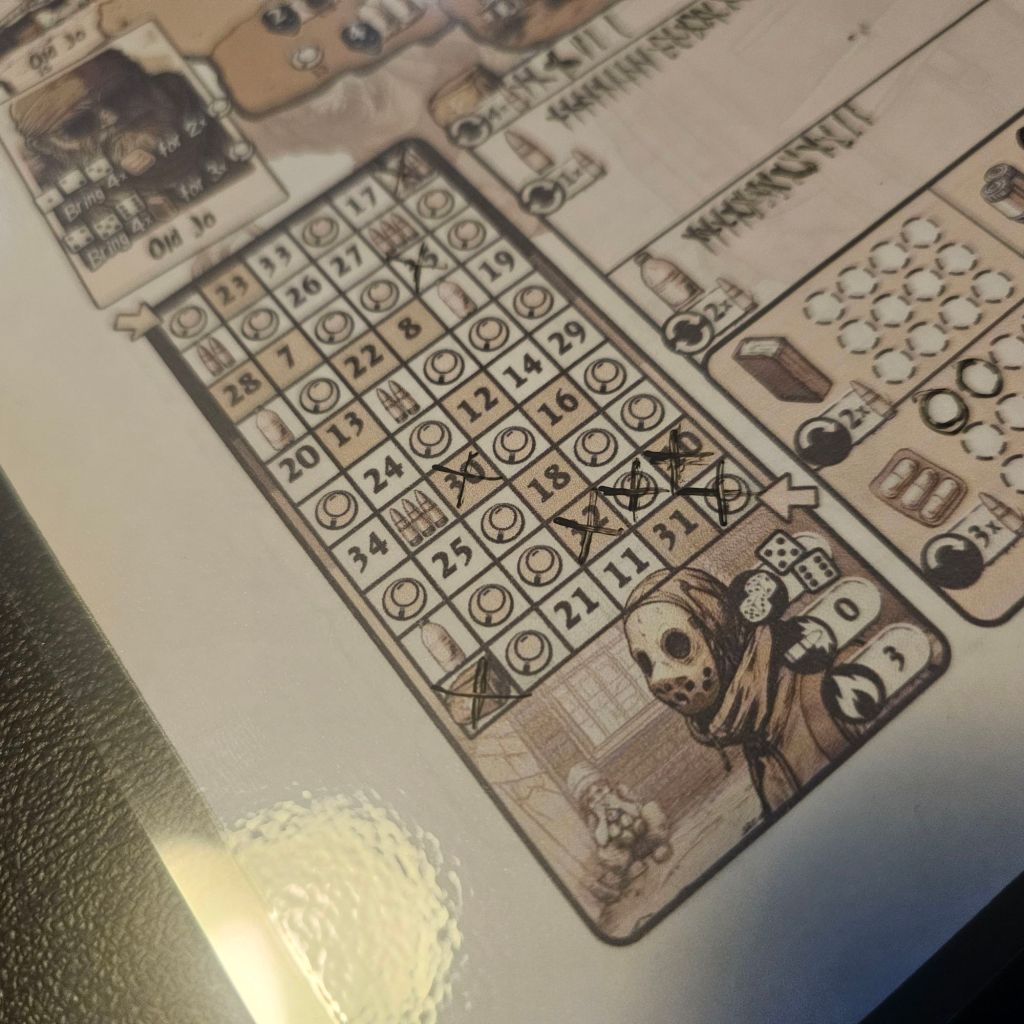
Trimod is an adventure game that takes place in exactly 3 cards. That’s it! But are 3 cards enough will it leave you wanting more?

How to Play

Quest Card

To setup. the game, you need to get the 3 cards for the campaign. Put one cube on each starting resource and on the 0 of the modifier, you only attribute.

On each turn, you chose where to move on the map. If it’s a numbered location you resolve its encounter, if it’s a symbol you roll on the event table to see which one is triggered, and then resolve it.

Most times you will resolve a location or event with a roll. There will be a result if you roll equal or under a number and/or one if you roll equal or higher. Then you roll a d6 and apply your current modifier.

You win a game of Trimod if you are able to resolve all locations or the main quest, and you lose if your modifier falls below – 2.

Rules and Components

Side Quests

This is an important section for this game because of its very design. Trimod is, gameplay wise, Pentamod. There are 5 card faces you need to actively use, the main quest, map, encounter, events and side quests. This means that you have to keep flipping cards over the whole game. It’s not ideal, but it’s functional.

However, it also mean that you can’t mark things like available side quest, events you already faced and your location. It all has to be by memory, which is an element I don’t really like. Trimod is a 10 minute game, though, so that is less of an issue.

Rules are well written and clear, and you can pretty confidently play a game after the first read. However, a huge issue is that the rules are formated to be printed and assembled as a booklet. If you do that, no problems. But I’d you, like me, read on the pdf, the pages are all over the place and you have to keep jumping between the sections.

Score: 6/10

Gameplay

Missions

Trimod is a dice rolling fest. Each turn is a dice roll of two until you either win or lose. But it’s also a very intuitive and fluid game, that does condense an adventure in its time frame.

There is a surprising amount of control over your outcome. You’re given resources to. mitigate your luck, and the different paths allow you to reduce your bad outcomes or try to push for better results.

However, it is snowball-y. Bad results lead to more bad results, good results lead to more good results. If you don’t start well it can feel. a bit jarring to keep going knowing that you’ll have a much harder time. But, again, it’s a quick enough game that you can just go again easily.

Score: 7/10

Theme and Art

Map

This game has 3 cards, so it would be easy to have it all dedicated to gameplay. It’s not the case. Everything has a thematic element to it. Every location has a short description, every event has a name and a thematic hook, and each adventure has a full page just for its story. It is a lot of dedication to make the player feel in a film fledged world.

The art style is clearly inspired by classic fantasy books and TTRPGs, and it shines with personality of each distinctive adventure.

Score: 8/10

Conclusion

Trimod is game built on a restriction, and I’m always fascinated by this style of design. I feel like most of its flaws are inherent to the 3 card limit, but it does rise above that to deliver an enjoyable experience.

But one thing is Trimod the game as it exists now. But, for me, Trimod is a system all on its on, and one I would love to see expanded upon. It can fit any theme, there are a lot of clever new mechanisms that could be introduced, and even more variations of Quests and events for the existing adventures. I hope Reaver Workshop keeps exploring it.

Rules and Components : 6/10

Gameplay: 7/10

Theme and Art: 8/10

Score: 7/10

PnP Review

PnP Review: Legend of Hexdom

1-100 Players

Designer: Papermage Games

Artist: Papermage Games

Publisher: Papermage Games

We go to a world full of adventures, monsters and hexes in this fantasy roll and write. But is this a world where dangers bring epic adventures, or is it hexed from the curses of the dark minions?

How to Play

Character on map

To setup, each player needs a map, an encounter table and a character. Game will go until a certain number of boss monsters are defeated, depending on the number of players.

Each turn 3 dice will be rolled. Each player will chose one for movement and two for encounters or battles. The movement die will determinate how much the player will move, if they go into special terrain, like mountains or water, and how many provisions they need to spend. Players can never move into the same terrain twice, and if they can’t move they are out.

The other two dice are used for either encounters, where players get or trade for resources and/or levels of weapons, or fighting monsters. To fight a monster a player needs to either have the necessary weapon levels or pay in life the difference. Both the encounters and the monsters available depend on the terrain type the player is in. If they are in villages or castles they can chose that or the terrain its on.

Bosses can only be fought in each of the six castles, and they require not only weapon levels, but also a special item (or additional life). Once a certain number of them are defeated, depending on the game type, the game is over.

Rules and Components

Character sheet

Beginning with the rules you’ll start to see a trend with this game: high quality, if not a bit of excess. The rules are well laid out, detailed and with plenty of illustrations and examples. It also has quite a bit of thematic flare to it. It also details every enemy, character and scenario. With all that, it is a huge 100+ page beast.

Initially this game was released with a full page with one map and encounter table for each character. The problem is that there are 300 maps over 3 scenarios, and 16 different characters. Luckily, one stretch goal was hit that broke that down into 3 parts, so you just need to print the 16 characters, 8 encounter table for each of the 3 campaigns, and the maps. Again, there are 300 of them. Honestly, print a sample that and you’ll be fine.

But let’s analyze those parts. The character and encounter tables are clear and easy to understand and use. I wish the spaces to mark your stuff, specially food and life, were bigger. It can get a bit messy. But it’s mostly fine.

The map is clear and feels big, but it’s also a bit busy. Since you have to mark all of your travel, halfway through the game it can get chaotic. I highly suggest having a meeple to. mark your current location.

Score: 8.5 / 10

Gameplay

Encounters and treasures

This game plays a bit like trying to fix a leaking boat on the water. You need to get food, get more life, improve your weapons, and not get stuck, and usually you have to spend or forego one for the other. You will be in constant fear of defeat, but with careful planing you can turn around and get powerful.

There is never a dull moment in Legend of Hexdom. Every turn is tense and exciting, and filled with grueling decisions. But making your plans work and getting the bosses make you feel that much better.

Score: 8.5/10

Theme and Art

Forest Map

The theme is classic adventures in a dangerous Kingdom deal, and it’s heavily inspired by old school JRPGs like Final Fantasy and Dragon Quest. But what’s cool is that Papermage took its time to give every character, enemy and boss its own personality and a little backstory. This is going above and beyond for theme, and I appreciate that.

Art style is very distinctive, and it will either trigger your nostalgia or it will fall flat. It is well done, but simplistic. But it fits well with the package and it integrates with the theme.

Score: 8/10

Conclusion

Legend of Hexdom is an excessive game. Almost everything is almost too much, and that usually comes at the cost of good design.

Luckily, that’s not the case here. This is a cohesive, well rounded and well balanced game. Games are exciting and have a great arc, ending just when they should. It’s a well. designed game that just happens to have an absurd amount of extra stuff.

Rules and Components8.5/10
Gameplay8.5/10
Theme and Art8/10
Score8.3/10
PnP Review

PnP Review: Warriors & Writings

1-4 Players

Designer: Nathan Wells

Artist: Murzabaev Roman

Publisher: Nice @ Dice Games

Pulling out from the old days of TTRPGs, Warriors & Writings throw you in a dungeon to find treasures, fight monsters and confront the big boss. But is this a treasure to be hoarded or does it deserve its place in the darkest of pits?

Disclosure

A copy of the base game was very generously donated by the designer for this review. However, I will do my best to give my full honest opinion.

How to Play

Goblin’s Den Map

To setup the game, each player needs their own character sheet (that can be different) and a map sheet (that should be the same), as well as one map reference and one action reference to be shared.

The game goes for 40 turns, and during each turn two dice are rolled, and players use them to take actions. There are no basic actions in the game, all actions available are in the character sheets, and they are mostly about moving or attacking. Players go around the map fighting monsters, getting treasure and exploring. The goal is to defeat the map boss, and then have the most gold.

Solo gameplay is the same, you’re just aiming to beat your own score in gold while still defeating the boss under 40 turns.

Rules and Components

Knight Character Sheet

Rules are well written and clear, leaving little room for doubts even on initial plays. They also have plenty of examples of gameplay, which is always appreciated.

Components are easy to use, with simple symbology and plenty of references to simply consultation during play. Unlike most print and play games that you could just print and use as a one time use, W&W is a game that requires laminating, specially the character sheet. There is a lot of writing and erasing resources, and can get quite messy at times.

For the map, the way it’s intended to be used is to write your path as you go, but I found that this too can get messy and confusing, specially if you are returning a lot to the same places. There is one particular map, the Wizard’s Tower, where this becomes particularly bad as it requires you to walk the same paths multiple times. I found that using a meeple or token makes it considerably better.

SCORE: 8/10

Gameplay

Character on map

It can seem that 40 turns is a lot, but this game is snappy. Turns are lightning fast, and those 40 turns go quickly. It is a thinky one though, as on one hand you’re trying to bolt to the boss, but you also need to get treasure along the way. Time is your main enemy here, and often you need to leave stuff behind or just tank the hits.

Also, each character and map require its own strategy, and it does change a lot. One thing, more noticeable on solo than on multiplayer, is that the rolls can really make or break a run. Yes, there is mitigation in the form of grit, but if you’re rolling a lot of lows you’re going to move slower and have a harder time.

Still, it’s a game where you rarely feel out of options or just going through the motions. It’s engaging and a ton of fun.

SCORE: 8.5/10

Theme and Art

Mage Talents

I’ll preface this section saying that will be a huge caveat on my analysis. Bear with me.

Theme is clear, it unapologetically evokes the old TTRPGs in every aspect, and it does so very successfully. It is a distilled down version of a dungeon run on those games, but every aspect feels thematic. The two characters are very distinctive, with the knight lunging forward while the mage needs to move slower and manage their mana. The three maps on the base game are also filled with unique and interesting twists that make them come alive.

This game art is pretty bare bones. Aside from the illustration on the cover of the rules, everything is just black and white writing, boxes and icons. There is no illustration of the characters, no backdrops or details on the map or on the characters.

But, as for the caveat, this look is exactly what you would get on the TSR age of Dungeons and Dragons. A cool artwork for the cover, and just black and white inside. If you lived that, like I did, it feels right at home. It was a bold, but I feel like a deliberate one. But it’s one that needs that nostalgia from the player to work.

SCORE: 7.5/10

Conclusion

I tried my best to keep my review as neutral as possible, analyzing the game on a modern lens, and on that we find a simple looking but intensely engaging and highly thematic dungeon crawler.

But I feel like I am the exact niche this game appeals to. I didn’t just play TTRPGs, that was my childhood and teenage years. So I felt at home, every aspect clicking in a special way that triggers my nostalgia bad.

In either case, I would give this one a go. The decision space alone is enough to make interesting games.

Rules and Components8/10
Gameplay8.5/10
Theme and Art7.5/10
Final Score8/10