Review

Let’s Review More: Apiary

Apiary Box

1-5 Players

Designer: Connie Vogelman

Artist: Kwanchai Moriya

Publisher: Stonemaier Games

About the Game

When I was wondering about the next Stonemaier game, space faring bees was not in my guess list. But here we have a worker placement / tile layer with variable worker values. Is it worth the buzz?

Gameplay
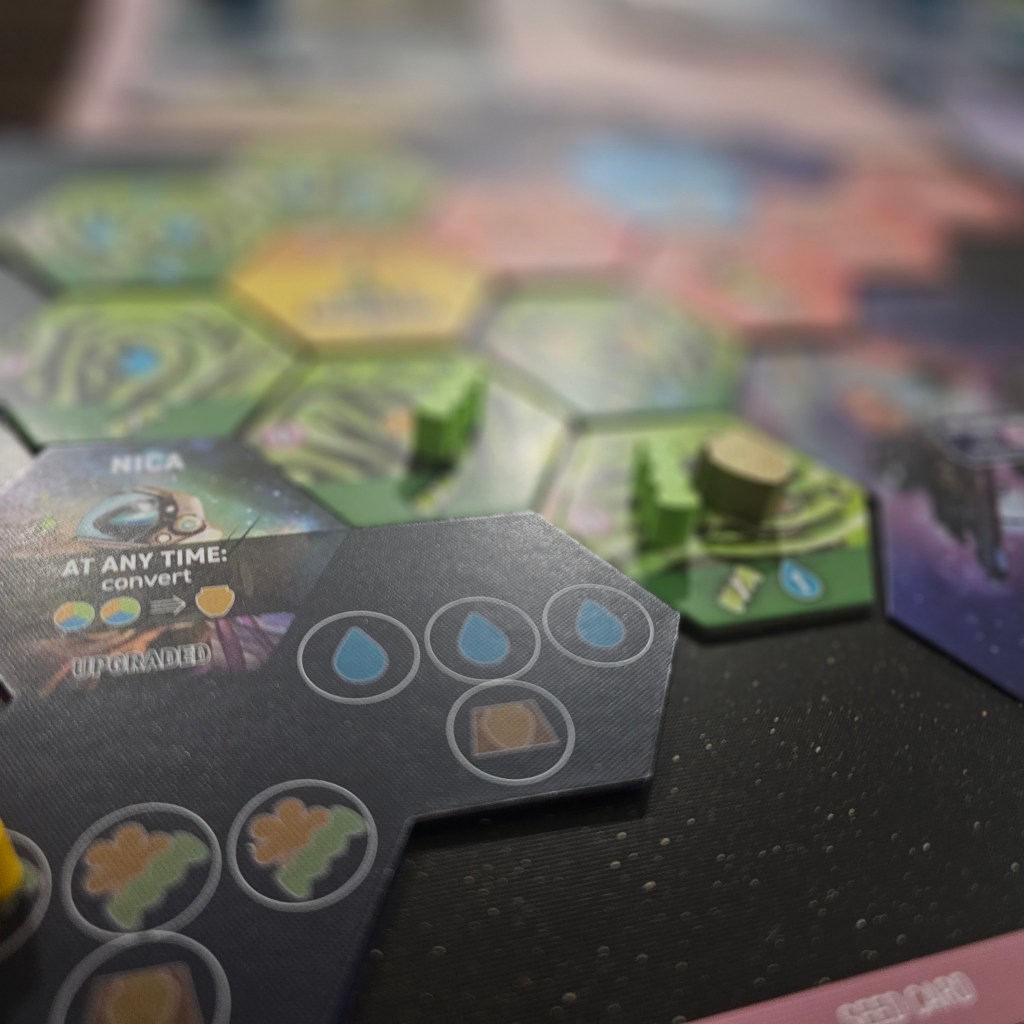
Apiary Home Mat

On your turn, you either place one of your bee workers or recall all of your workers to your mat.

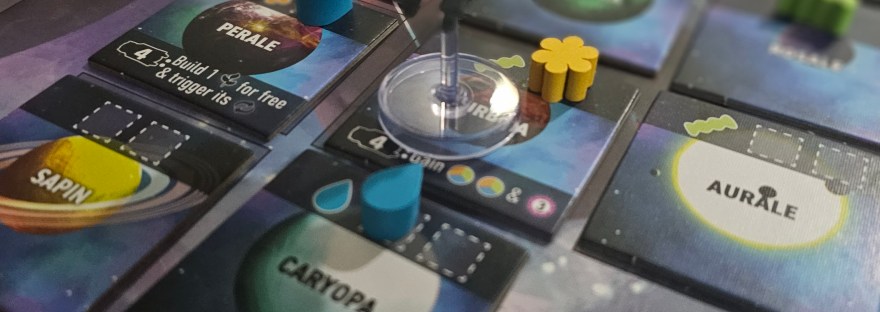
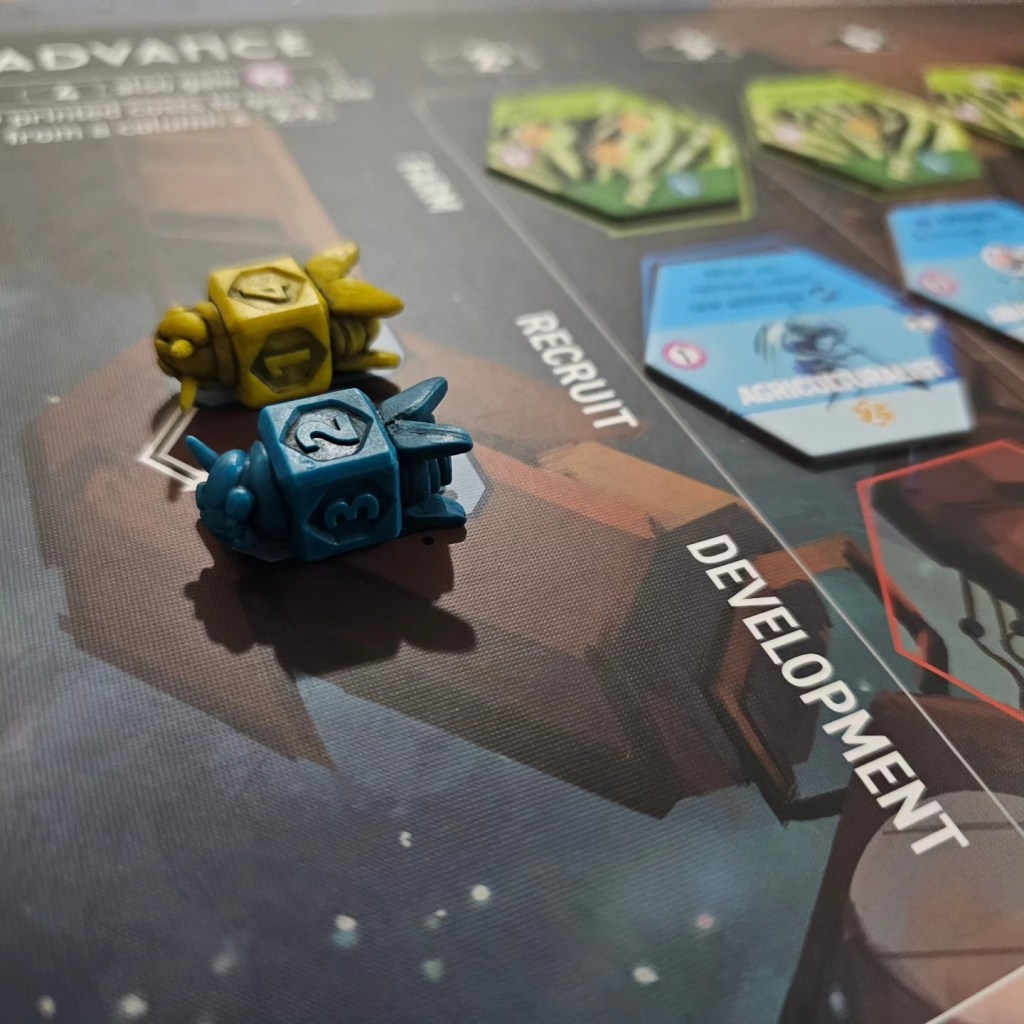
When placing, you chose a worker, all with values 1-4, and place them in any action on the board. No spaces are ever blocked, instead if it’s already occupied you bump the existing one. Spaces are not complex, are mostly about getting or trading resources and cards, or adding tiles to your base.

When workers go back to the active pool, either by being bumped or when you recall them, their value increases by one. Level 4 workers trigger special bonuses when played, but when their value would increase instead they hibernate. You lose that worker, but you get a bonus on tracks on the main board. Game ends when all the hibernate spots are taken or when a player uses all 7 of their hibernate tokens.

Solo Gameplay
Bee Workers

Automa Factory is amazing, everyone knows that, but that might be the smoothest of them all. You setup with 3 grey and 2 yellow with values depending on the difficulty. On your turn, you flip over a card and do the first action you can, using the top of the deck to see what color will activate and other decisions.

Basically, every automa card will recall and get some points depending on how many of that color they have placed, or carve if they have a level 4 worker, or one of the other actions. When the Automa performers an action, they will mostly get points or some tiles or explanation tokens. Also, most of the actions are clearly are right there on the card, so they are super simple.

Components
Components

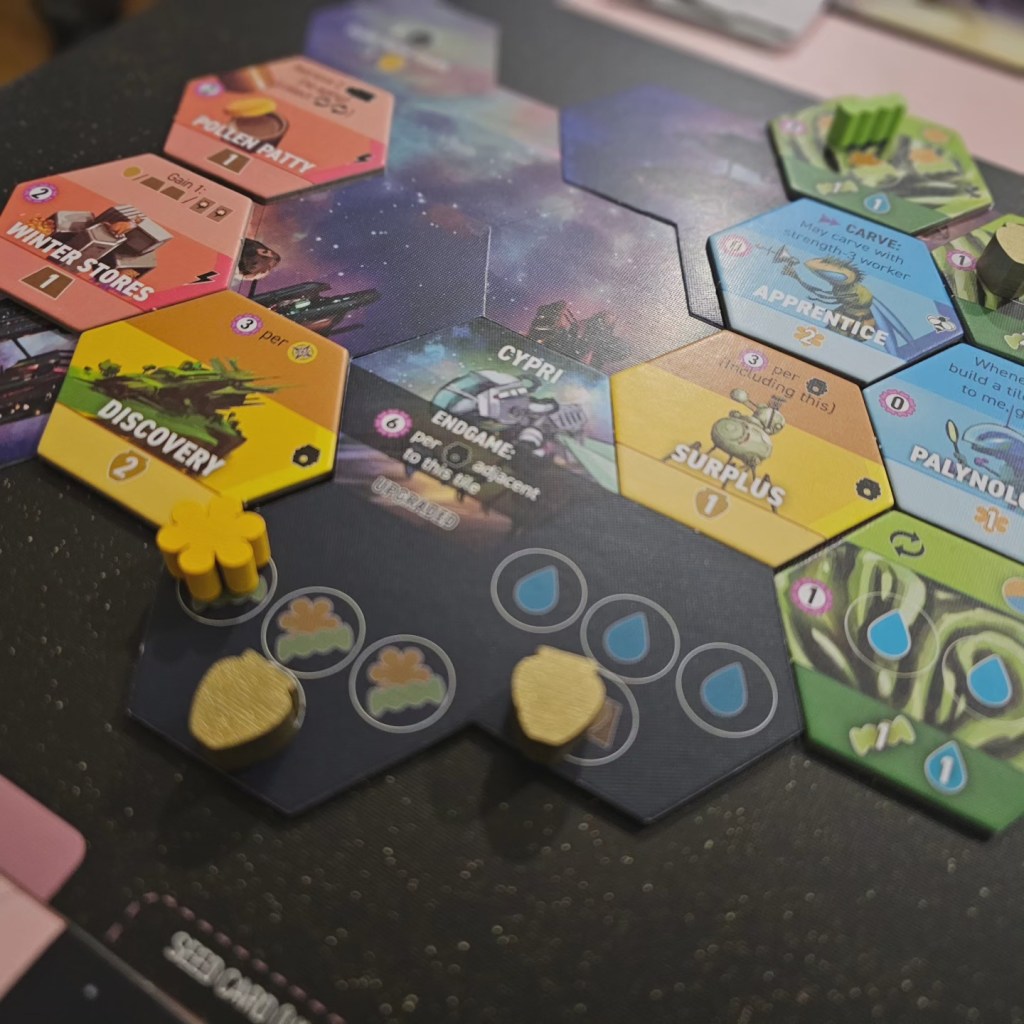
That part is almost obvious, Stonemaier has always great components. But Apiary is an interesting case, specially after Expeditions. It’s minimalistic.

The tiles are small, have simple drawings in the middle, and there is a lot of blank space. However, it’s a game with a lot of simultaneous components in the table, so I think overall the approach works beautifully, specially from an usability stand point.

Conclusion
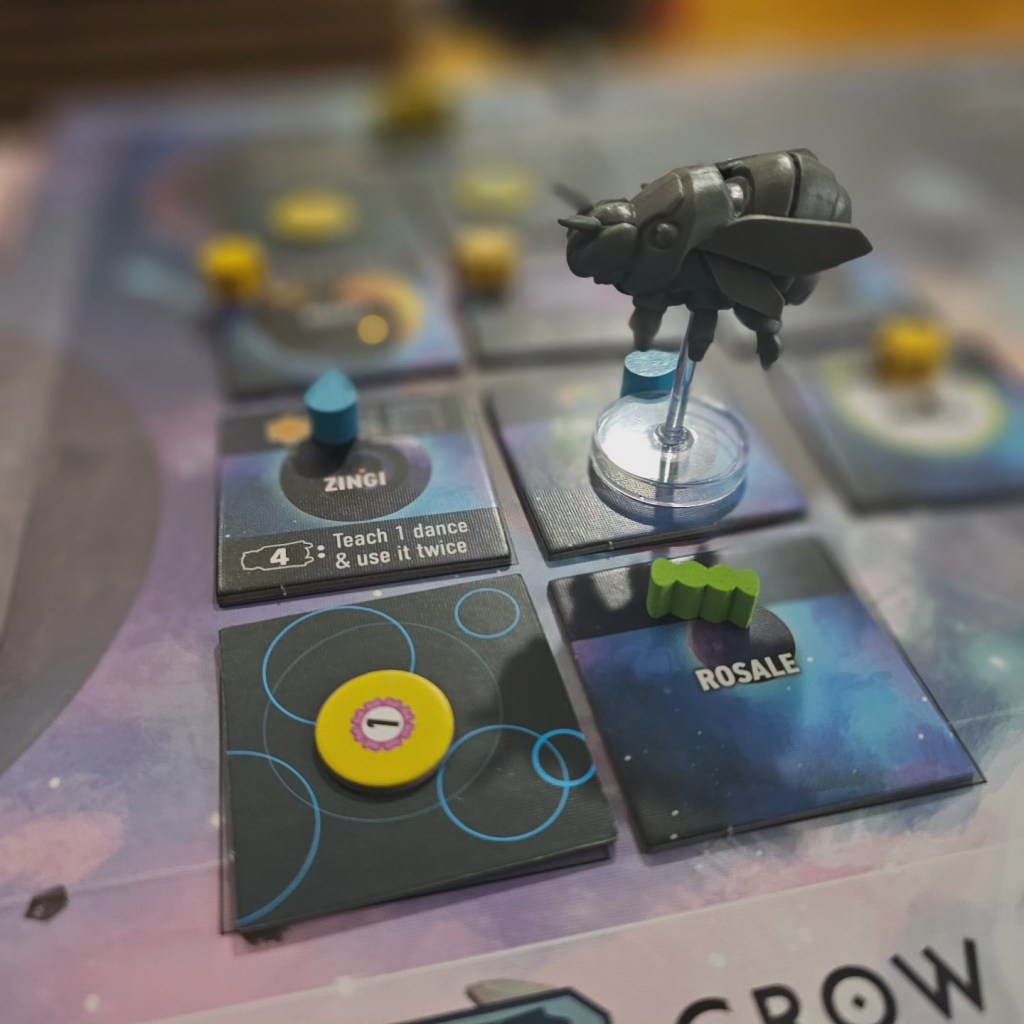
Queen Bee Exploration

Reviewing Stonemaier games is always a tough deal. There is a ton of excitement and expectations. So I tried to go in as blind as possible, not seeing gameplay or reviews, or even following the design diary.

My initial feeling is that even though it seems overwhelming, about 3 turns in I understood the flow. Is a very intuitive game, and a bit on the light side for the most part.

However, it’s a rich game. Navigating the flow of the bees, yours and others, is the key here. Sometimes a less effective action can absolutely worth in the big picture.

The downside on this game is that the individual mats and factions are important, but not game changing. The flow feels mostly the same. Not a huge deal, but it’s something that I hope gets expanded.

In the end, I feel like this is one of the most approachable or their games. Specially with the great insert, the game can be setup very quickly, and it’s not a long game, but every minute feels interesting and rewarding.

Score : 9/10
Review

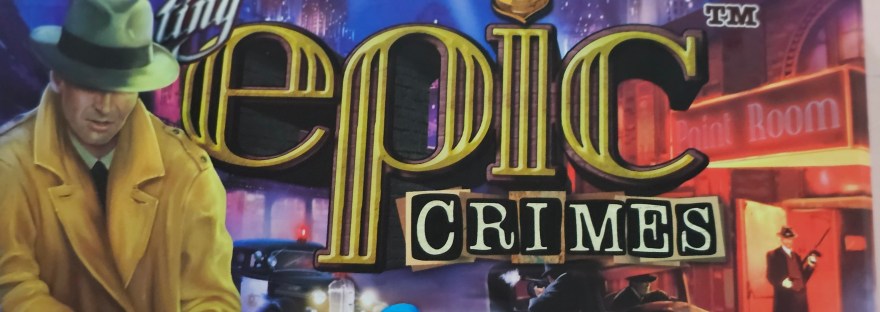
Quick Review: Tiny Epic Crimes

1-4 Players

Designer: Scott Almes

Artist: Nikoleta Vaszi

Publisher: Gamelyn Games

About the Game

I will be honest, I was skeptic when Gamelyn announced Crimes as their next Tiny Epic. The theme was unlike all others, it was centered around a gimmick, and it has again co-op and competitive plays, which is always risky. Were they successful?

Gameplay

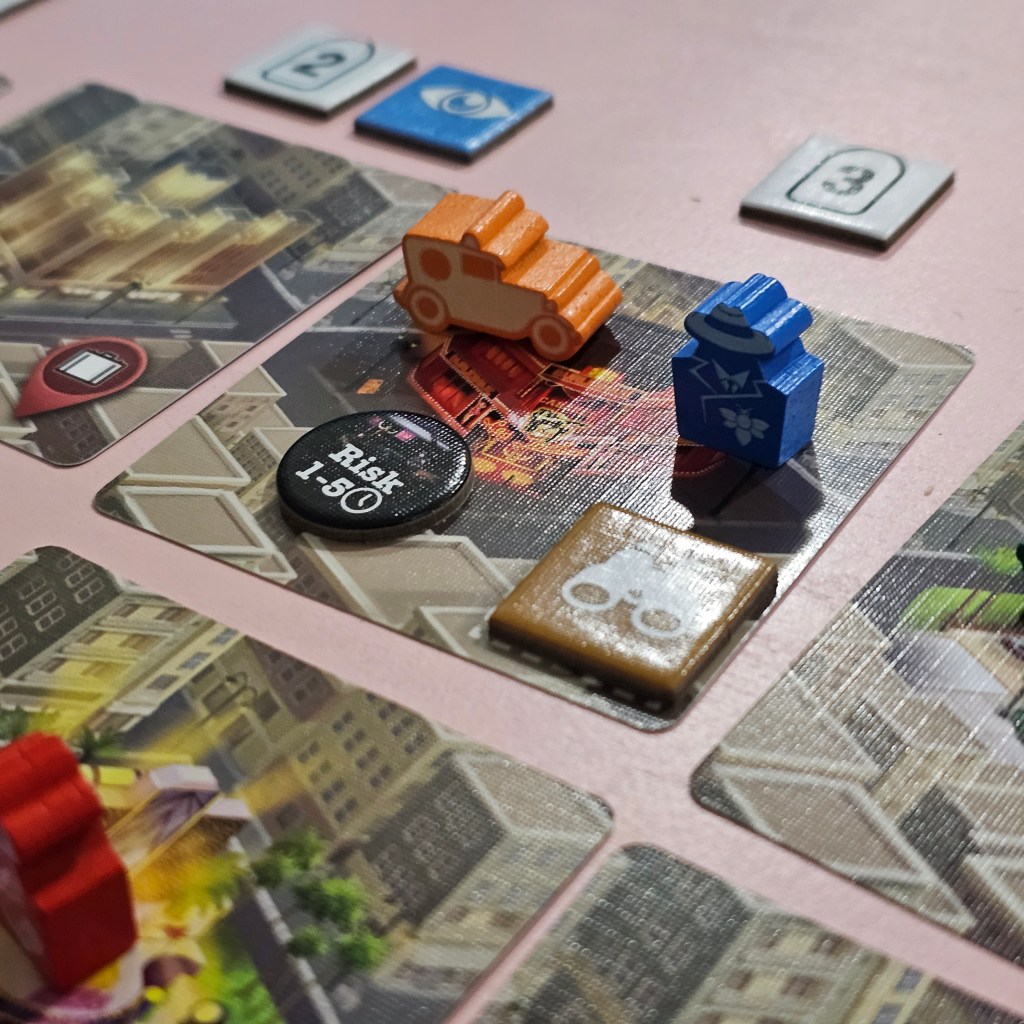
Arresting a mobster

Tiny Epic Crimes uses the “active player is the last in the time tracker”, mechanism, and on their turn a player moves any amount, spending that much time, then additional time to perform an action, usually arrestijg mobsters, gathering evidence in many ways, or resolving events. Then a new mobster is placed and a new event is revealed if all players are after a threshold.

The competitive mode uses a night and day system, where certain actions can only be performed in the correct time of day. The evidence is shared, but only the last person can review it at all times, and there is a bigger influence of individual suspects (which are private.

The cooperative mode doesn’t time of day, instead each player can only perform certain actions. Also, the time can be reduced if there are too many events or mobsters on the city.

Solo Gameplay

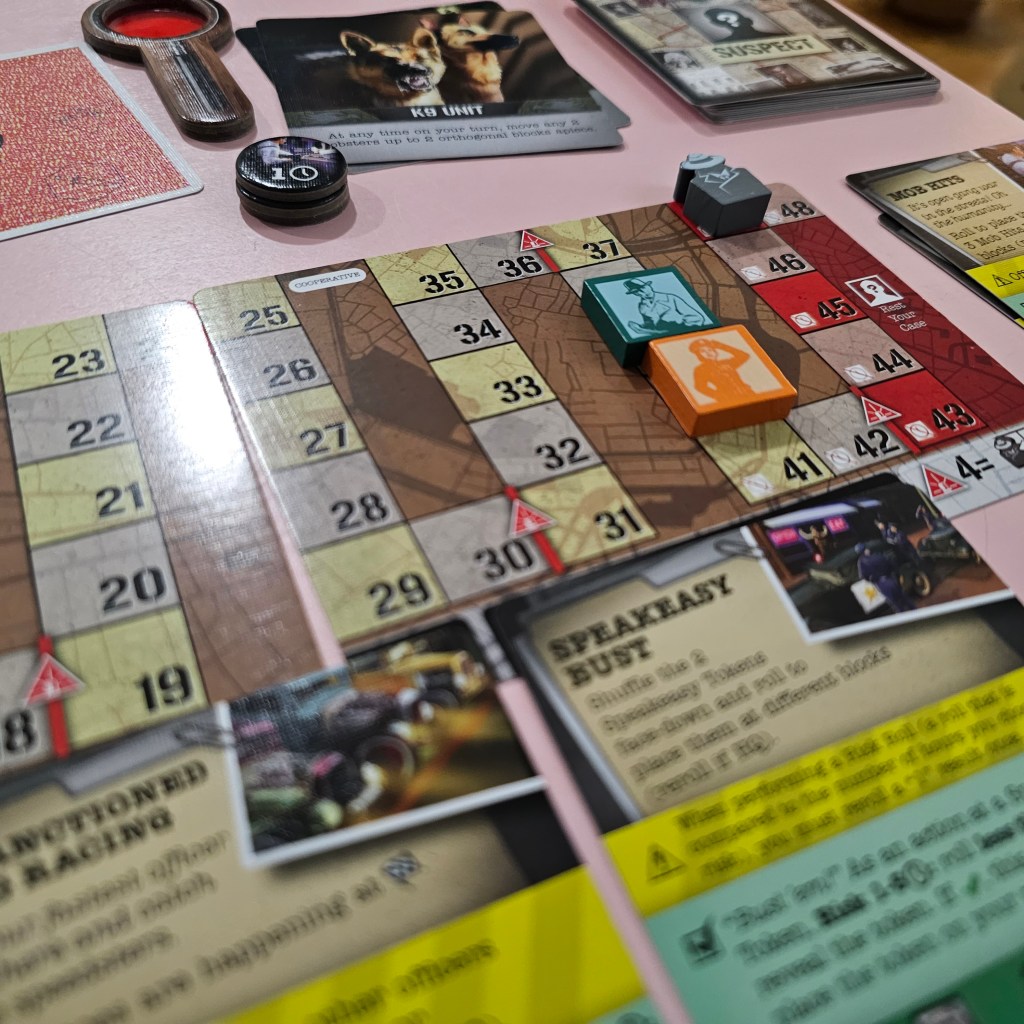
Cooperative time tracker

Solo is basically two player co-op, like most of the cooperative Tiny Epics. A really smart decision was to have the only “hand”, the force cards, be shared for both 1 and 2 players. It simplifies the game a lot without too much hit on the balance.

Components

Decoder System

Very standard Tiny Epic affair. Big cards for the players and trackers, squares for evergthing else. The wooden pieces for the players and mobsters are screen printed and great quality, and there is about a gazillion cardboard tokens for everything. Each individual event has its own unique counters, which is nice. Though some are a little tough to identify at a glance.

But, let’s talk about the Epic Decoder System, the big gimmick. It’s not anything innovative. It’s a red filter on many spots to identify characteristics or identity. It’s basically the same filter on games like Decrypto. It is simple, and it works. For the most part… Under certain lights, it is tough to make out, specially the name of the criminal.

Conclusion

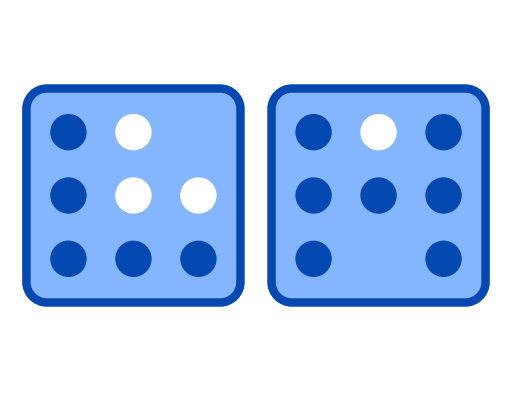
Bullet dice!

To put it very simply, this is the 21st century version of Cluedo. Run around, collect evidence, accuse. It was Eve, with a knife, escaping in a bike.

As far as Tiny Epics go, this is on the simpler side. Move, spend some time, do action, spend some time. Some are fixed, some are wagers, but everything is smooth sailing. The events can get a little convoluted, but that’s good to keep this from being too same-y.

But it works, and it’s a lot of fun! Unlike Zombies, both co-op and competitive work equally well, with their unique challenges and adjustments. There is an element of semi co-op on the competitive, but you’re never getting out of your way to benefit the group.

Color me surprised. This is one I see getting attention often. I play a lot of Tiny Epic with a younger crowd, and this will fit right in their alley. But, even for me as a solo player, it’s snappy, quick and a good challenge.

Score: 8/10

Review

Quick Review: TradeWorlds: Exterra Edition

1-4 Players

Designer: Kristopher R. Kycia

Artists: Charles Vinh

Publisher: Outer Limit Games

About the Game

Tradeworlds is a game that has a very complicated Kickstarter history, among mismanagement and personal tragedies, and being delivered 6 years later. However, today I’m going to focus only on the game itself, but the 6 year period will be actually relevant.

Gameplay

The game follows a very simple and easy to remember ABCD structure. First, you select a role and perform its (A)ction, then you (B)uy cards from your own personal market, then you can (C)onfigure a ship using a ship, a crew and a weapon card, and finally you (D)iscard as many cards as you want and draw back up to five. You keep doing that until someone achieves the goal of the scenario, be it a number of credits banked or destroy every other homeworld.

Solo Gameplay

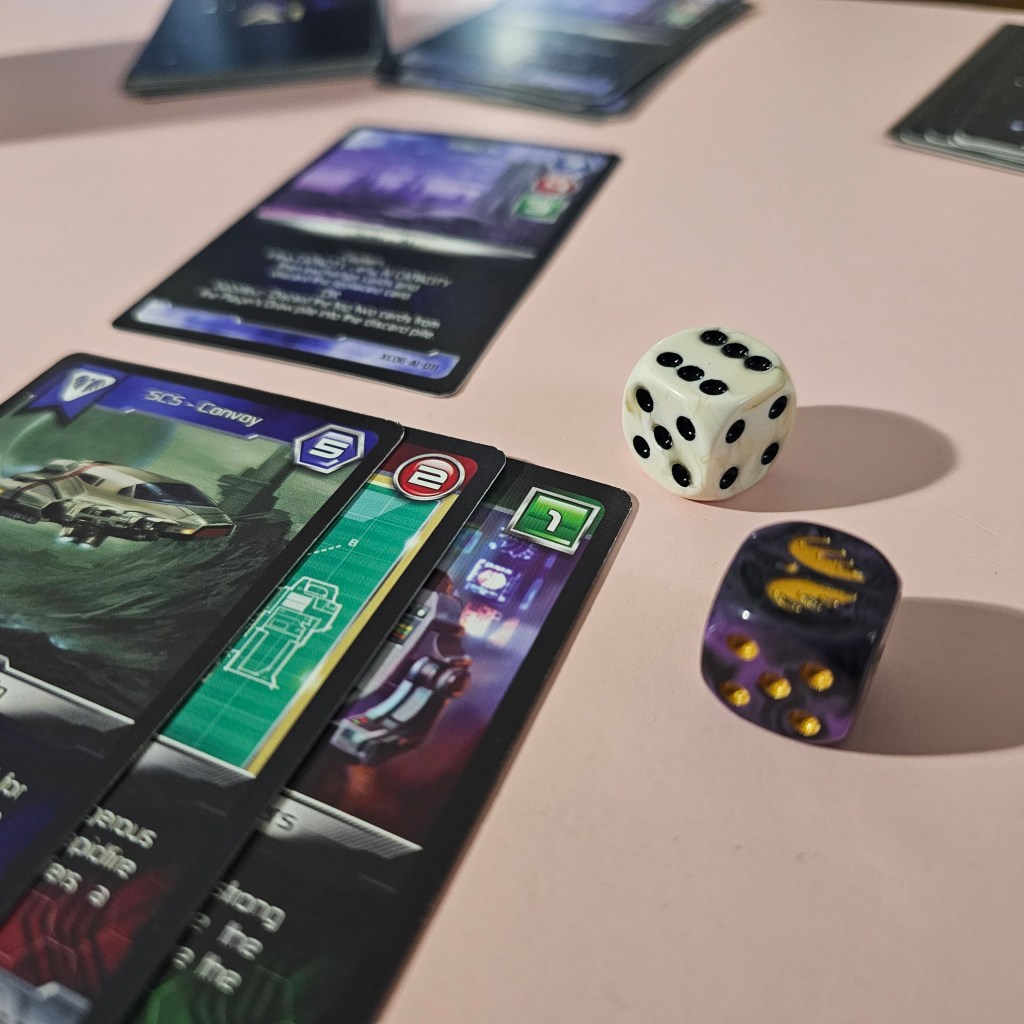
Solo play against AI

The base game comes with a solo scenario where you try to defeat a single menacing ship before it either destroys your home world or hit critical mass. The expansion that comes with the Kickstarter also has a solo AI that simulates the roles and ships the human player has, but in a more condensed form.

Components

Most of the components of the box are fine. The cards have a good finish, not great but feel sturdy and durable. The artwork is generic sci-fi, but it has a cohesive look and the visuals are nice.

Designwise, I do have some issues. First is the fact that flavor text and game text are written with the same font. It makes it harder distinguish at a glance what is relevant for the game and what is not. Also, I don’t see the need for the double sided cards. Almost all of the information on the back is present on the font, and the aspects that do use the back are fairly minor. I feel like this could have been changed and given a better experience without it.

The rulebook is also a problem. It’s vague and not well organized, making some aspects of the game confusing. It also uses a lot of terminology without actually defining it, leaving it to the players to have to understand by context. The good thing is that the designer is active on BGG, so most of these are just a search away.

Conclusion

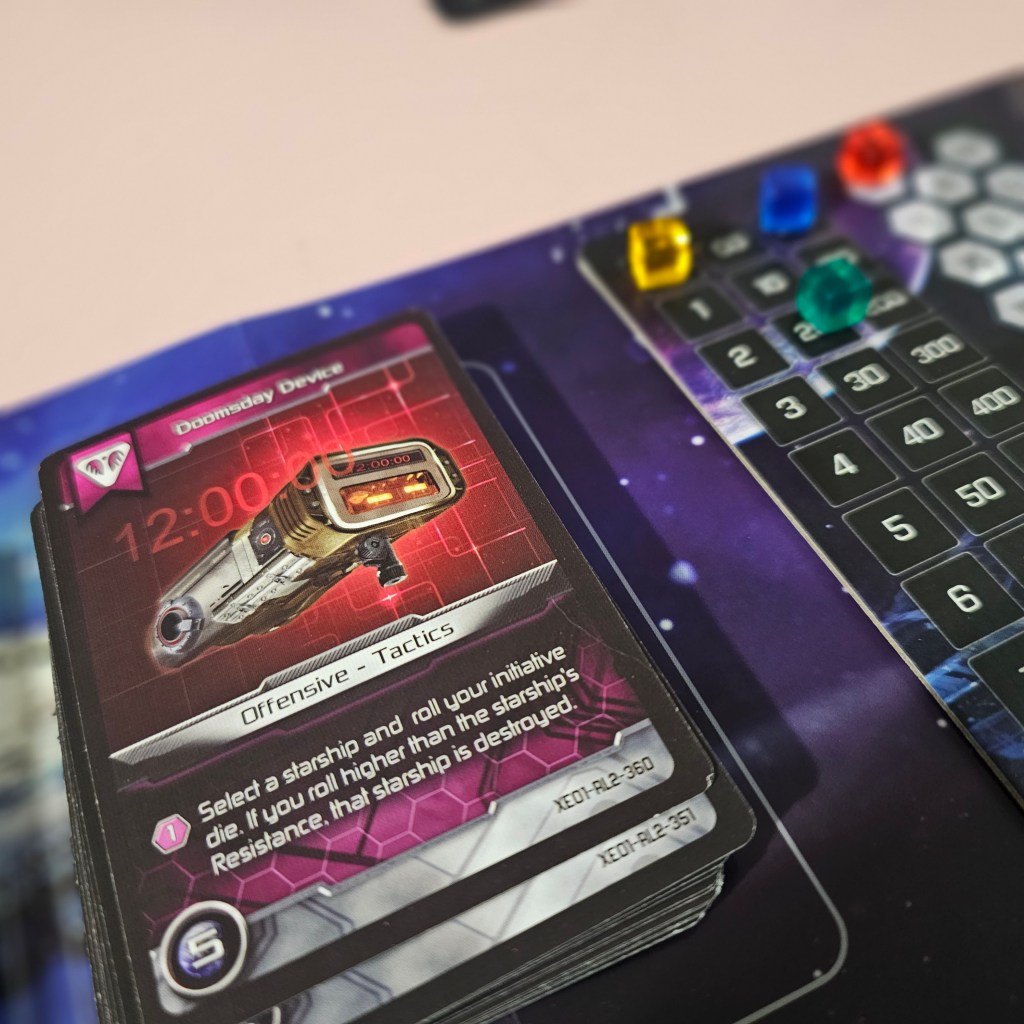
Homeworld board

This was a messy Kickstarter campaign, with so many falso promises and the unfortunate passing of one of the designers. His father took on the task of getting this game out in memory of his son, and I am glad that it’s being delivered.

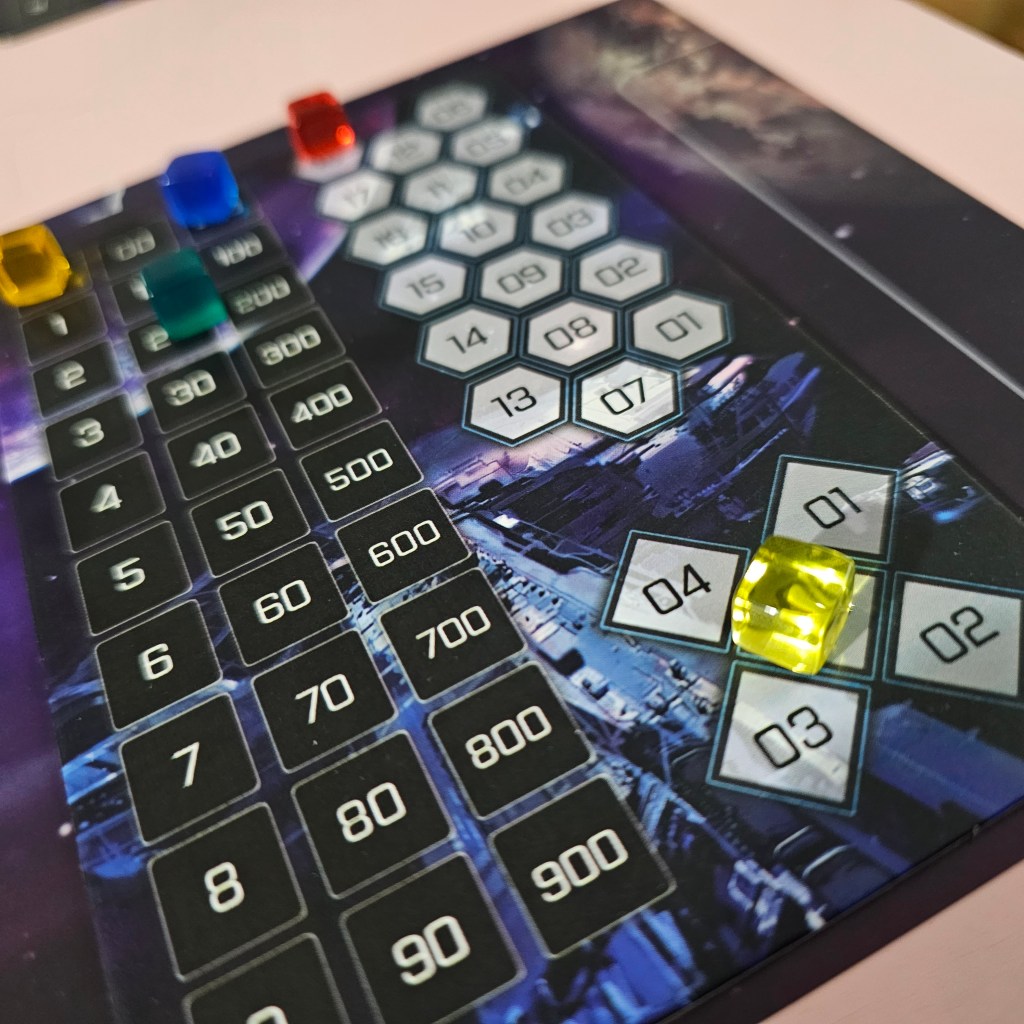
But this game was promised for 2018, and I got it five years later. So let’s talk about it. Tradeworlds has elements of many other games, but sadly they are too simplified. There is role selection like Race for the Galaxy, but no actual tension and play / counter-play thinking. It’s just an action you can do that turn, and there are no restrictions around it. There is also upgrading your empire like in Tiny Epic Galaxies. But banking is just a threshold to launch more ships or to achieve a goal in the scenario. The homeworld board goes to the hundreds of banked credits, but there is very little reason to go above 100, ever.

And there is the deck-building aspect. It lacks my favorite aspect of deck-builders, which is creating a refined engine. In the end, Tradeworlds is just a numbers game. There are 4 types of cards, 3 of them used to build ships. While its fun to create ships with different parts, they’re just different configurations of vanilla creatures. You can launch a ship that has 2 attack and 5 resistance, or 3 attack and 1 resistance, and so on. And the fourth type, tactics, are mostly one time modifications of those attributes for combat. It’s all just numbers.

And the reason that I mention that this game was in production for over 5 years is that it could have been given to more people to. Play and refine those issues. TradeWorlds is not a bad or broken game, it’s fine, fun even. But also tame and forgettable. And, because of that, it will not leave the shadow of its campaign.

Score: 4/10

Review

Quick Review: Horrified American Monsters

1-5 Players

Designer: Michael Mulvhill

Artists: George Doutsiopoulos, Kory Lynn Hubbel, Victor Maristane, Tom Moore, Joshua Newton, Studio HIVE

Publisher: Ravensburger

About the Game

The team at Prospero Hall bring the terror from the successful and super fun Horrified out of the studios and into the American lore, something I could see Winchester Brothers dealing with.

Gameplay

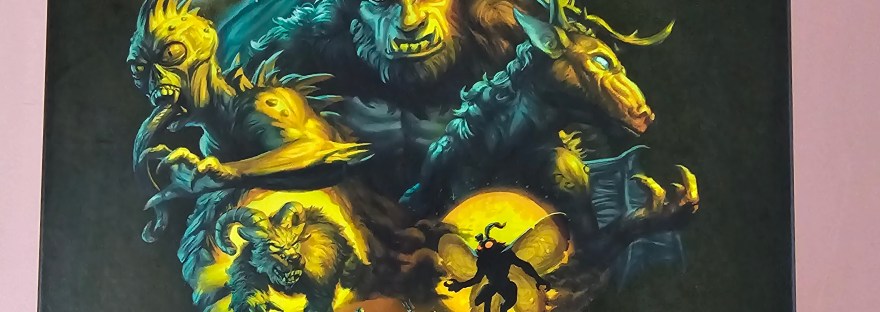
American Monsters

Everything but the details of each monsters is the same as the original, but let’s recap. On your turn, you have a number of actions depending on your character to move, collect items, and use those items in creative ways to defeat the monsters. Each monster have their unique mechanisms. Then the monsters activate, do some effects and try to attack the heroes or the people in the village. You win if you take care of all monsters, and lose if the terror gets high enough or if the event deck runs out.

Solo Gameplay

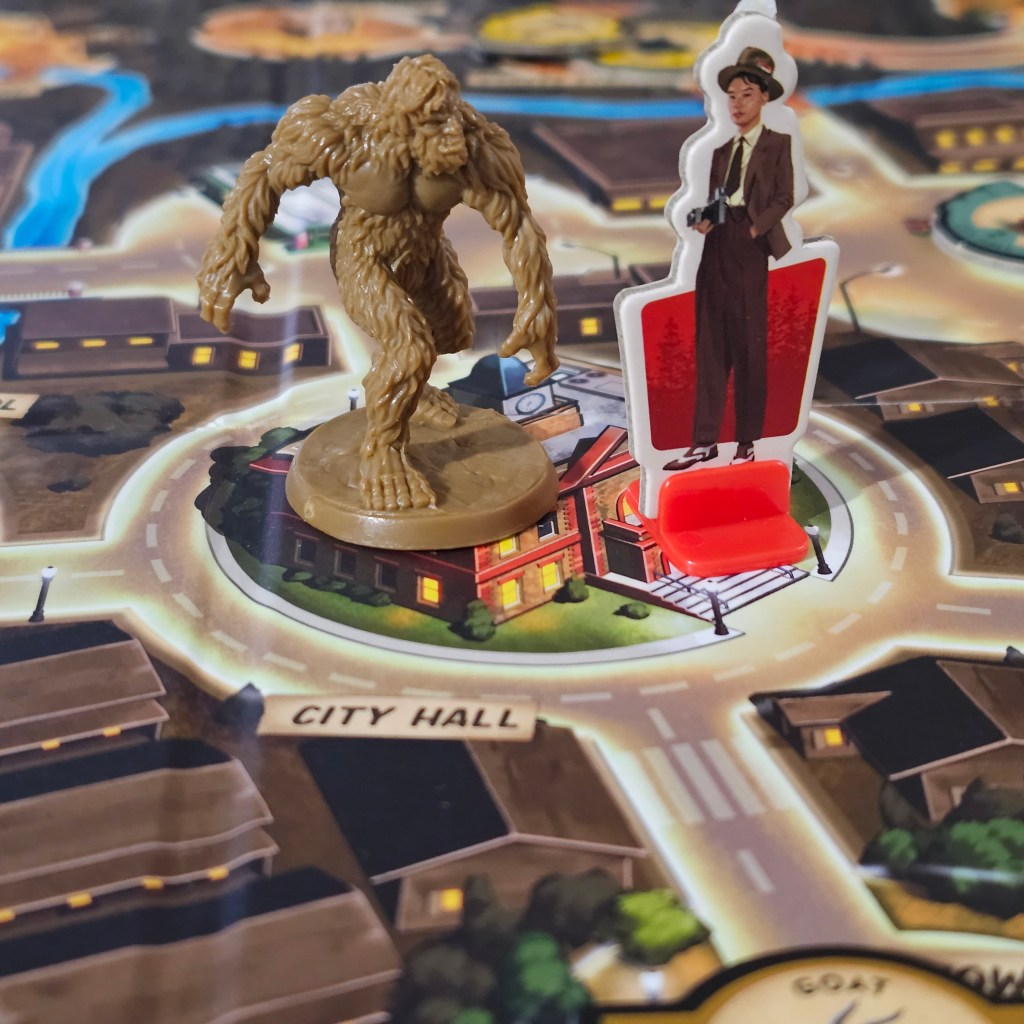
Exactly the same as the regular game, except the terror begins at 3. However, unlike the first one, the balance seems a little off. Some monster seem not work as well solo, Bigfoot being the most proheminent example.

Components

Horrified Dice

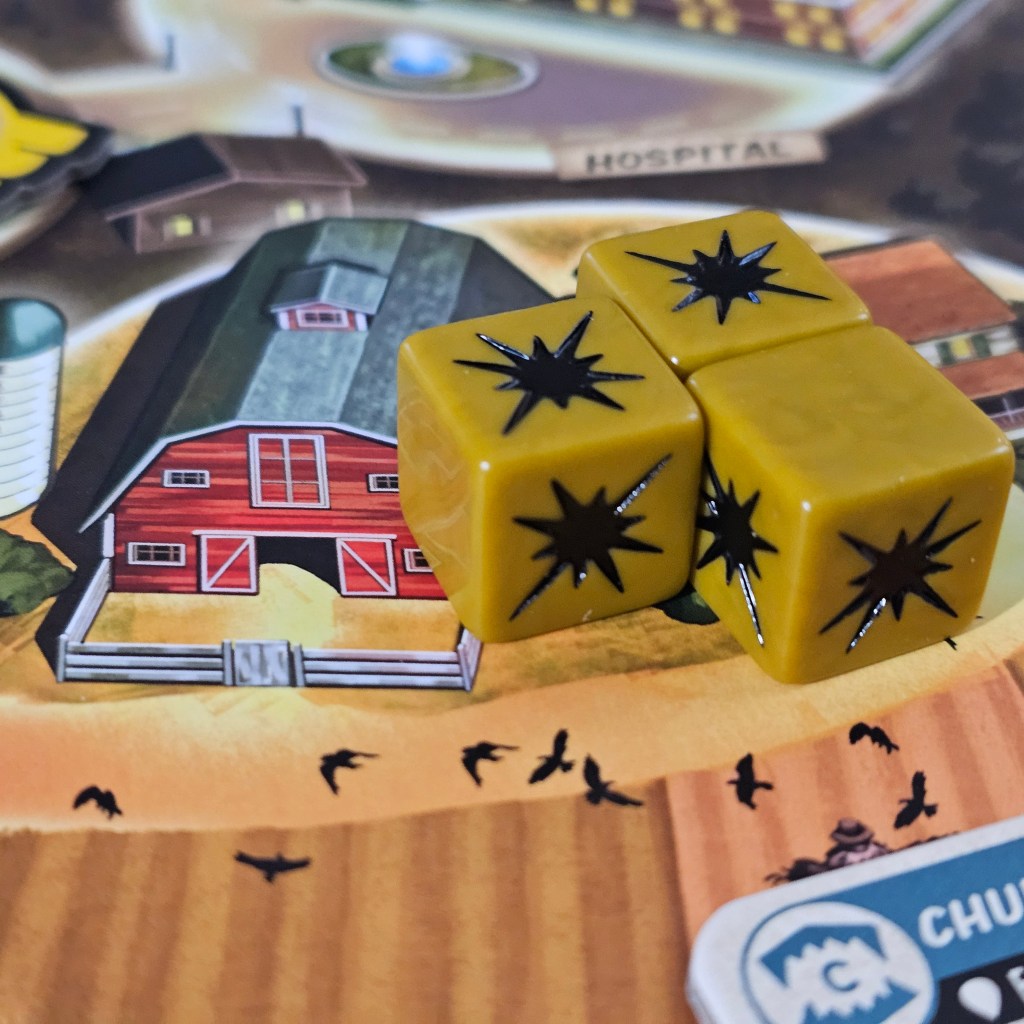
I don’t know what happens with the Prospero Hall / Ravensburger partnership, but all of their games I’ve played share the combination of great component quality and decent price. This is, for the most part, true.

Everything was revamped for the theme. Instead of the cook oldies feel, now you have files and notes and stuff. It’s also quite a bit more colorful and bigger. That second part is a bit of an issue as there can be some warping in the long run. Each creature also have their unique tokens and overlays, but, unlike the first one, the overlays are not really overlays, but little placards.

The bad part is the rules, though. The increase in the complexity of the monsters was not followed by a more thorough description. There are points that are quite vague and require you to take a decision or make a ruling. Also, there is one specific case that the game is actually broken, as there is a deduction where one combination has no answer.

Conclusion

I love the new lore, the new visuals and the new challenges. And, I can really hope they continue the line with new takes on the theme, which can be other folklores, other works of art, or so many more.

However, this feels unpolished. Although I did enjoy all my plays, I also feel like the original beats it in almost every aspect. I also feel like it’s a common issue when Prospero Hall takes on more complexity, so it might just be a need for someone to take a closer second view. With the third one coming up, fingers crossed they will have learned their lesson.

Score: 7/10

Review

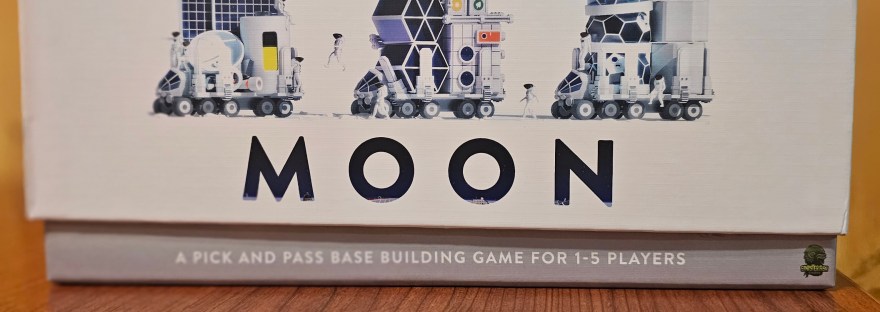
Quick Review: Moon

1-5 Players

Designer: Haakon Hoel Gaarder

Artist: Haakon Hoel Gaarder

Publisher: Sinister Fish Games

About The Game

Third in a series of games designed and illustrated by Haakon Hoel Gaarder, Moon is maybe the simplest of all three, with very simple drafting and card play. But simple does not mean easy, as it’s a tight race game.

Gameplay

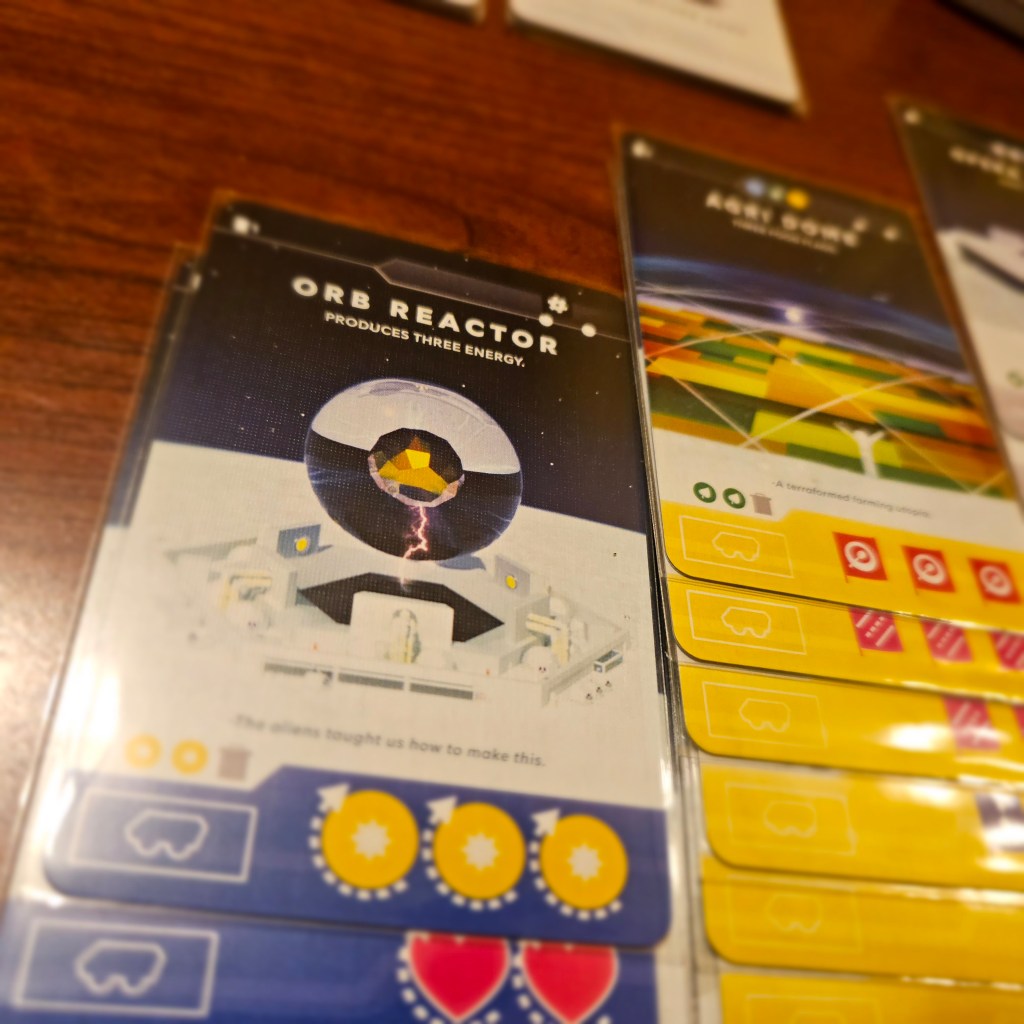
Moon Card Play

Each turn, you will draft and either build a card or discard it for resources, and also possibly use your lunar modules to access other people’s resources, or claim awards. Cards come in 4 types : resources production, flags, once per era abilities and end of game scoring. At the end of each era, each flag is scored for majority, as well as ongoing point earning opportunities.

One thing that I felt it differ from other drafting games is that the costs do not scale too much. So the crux of game is not if you will be able to score, but it’s how tight you can win so you can branch out and win on other areas as well.

Solo Gameplay

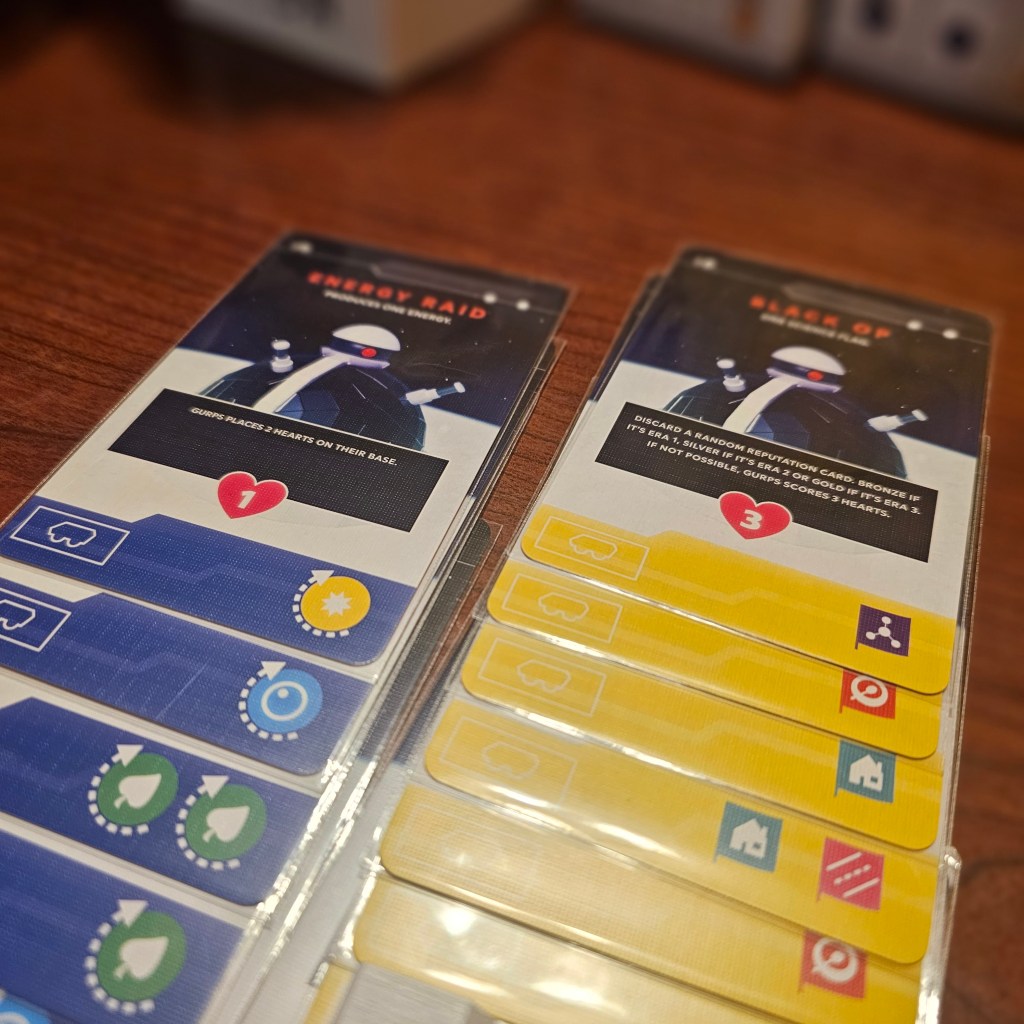
Moon AI

Instead of having a way for the AI to draft, it simply plays a card from the top, do some action, and score some points. Meanwhile, you draft once from each of 4 hands. Then the AI takes one away, and you draft a second time from the remaining 3. It’s simple, elegant, and feels like a natural player. On my first games, the scores were usually 10-15 points apart, in a game that scores 100+.

Conclusion

I was surprised on how elegant this how package is. The components, as usual, are top notch. Great art, great tokens, good storage. But Moon takes elements from Villagers with the drafting, and Streets with the color dispute, and ties it into a game that is easy to learn hard to master. Moon presents you with lots of options, and it’s very rare to be stuck. But the almost Feldian way that everything can contribute to scores means that you have to juggle a lot. Also, I really enjoy the tight dispute that forces you to predict your opponents moves so you are not too far ahead, just a bit. Because, here, winning by a little in 2 areas is worth way more than winning by a lot in one.

Score: 9/10

Review

Quick Review: River Wild

1 player
Designer: Steve Aramini
Artist: Milan Zivkovic
Publisher: Button Shy Games

About The Game

Steven Aramini has made a name for himself with the ‘Opolis trilogy for Button Shy games, and now he is presenting another tile laying game, this time about a river with inhabited by mystical creatures. Is it unique enough to stand out?

Gameplay

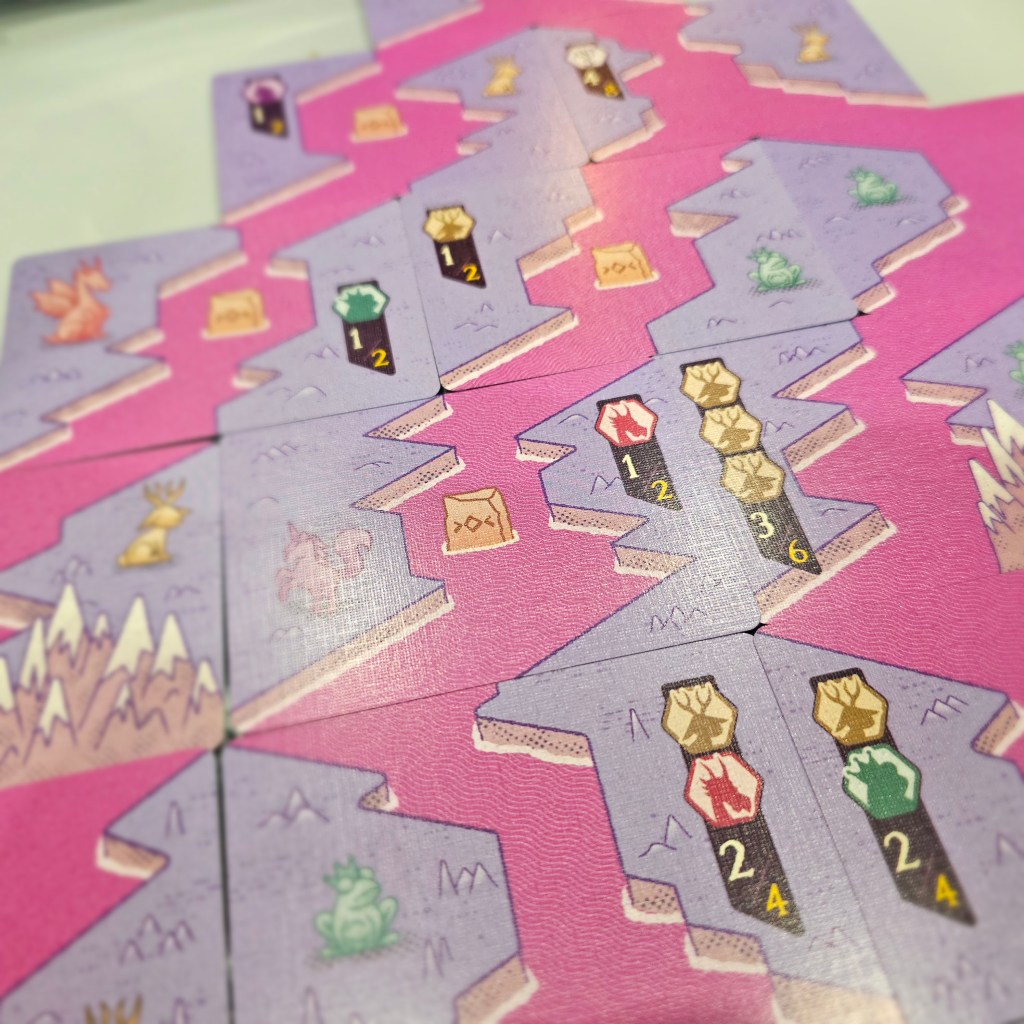
The basis will sound very familiar. You start with a card, which is the top of the river, and you have a hand of 3 cards to chose and place. I promise I will stop making ‘Opolis references, because the similarities end there. Each card has rivers, lands and mountains, and you need to match them (mountains can be matched to and by either). Each card can be placed directly below or half shifted from the card above, and the goal is to created completely enclosed islands along the way.

On each land section, there will be either one of 4 animals, or one scoring condition. When you created an enclosed island, called a protected land, you score that at the end of the game. The lowest amount for the biggest protected land, and the higher for all others.

Components

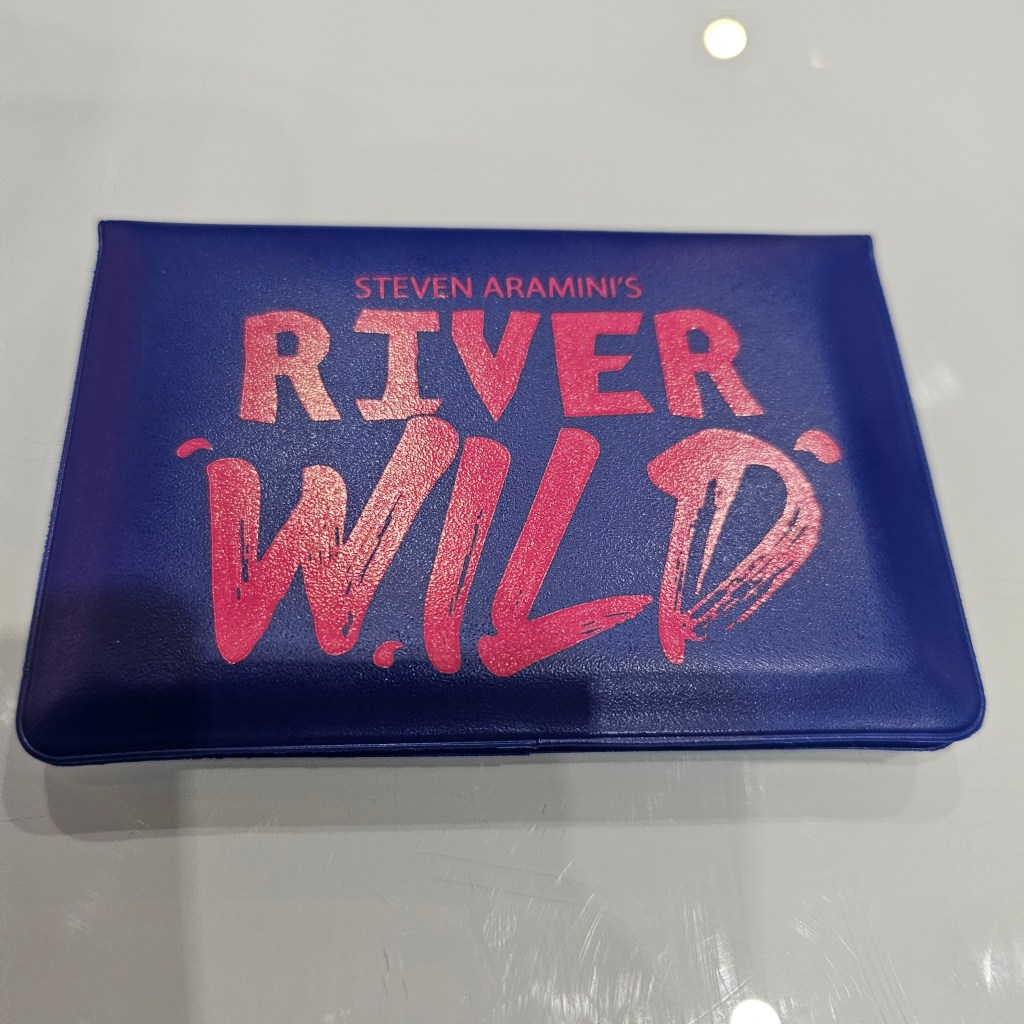
As usual, Button Shy has great card quality and the snazzy little wallet it comes in. Iconography is pretty clear, and the rules, that are sometimes an issue with the company, are clear enough and I think it leaves little room for questions this time around.

The artwork is something else though. While the theme is not super unique, the decision to go with striking funky palette was absolutely a win here. Milan Zivkovic was able to transform a fairly mundane setting into this cool little world that you look and know it’s River Wild.

Conclusion

It’s hard to review River Wild in isolation, as it carries a lot of DNA from other games from the same publisher and it’s against a line of very good solo games. But, on its own, it’s a super fun and light game. It is a completely tactical one, as you need to be quick to evaluate the opportunities you will be able to actually accomplish. Placement is not trivial, as the positioning and be awkward at times, forcing you into less than optimal plays.

But, inserting it into the line, it does have some issues with replayability. Yes, there is and there will be expansions for it to increase longevity. But, on its own, even though each game will be unique, the overall arc is mostly the same. Luckily, I think this is pretty much the only criticism of the game. It’s cool, beautiful, quick and fun.

Score: 7.5 / 10

Review

Quick Review: For Northwood!

About the Game

1 player
Designer: Wil Su
Artist: Wil Su
Publisher: @sideroomgames

Restrictions breed creativity, and designing a solo trick taking game seems like a challenge.

Gameplay

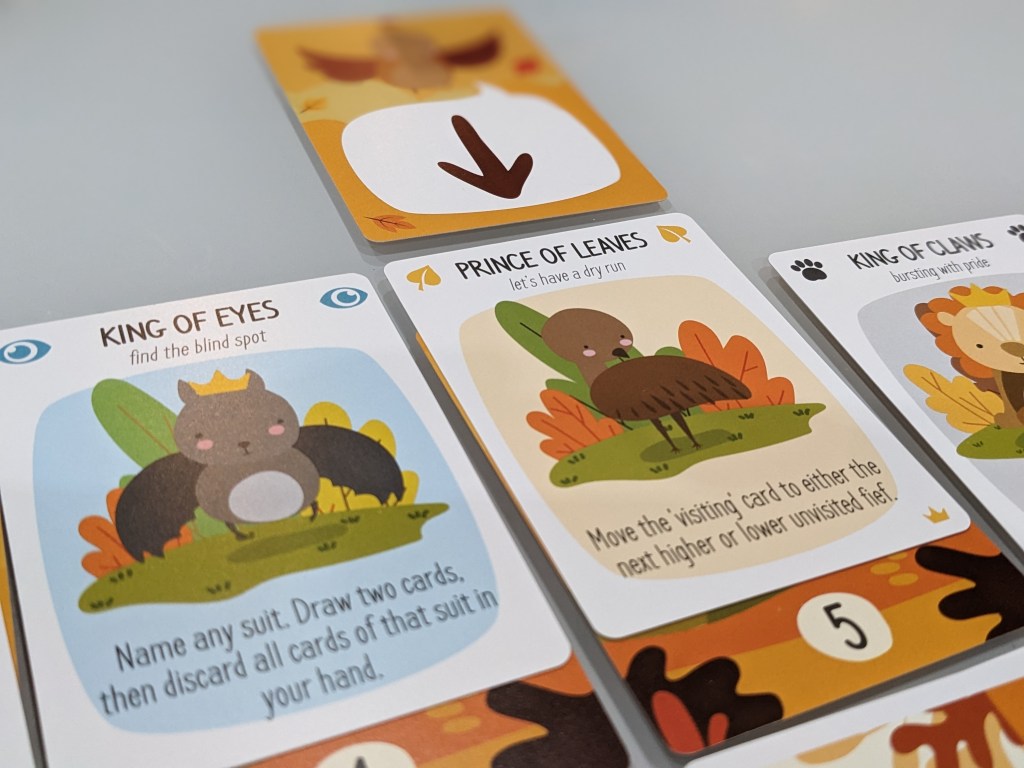
You play on 8 fiefs, valued 0-7. Each turn you draw 8 cards, and you have to win exactly that amount. The fief always leads, and you have to follow suit as usual. You also have 4 once per fief powers, and you get more as you collect them.

Components

Sideroom has a great production with high quality cards, and a nice small box to store them. The art is absolutely adorable, and it really ties in the theme even though the game is mostly abstract.

Conclusion

I absolutely love small solo games, and this one has it all. Quick, easy to play, lots of replay value, great decision space and small package. Sideroom has tons of amazing solo games, but this one is on the top easily.

Score: 9/10