
Review

Let’s Review More: Mech Bunny

1 Player

Designer: Gabe Barrett

Artist: Jake Lawrence

Publisher: Best With One Games

A desolate planet, unknown, with dangers lurking in every corner. Who better for that role than a BUNNY IN A MECH SUIT! But is this game a hare find or is just a hop away from dust bunnies?

How to Play
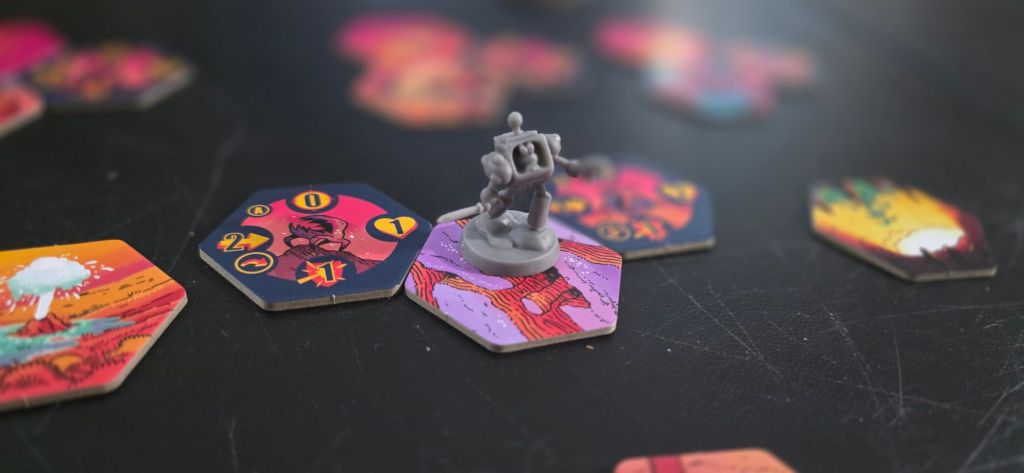
Danger? I don’t carrot at all!

Mech Bunny takes place over sequential scenarios on a campaign, where you unlock new weapons and bigger challenges.

Each game have specific missions and setup, but the basic structure is the same. On your turn you have four cards, and you can use energy to play these cards for their effects, usually attacking in some capacity. The first 3 of energy are free, the rest gives you heat, which just clogs your deck.

After your turn, enemies on your location or your spaceship attack. Attacks on you give you heat, on your ship causes it damage. Too much of either and its game (and run) over.

One of the main mechanisms is upgrading cards. Whenever you kill an enemy, you get XP. With enough XP, you get a transparent upgrade that permanently (well, for that run at least) improves your cards.

Rules and Components

Leeeroy Flufiiiiiins

The core of the game is fairly straight forward, and slowly introduces its more complicated aspects through the different scenarios. It’s a good ramp and it eases you in with complexity along with difficulty. However, the rules could be better written. Some definitions are too vague or ambiguous.

Components are interesting. Card and token quality is good, and tokens and locations don’t have any icons to make them flexible in the scenarios. The transparent cards are sturdy, but maybe too thick when you start piling the on the cards. Small issue, as you don’t usually put more than 2 or 3, but it gets noticeable.

Score: 7/10

Gameplay
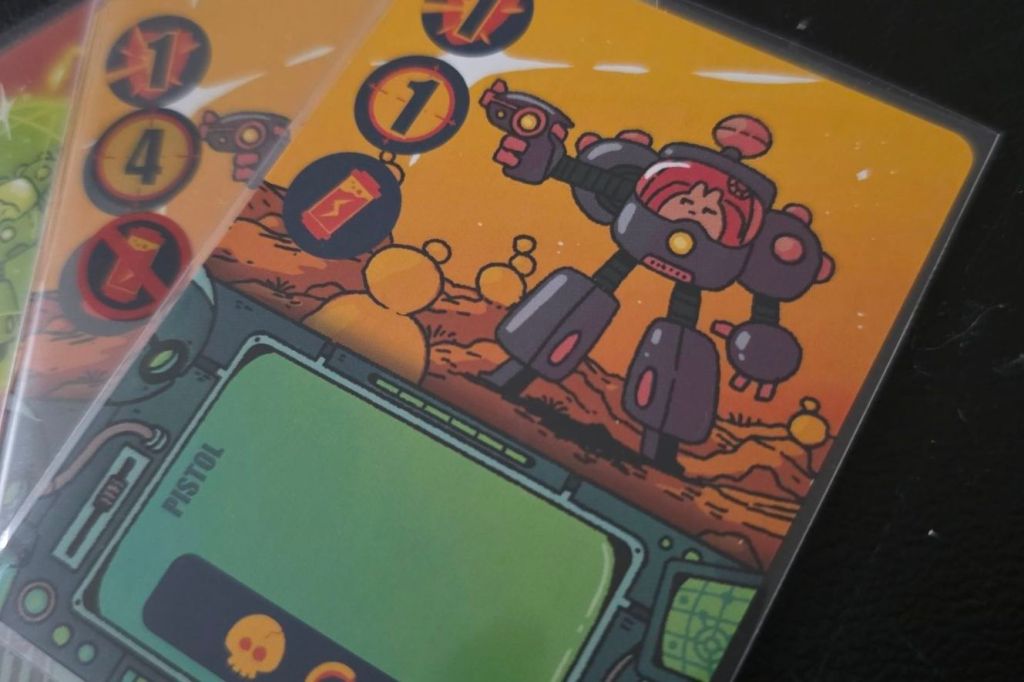
Destruction never looked so adorable

I played this game a lot more than I usually do when I’m doing reviews so I could get a clear impression. This is because the first few games are fun, but they don’t really shine. But as the scenarios progress, you can really see rhe variety of concepts and ideas that never weight down on the complexity. The new mechanisms roll right in the gameplay, but they force you to look at the strategy in a different light.

I don’t feel Mech Bunny implements any of its mechanisms in an unique way, but they are more then the sum of their parts. It both makes you feel indestructible with the firepower you accumulate, but also overwhelmed by all the enemies and tasks to win.

Score: 8/10

Theme and Art
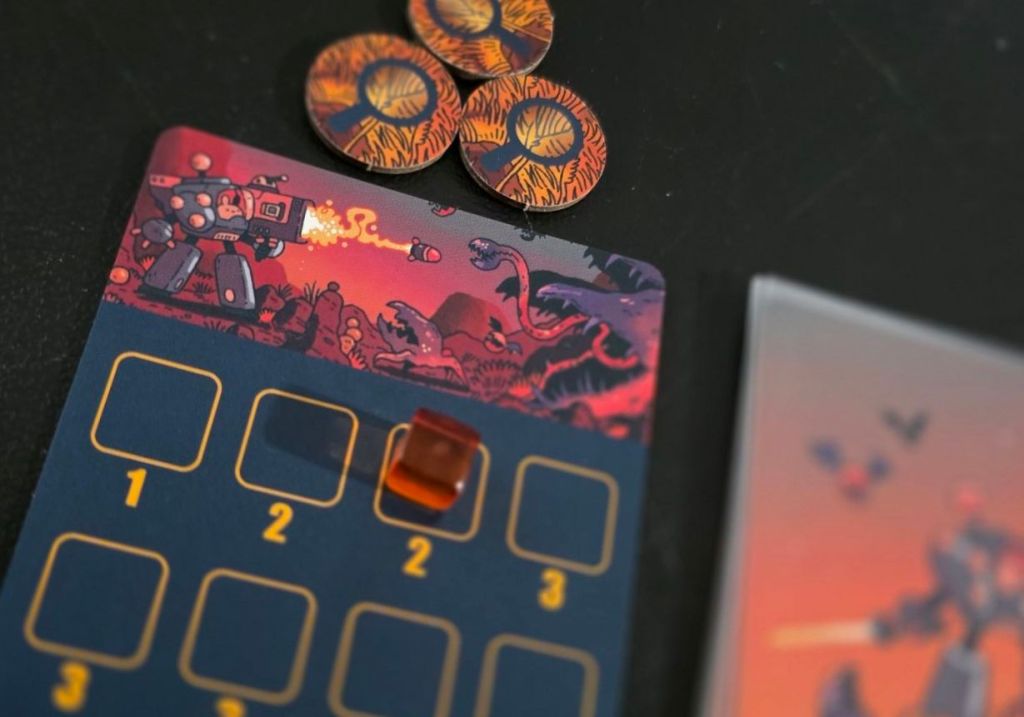
Mission: Red Planet

The theme is minimalistic. It’s a bunny in a mech suit exploring a new planet. No info on the planet or the mech or the bunny. And that feels on purpose, it’s supposed to be whimsical and, in a sense, almost fairy tale like.

That allows the story to be told through the mechanisms. The way your cards work, the enemy abilities, the new challenges you face, all tell what needs to be told, which I appreciate.

Score: 8 / 10

Conclusion

This bunny is on fireeee!

Mech Bunny strikes a great balance of being a campaign game that is both easy to get into and also offers enough to keep you entertained through each run. It’s also a great show of flexibility, since after going through the campaigns you can actually mix and match challenges to create your own.

Score: 7.6/10
Review

Let’s Review More: Shred of Redemption

1 Player

Designer: Artem Safarov

Artist: Cole Munro-Chitty

Publisher: Best With 1 Games

Shred of Redemption tells the tale of a knight who long lost his way and got corrupt, only to look back and try to atone for his acts and end his life in righteousness. But does this game have too many wins or are its virtues enough to rise above?

How to Play

Virtues like Doves and Hammers

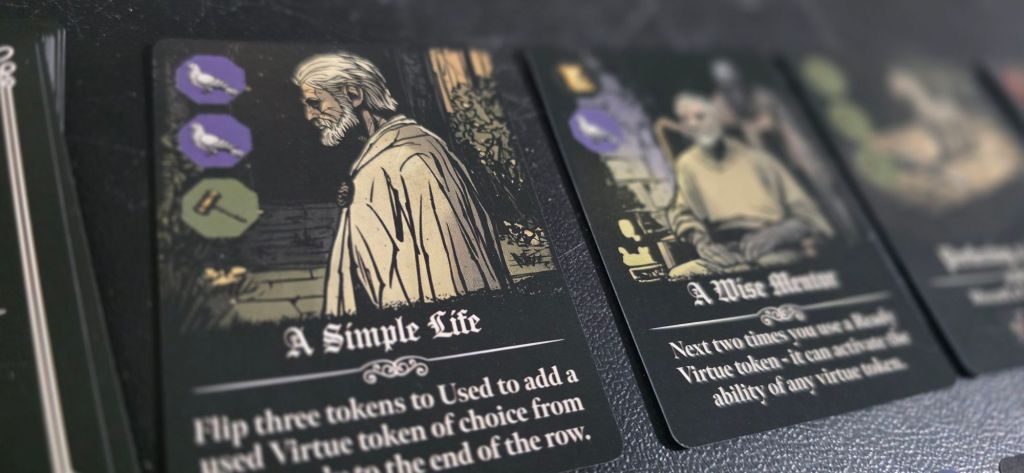
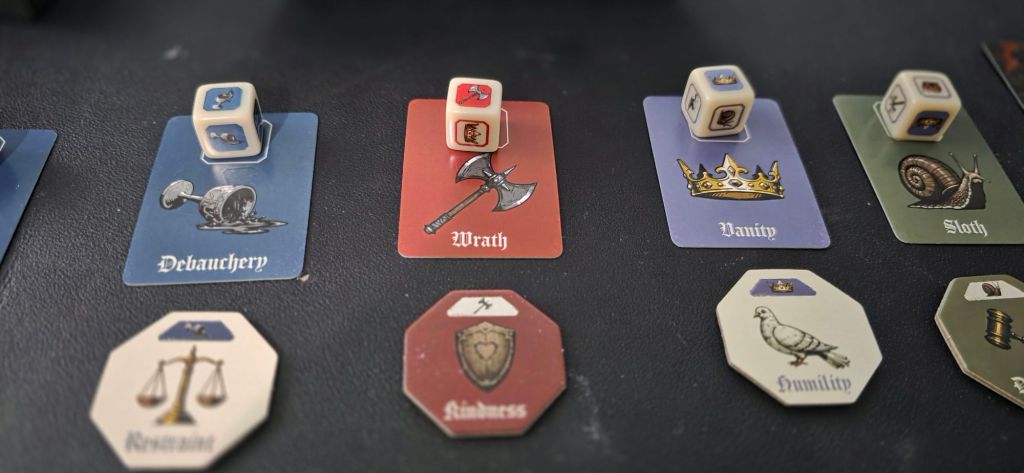
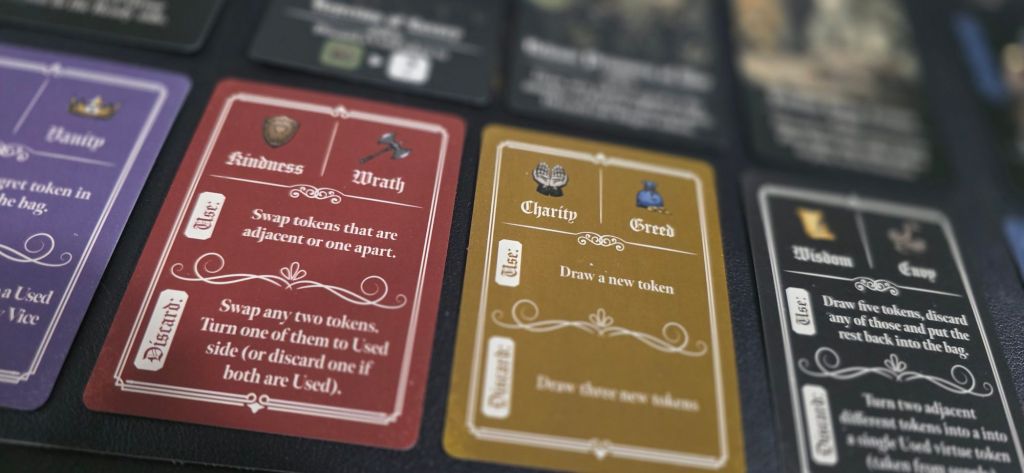
To setup, draw one vice die from the bag, without rolling it and set aside. Each dice have 3 faces of its main vice, and a combination of other 3. After that, draw two cards, picking one and discarding the other. Each card gives you a one time ability, as well adding some virtue tokens to the bag. Repeat this 4 more times, then use the cards to populate the token bag, and only the roll each die in order.

You start the game with 5 tokens from the bag, which are a mix of virtue and regret. The goal is to have the token underneath each vice dice to be its corresponding virtue token, and no regrets in the line.

You do that by using tokens and cards to manipulate the row. Each virtue has an effect when you use it, like swapping cards and dice, discarding regrets or drawing more tokens. Each card has one unique effect you can discard it to use or they can be used to draw more tokens too.

If you manage to reach the wining position, you still have one final trial to face that will mess up your position. Reach the wining position again and you win.

Rules and Components

Hexes beat Cubes

The rules of the game are fairly short, but well illustrated and organized, with good structure and flow. I was able to understand the game on the first read and very little issues. There are a few points that are left implied, but nothing critical.

The dice are a bit small, but functional and clear enough. The faces are visible and distinguished from one to the other at a glance.

The tokens on the other hand are quite large, which is great for visualization and manipulation. However, the draw bag is quite small, and thus shuffling the tokens inside is a pain. Honestly, if possible get a bigger bag.

The color usage is a big miss. It’s so easy to get the colors mixed and more unique choices could have been used. Color is never a critical information, though, the symbols are, so this is not game breaker.

Score: 7.5/10

Gameplay

Treat your tokens with Kindness

This is an interesting puzzle like a Rubik’s Cube. You have 5 dice to fulfill, and you need to analyze what needs to done a few steps advance so all fall in place in the same time.

You also need to understand well the contents of the bag and probability. Since the seeding is varied, some abilities will be more common than others. Drawing is often necessary, but almost always comes with the risk of Regret, and you have to be ready.

Efficiency is always important, as there is the reckoning that will wreck your well laid plans and you have to have wiggle room. Without it, the game could feel a bit too trivial, but that adds just the right amount of challenge without adding too much playtime.

Score: 8.5/10

Theme and Art

He Had Monopoly in his Collection

I think the theme is fascinating. It’s all about this unknown figure that led a life of sin and darkness trying to find the Redemption at its end, with time running out. It’s well punctuated not only with card names, but the gameplay feels like a reflection.

That is helped by a beautiful artwork on each illustration, and even the iconography supports well and keeps the somber and melancholic tone. It all ties well and tells a story with relatively few words.

Score: 9.5/10

Conclusion

Let me get one thing out of the way. I’m so glad to have this game. After the whole chaos and everything terrible surrounding Unbroken and The-Company-That-Shall-Not-Be-Named, I was afraid that Artem would not be able to rise above, and I feel he was just a honest designer caught in a bad situation. So, in a big way, Redemption is fair for his journey.

That being said, this is a really good game. It’s quick to setup and play, but there is a lot here. And because of the combination the cards and dice, each game is a very unique puzzle and will offer very unique style of solutions.

Score: 8.5/10

Review

Let’s Review More: Dieson Crusoe

1 player

Designer: Jinhee Han, Heewon Kang

Artist: PASIO

Publisher: Best With 1 Games

Crusoe is lost in an island full of danger, dice and rondels, and it’s for him and his friend to overcome this and survive. Is this game a great adventure or should it be fed to the wild animals?

How To Play

Dice and event rondel

To setup the game, put the two cloth mats side by side. Put the meeples on the map on the action rondel, and markers on the event rondel and day tracker. Also get all tools and pick one character, one friend and one mission card.

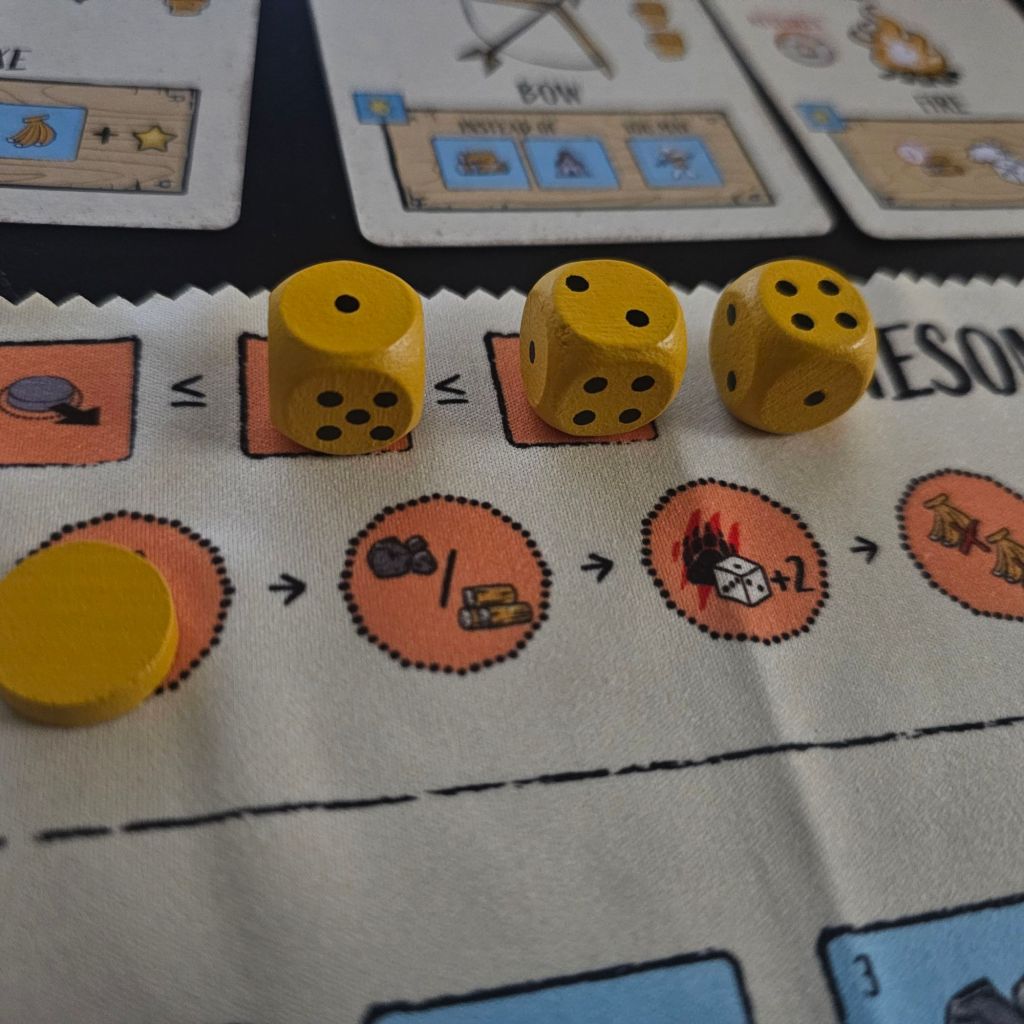
Every day is split in morning, afternoon and evening. On mornings you roll the 3 available dice and put them in crescent order. The lowest value moves the event marker on the rondel and triggers a new event.

Then on the afternoon, the player chooses one die at a time, advance the meeple in the action rondel and either take the action, advance the marker on your friend or build a tool. Each die value gives the player 0-3 stars to use in certain actions. The actions vary on building your shelter, getting resources, moving on the map or hunting. The stars also determinate which tools you can build.

During night, you first eat a food, then depending on the value of the die placed there on the turn before it’ll trigger the weather (which will damage your shelter or you) and animal ambush (which varies by the area your in).

You win if you achieve the mission on your quest card, which usually is building a specific tool, getting to certain area on the map, hunting a certain animal, etc. You lose if you run out of health or out of days.

Rules and Components

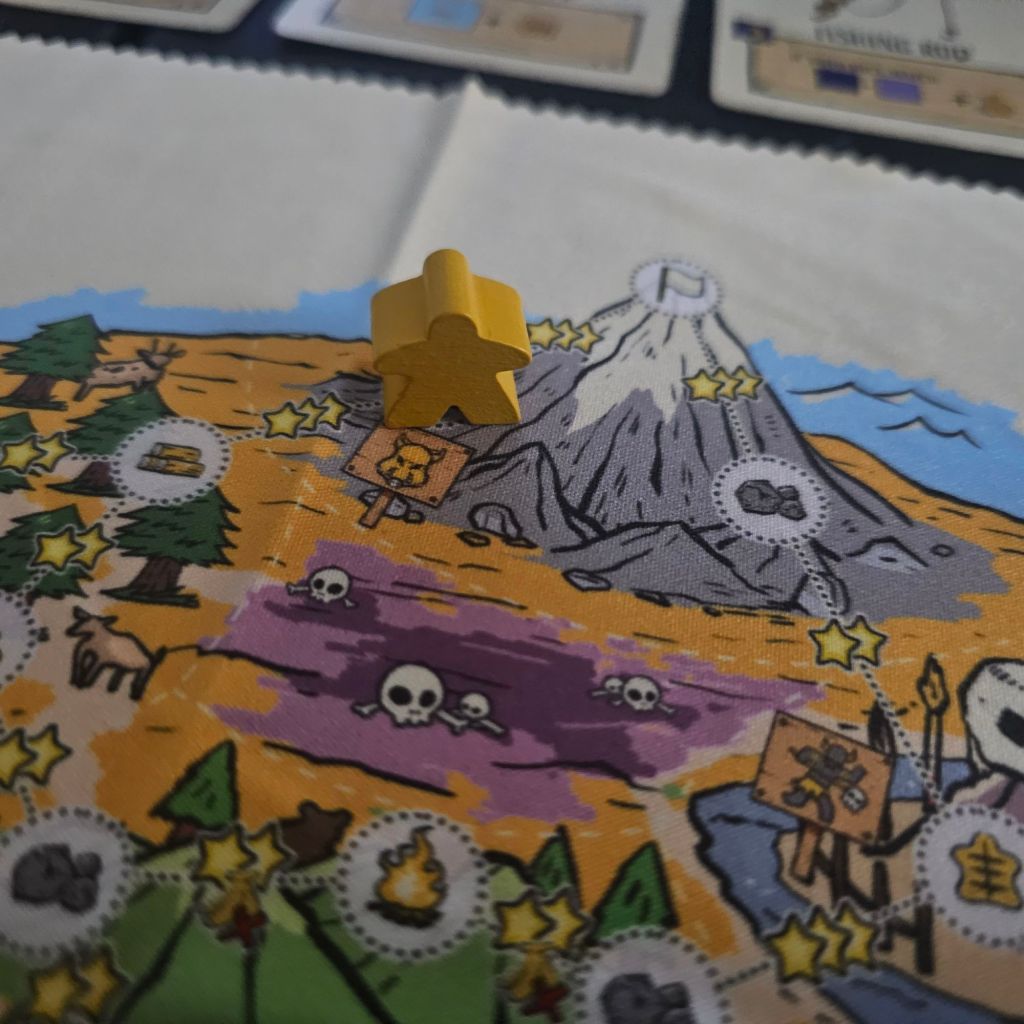
Meeple on the map

This was originally a PnP, and just now got published. I think during this time the rules were tweaked and refined by the designers and it shows. Rules are clear, concise and, for the most part, comprehensive. There is also a big section for individual cards, which I appreciate.

The game comes with two cloth boards, which are super nice, but they are small and that causes a few problems. The map is hard to read from a distance and the spaces for the resources can get cramped and block their information.

All the rest is relayed through icons and they very functional and clear, specially after a few games under your belt.

Score: 8/10

Gameplay

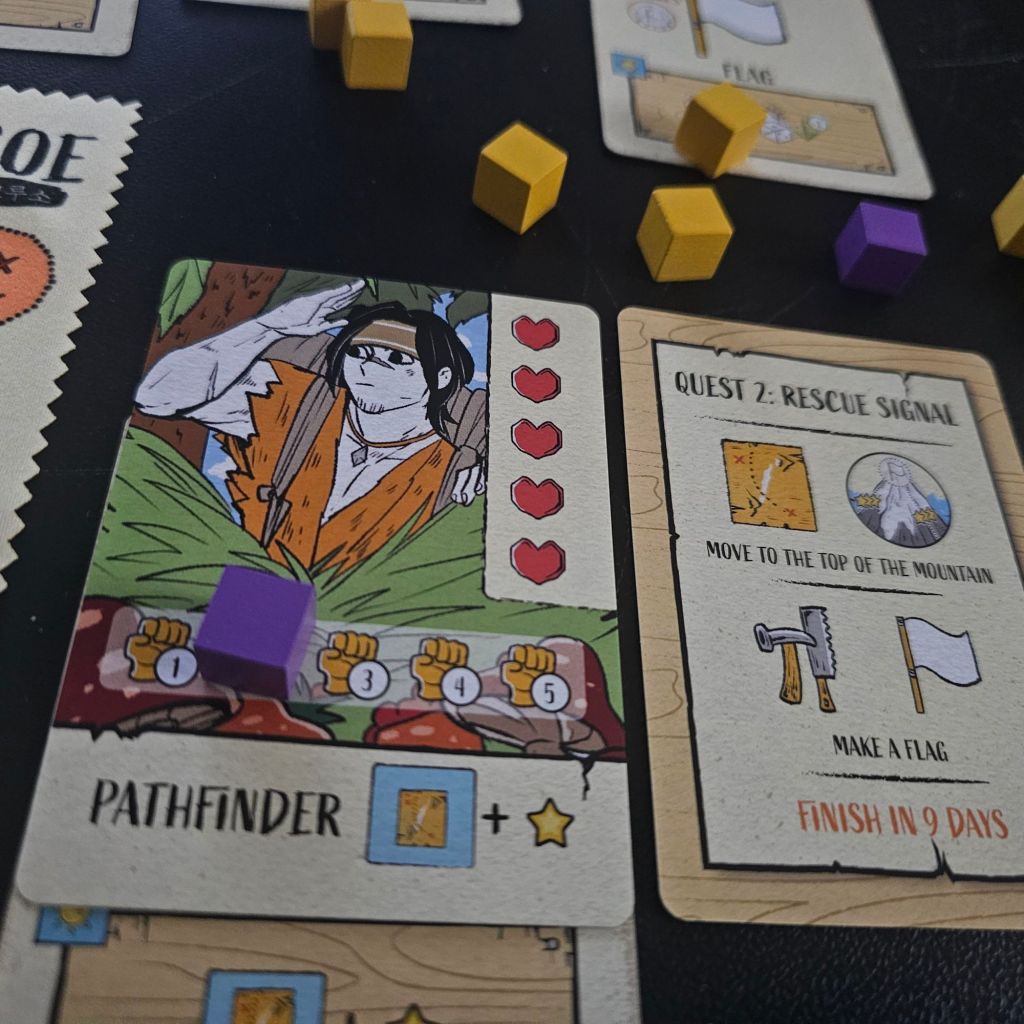
Character and Quest

Dieson Crusoe is an intense game for its duration. It’s an interesting mechanism to have larger numbers on the dice be better for actions, but also more dangerous. Also, I like that every resource has a secondary effect to manipulate the game state in some manner, but it’s also something that you will not use often as things can get tight and you need them for tools and buildings.

It has a nice tension arc, where the danger rises as you progress through the island and through the days. It gets more dangerous, but you also yield more resources for exploration and hunt. I feel like this is a well balanced, albeit tough game. Don’t let quest 1 fool you.

Score: 8.5 /10

Theme and Art

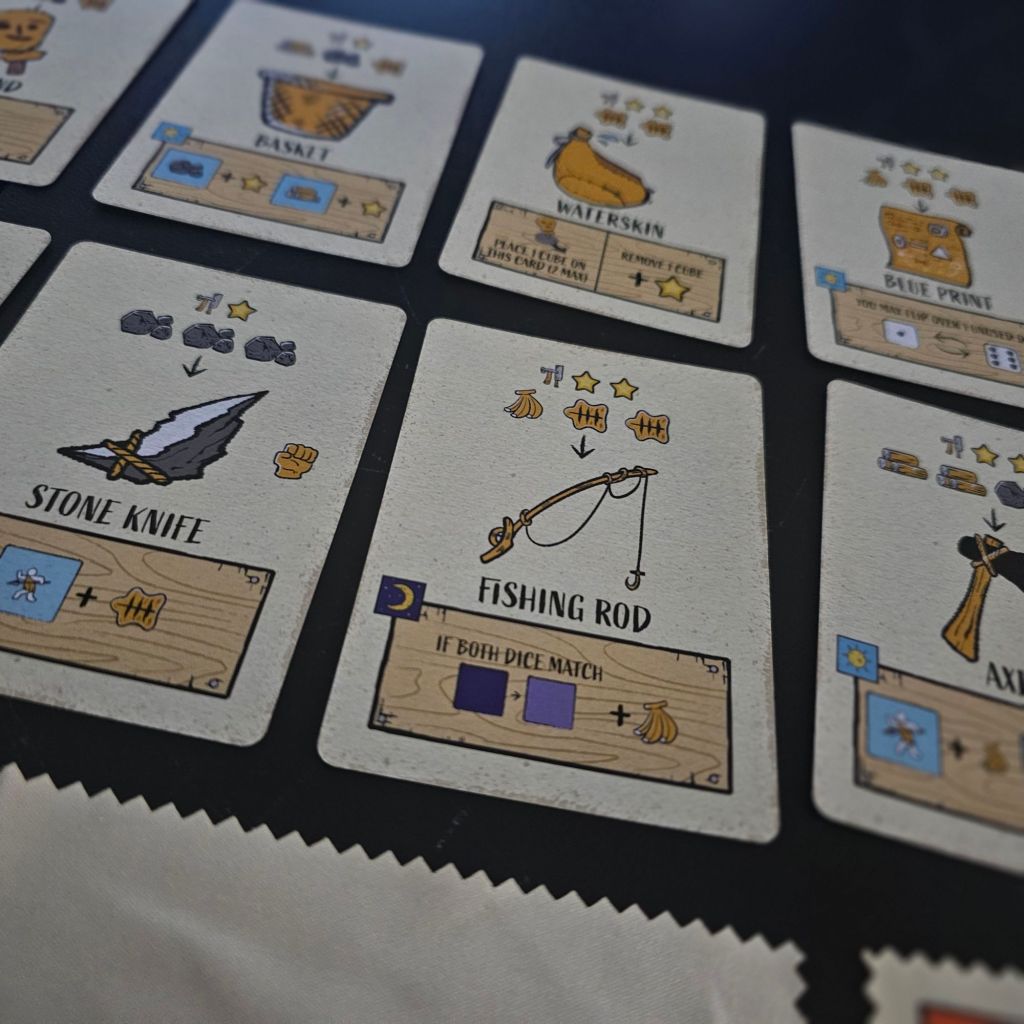
Tool Cards

The artwork and design is fairly simplistic and quite clean, but it does have a very distinctive look. It for the most part favours usability, but the game still looks great on the table.

The map is where you will find the most details, but it is very evocative of illustrations on books. Robinson Crusoe is a story told many times on baord games, so it’s well known. Dieson Crusoe takes that and uses just the right elements to evoke parts of the story without being too complex.

Score: 7.5/10

Conclusion

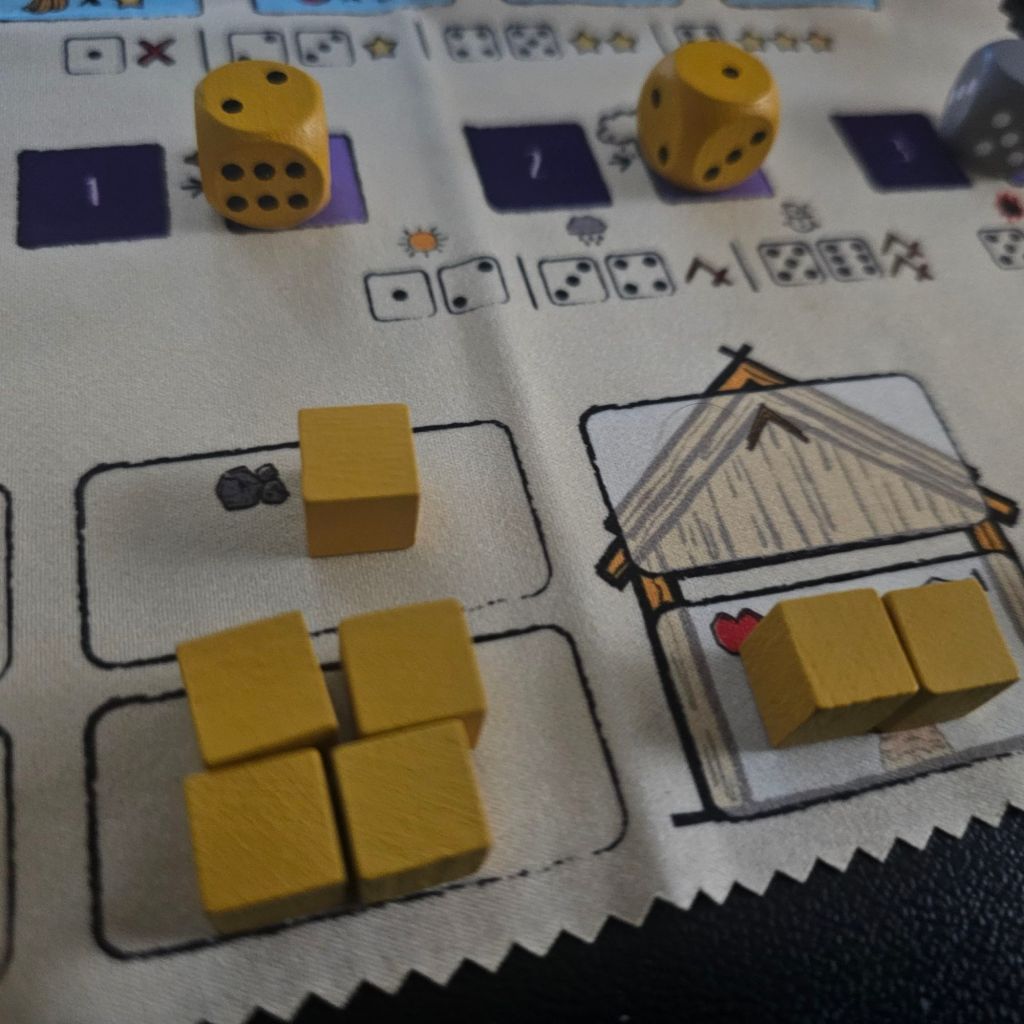
Resources

I think it’s no secret that this game was inspired by Robinson Crusoe: Adventures in the Cursed Island by Ignacy Trzewiczek, but condensed down into a 30 minute adventure. You can recognize easily the DNA, and I felt right at home instantly.

But that’s not all it is. It has its own unique mechanisms that are engaging and fun. I really like the action rondel and the way the dice used determinate the bad things coming your way. Knowing when to be risky and when to play safe is a huge part of the game.

I feel like this is a very solid and tense solo experience that will have you coming back to beaten time and again. My impression is that this game was designed by and for players, as lots of PnPs are, and got a deserved polished release.

Rules and Components: 8/10

Gameplay: 8.5/10

Theme and Art: 7.5/10

Score: 8/10