Review

Let’s Review More: Shred of Redemption

1 Player

Designer: Artem Safarov

Artist: Cole Munro-Chitty

Publisher: Best With 1 Games

Shred of Redemption tells the tale of a knight who long lost his way and got corrupt, only to look back and try to atone for his acts and end his life in righteousness. But does this game have too many wins or are its virtues enough to rise above?

How to Play
Virtues like Doves and Hammers

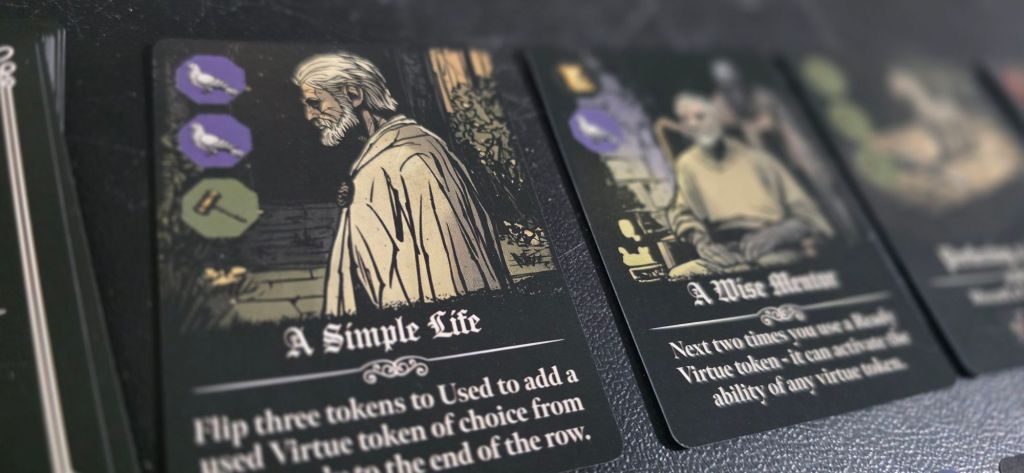
To setup, draw one vice die from the bag, without rolling it and set aside. Each dice have 3 faces of its main vice, and a combination of other 3. After that, draw two cards, picking one and discarding the other. Each card gives you a one time ability, as well adding some virtue tokens to the bag. Repeat this 4 more times, then use the cards to populate the token bag, and only the roll each die in order.

You start the game with 5 tokens from the bag, which are a mix of virtue and regret. The goal is to have the token underneath each vice dice to be its corresponding virtue token, and no regrets in the line.

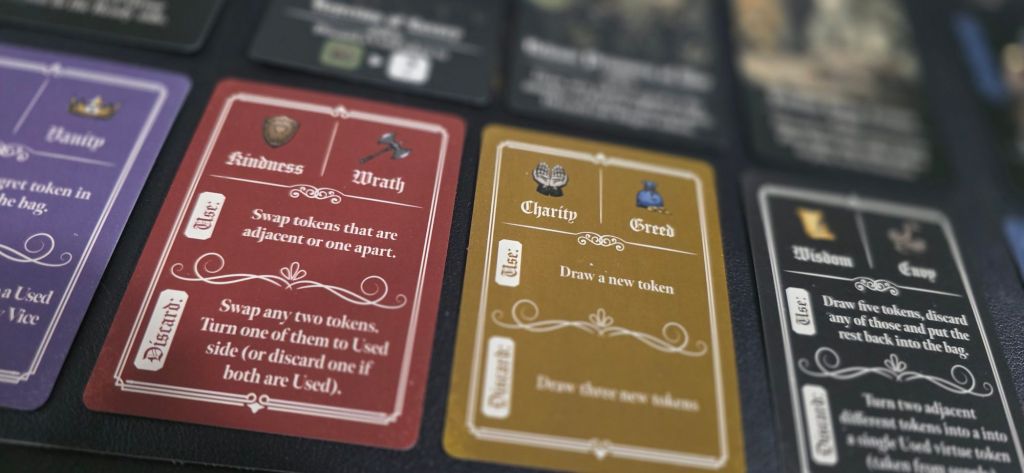
You do that by using tokens and cards to manipulate the row. Each virtue has an effect when you use it, like swapping cards and dice, discarding regrets or drawing more tokens. Each card has one unique effect you can discard it to use or they can be used to draw more tokens too.

If you manage to reach the wining position, you still have one final trial to face that will mess up your position. Reach the wining position again and you win.

Rules and Components
Hexes beat Cubes

The rules of the game are fairly short, but well illustrated and organized, with good structure and flow. I was able to understand the game on the first read and very little issues. There are a few points that are left implied, but nothing critical.

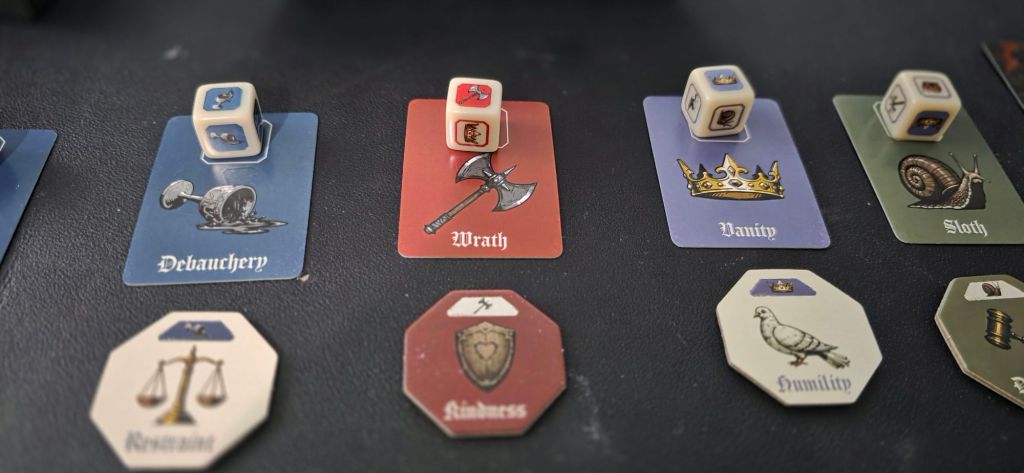
The dice are a bit small, but functional and clear enough. The faces are visible and distinguished from one to the other at a glance.

The tokens on the other hand are quite large, which is great for visualization and manipulation. However, the draw bag is quite small, and thus shuffling the tokens inside is a pain. Honestly, if possible get a bigger bag.

The color usage is a big miss. It’s so easy to get the colors mixed and more unique choices could have been used. Color is never a critical information, though, the symbols are, so this is not game breaker.

Score: 7.5/10

Gameplay
Treat your tokens with Kindness

This is an interesting puzzle like a Rubik’s Cube. You have 5 dice to fulfill, and you need to analyze what needs to done a few steps advance so all fall in place in the same time.

You also need to understand well the contents of the bag and probability. Since the seeding is varied, some abilities will be more common than others. Drawing is often necessary, but almost always comes with the risk of Regret, and you have to be ready.

Efficiency is always important, as there is the reckoning that will wreck your well laid plans and you have to have wiggle room. Without it, the game could feel a bit too trivial, but that adds just the right amount of challenge without adding too much playtime.

Score: 8.5/10

Theme and Art

He Had Monopoly in his Collection

I think the theme is fascinating. It’s all about this unknown figure that led a life of sin and darkness trying to find the Redemption at its end, with time running out. It’s well punctuated not only with card names, but the gameplay feels like a reflection.

That is helped by a beautiful artwork on each illustration, and even the iconography supports well and keeps the somber and melancholic tone. It all ties well and tells a story with relatively few words.

Score: 9.5/10

Conclusion

Let me get one thing out of the way. I’m so glad to have this game. After the whole chaos and everything terrible surrounding Unbroken and The-Company-That-Shall-Not-Be-Named, I was afraid that Artem would not be able to rise above, and I feel he was just a honest designer caught in a bad situation. So, in a big way, Redemption is fair for his journey.

That being said, this is a really good game. It’s quick to setup and play, but there is a lot here. And because of the combination the cards and dice, each game is a very unique puzzle and will offer very unique style of solutions.

Score: 8.5/10
Review

Let’s Review More: Oliva

1-4 Players

Designer: Costa, Rôla

Artist: Marina Costa

Publisher: PYTHAGORAS

Pythagoras brings us the third game in the Cinco Quinas line, full of Portuguese themes, cubes and odd rules. But, as an official hater of olives, does this leave a bad taste or does it flow well like a good Portugese olive oil?

How to Play

Olive-ing La Vida Loca

You play a number of turns depending on the player count, and each round starts with revealing a new nation card. Then players play cycles, once with each player leading.

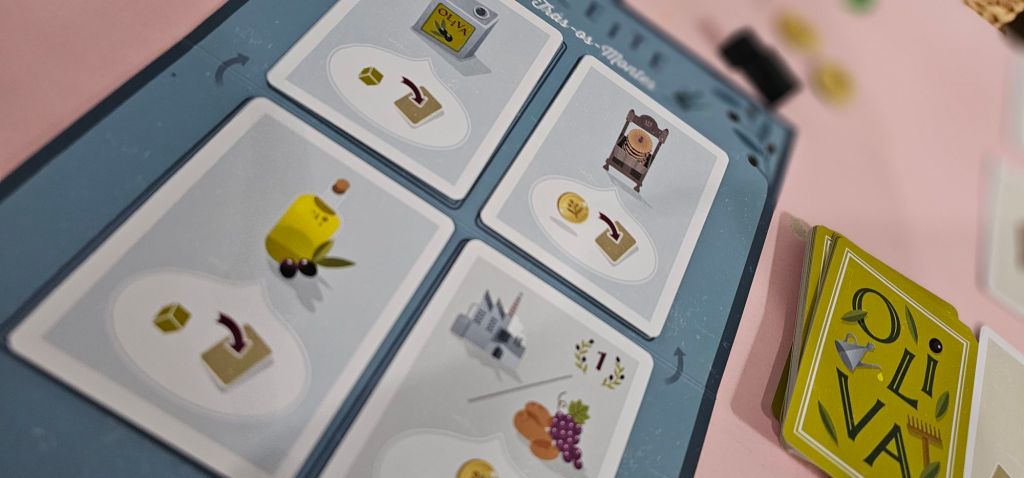
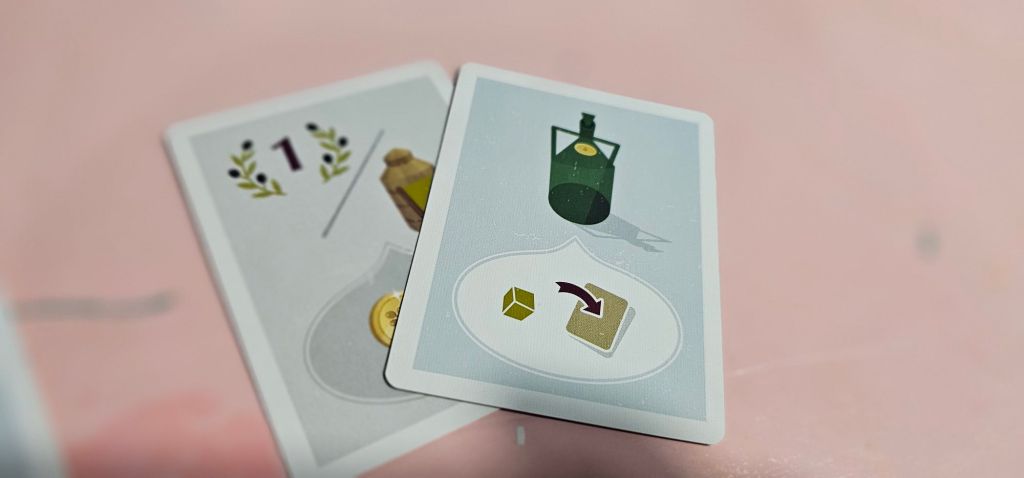
Each cycle starts with players drawing five cards from their deck and playing two face down on their board, discarding the rest. Then, they go around revealing a card and activating its action. But, here’s the fun part, you activate the card you revealed and every card that shares it’s symbol.

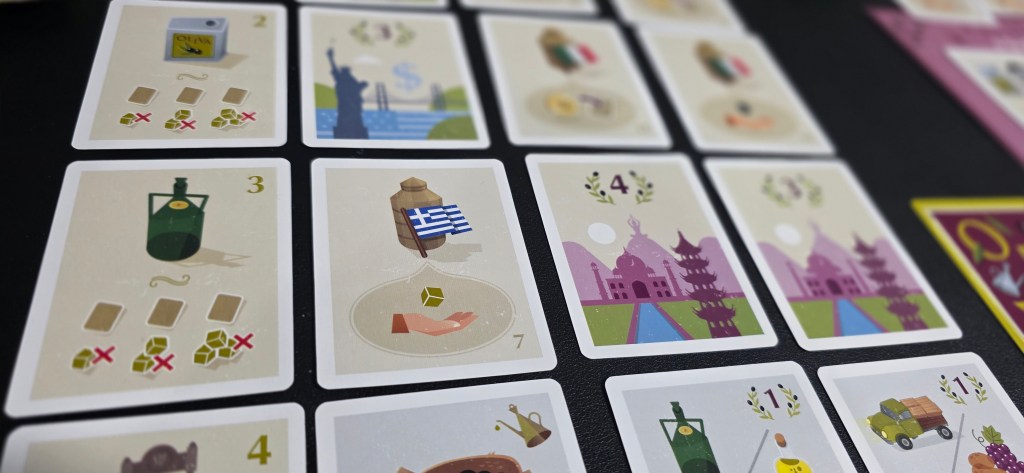
The actions are pretty standard production business. Get olives, convert them into olive oil, get money, or use those to get cards from the display, which can be advanced actions or scoring opportunities.

After each player revealed both cards, the two cards on the top are discarded, the ones on the bottom go up, and play continues.

With two players, some cards are removed and there is a third “ghost” player that players take turns adding cards so they always contribute two additional symbols.

Solo has a dedicated automa deck that adds multiple symbols and takes cards from the display, but it’s not really an opponent, the game is a beat your own score deal.

Rules and Components

Spot the Difference

Here things get complicated on both ends. Let’s start with the rules. For the most part they are well laid out and complete, explaining well each card type and the flow of the game. I don’t think the wording is the best, but after a couple of reads I was able to play without major issues.

My biggest problem is with the alternative game modes, meaning 2 player and solo. The changes on the setup are clear, but the flow is often described with vague instructions and implied rulings. For example, for solo it explains that the automa plays the top card each turn, but it is not specified where they are played. Also, for solo, it’s said that it’s setup as a 2 player game, but there is no clear indication that the “ghost” extra player is not used.

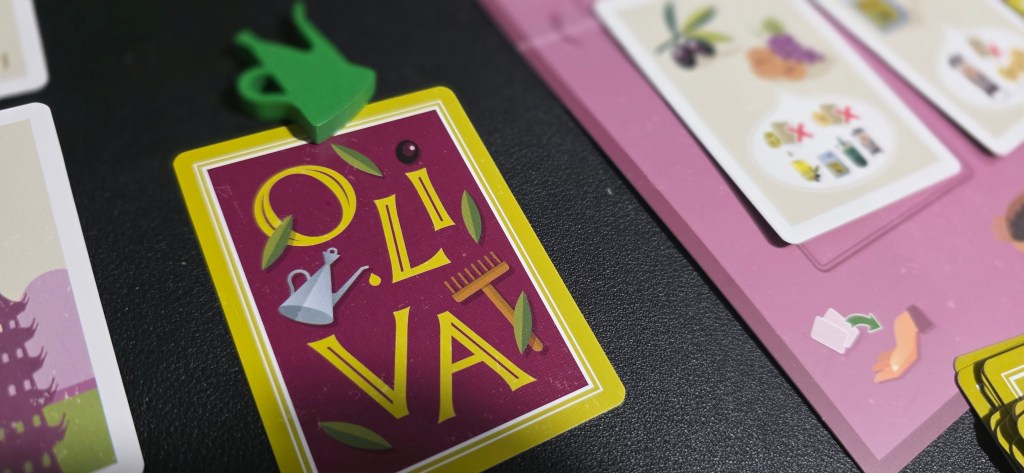
Components are for the most part pretty good. The cards are of great quality, the symbology is big and clear, and it has that specific artsy / minimalistic look that is characteristic of the series. Once setup, it is a big sprawling for the box size, but it does have a good table presence.

But there are a couple of usability issues. For example, there are a few types of cards with the same back, expected as it is a deck builder after all, but they are just differentiated by their backs, which already is not idea for color-blind people. But some, for example the blue player and the grey special action / scoring, are hard to tell apart depending on the light.

Score: 7/10

Gameplay

Does this olive oil feel Greece-y to you?

Half of this game is pretty standard production game: get cubes, transform into different cubes, cash in for cards or money, get points. It’s a streamlined and clean implementation of a familiar mechanism that will make a lot of people feel at home.

But where it shines is on the deckbuilding and card playing side of it. It’s a game where reading your opponents is not good, it’s crucial for wining. Timing well and paying attention to what everyone else is doing creates these huge turns where you can be super efficient, but no opportunities exists in a vacuum. It’s not just playing the most common symbols, it’s being ready with the right resources for when those opportunities arise. This is a wonderful style of table interaction, where you get out of your own situation and are required to notice everyone’s game, but nothing is taken, it’s all positive and adding.

Score: 9/10

Theme and Art

My Heart Oliv-On

Marina Costa has this particular clean, cartoon-y and very whimsical style that became the heart of the Cinco Quinas line, but here is where it’s displayed more and with more details. It’s very welcoming and warm, and makes you want to dive in this world.

And this ties together with the love that Pythagoras usually puts in with their Portuguese themes. It’s not just a game about olives and olive oil, but specific regions and traditions of that country. I may be biased as it is my heritage, but every small detail is evocative. It’s not a heavy handed theme, not in the slightest, but it’s seen and felt.

Score: 8/10

Conclusion

From Iberia, to the World!

Oliva packs a punch from its small box, threading a nice line between familiar mechanisms and unique implementations. It’s a game that requires table awareness and promotes an environment where players are present at all times, at all turns, always seeing what’s next, what card each one took, what moves they are making and setting up to make. But that is not overwhelming as turns come and go blazing fast. It’s simple, but very rich.

And that is allied with all the Portuguese love that is a big characteristic of Pythagoras and the Cinco Quinas line. As the game is fluid, it allows you to appreciate the theme and feel yourself at home and sink in all the cubic oily goodness. But not the olives, those black cubes are gross and everyone knows it. Or maybe it’s just me…

Score: 8/10