
Review

Let’s Review More: Raiders of Scythia

1-4 Players

Designer: Shem Phillips

Artist: Sam Philips

Publisher: Garphil Games

About the Game

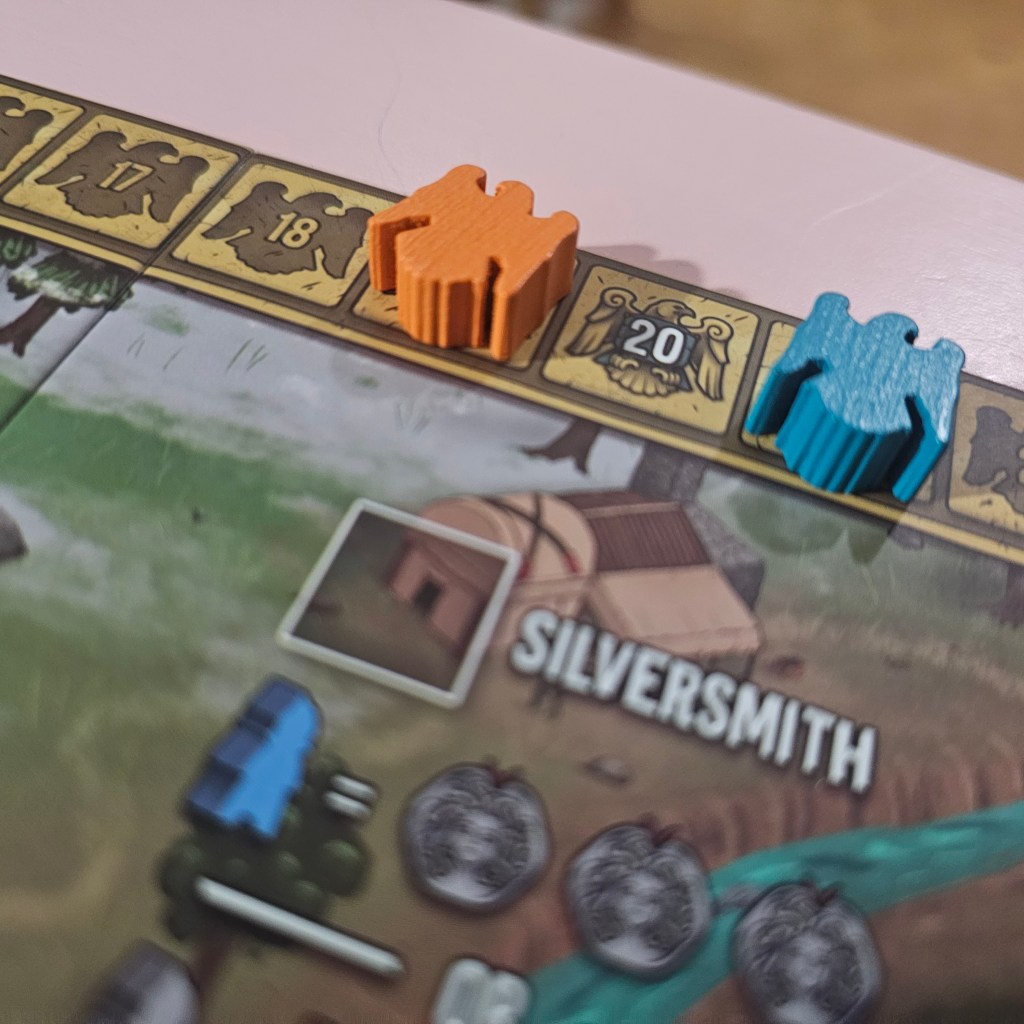
Scoring eagles

Garphil Games released an amazing game called Raiders of North Sea with two expansions and it’s still regarded as a modern classic. Then they went back on the system and released Raiders of Scythia. How does it fare against its predecessor and on its own?

Gameplay

Raiding is fun

The core premise remains: you start your turn with a single worker, you end with a single worker. One of your options is to work, where you will place your worker on one of the top locations and activate that to get or trade resources and cards, play crew or solve Quests. Then you pick up a worker from a different space and activate that too. Or you can raid, where you must have a number of crew members and spend provisions and Wagons to get all resources in one place and points depending how strong your crew is plus the dice from that region. However, the dice also place wounds on your crew, reducing their strength or even killing them.

Solo Gameplay

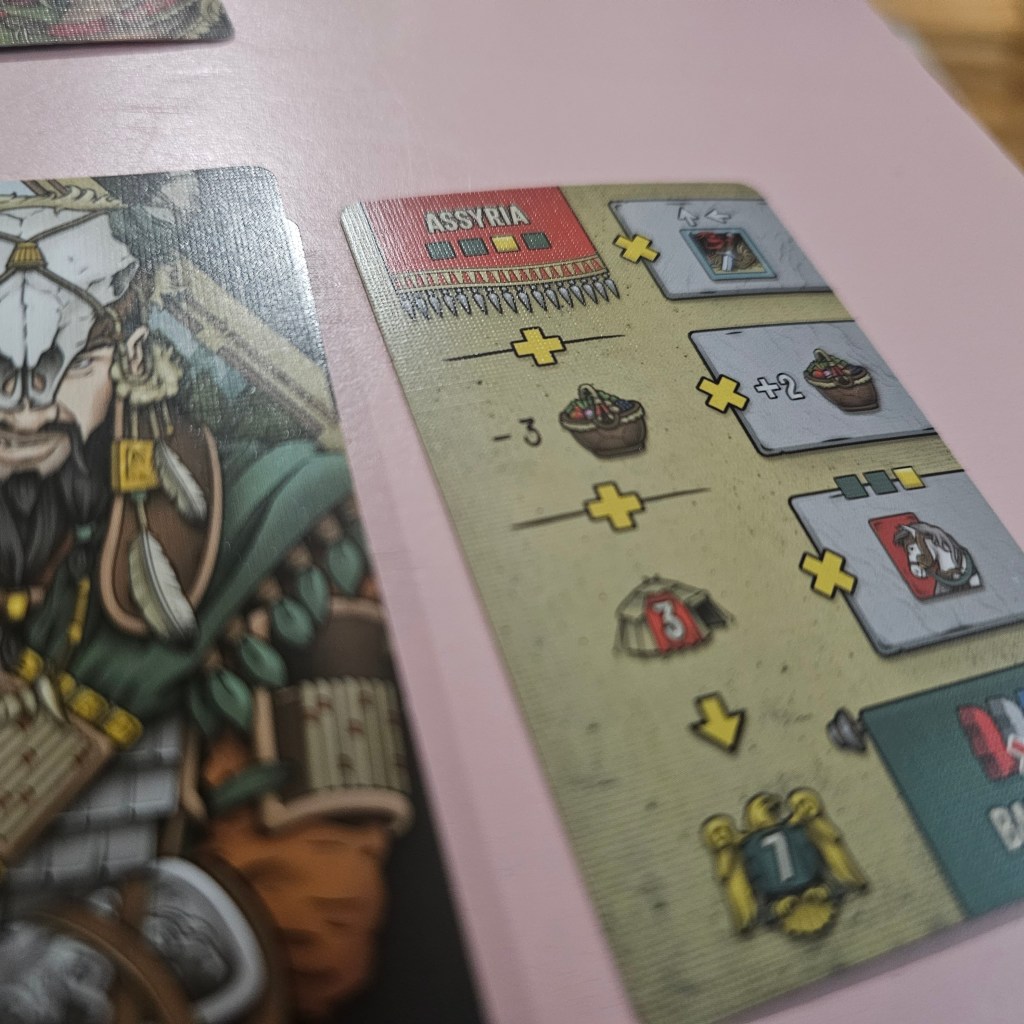
Solo cards

On the AI turn, they will block off one space, where you can’t place or pick workers from, and then proceed to try to raid. They check if there is an available spot on the right region, if they have enough provisions and enough strength from horses. If any of these are false, they either get a quest or more of whatever is missing. Otherwise, they clean up the spot and get a fixed amount of victory points.

Components

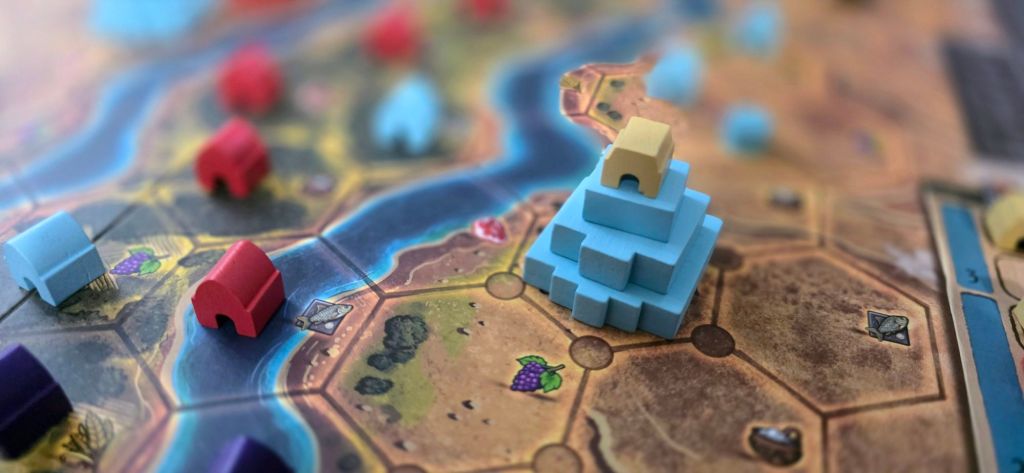
For the most part, the components are Garphil level quality. Great cards, great art, meaningful symbology. I love the Kumis and provision tokens, and the coins, specially on the Deluxe, are amazing.

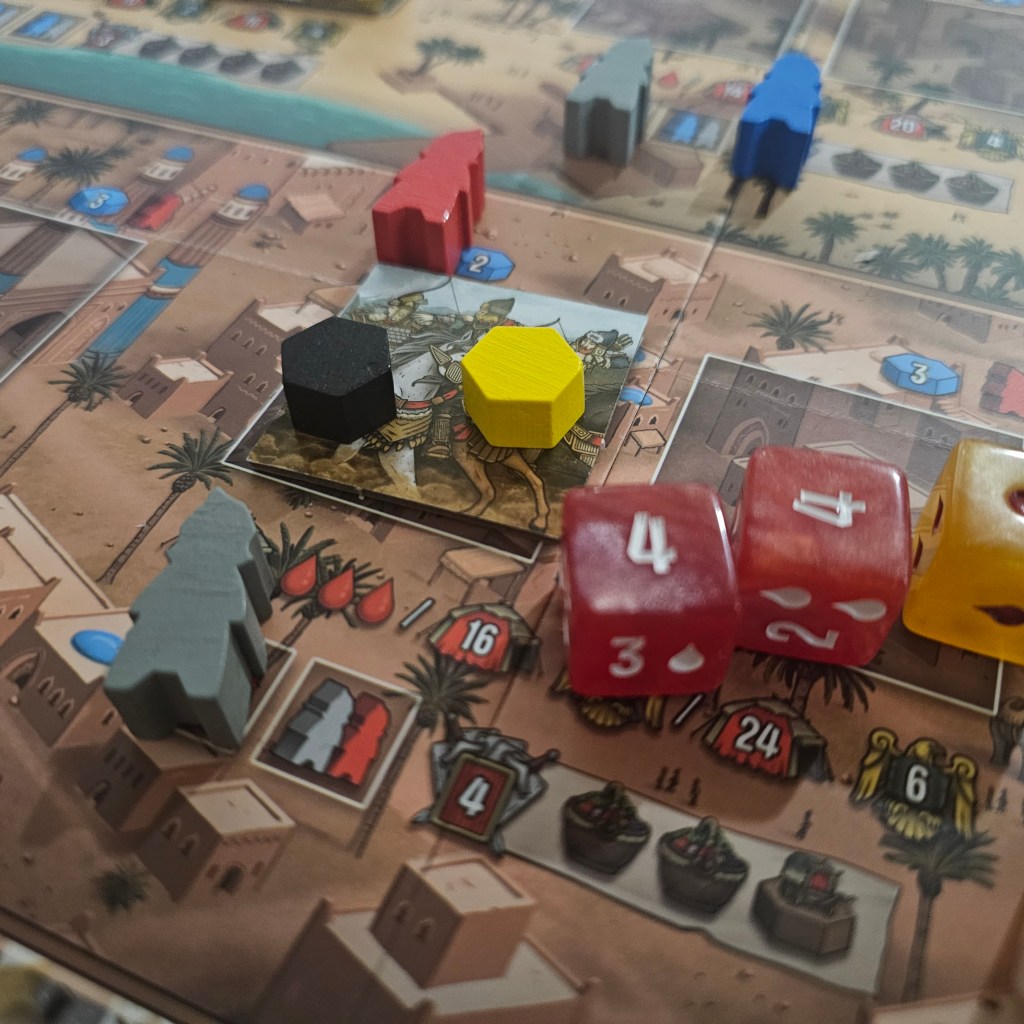
There are some snags though. Unlike North Sea, all bag resources are hexes, just with different colors. However, the brown and black are hard to tell apart in some lights. This is specially jarring since brown ones (Wagons) are necessary to raid lower regions.

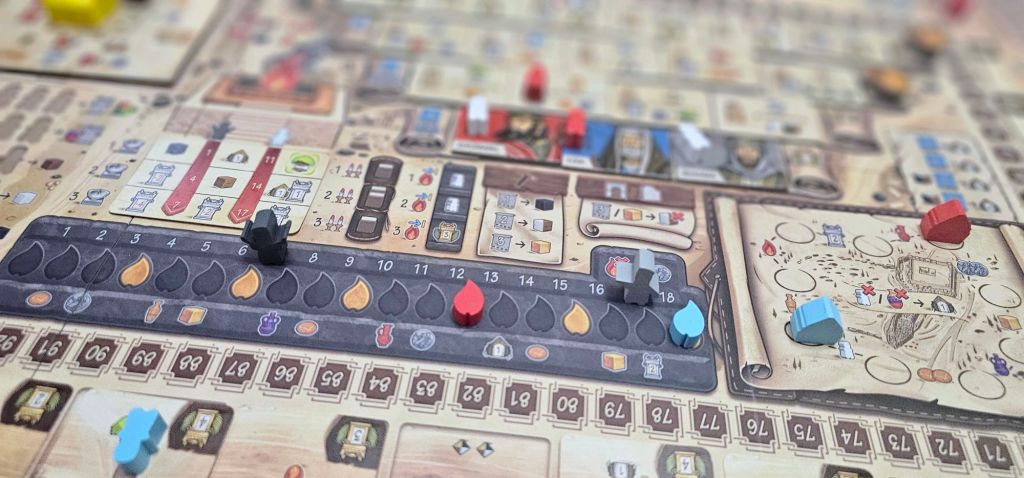
I also feels like the board is way too crowded. The art is great, but it is a busy background and can be visually overwhelming.

Comparing Raiders

Raiders of Scythia is basically Raiders of the North Sea with some of expansions integrated, but there are new things.

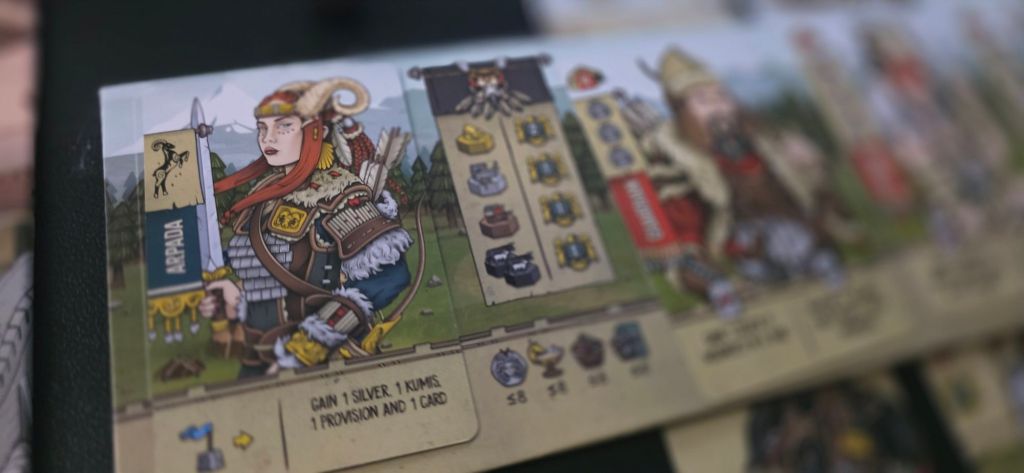
The heroes now are not one special type of crew, but your character that has an unique action that can be taken on the Town Centre without discarding a card. Also, gone is the armor and Valkyrie tracks (not big fans of Odin those Scythians). Instead, the damage from Fields of Fame are integrated on all raids. Also, you now can get horses and eagles to boost strength, provide victory points and add more actions to the Town Centre.

From Hall of Heroes, mead to strength up your attacks becomes Kumis, and the Quests are mixed with the chieftain tributes and are a single thing.

So, strictly speaking, do you need both? No, you don’t. There is plenty of overlap between them that having one makes you not miss out big on the other. But is there space for both? Absolutely. I own both and play them in different times for different reasons.

For me, if you want to pick one it boils down to if you will get just one box of each, or if you would get North Sea complete. As a base game, Scythia is more robust and interesting. But, when complete, I like the options of North Sea better. Also, visually I like North Sea way better.

Conclusion

What about on its own? Raiders of Scythia is absolutely fantastic. It gets a simple premise with simple rules, and transforms it into this game with an ebb and flow play style where every turn is a question of efficiency and opportunity. And it took its big brother and condensed into this fantastic amalgam that is truly bigger and better than all its parts.

It’s not without its faults, components being the biggest. But, in the grand scheme, those are fairly minor

Score:9/10

Review

Let’s Review More: Raiders of Scythia

1-4 Players

Designer: Shem Phillips

Artist: Sam Philips

Publisher: Garphil Games

About the Game

Scoring eagles

Garphil Games released an amazing game called Raiders of North Sea with two expansions and it’s still regarded as a modern classic. Then they went back on the system and released Raiders of Scythia. How does it fare against its predecessor and on its own?

Gameplay

Raiding is fun

The core premise remains: you start your turn with a single worker, you end with a single worker. One of your options is to work, where you will place your worker on one of the top locations and activate that to get or trade resources and cards, play crew or solve Quests. Then you pick up a worker from a different space and activate that too. Or you can raid, where you must have a number of crew members and spend provisions and Wagons to get all resources in one place and points depending how strong your crew is plus the dice from that region. However, the dice also place wounds on your crew, reducing their strength or even killing them.

Solo Gameplay

Solo cards

On the AI turn, they will block off one space, where you can’t place or pick workers from, and then proceed to try to raid. They check if there is an available spot on the right region, if they have enough provisions and enough strength from horses. If any of these are false, they either get a quest or more of whatever is missing. Otherwise, they clean up the spot and get a fixed amount of victory points.

Components

For the most part, the components are Garphil level quality. Great cards, great art, meaningful symbology. I love the Kumis and provision tokens, and the coins, specially on the Deluxe, are amazing.

There are some snags though. Unlike North Sea, all bag resources are hexes, just with different colors. However, the brown and black are hard to tell apart in some lights. This is specially jarring since brown ones (Wagons) are necessary to raid lower regions.

I also feels like the board is way too crowded. The art is great, but it is a busy background and can be visually overwhelming.

Comparing Raiders

Raiders of Scythia is basically Raiders of the North Sea with some of expansions integrated, but there are new things.

The heroes now are not one special type of crew, but your character that has an unique action that can be taken on the Town Centre without discarding a card. Also, gone is the armor and Valkyrie tracks (not big fans of Odin those Scythians). Instead, the damage from Fields of Fame are integrated on all raids. Also, you now can get horses and eagles to boost strength, provide victory points and add more actions to the Town Centre.

From Hall of Heroes, mead to strength up your attacks becomes Kumis, and the Quests are mixed with the chieftain tributes and are a single thing.

So, strictly speaking, do you need both? No, you don’t. There is plenty of overlap between them that having one makes you not miss out big on the other. But is there space for both? Absolutely. I own both and play them in different times for different reasons.

For me, if you want to pick one it boils down to if you will get just one box of each, or if you would get North Sea complete. As a base game, Scythia is more robust and interesting. But, when complete, I like the options of North Sea better. Also, visually I like North Sea way better.

Conclusion

What about on its own? Raiders of Scythia is absolutely fantastic. It gets a simple premise with simple rules, and transforms it into this game with an ebb and flow play style where every turn is a question of efficiency and opportunity. And it took its big brother and condensed into this fantastic amalgam that is truly bigger and better than all its parts.

It’s not without its faults, components being the biggest. But, in the grand scheme, those are fairly minor

Score:9/10

Review

Let’s Review More: Scholars of the South Tigris

1-4 Players

Designers: S. J. MacDonald, Shem Phillips

Artist: Mihajlo Dinitrievski

Publisher: Garphil Games

About the Game

Science Tracks

We have the second game on Garphil’s third trilogy, this time about transcribing knowledge from all around the world. As usual it’s hard to follow up a great first game in Wayfarers, so how do Scholars fair?

Gameplay

Scholars Card Play

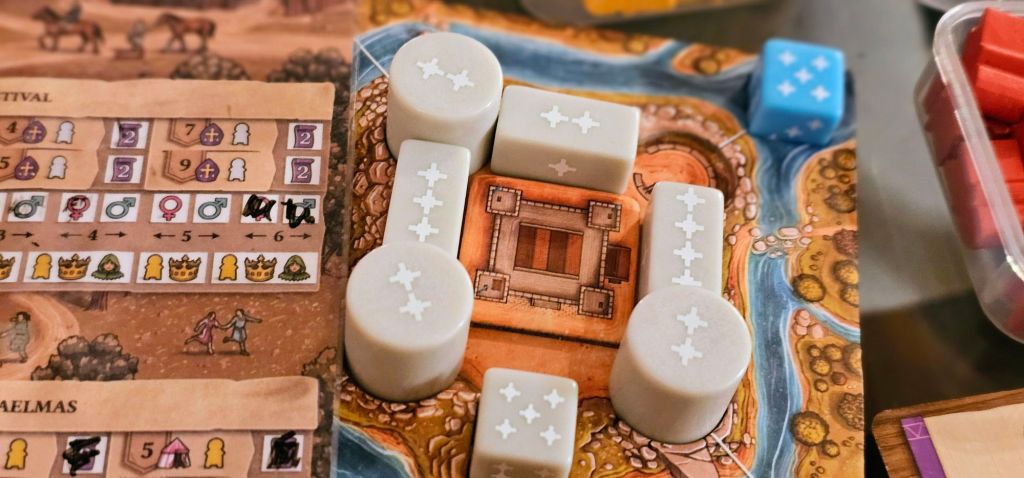
On your turn, you either play a card or rest. To play a card, you chose one of the actions on you board and play a card and 1-2 dice. The dice will not only determine the value of the action, but also the color. Some actions care about just value, some just color, some both. Primary color dice will also combine color to secondary ones. Each dice can also be modified by up to two works to either change their color or to improve its value. There are less actions this time, mainly getting more translators, adding scrolls to be translated and translating them, and going up on the different scientific tracks.

When you rest, you rest, you get the income of all the cards you play. Those are either getting some dice or activating the income of one of the tracks. This dynamic makes the timing of acting and resting really interesting.

Solo Gameplay

Solo Board

As usual, we have a dedicated solo board, and it uses the 2 color system that Wayfarers used. This 6 card solo deck means that the AI is just interested in getting translators and dealing with scrolls, ignoring the science tracks. However, it still feels like a realistic, though abstracted, opponent.

One big difference is that we don’t have “personalities” this time around, but difficulty levels. I appreciate that route, as it would be difficult to isolate or incentivize too much one aspect.

Components

Translators

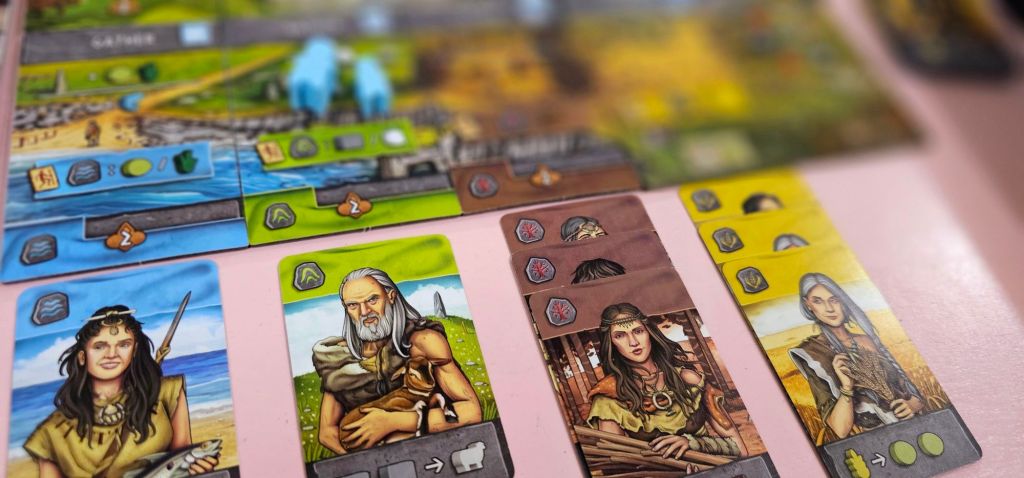
This is a standard Garphil production, with all the good stuff that comes with it. Great art, great components, lots and lots of symbols but a pretty good rule book with a back dedicated to symbology. It also uses all the familiar components, with the little flag for tracks, asterisks for influence and lots of familiar symbols.

One aspect I think they did great is accessibility. For a game that uses color as one of its central mechanisms, I believe that the way the symbols of the primary and secondary colors differ on more than just color, and the color of the dice and pips were chosen make this fairly color blind friendly. I’m no expert in the matter though.

Conclusion

Scholars feel smaller in scale, but that is actually a good thing. All systems in Scholars feel tighter and more connected. When comparing to Wayfarers, Scholars felt a bit more intuitive though no less of a challenge to optimize.

There is not much to criticize here. It’s what you expect from SJ and Shem, but it feels like a step towards a cleaner and less comborific fashion. And it works really well.

Score: 9.5/10