Meteor Incoming
Preview

Let’s Preview More: Doomsday Manager

1 Player

Designer: Dennis Kurdiukov

Artist: Dennis Kurdiukov

Publisher: Nuka Zombee Games

So, you would think that a giant meteor coming straight for us would be a big deal, but no… It’s your job to manage the crisis, get funds, bri.. convince politicians and feed the media, without going overboard of course, to have a chance of survival. But is this crisis manageable or should we just let the meteor do its thing?

How To Play

Weapons Grid

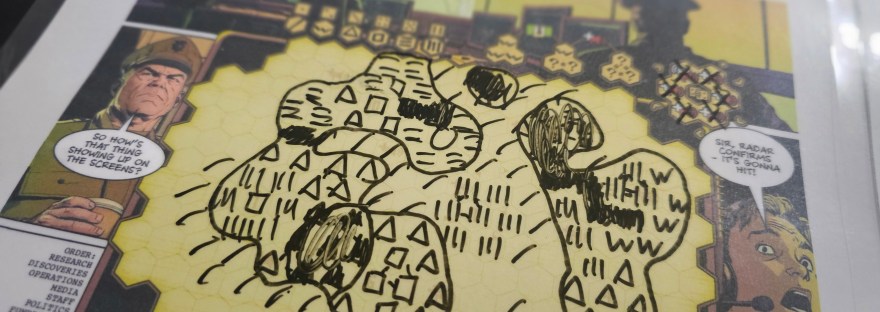
To setup, you just need three sheet and a whole bunch of dice. Each turn is comprised of whopping 8 phases, but all but media phases are optional. On research you roll a pair of dice for each worker, one being the material and the other how many will be added in a spiral shape. Once a shape cannot grow anymore, you start from the next numbered origin. Once all numbers are used and the meteor cannot grow anymore, it’s fully mapped. Doubles will tell the direction of the meteor, that will help spread media attention.

On operations, you roll a die for each worker and add that to one of the weapon matrixes. Each matrix need to be complete and all equations correct for the weapon to be active. During the media phase, you again roll a die for each worker. Ones mean loss of future money, while fives and sixes make will allow you to bump one of the media channels of your current influence level. These can give you money or cause crisis. Once all of one color are filled, the next influence level is unlocked.

Staff phase will allow you to spend money to upgrade one of the previous three departments or get more workers for that department, unlocking more dice. Politics allow you to, well, direct money to one of the politicians so that they can see your point of view more clearly. Each one will have immediate or triggered ability that will activate once they are marked. Once all boxes of one person are marked, it will increase your influence over a certain ideology as well as triggering one political favor.

Fundraiser will allow you to invest money to get a return on the next year. Finally, attack will allow you, once the meteor is mapped, weapons are unlocked and the correct bills are passed, to spend money to use the weapons against the meteor. Different weapons will target in different manners, but the goal is to have all of the meteor destroyed. Some weapons target big areas, while others will break it into smaller chunks, as any area 7 hexes or smaller can be destroyed automatically.

The only way to win is to destroy completely the meteor, and you lose if time is up and the big rock does its thing.

Rules and Components

Influencing Politics

As I usually stress, this a preview from a prototype so things are bound to change. But this is quite complete at this point I believe.

Usually print and play games are one or two pages long, and I appreciate Dennis spreading to a third. Though there is a lot happening, every section is well displayed and nothing feels cramped. Wording for a few abilities and effects could be clearer, but even at the first few plays, everything feels in place and make sense.

Different from previous games, this time rules are laid out in a more standard manner and I appreciate for a game on this complexity. Every section is well explained, but some wording can be vague or left to interpretation at this point. I did reach out to the designer, and most of my interpretations were correct, and I do hope the final version is even clearer than it is now.

Gameplay

Political Bills

Starting to play Doomsday Manager can be a bit daunting, but its a game that when you start playing is quite more intuitive than it first look. Each section is its own mini-game almost self contained and easy to manage. This is half of the game. The other half is managing funds and investment on each section, and having the proper support on all of them according to needs.

One aspect that I noticed is that the dice mitigation is mostly done through additional rolls, but not through dice manipulation. In a game where specific rolls are needed and, often, crucial, this can make you feel like you’re at the mercy of the dice. Brutal, but on the other hand, thematic.

Theme and Art

Media Frenzy

Theme is odd and unique, for sure. Honestly, the way it develops is quite like a cheesy classic disaster movie, and I love that the game leans on it and uses that to its advantage. It’s at the same time cinematic and, in a way, administrative, and somehow both work really well together.

Art again falls into the same feel. It uses the Nuka Zombee Classic Comic Book Flow (patent pending) to evoke dramatic moments to highlight each section as a scene, and elevate that from just another system.

Conclusion
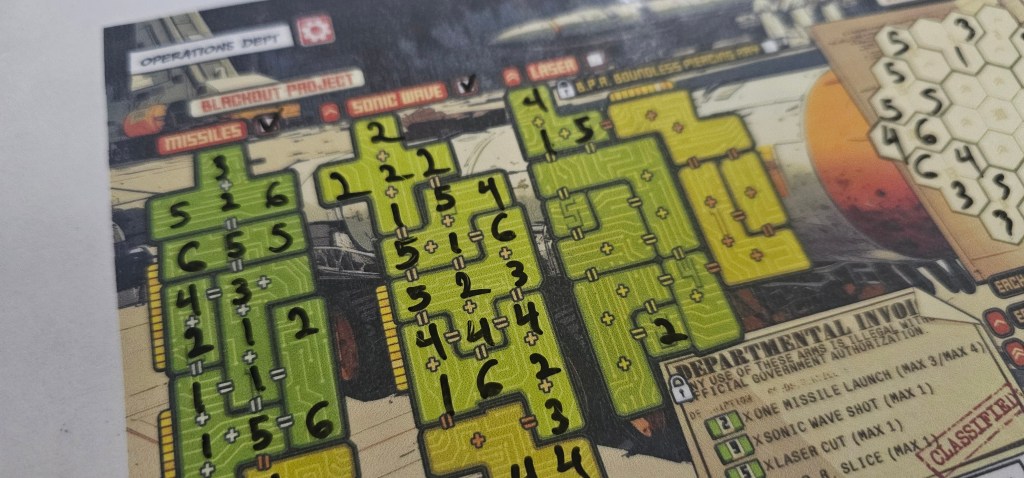
Weapon Matrix

Doomsday Manager is epic, out of control and, honestly a bit frustrating at times. It’s absolutely a game that takes its unique premise and runs with it the whole way. Each individual section is simple and almost mundane. That really forces you to look at the game from a higher perspective, seeing the big picture, almost like setting up a situation and just running the results. The biggest decisions and where the heart of the game lies is the runaround of funding and resources, timing and long term plans.

It’s also a game that breaks expectations in a big manner. It gives you impression of being a big lengthy and grind-y experience, specially knowing one of their previous games, like Recycled. However, it’s not that at all. Turns fly by, and often with little change between them. It’s not a game of epic turns, but a game of slow flow and long term plans materializing over time. It requires a whole type of approach and smart plays, and, honestly, I see so many branching paths to both victory and defeat that I can’t wait to explore it more.

PnP Review, Review

Let’s Review More: The Tracker

1 Player

Designer: Denis Kurdiukov

Artist: Denis Kurdiukov

Publisher: Nuka Zombee

The world outside is a horrible nightmare, full of zombies, mutated beasts, and horrible people just waiting to take you and everything you have. But you insist in going on and trying to find a way to save a little girl. But is your will strong enough or are you going to succumb along the way?

How To Play

Scouting

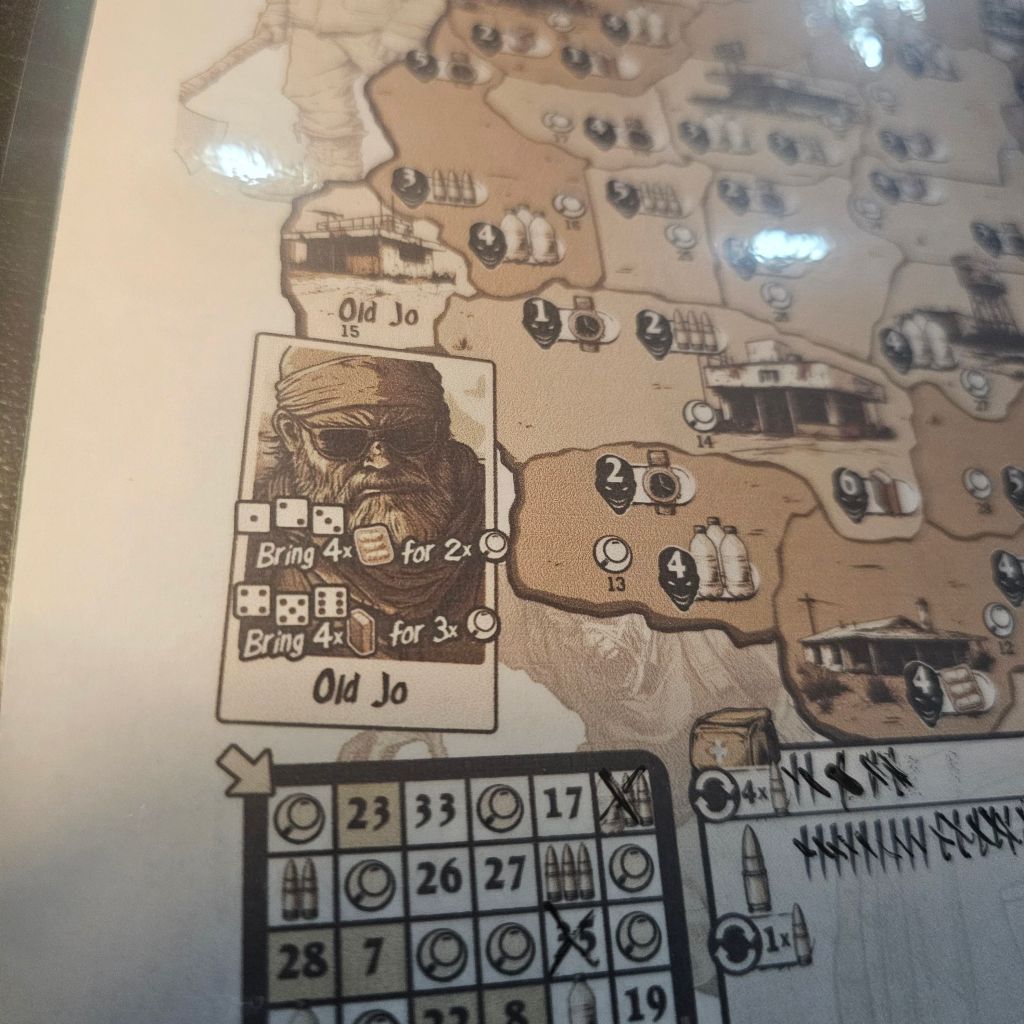
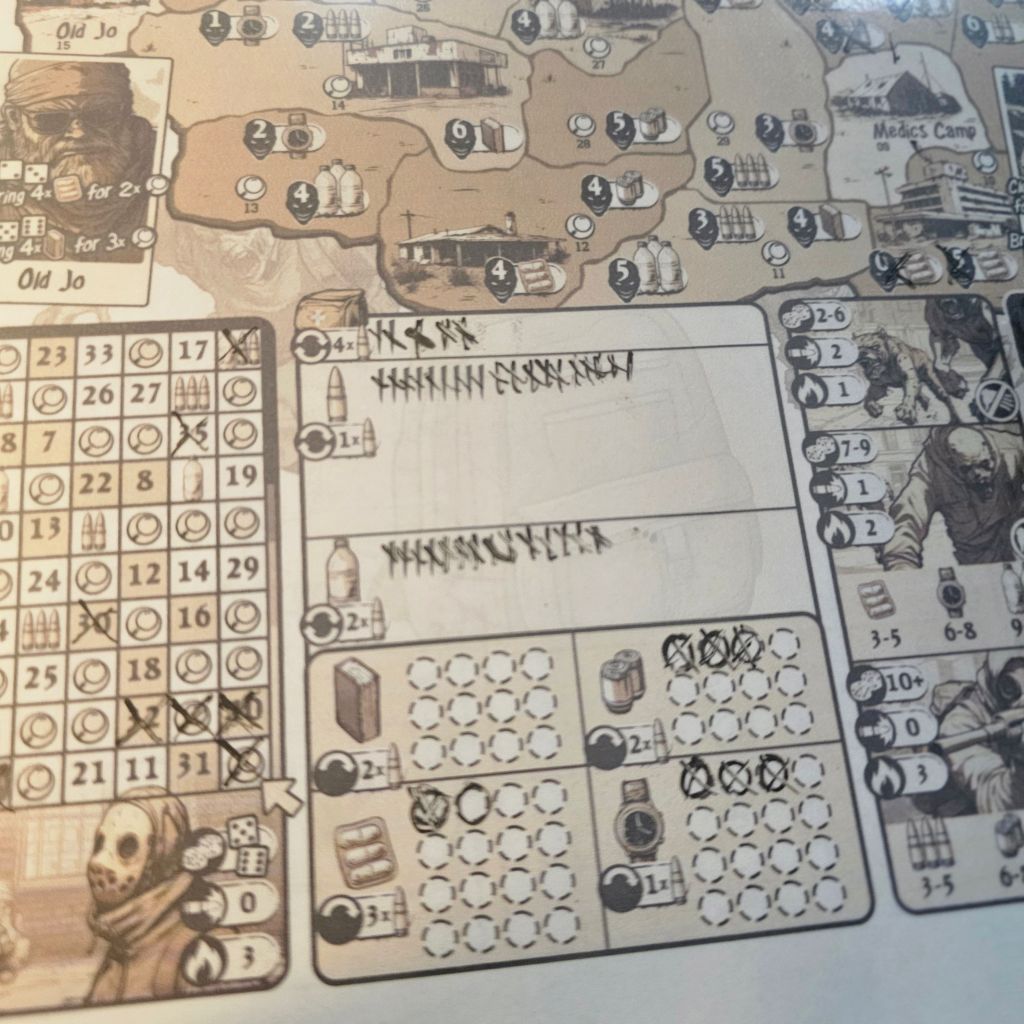
Setup is just getting the sheet, it already has all the resources and starting situation. You also need 8 dice, 4 of each color and a marker for your position. On each turn, you may do some trades with the locals for clues, but most often you will try to go to a new area for clues are resources.

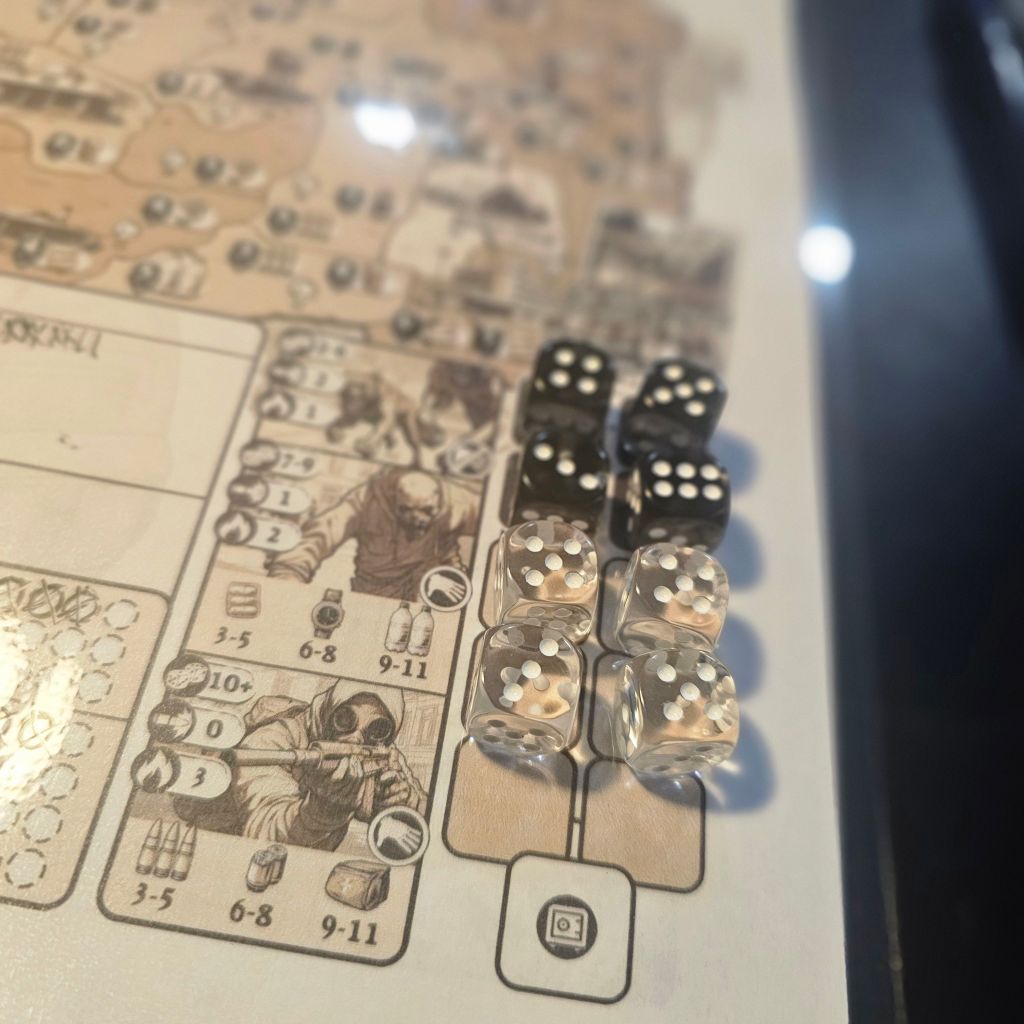
To get into a dangerous area, first you spend a water roll your 4 dice to create your pool, and set one of the enemy dice as the danger of the area as stated on the map. One die at a time, you assign one die for the scout test, roll another for the enemy and assign a final one if needed. If you match or exceed, scout is successful and you proceed to battle. If not, you just lost time and a water.

Battle is similar, you assign your dice then roll two for the enemy. If it is enough, you win the loot, if not you lose a medpack and, if able, spend bullets to finish off or accept defeat.

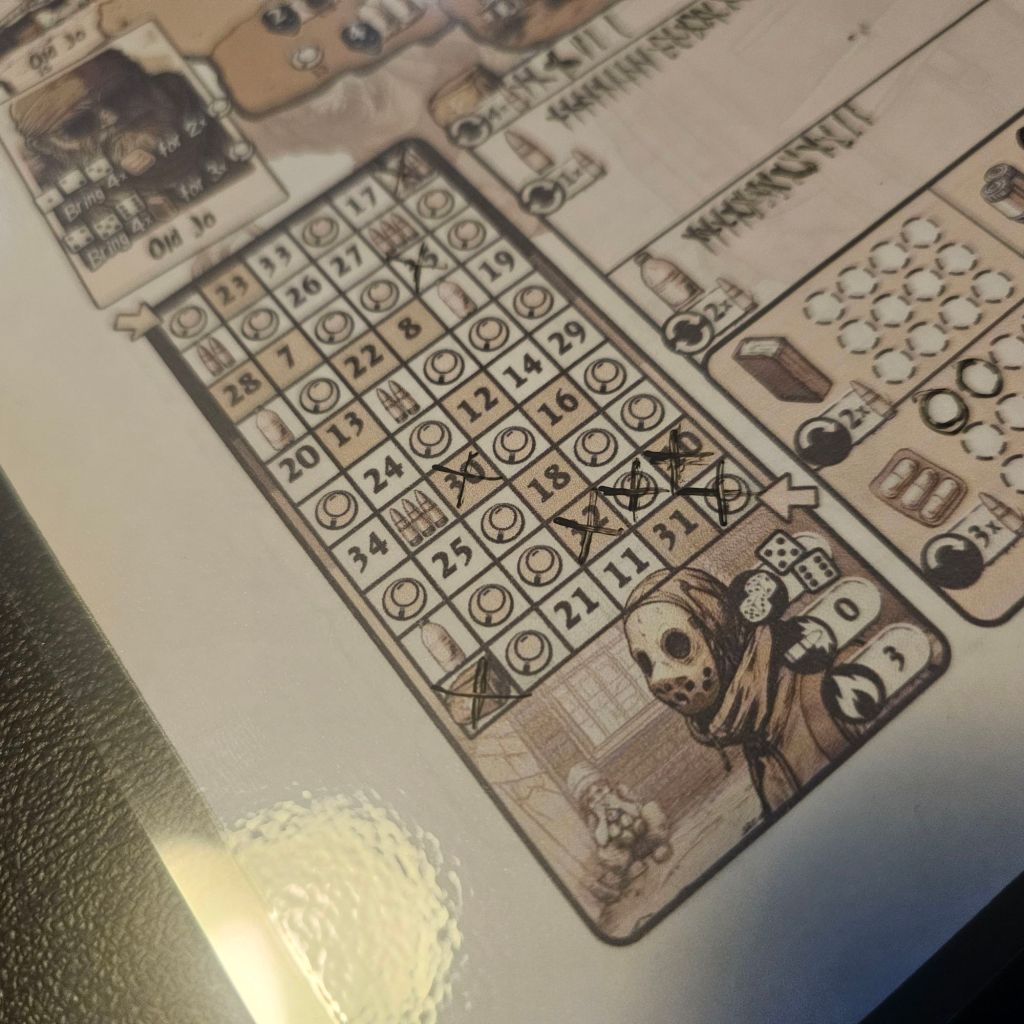
Each time you get a clue from locals or secure an area, you mark the clue or number into the main quest grid. Your goal is to make a continuous path from the starting arrow to the finish where the girl is. If you are able to do that and defeat the final boss, you win. If you ever run out of resources, you lose.

Rules and Components

The mission

The iconography is pretty clear for the most part, and it may seem overwhelming at first it does make sense once you start playing the game. Even though there are a ton of icons, I never felt the game got too cramped or messy as I went along.

Rules are, as usual for Nuka Zombee, laid out nicely in a kind of a comic book flow type of way. Rules are organized progressively, as if you are playing the game and reading the rules along for the first time, explaining as they are needed in the play. It’s an interesting approach, but not the most friendly at times.

It takes a bit to really internalize everything, but this is a game with a fairly unique flow and I honestly don’t know if any other layout would be better beneficial. I do appreciate the lengths they go for different examples.

On the other hand, there are terms and functionalities there are left to be understood by context, and I usually prefer things clearly laid out, like spending bullets to adjust dice or finishing off enemies.

Score: 7.5/10

Gameplay

Rolls

Unlike many games within the genre of apocalyptic survival, this game never feels oppressive. Instead it takes the other common facet of such games, dwindling resources, and makes it the heart of the problem. You know what is your dice pool BEFORE deciding where to go, and it’s up to you to be open in terms of choices and how much you’re willing to spend to achieve a certain objective.

It is a slow and analytical game, where along with the resource management, luck mitigation is key. You will have to take risks, no questions, but it’s all about how and when. That being said, it is also a game of patience and repetition, and getting into the game knowing that it is not going to be an in and out situation. You will never win quickly, and very rarely will lose quickly either.

Score: 9/10

Theme and Art

Old Jo

The artwork is stark and evocative, and it does a great job in setting the mood. The muted color scheme also adds to the feel, while also helping the game sheet feel less overwhelming.

The setting is left vague, only with a brief explanation of what is the current situation and not how it got there. It is left to the player to fill in the gaps. But I didn’t feel that this stopped me from being immersed into the theme and caring for the characters around me.

Score: 7.5/10

Conclusion

Resources

The Tracker is a tense, methodical and analytical roll and write with a continuous sense of dread and slowly building up your path to the end. And I described this game as slow many times during this review, but yet not once I felt the game was sluggish. Instead, it is a game that takes its time in progressing, and encourages the player to do the same. It is also engaging for the whole duration, and the scouting and combat setup is both thinky and exciting.

In the PnP realm, this one for me easily stands out if you read the description and see yourself in this world and you understand the pace of the game you’re getting into. But, if those things are for you, you will find here a well crafted and well designed game that will reward smart plays and will engage your brain (or leave them on the floor if you’re not careful enough).

Rules and Components: 7.5/10

Gameplay: 9/10

Theme and Art: 7.5/10

Score: 8 / 10

Preview

Let’s Preview More: SkyCraft

1-99 Players

Publisher: NukaZombee

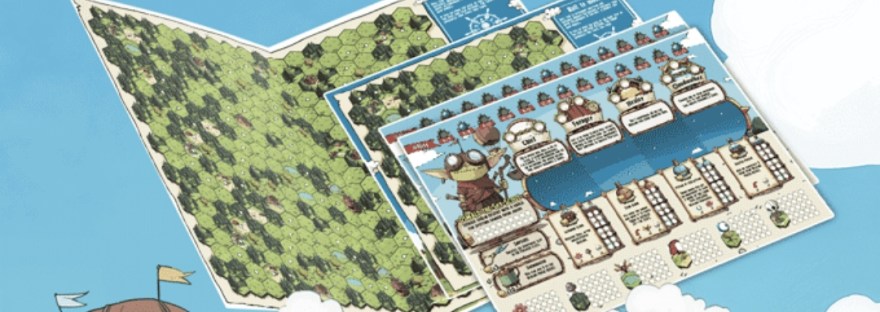
After a few very bleak releases, NukaZombee comes out with a whimsical journey through a land of orcs, alchemy and air balloons. But is this journey going to soar but is the orc’s curse is just too much?

EDIT: A few corrections due to a rules misunderstanding.

How to Play

To setup, put the enemy on the first spot on its path, your character in the middle and gems on the spots on the player sheet and map. Each turn is broken into three steps: move, actions and enemy movement.

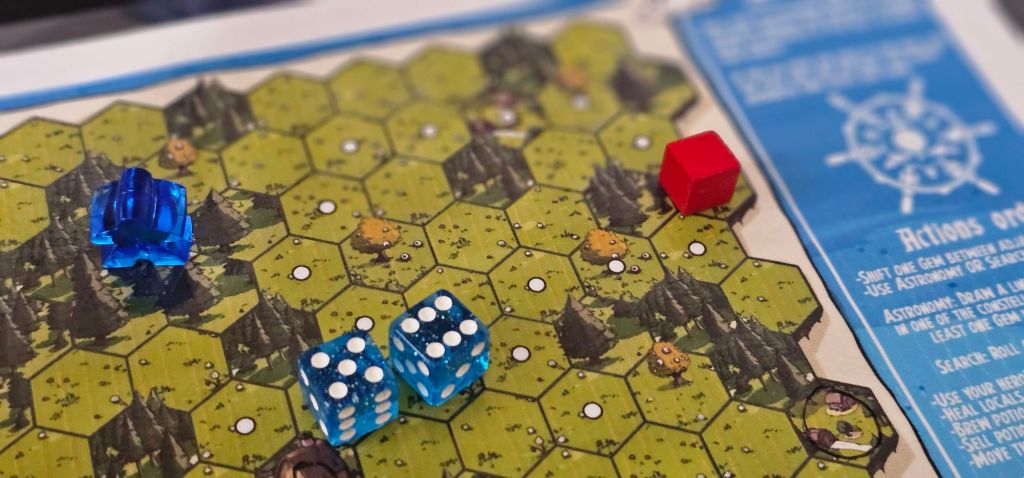
To move, the player rolls two dice, one sets the destination and the other for the move amount. If the player acquired any constellations they can use them to change one or both of the values to get to specific spots.

On the actions, first the player can move one of the gems between the classes to get different bonuses, then getting ingredients or mapping stars. Then, depending on where the player is, they can get more ingredients or heal the villagers . Finally, the player can craft items and brew/sell potions. After that, the orcs advance one space, two if the player went off of the edge of the map.

The player wins if they are able to get the healing skill to max and do one more healing, and lose if the orcs reach the final spot, the King.

Rules and Components

Take this section with a grain of salt, since this is an early preview copy and lots can and will change. As of know, the rules have a great and vibrant layout and use a lot of visuals to show each element of the game. However, as of now, they feel incomplete and a few spots are unclear. Again, early preview copy. The game is perfectly playable, even if a mistake or two are there.

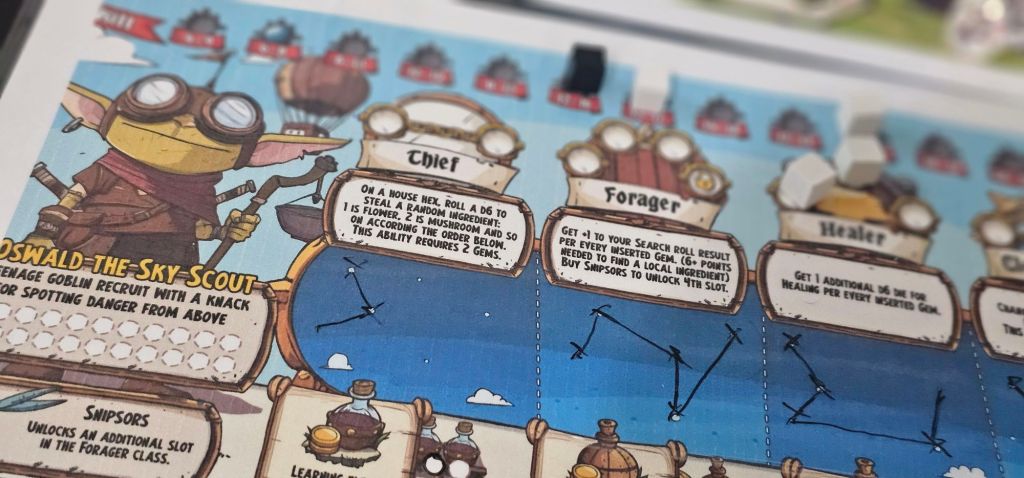
As I mentioned, the visuals are clear, vibrant and rich. There are two sheets, one for the map and one for the player. The player sheet works great, rules are embedded on each spot and they work really well. The map, while beautiful, lacks a bit of usability, specially a spot to clearly see which villages are there.

Gameplay

SkyCraft is not rules heavy, but it’s surprisingly thinky and requires a lot of planning to be successful. Movement is the main challenge, just getting to the right place and getting the right ingredients or skills at the right time. There are four skills, and you can only move laterally and one gem per turn. Having flexibility with the movement will probably mean that you are not healing or foraging as well.

Healing is a bit odd. You have one die, plus one for each gem on the healer class, and you have to roll within a range, not less or more. Whenever you succeed you advance on the skill, if not you move back. The odd part is while you do move towards having more gems as your skills increases, it also requires more dice and a harder roll. It’s not always advantageous to skill up.

Even with these hurdles, as of know the game is fairly forgiving in terms of the challenge of completing the goal before the orc gets to the final spot, specially when there is a potion that moves back the orcs a whopping 20 spots.

Theme and Art

I absolutely love the art for this game! The characters, both the one available on the preview and the ones announced, are goofy and have a lot of personality. The map is also interesting, with even spots that share a type being unique.

The theme for the most part comes through as well, with the character just flying around the land and, in my mind, tossing healing potions right to villagers head. There are a few spots that I feel it could be better.

One, it bothers me to no end that we are stealing from the villagers we are trying to save. It could be donations or something else, but stealing just feels wrong. Also, the orcs as of now feel mostly just like a timer. They are not a looming scary presence that can cause havoc, they are just walking around up until the next step.

Conclusion

Despite my criticisms, I feel like SkyCraft is a blast to play. It’s a game where you take very little to get into, but then slowly start to realize that if you don’t plan right, you will not do well. It’s a game about understanding the odds and planning your turns ahead of time, and when you are able to pull it off you it’s exciting.

Unsurprisingly, there are a few balance issues, but even with those the game feels rewarding and complete. And, on top of it, knowing that there will be extra characters I’m super excited to see what they are going to bring to the skies.

NukaZombee has a knack for making longer roll and writes feel like a breeze, and I feel engaged the whole playthrough. If a thinky but whimsical adventure is up your alley, you will find a great game here!

PnP Review

PnP Review: Lepra

1 Player

Designer: Denis Kurdiukov

Artist: Denis Kurdiukov

Publisher: Nuka Zombee

In Lepra, you’re trying to survive a horrible plague and find a cure before your town is consumed. Is your destiny to be the saviour or are you down with the sickness?

How to Play

Harbor Area

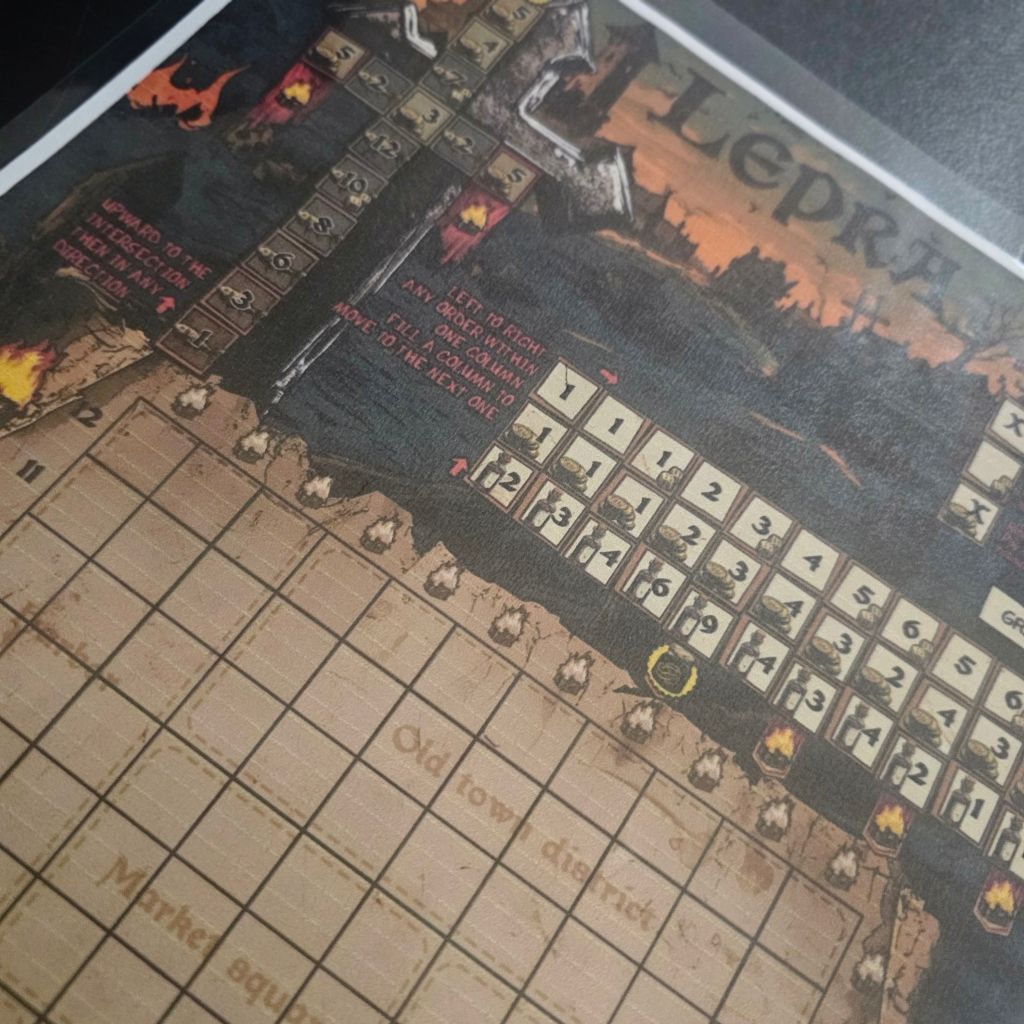
To setup the game, you just need two sheets and two pairs of dice of different colors. First, you roll all 4 dice, with each color being one coordinate. That square on the map is hit by the plague and crossed. If that spot is already taken, you find the first spot without plague in each direction and cross them. Then, for free, you can quarantine one spot on the map. Quarantined squares can take one hit from the plague before succumbing to it.

Then, you can use any of the four dice to take one dice action, and you can also use resources you acquired to take spend actions. Resources other than coins need to be spent in groups, so if to earned 3 food and needs to spend 1, the last one is lost.

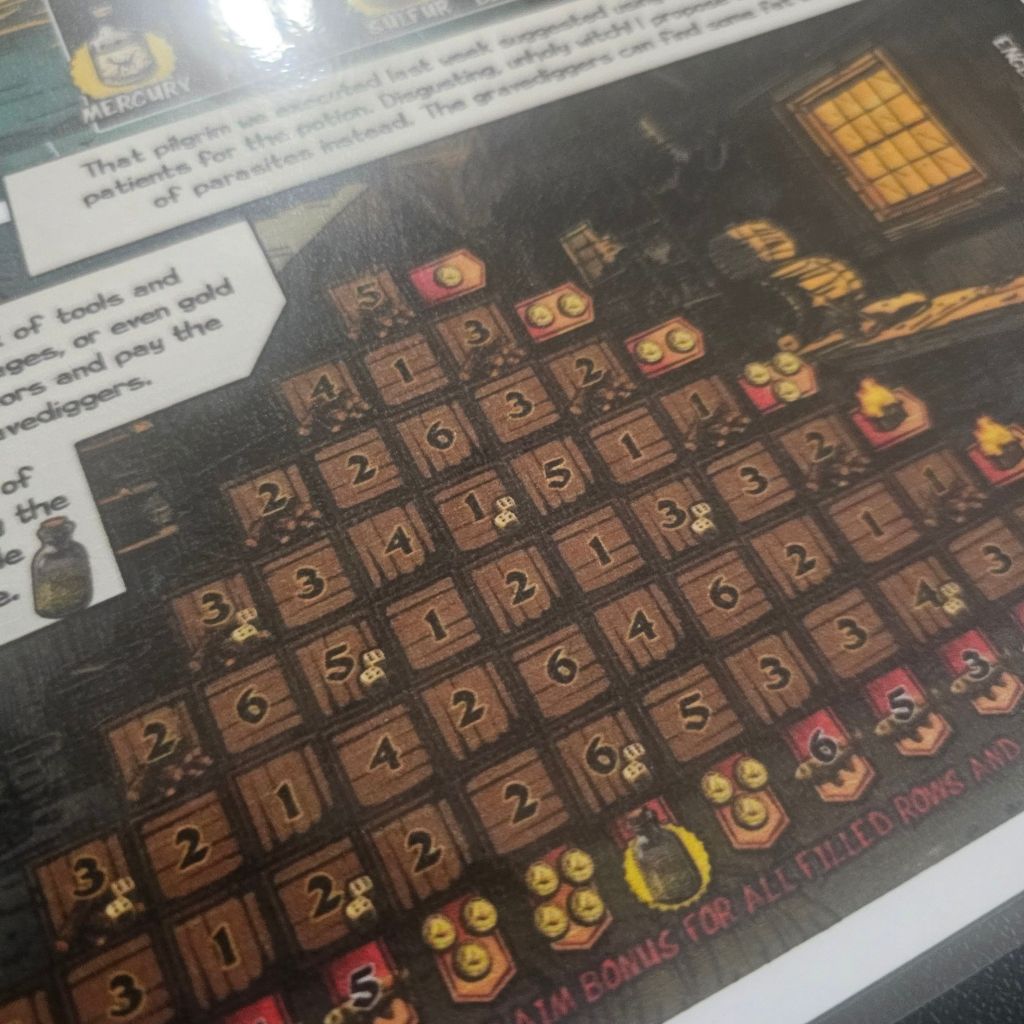
Each of the four areas must be filled in different ways. The cross needs to be filled from the bottom up, and only takes resources, the graveyard needs to be filled one column at a time, the harbor needs to be filled one row at a time and with values summing to a specific value, and the workshops can be filled freely, and give you bonuses for completed rows and columns.

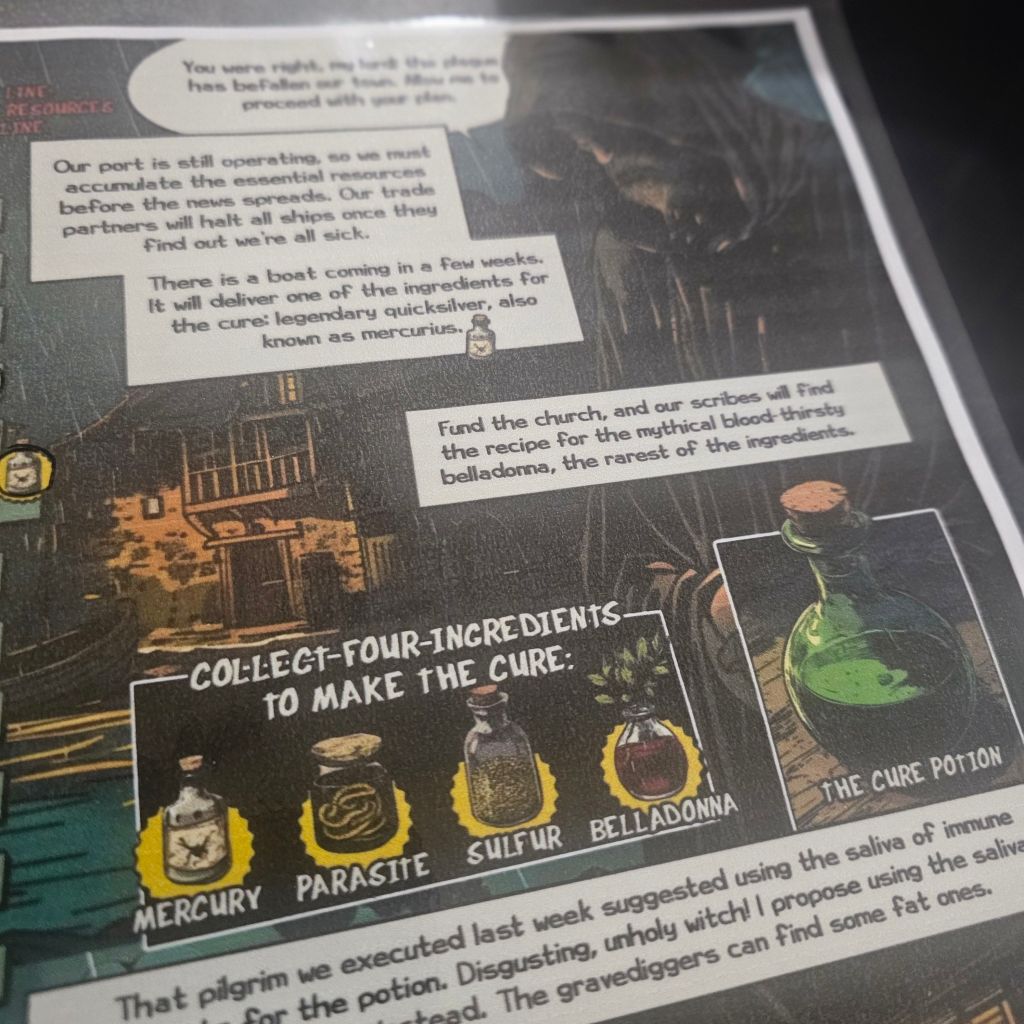
Each area at a certain point gives you an ingredient for the cure. If you find all four you win the game. However, if you ever have a 2×8 area of a 5 square cross, you lose.

Rules and Components

Workshops

I know rules for PnPs, specially ones just released, are in constant evolution, but Lepra already starts with a mostly well written piece. There are a few areas where the wording could have been better, but I do also appreciate the faq in the end. I complained about the layout of Nuka Zombee’s rules for Recycled, and I do feel like it’s much better here.

The sheets, however, are totally too dark. I understand the thematic reason for if, and while I do appreciate it, it gets in the way of good usability. Explanations on how each area works are written near them on the sheet, which is good. But it’s red on a very dark background, and while it is readable on the pdf, when printed it becomes quite hard.

Score: 6.5 / 10

Gameplay

Plague and quarantine

In its essence, Lepra is a games about action economy and “just enough” spending. With a single dice action per turn, you have to be precise on when and where to spend it to get you close to victory. Since you spend resources in bunches, ideally you gather and spend the exact amount, as the surplus could be used elsewhere. That ties in, for example, with the harbor. It’s quite interesting how to obtain a good amount of a certain resource you will earn less of the other.

Some actions gives you purges, which completely burn down a house, preventing the plague from hitting or spreading from there. Obtaining those in the right time and spending them in the exact spots is crucial for victory. However, if you take too long obtaining more purges you can leave yourself unprotected from the lose conditions.

In a practical sense, it’s a very straightforward game, but it’s also one that challenges your decision making to have a chance of wining.

Score: 7.5 / 10

Theme and Art

Ingredients for the Cure

As I mentioned, Lepra is very theme focused. All areas make thematic sense, in a super abstracted sense of course, and the visual is striking and stark, as the theme requires.

There is one area, I few, it’s quite lacking, which is the village itself. It doesn’t feel alive, or meaningful other than the puzzle that the game imposes. But it does feel like a deliberate to keep the game simple and streamlined. And, after exploring the expansions, I feel even more like that’s the case as this issue is addressed on those. In China, we have the wall parts, Africa has the wells and Aztec has the ritual sacrifices, all giving more personality to your people.

But, since we are just considering the base, I feel like it was a missed opportunity to not give meaning to your people, and that makes it trivial in a sense to put them in harm’s way or to sacrifice them. And that is so central to the theme of the game.

Score: 7/10

Conclusion

Cemetery, Church and Town

Lepra is a slow burning and tense game with a very streamlined and elegant set of rules. The challenge is that to win you have to walk on the edge of risk and efficiency, and that is exciting.

But, it’s not groundbreaking or particularly memorable. I will absolutely play this from time to time, and I feel like it rewards replay for the honing of your skills. But it’s not one that will stick with you after you put it away, something I felt on the past couple of Nuka Zombee’s games.

Rules and Components: 6.5/10

Gameplay: 7. 5/10

Theme and Artwork: 7/10

Score: 7/10

PnP Review

PnP Review : Recycled

1 Player

Designer: Nuka Zombee

Artist: Nuka Zombee

Publisher: Nuka Zombee Games

In a distant future, you are a lone scientist left behind in a remote planet, where you have to use your wits and science to survive. But is game mechanically solid or does it make you feel like garbage?

How to Play

Action List

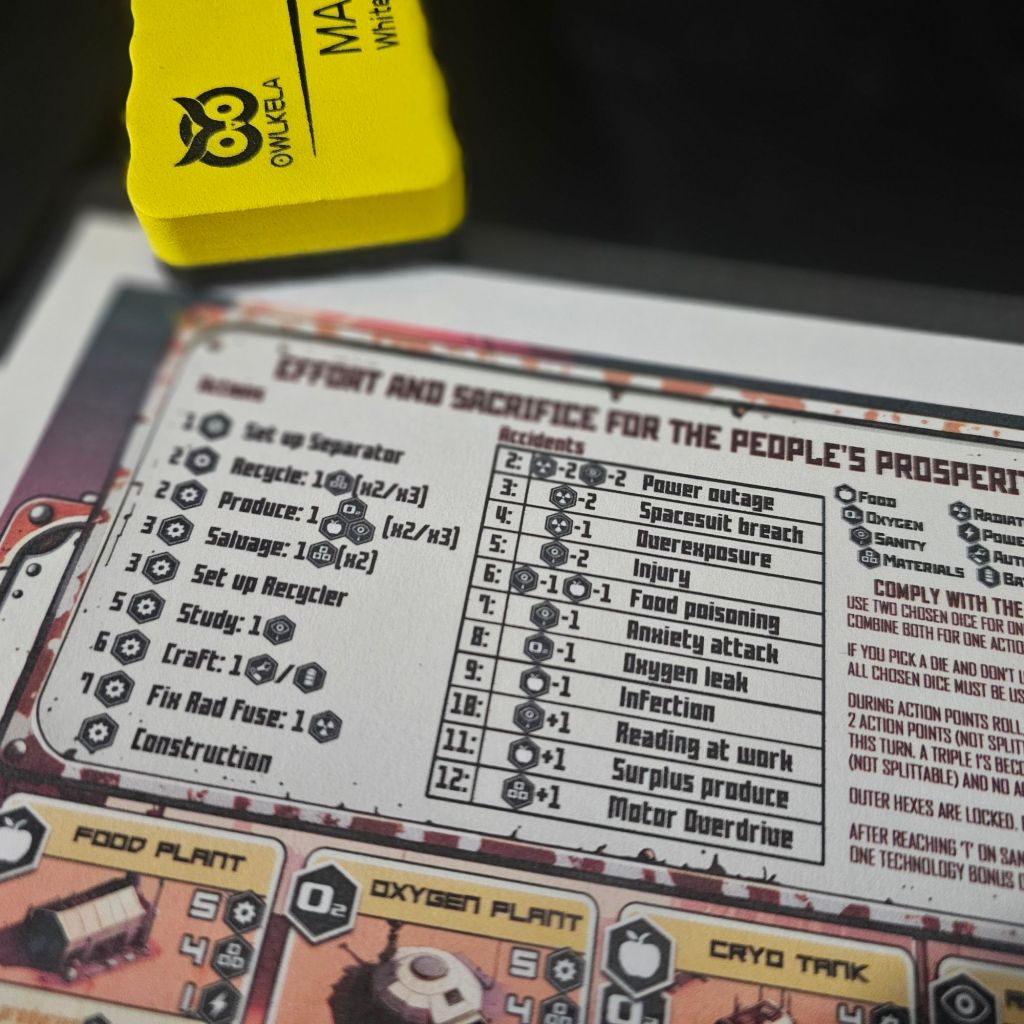
On each turn, you roll 3 dice. Two will be used to take actions, and the last one will be used to check for accidents.

For the action, each dice gives you action points to use for various actions, or you can combine both to take a single action. Excess action points are lost. The actions are basically build building, either directly or through multi phase for some of them, or to generate resources.

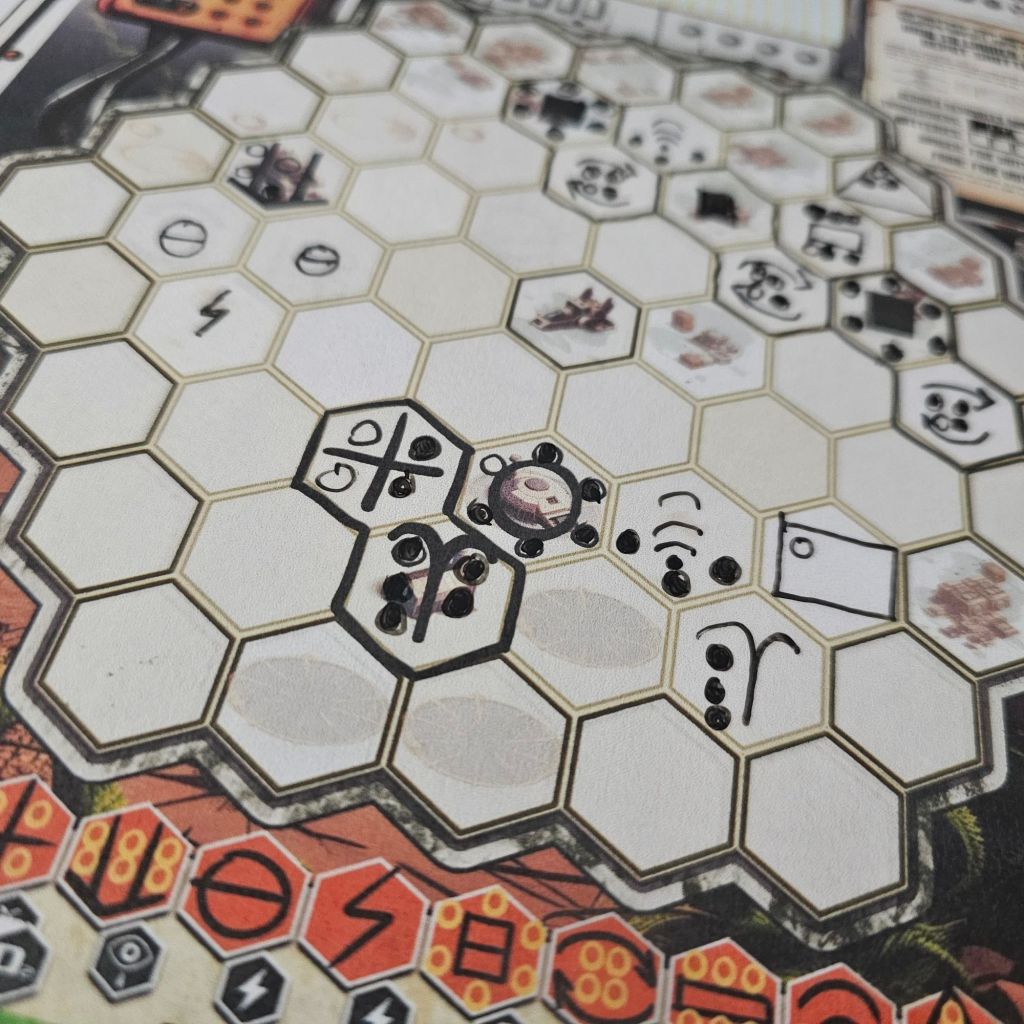
Most buildings generate resources locally, meaning that it will be marked and spent from the building itself, and each building has a maximum capacity, usually 6.

The left over dice is combined with another roll to check for accidents, which will usually drain some resources. The lower the roll the worst the loss.

You win the game if you manage to survive 75 rounds, or if you build and produce everything needed for the rescue. You lose if you ever spend your last food, oxygen, sanity or radiation.

Rules and Components

Buildings

While not being a rules heavy game, Recycled does have a lot of nuances to the game flow and actions. Luckily, the rule book does a good job in explaining everything and giving examples. The descriptions could be a little more xkmpl te and the examples a little more extensive, but they do good job.

I am not a big fan of the layout, though. While it looks great and it does use the same style of the components, it is organized in diagrams and tables instead of a regular sequential rule book. That might be a personal issue, but to. my neurodivergent brain it’s just a bit too busy.

The components are great. Both sheets are not only well illustrated, but they are easy to consult, and have all the information needed readily. All resources in this game are circles, and the circles mean something different in each building. However, the building symbols are distinguished enough that you can internalize quickly their meanings.

Score: 8/10

Gameplay

Buildings and resources

Recycled feels very different from most PnP roll and writes. It’s a continuous slow burn where you need to be methodical in your approach and assess the areas of risk and work towards them. Nothing is done quickly and you can’t just turn around and solve an issue in a turn.

The dice mechanism is really interesting. You can either use your big dice to get a lot done, and risk worst accidents, or you can do less actions and be safer. And, what’s best, it’s not a constant choice, it’s all about timing and reading the situation.

This game, interestingly, does not have mitigation. You have to make due with whatever you have. However, double or triple 1s are a safe turn, at least. But that also. mean that you really have to look ahead and plan for worst case scenarios.

The one thing is that 75 turns is quite a lot, and unless I’m required to play for it, like with the pioneer expansion where you cannot build the shuttle, surviving that long does not feel like a good path when compared to the shuttle.

Score: 8.5/10

Theme and Art

Turn tally

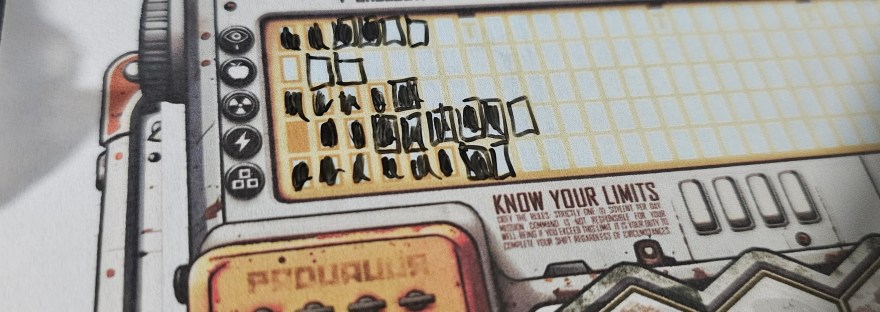
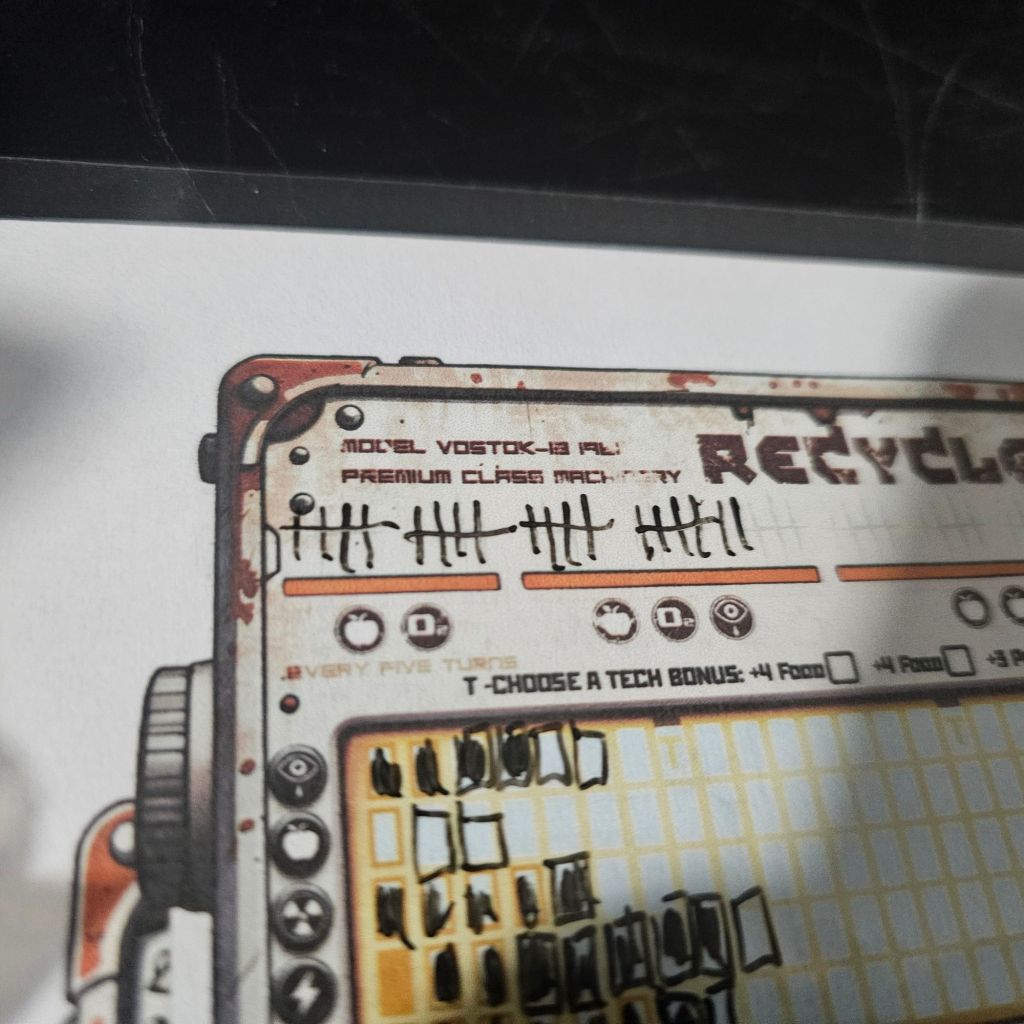
Recycled uses a retro-futuristic aesthetic, full of nobs and dials and switches. It has a very grim, mechanic and barren look, which works perfectly with the theme. Even the tjr a are marked with tallies as if written on a wall. Honestly, you could not read a single. line of description and get exactly what is going on.

One thing that is not an issue so much as it is a missed opportunity, but the additional planets have different setup and different starting resources, but they don’t have particular mechanisms. Infected planet does not feel particularly infected or hot planet does not feel particularly hot. 

Score: 9/10

Conclusion

Shuttle launch

Recycled really stands out from other print and play games. The word that defines this game is methodical, and it wears it on its sleeves the entire time. Despite being just two pages, it fills its longer playtime with meaningful decisions and a intensity thinky game arc that requires attention and planing.

And that whole feel ties with its theme. It is deliberately desolate and scenario scientific, and it reminds me so much of many sci-fi books that go to this more realistic approach.

It is not, I believe, a game for everyone, specially on the PnP realm. It’s slow and long, contrary to the norm. But it is smartly designed and it shows from the first play. It is also tough and quite the nail biter.

Rules and Components: 8/10

Gameplay: 8.5/10

Theme and Art: 9/10

Score: 8.5/10

PnP Review

PnP Review : Treasures Lost

1-99 Players

Designer: Nuka Zombee

Artist: Nuka Zombee

Publisher: Nuka Zombee Games

Another print and play roll and write, this time all about managing time and finding valuable treasures. But are those treasures found or is the value forever lost?

Gameplay

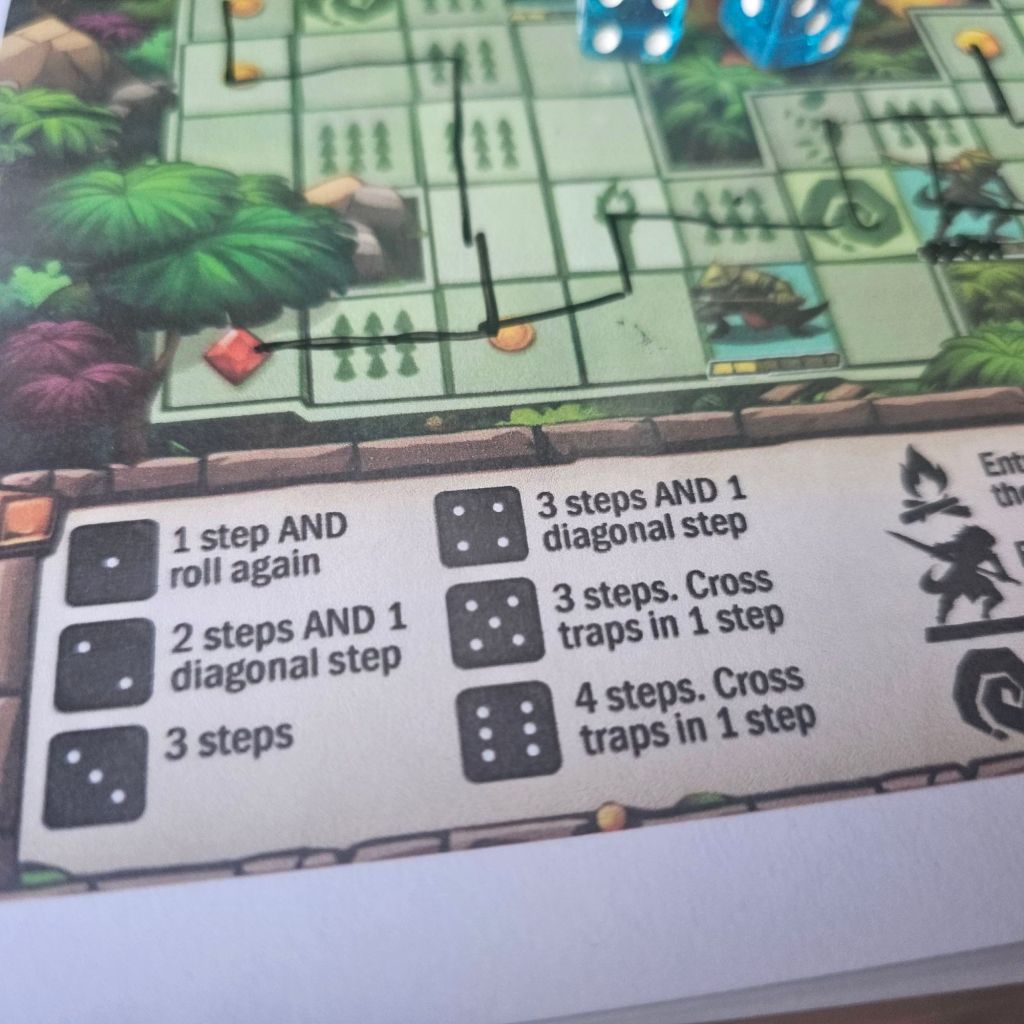
Movement Table

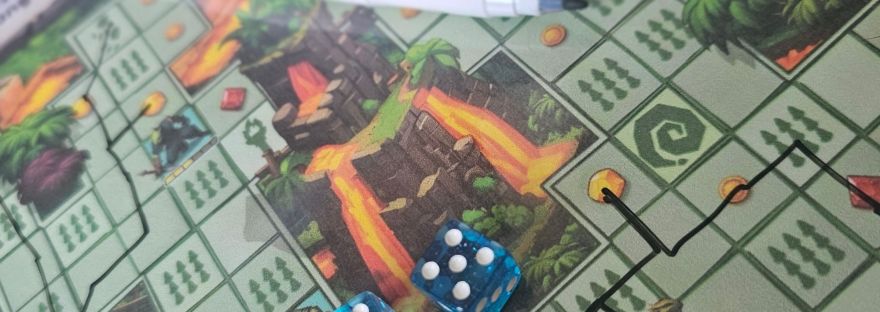
Turns are shared, and on players’ turns, first someone roll a single d6. Players move according to the table, that involve some orthogonal steps, and depending on the roll some diagonal or passing easier through traps.

Things on this game don’t really hurt you. You don’t even have a health bar or something similar. Everything affects your time. Warps halt you in place, enemies get you stuck until you beat them, traps cost you extra movement.

Players go until they run out of turns on the day track on each of three stages of the scenario. There are also a few spots that are for the night that players can extend to, but at the cost of time on the next map.

The goal is to go around collecting coins and treasure. Gems go on their on tracks, chests must be paired with keys, and coins go in a grid to collect resources when rows and columns are complete. However, how each one work varies by character. The apothecary favours blood gems, the Explorer likes the artifact, and the rascal doesn’t even need keys for chests. It’s all very thematic.

Solo Gameplay

There are no differences between the multiplayer and single player game, aside from beating your own score or beating your opponent’s. The track itself has bronze, silver and gold crowns to mark your score for a quick reference.

Components

Character Sheets

The game really looks gorgeous. All the dungeons are thematic to their region and have details on their specific version. The characters are also well illustrated and have tons of thematic touches. I mentioned before, each track is different, but also each ability has a name and adds to the personality.

But absolutely none of this interferes with the usability of the game. Icons are clear, things are easy to manage on the gameplay, and nothing adds complexity. This is, after all, a simple game.

But, even though the game is simple, the rules could have been a little clearer. There are some instances that something is implied and can be understood, specially around movement, but I would prefer it to be spelled out.

Conclusion

Treasures Lost is easy to pick and play and very dynamic. I like the fact that they simplified the risks on just time, and everything is about efficiency. Do you risk fighting that monster and getting stuck, or is the way around more guaranteed? Do you count on that movement that leaves you needing a diagonal step to be worth it? I also love how thematic it feels. Each scenario has its own quirks, each character does truly feel unique on its own, but it never gets too complex. Over the first couple of turns you already got what the game is about. But every second I spend on it I feel the tension and the excitement of treasure hunting.

Score: 8.5/10