Review

Let’s Review More: Oliva

1-4 Players

Designer: Costa, Rôla

Artist: Marina Costa

Publisher: PYTHAGORAS

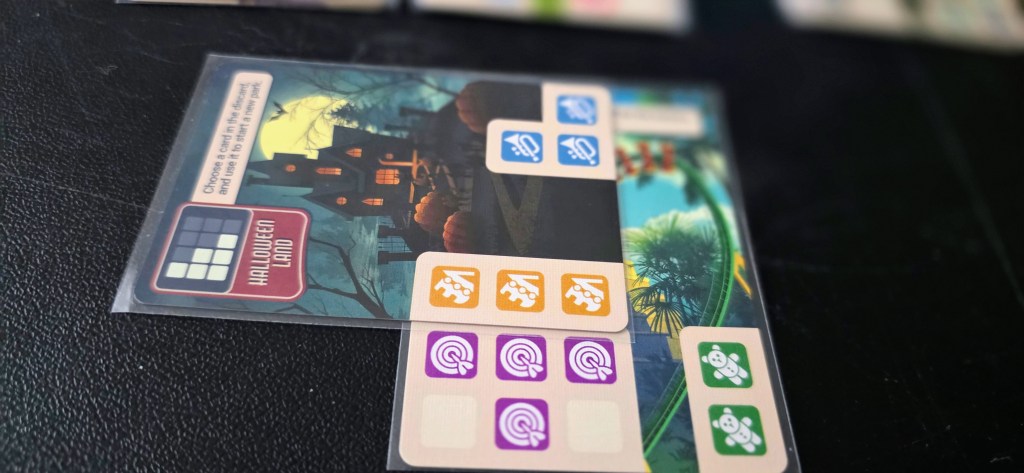
Pythagoras brings us the third game in the Cinco Quinas line, full of Portuguese themes, cubes and odd rules. But, as an official hater of olives, does this leave a bad taste or does it flow well like a good Portugese olive oil?

How to Play

Olive-ing La Vida Loca

You play a number of turns depending on the player count, and each round starts with revealing a new nation card. Then players play cycles, once with each player leading.

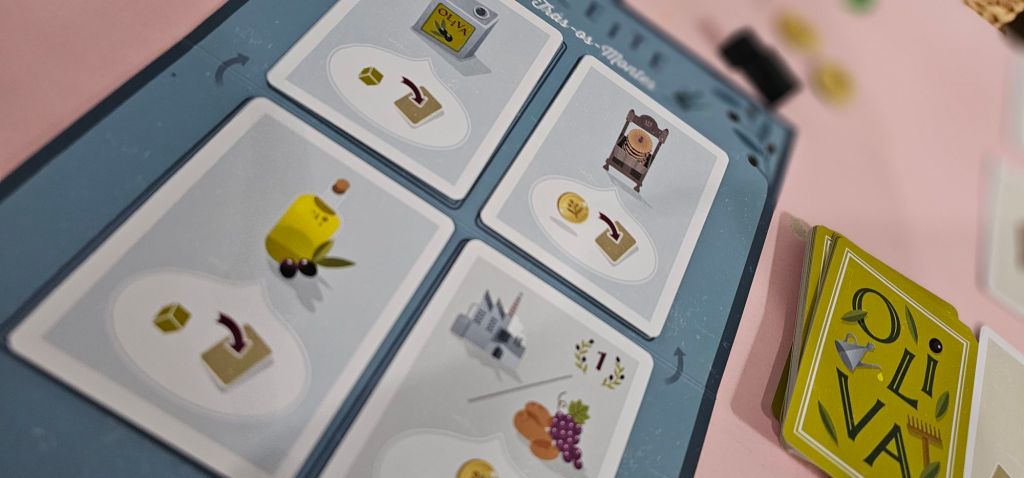
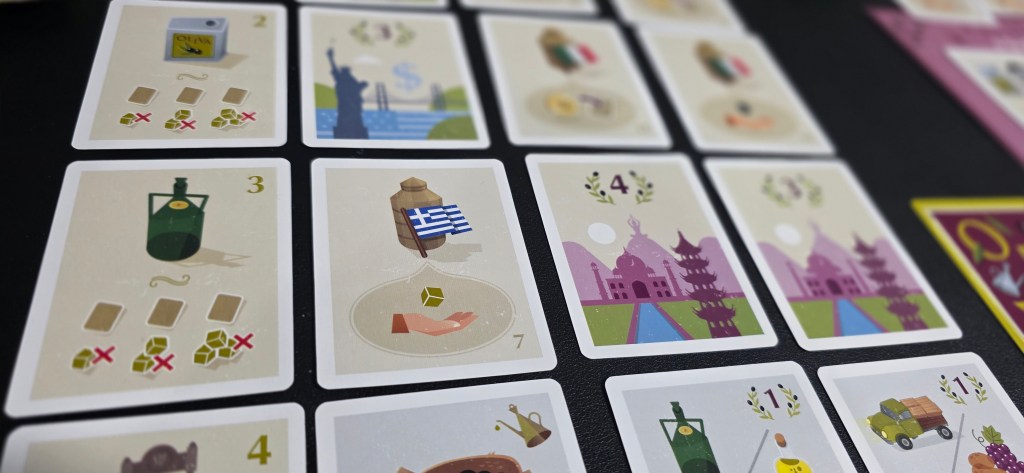
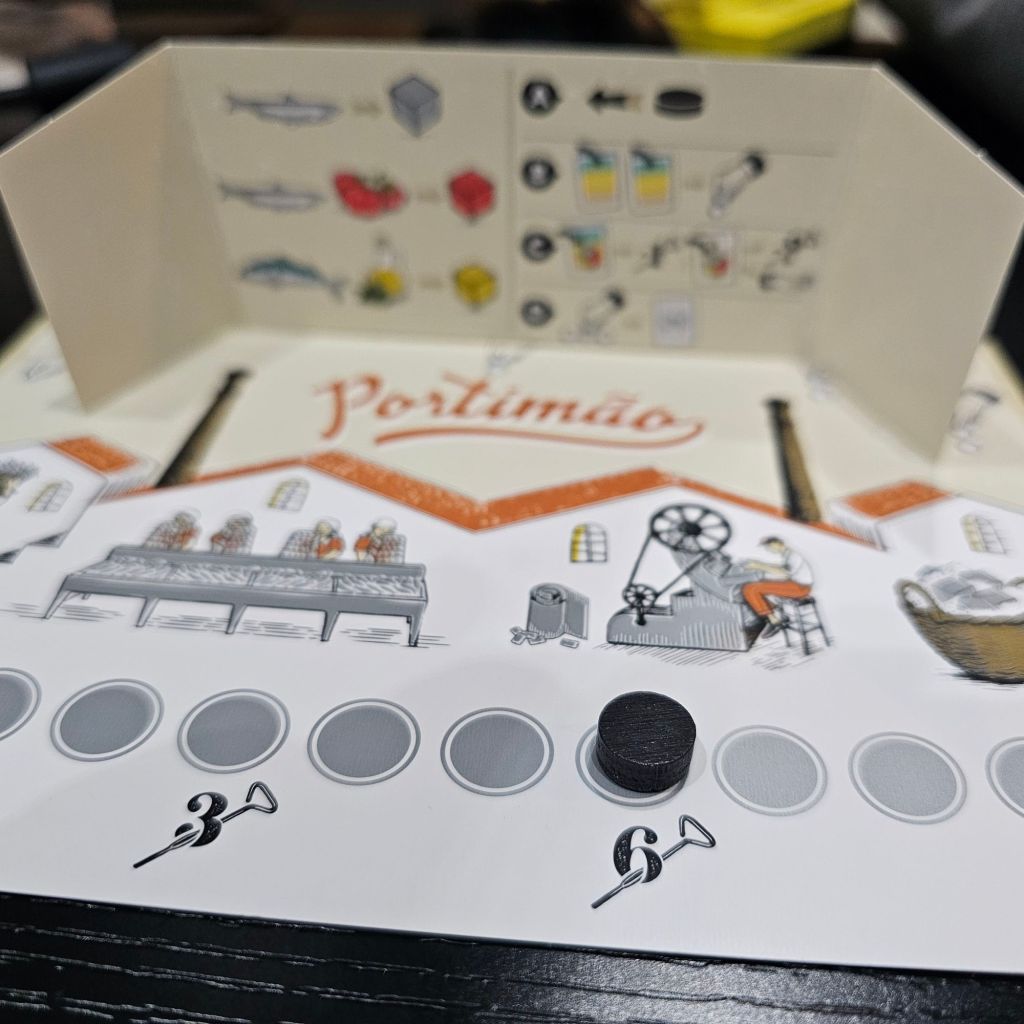
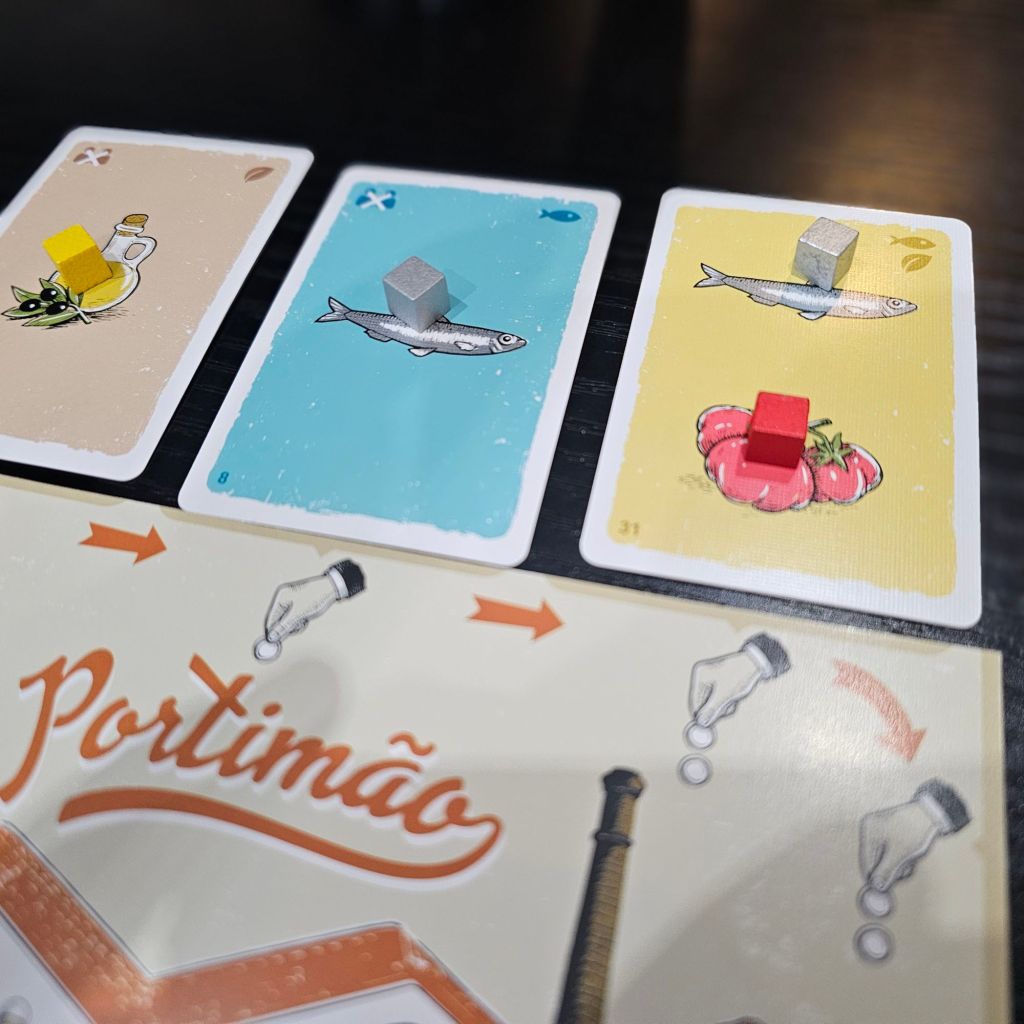
Each cycle starts with players drawing five cards from their deck and playing two face down on their board, discarding the rest. Then, they go around revealing a card and activating its action. But, here’s the fun part, you activate the card you revealed and every card that shares it’s symbol.

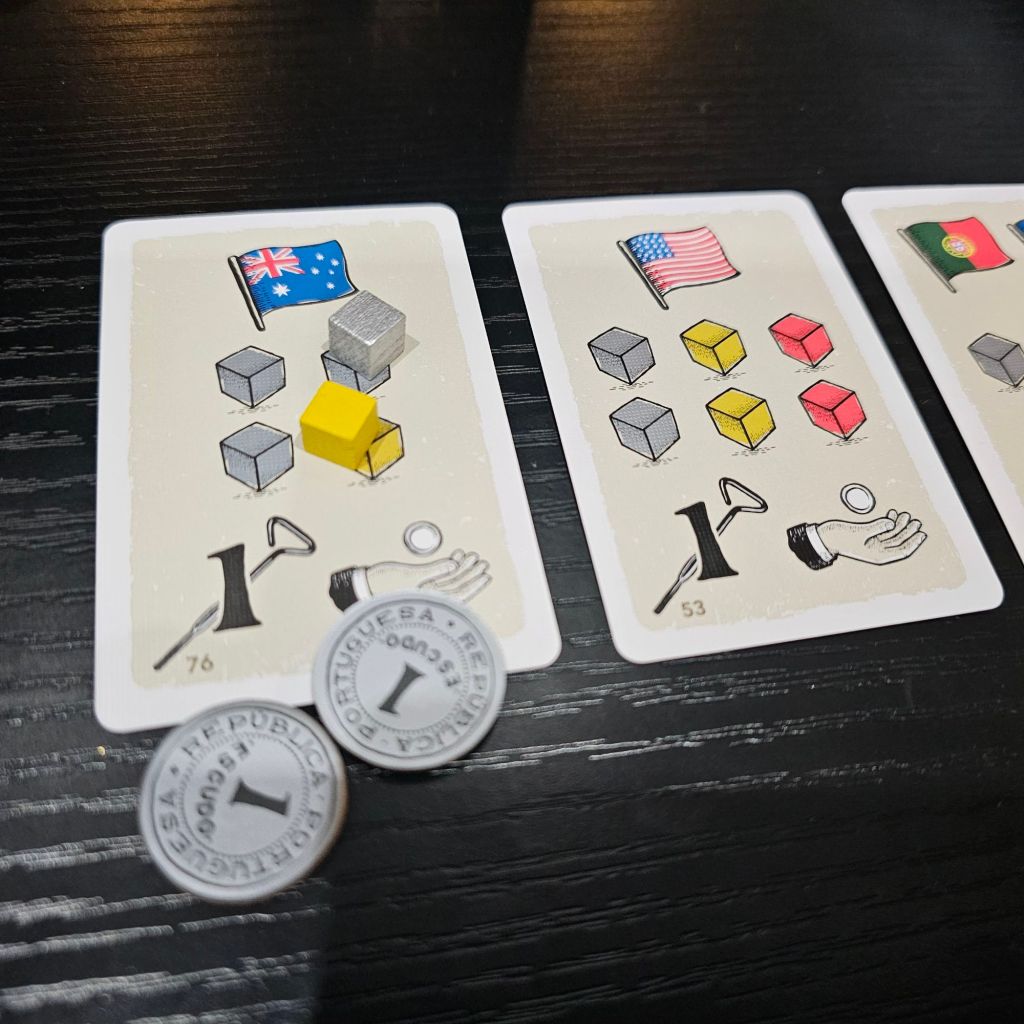
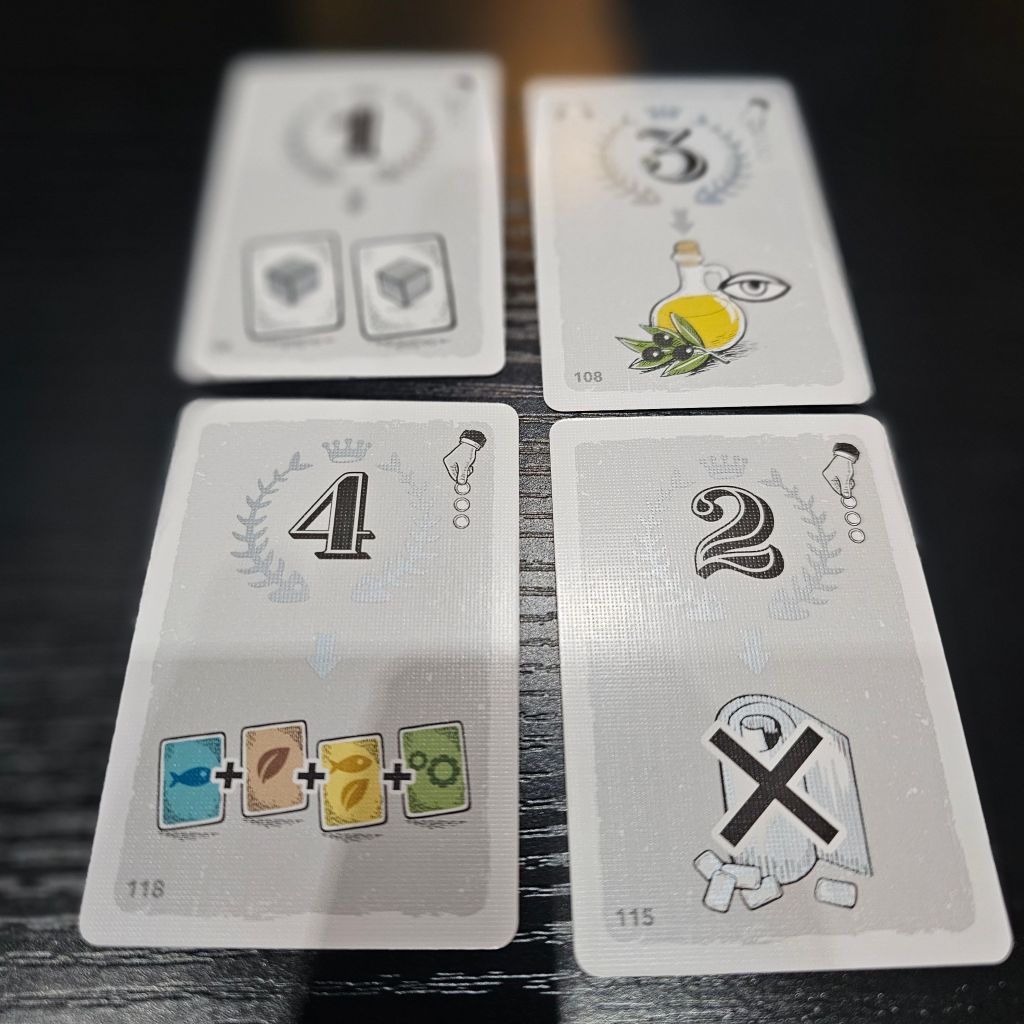
The actions are pretty standard production business. Get olives, convert them into olive oil, get money, or use those to get cards from the display, which can be advanced actions or scoring opportunities.

After each player revealed both cards, the two cards on the top are discarded, the ones on the bottom go up, and play continues.

With two players, some cards are removed and there is a third “ghost” player that players take turns adding cards so they always contribute two additional symbols.

Solo has a dedicated automa deck that adds multiple symbols and takes cards from the display, but it’s not really an opponent, the game is a beat your own score deal.

Rules and Components

Spot the Difference

Here things get complicated on both ends. Let’s start with the rules. For the most part they are well laid out and complete, explaining well each card type and the flow of the game. I don’t think the wording is the best, but after a couple of reads I was able to play without major issues.

My biggest problem is with the alternative game modes, meaning 2 player and solo. The changes on the setup are clear, but the flow is often described with vague instructions and implied rulings. For example, for solo it explains that the automa plays the top card each turn, but it is not specified where they are played. Also, for solo, it’s said that it’s setup as a 2 player game, but there is no clear indication that the “ghost” extra player is not used.

Components are for the most part pretty good. The cards are of great quality, the symbology is big and clear, and it has that specific artsy / minimalistic look that is characteristic of the series. Once setup, it is a big sprawling for the box size, but it does have a good table presence.

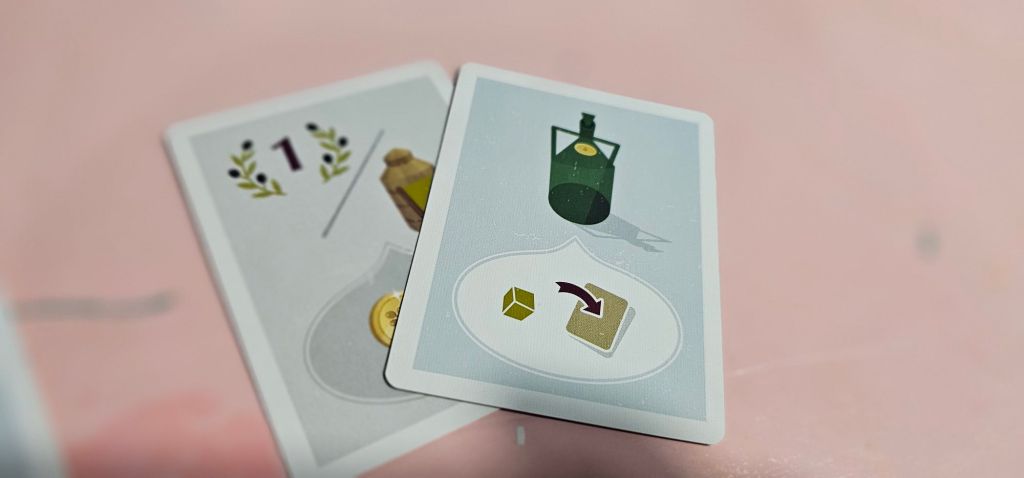
But there are a couple of usability issues. For example, there are a few types of cards with the same back, expected as it is a deck builder after all, but they are just differentiated by their backs, which already is not idea for color-blind people. But some, for example the blue player and the grey special action / scoring, are hard to tell apart depending on the light.

Score: 7/10

Gameplay

Does this olive oil feel Greece-y to you?

Half of this game is pretty standard production game: get cubes, transform into different cubes, cash in for cards or money, get points. It’s a streamlined and clean implementation of a familiar mechanism that will make a lot of people feel at home.

But where it shines is on the deckbuilding and card playing side of it. It’s a game where reading your opponents is not good, it’s crucial for wining. Timing well and paying attention to what everyone else is doing creates these huge turns where you can be super efficient, but no opportunities exists in a vacuum. It’s not just playing the most common symbols, it’s being ready with the right resources for when those opportunities arise. This is a wonderful style of table interaction, where you get out of your own situation and are required to notice everyone’s game, but nothing is taken, it’s all positive and adding.
Score: 9/10

Theme and Art

My Heart Oliv-On

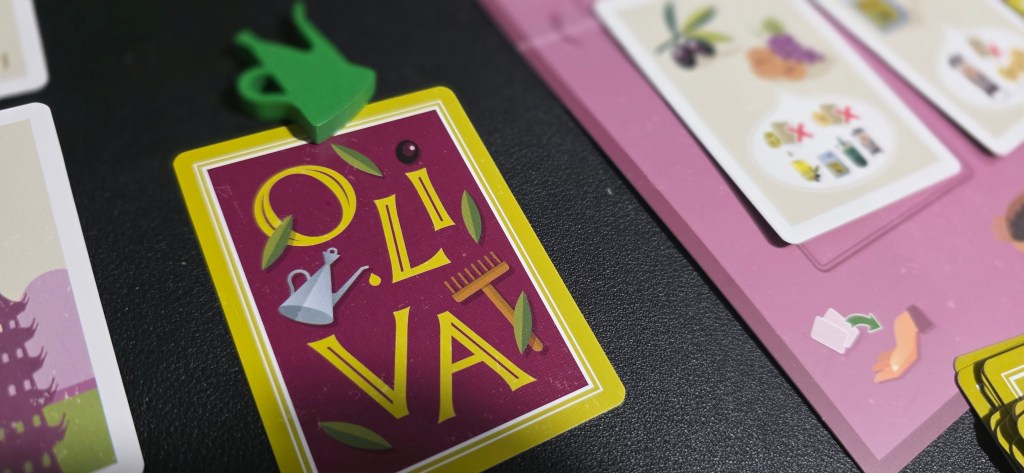
Marina Costa has this particular clean, cartoon-y and very whimsical style that became the heart of the Cinco Quinas line, but here is where it’s displayed more and with more details. It’s very welcoming and warm, and makes you want to dive in this world.

And this ties together with the love that Pythagoras usually puts in with their Portuguese themes. It’s not just a game about olives and olive oil, but specific regions and traditions of that country. I may be biased as it is my heritage, but every small detail is evocative. It’s not a heavy handed theme, not in the slightest, but it’s seen and felt.

Score: 8/10

Conclusion

From Iberia, to the World!

Oliva packs a punch from its small box, threading a nice line between familiar mechanisms and unique implementations. It’s a game that requires table awareness and promotes an environment where players are present at all times, at all turns, always seeing what’s next, what card each one took, what moves they are making and setting up to make. But that is not overwhelming as turns come and go blazing fast. It’s simple, but very rich.

And that is allied with all the Portuguese love that is a big characteristic of Pythagoras and the Cinco Quinas line. As the game is fluid, it allows you to appreciate the theme and feel yourself at home and sink in all the cubic oily goodness. But not the olives, those black cubes are gross and everyone knows it. Or maybe it’s just me…

Score: 8/10

Let's Review More: Tend
Review

Let’s Review More: Tend

1-6 Players
Designer: Max Anderson, Zac Dixon, Austin Harrison, Toby Sarnelle
Artist: Kelly Nakamura
Publisher: IV Studio

IV Studios comes to us with a “Roll and Write” which gets pretty much everything traditional about the style and goes a different route: the box is huge, there are dice but you never roll them, and there are even scratch-off cards. But do those all crazy ideas form a beautiful garden or is it just a pile of mulch?

How To Play

Let’s Tend More

Don’t be fooled by the huge box, the game is quite straight-forward in terms of rules. You will play for 12 rounds, each round will start with basically some upkeep, like replacing friend bonus cards, refreshing the action row and ticking up your crops and animals.

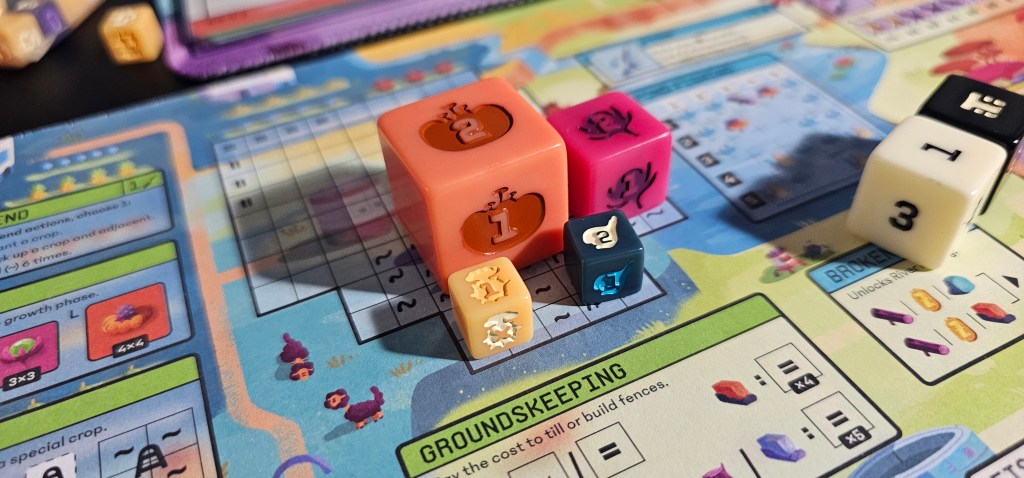
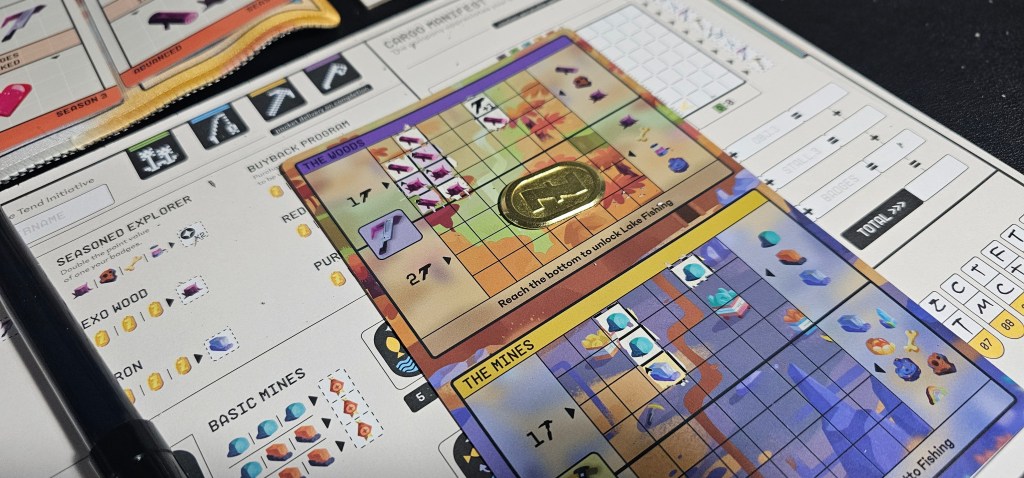
But the main focus on the game is in the action phase, where from the 5 available action cards, each player chooses two and executes them in any order. There are four main actions in the game. Tending allows a player to till soil and also plant and water crops in your garden. Fishing allows you to roll dice and fish in the coordinates rolled in any available fish spot. Cutting and mining takes you to the scratch-off card and just scratching an available spot, which will give you resources, but sometimes also additional actions and level ups.

In Tend, any resource gained must be immediately spent, either on various upgrades and awards, sold to the commissary, or stored in your bins with cute and super handy stamps included in the game. Items in storage, awards gained and three end of game scoring opportunities will give you points.

Rules and Components

I’m Jack, the Pumpkin King

Starting easy, rules are really clear, well laid out and structured with plenty of illustrations to make sure that all areas of gameplay are clear. The only downside is that the rules present all components in details before explaining what they do, so starting off can feel a bit daunting, but once rules start going it’s easy to parse what everything is and how it works.

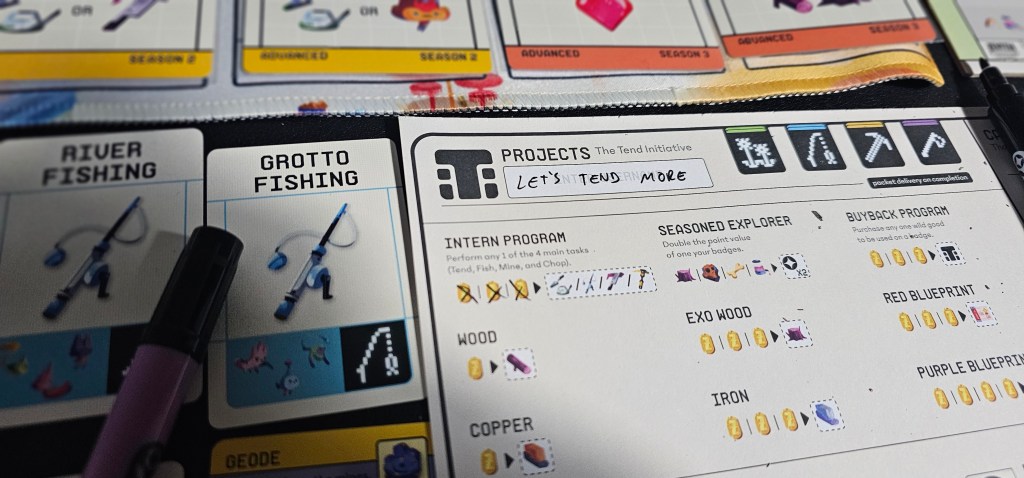
Components are, well, excessive, in a good way. I mentioned the huge box, and its goal is to house every component comfortably. It’s not that there are too many components, but the game does include an obscene amount of pads and scratch-offs so you can play and play and play. There is SOME overkill, like the stamps in the pens, but absolutely nothing feels extra or unnecessary, and everything comes together to create a beautiful play experience.

Also, the components feel super premium. The pens are nice, the dice are nice, the pads are nice, the cards are of amazing quality. Every upgrade feels like a quality of life upgrade, they have a purpose and do make the overall feel better.

Score: 9.5/10

Here fishy fishy!

Tend is the type of game I greatly appreciate in terms of how they handle the rules. The rules themselves are actually simple, nothing too fancy or out of place. From the first gameplay and every single experience since, I felt like every single turns goes like a breeze, everything just clicks in place, the actions feel fluid and you can see the many lines of play the four actions will allow you.

Gameplay

But, let’s be clear: this is a thinky game. There is a lot to keep your eyes on, lots to plan and everything feels interconnected in an interesting way. The game heavyness lies completely on how you handle your opportunities, how to get the most out of them, and just keep track of everything you want to do. The path for each of the 3 scoring goals is multi-stepped and requires you to hinge your opportunities and have a clear plan ahead.

Score: 10

Theme and Art

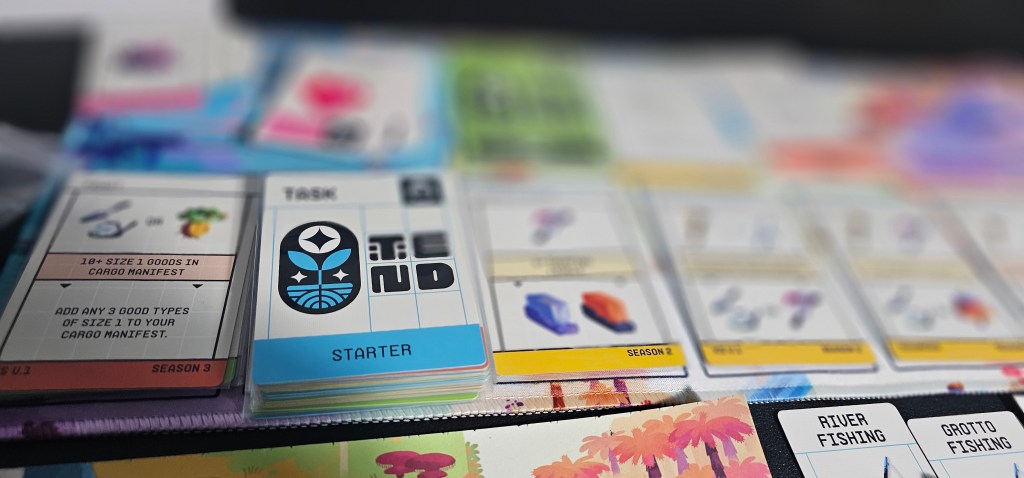
IV Studios chose a very video-gamey feel to Tend. The icons are simple, there is plenty of pixelated icons and fonts, and everything is super bright, but somewhat minimalistic. Each individual component seems to be created to maximize usability and simplicity. That being said, everything comes together in an incredibly cohesive package that just looks good and thought out.

This also ties in really well with the theme and feel the game puts out. It’s a light theme, a futuristic farming simulator. That’s pretty much it. But it’s not about depth, it’s about how it makes you feel. It’s a friendly game, with friendly challenges and friendly looks. It’s, overall, a feel good package. For me, it did make me feel good playing, even when my brain was going into overdrive.

Score: 9/10

Conclusion

I was not sure of what to expect from Tend, and I purposefully went in blind. It’s a game of contradictions: it’s a game that is both excessive and minimalistic, easygoing and brain burning, easy to play but hard to play well.

But very rarely a game is so consistent in making me smile. Even in all contradictions, every aspect of Tend clicks and ticks like every single element in this game is on the right place, in the right amount, and it’s all up to the player to make the most out of it.

Every aspect of the game is super friendly, from the visuals, themes, mechanisms, components. It’s a heavy game in terms of tactics and strategies, but it feels way lighter. It will make you work and sweat your neurons to do well, but it never feels oppressive or unachievable. It’s a 60-90 minutes game that feels like a 15-30 minute game. And every single game so far I looked at the completed session and I wanted to just go one more time, try something else, something different, discover more.

Score: 9.5/10

Review

Let’s Review More: Flamecraft Duals

1-2 Players

Designer: Manny Vega

Artist: Sandara Tang

Publisher: Carboard Alchemy

Following the footsteps of its already classic older sibling, the adorable little dragons of Flamecraft now come in Duals form. But is this head to head iteration hold the flame or does it just burns out quickly?

How to Play

Bag of (Dragon) Holding

Turns in the game are comprised of 3 steps. First, the player draws a token from the bad and places it any open spot or on top of any dragon as long as there is never a stack higher than 3.

Then, the player can fire off the dragon’s ability, and those can be to add more dragons, move other dragons or fire their abilities, which can cause a whole lot of chain effects. Finally, the player can score if they have a pattern in the board that equals the card in their hands. Most points from the scored cards win.

There are a couple of additional modules. Fancy dragons will add player powers, while fountains adds shared scoring opportunities while also adding a fountain to the board, which will get in the way.

Solo is quite simple, every turn the player needs to score a card, from their hand or a fountain card, or spend a coin. If they can’t, they lose. If they are able to score all 6 fountain cards, it’s a victory.

Rules and Components

Board with Fountains

The rules are fine. It’s a fairly simple and straightforward game, and the rules do a good job in presenting the game in a well structured way explaining briefly each phase and how each dragon works. It does leave some specifics a bit too much to interpretation, which is unfortunate.

I will start the component part with a caveat: I do have the the Deluxe version, so that’s the one I’m reviewing. But, as expected from Cardboard Alchemy, the art is stellar. It’s the gorgeously adorable art of Sandara Tang displayed in all tokens and cards, and they look as good as ever. The dragon tokens are nice and chunky, so satisfying to handle, and the metal coins are pretty and big. I did find the cards a bit on the thin side and quite slippery to handle.

Score: 8/10

Gameplay

Reference and Dragon Powers

This is at its surface quite light and simple, draw a dragon, place it, fire its ability, score. But, in all honesty, this is way more combo-y than expected. There is a lot of chain reaction, specially when 2 types of dragon (breads and leaves) and fire another power, which can in turn fire more and so on.

It’s strikes a great balance of light and gamery, and the results are quite satisfying. On 1v1, your scoring cards are hidden so there is not a lot of hate drafting or spoiling the other movements, it’s more setting up yours and seeing the opportunities immediately. It’s pretty much a tactical game, not a lot of long term strategy, it’s who can be the most efficient in terms of opportunities.

Solo is a bit more strategic, since you do know you have to setup and score all 6 fountains, and each is comprised of a 4 in a row of a single type. But, since you don’t know which order they will appear, there is a lot in making sure you have open opportunities each turn.

Score: 8.5/10

Theme and Art

Heart Melting Art

On one end, the game is for the most part quite abstract. The scoring cards have no names, the dragons are all the same and there is no lore described. It’s a game solidly based on its mechanisms, and in fact you could replace the theme and it could work just as well.

But why would you though? The art is disconnected, yes, but as I mentioned it’s beautiful and evoking, and there is so much cuteness your heart my just explode. It has a small size but great table presence, and the art does vibe well with the relaxed theme of the gameplay.

Score: 7.5/10

Conclusion

Ca-ching

First of all, the obvious question: if I like Flamecraft, will I like the Duals version? Sincerely, there is absolutely no answering that. Aside from art, the game are mostly disconnected, though there is a sense of familiarity on a surface level with the dragon powers.

On its own, Flamecraft Duals is a chill but engaging abstract game, quick to play but has enough to keep you coming back. There isn’t a lot to discover, it’s all pretty much at your face, but it’s a game that will reward multiple gameplays in terms of acquired skill and board understanding.

I think Duals fits right into my collection for when I want a quick investment of time and brainpower, but still will come out satisfied with a gaming experience. And, adding to that, manipulating those chonky pieces is so fun!

Score: 8/10

Meteor Incoming
Preview

Let’s Preview More: Doomsday Manager

1 Player

Designer: Dennis Kurdiukov

Artist: Dennis Kurdiukov

Publisher: Nuka Zombee Games

So, you would think that a giant meteor coming straight for us would be a big deal, but no… It’s your job to manage the crisis, get funds, bri.. convince politicians and feed the media, without going overboard of course, to have a chance of survival. But is this crisis manageable or should we just let the meteor do its thing?

How To Play

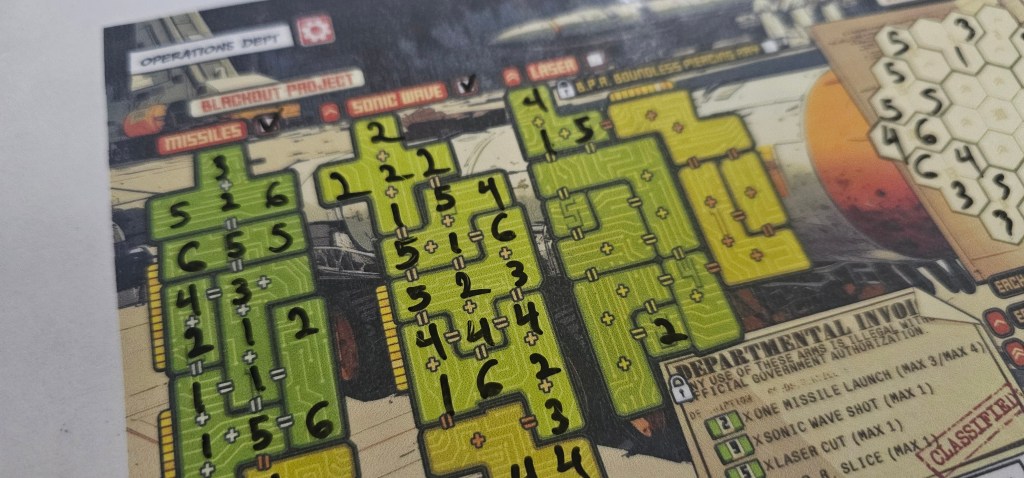
Weapons Grid

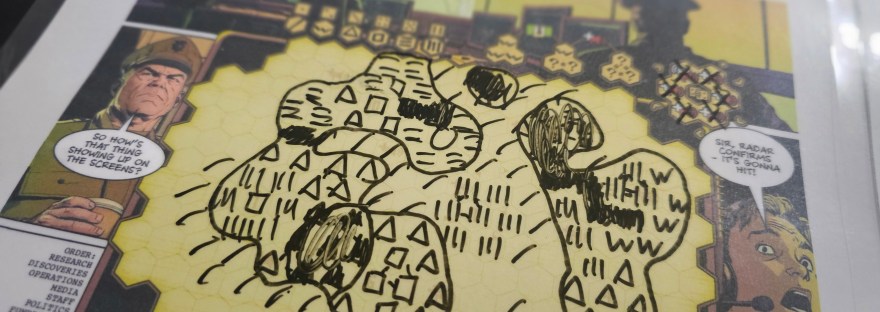
To setup, you just need three sheet and a whole bunch of dice. Each turn is comprised of whopping 8 phases, but all but media phases are optional. On research you roll a pair of dice for each worker, one being the material and the other how many will be added in a spiral shape. Once a shape cannot grow anymore, you start from the next numbered origin. Once all numbers are used and the meteor cannot grow anymore, it’s fully mapped. Doubles will tell the direction of the meteor, that will help spread media attention.

On operations, you roll a die for each worker and add that to one of the weapon matrixes. Each matrix need to be complete and all equations correct for the weapon to be active. During the media phase, you again roll a die for each worker. Ones mean loss of future money, while fives and sixes make will allow you to bump one of the media channels of your current influence level. These can give you money or cause crisis. Once all of one color are filled, the next influence level is unlocked.

Staff phase will allow you to spend money to upgrade one of the previous three departments or get more workers for that department, unlocking more dice. Politics allow you to, well, direct money to one of the politicians so that they can see your point of view more clearly. Each one will have immediate or triggered ability that will activate once they are marked. Once all boxes of one person are marked, it will increase your influence over a certain ideology as well as triggering one political favor.

Fundraiser will allow you to invest money to get a return on the next year. Finally, attack will allow you, once the meteor is mapped, weapons are unlocked and the correct bills are passed, to spend money to use the weapons against the meteor. Different weapons will target in different manners, but the goal is to have all of the meteor destroyed. Some weapons target big areas, while others will break it into smaller chunks, as any area 7 hexes or smaller can be destroyed automatically.

The only way to win is to destroy completely the meteor, and you lose if time is up and the big rock does its thing.

Rules and Components

Influencing Politics

As I usually stress, this a preview from a prototype so things are bound to change. But this is quite complete at this point I believe.

Usually print and play games are one or two pages long, and I appreciate Dennis spreading to a third. Though there is a lot happening, every section is well displayed and nothing feels cramped. Wording for a few abilities and effects could be clearer, but even at the first few plays, everything feels in place and make sense.

Different from previous games, this time rules are laid out in a more standard manner and I appreciate for a game on this complexity. Every section is well explained, but some wording can be vague or left to interpretation at this point. I did reach out to the designer, and most of my interpretations were correct, and I do hope the final version is even clearer than it is now.

Gameplay

Political Bills

Starting to play Doomsday Manager can be a bit daunting, but its a game that when you start playing is quite more intuitive than it first look. Each section is its own mini-game almost self contained and easy to manage. This is half of the game. The other half is managing funds and investment on each section, and having the proper support on all of them according to needs.

One aspect that I noticed is that the dice mitigation is mostly done through additional rolls, but not through dice manipulation. In a game where specific rolls are needed and, often, crucial, this can make you feel like you’re at the mercy of the dice. Brutal, but on the other hand, thematic.

Theme and Art

Media Frenzy

Theme is odd and unique, for sure. Honestly, the way it develops is quite like a cheesy classic disaster movie, and I love that the game leans on it and uses that to its advantage. It’s at the same time cinematic and, in a way, administrative, and somehow both work really well together.

Art again falls into the same feel. It uses the Nuka Zombee Classic Comic Book Flow (patent pending) to evoke dramatic moments to highlight each section as a scene, and elevate that from just another system.

Conclusion

Weapon Matrix

Doomsday Manager is epic, out of control and, honestly a bit frustrating at times. It’s absolutely a game that takes its unique premise and runs with it the whole way. Each individual section is simple and almost mundane. That really forces you to look at the game from a higher perspective, seeing the big picture, almost like setting up a situation and just running the results. The biggest decisions and where the heart of the game lies is the runaround of funding and resources, timing and long term plans.

It’s also a game that breaks expectations in a big manner. It gives you impression of being a big lengthy and grind-y experience, specially knowing one of their previous games, like Recycled. However, it’s not that at all. Turns fly by, and often with little change between them. It’s not a game of epic turns, but a game of slow flow and long term plans materializing over time. It requires a whole type of approach and smart plays, and, honestly, I see so many branching paths to both victory and defeat that I can’t wait to explore it more.

PnP Review, Review

Let’s Review More: The Tracker

1 Player

Designer: Denis Kurdiukov

Artist: Denis Kurdiukov

Publisher: Nuka Zombee

The world outside is a horrible nightmare, full of zombies, mutated beasts, and horrible people just waiting to take you and everything you have. But you insist in going on and trying to find a way to save a little girl. But is your will strong enough or are you going to succumb along the way?

How To Play

Scouting

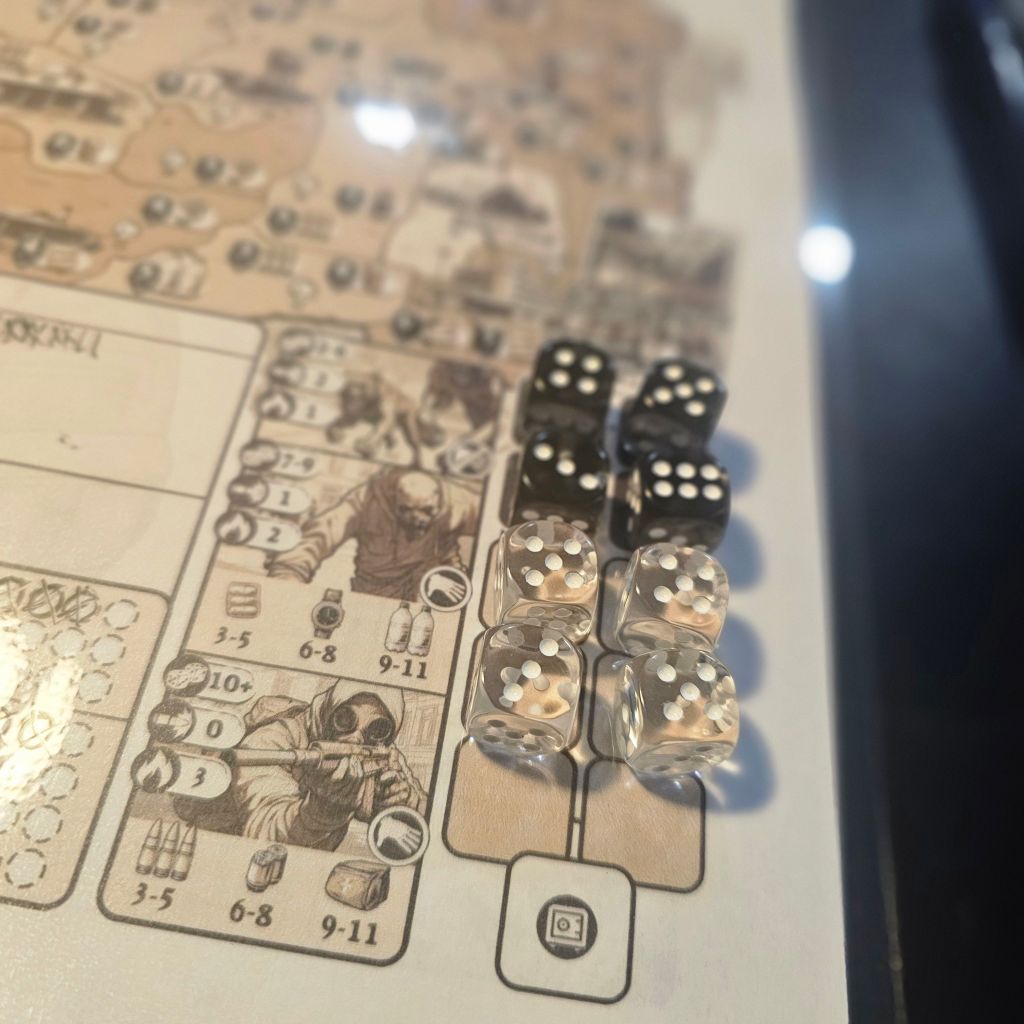
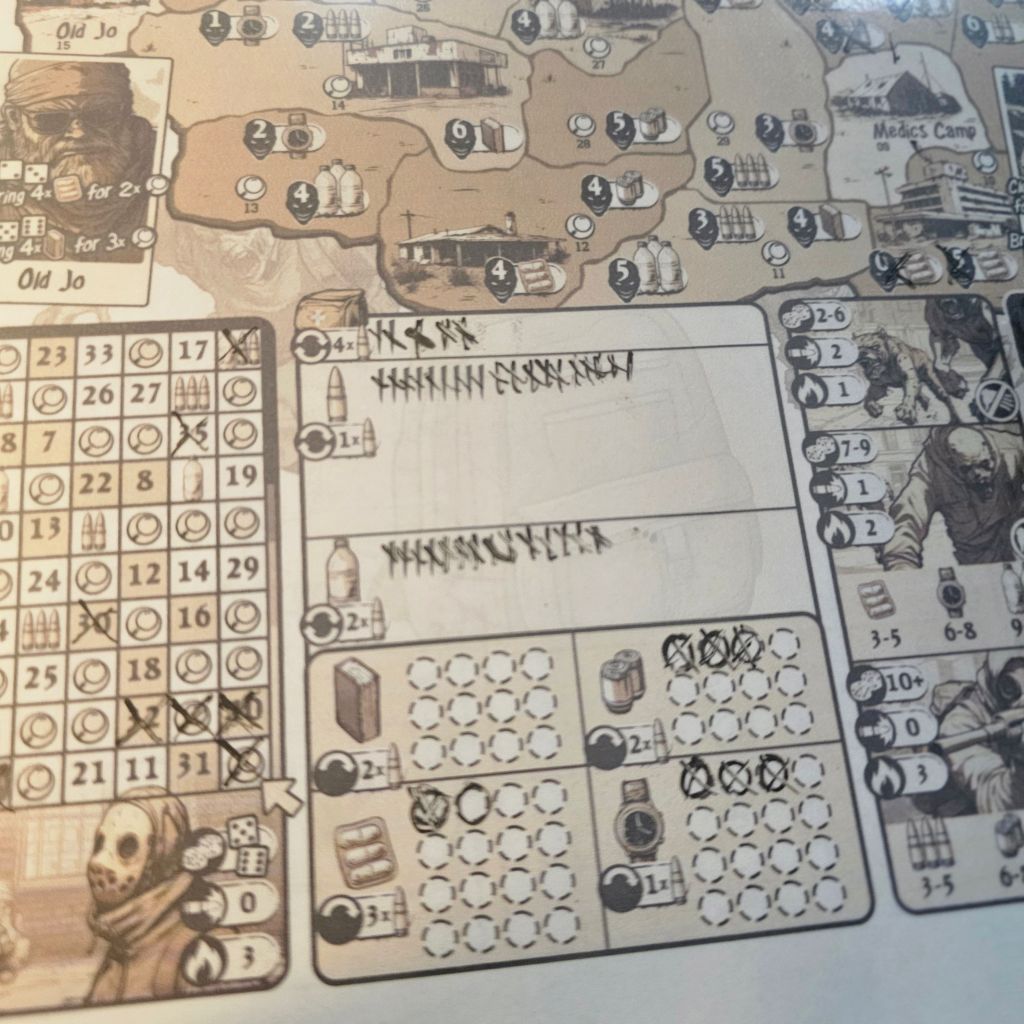
Setup is just getting the sheet, it already has all the resources and starting situation. You also need 8 dice, 4 of each color and a marker for your position. On each turn, you may do some trades with the locals for clues, but most often you will try to go to a new area for clues are resources.

To get into a dangerous area, first you spend a water roll your 4 dice to create your pool, and set one of the enemy dice as the danger of the area as stated on the map. One die at a time, you assign one die for the scout test, roll another for the enemy and assign a final one if needed. If you match or exceed, scout is successful and you proceed to battle. If not, you just lost time and a water.

Battle is similar, you assign your dice then roll two for the enemy. If it is enough, you win the loot, if not you lose a medpack and, if able, spend bullets to finish off or accept defeat.

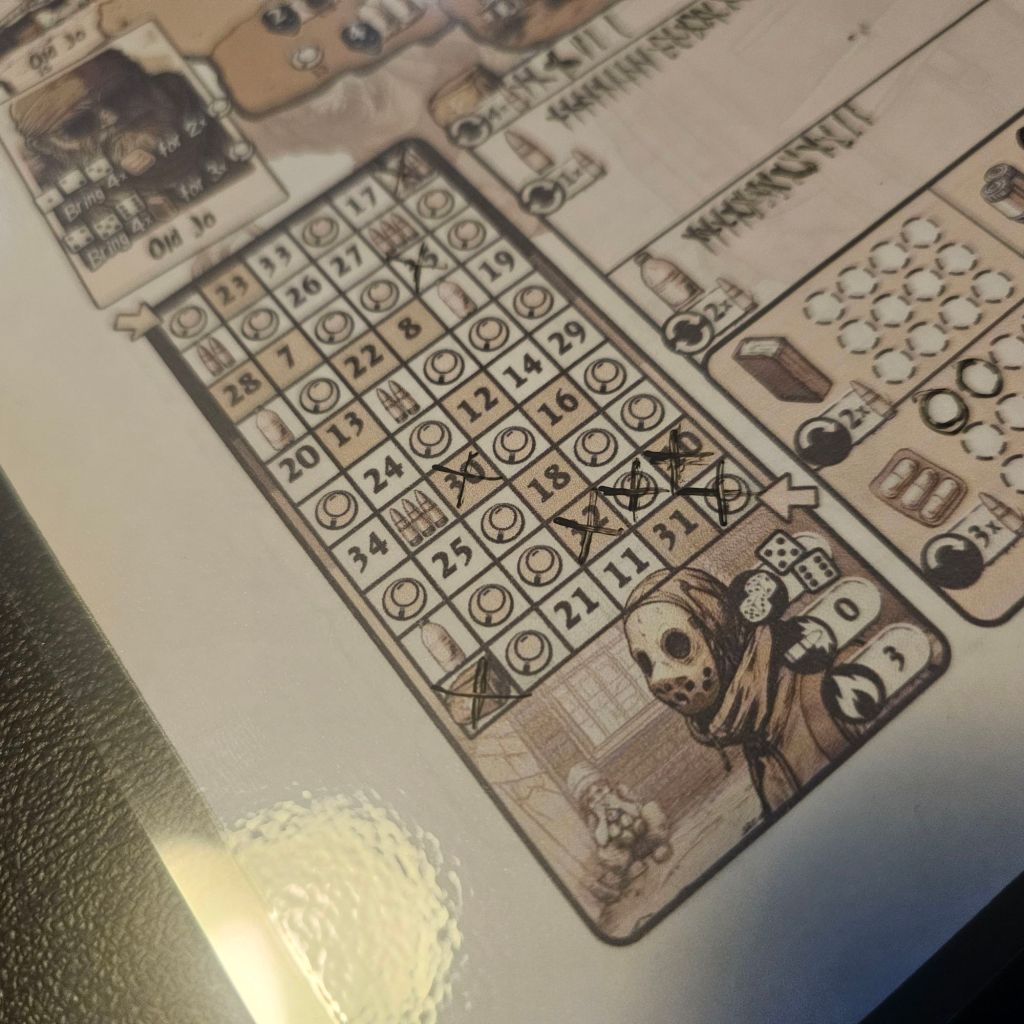
Each time you get a clue from locals or secure an area, you mark the clue or number into the main quest grid. Your goal is to make a continuous path from the starting arrow to the finish where the girl is. If you are able to do that and defeat the final boss, you win. If you ever run out of resources, you lose.

Rules and Components

The mission

The iconography is pretty clear for the most part, and it may seem overwhelming at first it does make sense once you start playing the game. Even though there are a ton of icons, I never felt the game got too cramped or messy as I went along.

Rules are, as usual for Nuka Zombee, laid out nicely in a kind of a comic book flow type of way. Rules are organized progressively, as if you are playing the game and reading the rules along for the first time, explaining as they are needed in the play. It’s an interesting approach, but not the most friendly at times.

It takes a bit to really internalize everything, but this is a game with a fairly unique flow and I honestly don’t know if any other layout would be better beneficial. I do appreciate the lengths they go for different examples.

On the other hand, there are terms and functionalities there are left to be understood by context, and I usually prefer things clearly laid out, like spending bullets to adjust dice or finishing off enemies.

Score: 7.5/10

Gameplay

Rolls

Unlike many games within the genre of apocalyptic survival, this game never feels oppressive. Instead it takes the other common facet of such games, dwindling resources, and makes it the heart of the problem. You know what is your dice pool BEFORE deciding where to go, and it’s up to you to be open in terms of choices and how much you’re willing to spend to achieve a certain objective.

It is a slow and analytical game, where along with the resource management, luck mitigation is key. You will have to take risks, no questions, but it’s all about how and when. That being said, it is also a game of patience and repetition, and getting into the game knowing that it is not going to be an in and out situation. You will never win quickly, and very rarely will lose quickly either.

Score: 9/10

Theme and Art

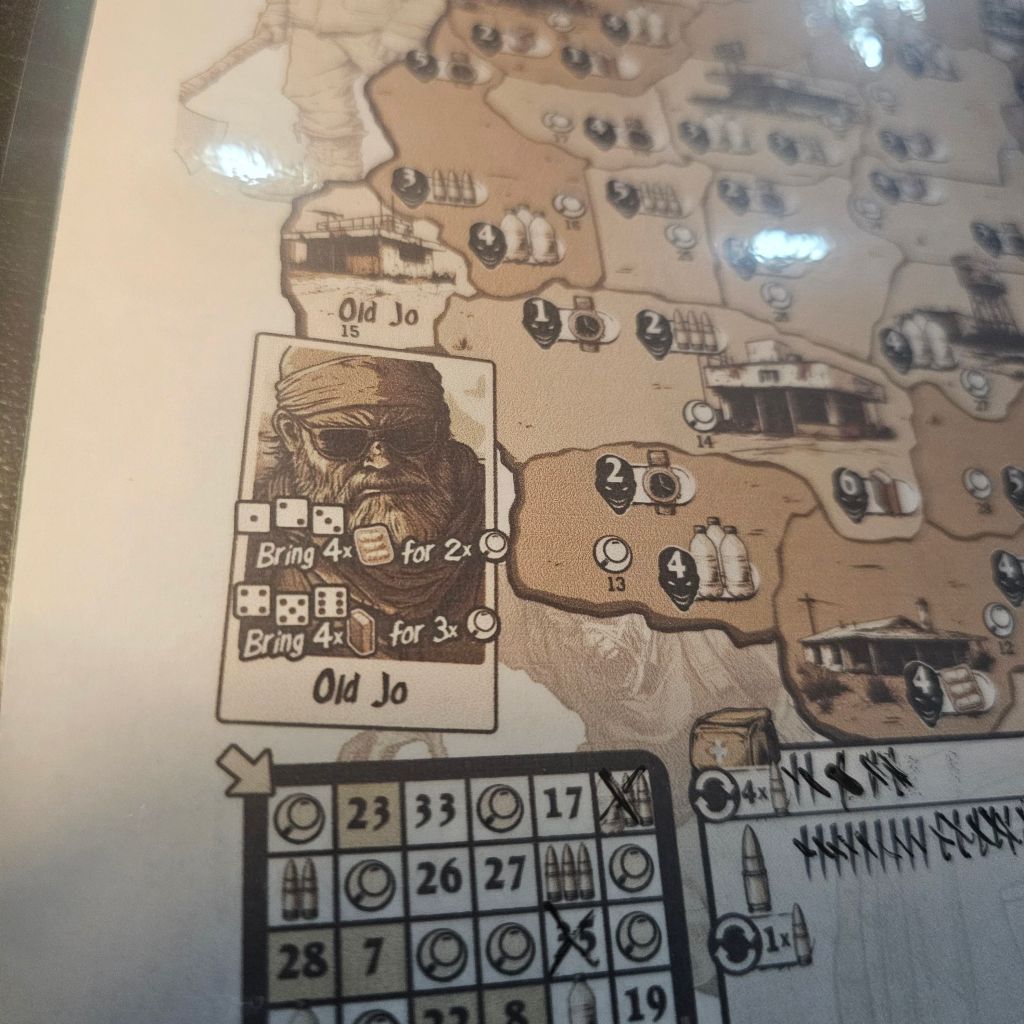
Old Jo

The artwork is stark and evocative, and it does a great job in setting the mood. The muted color scheme also adds to the feel, while also helping the game sheet feel less overwhelming.

The setting is left vague, only with a brief explanation of what is the current situation and not how it got there. It is left to the player to fill in the gaps. But I didn’t feel that this stopped me from being immersed into the theme and caring for the characters around me.

Score: 7.5/10

Conclusion

Resources

The Tracker is a tense, methodical and analytical roll and write with a continuous sense of dread and slowly building up your path to the end. And I described this game as slow many times during this review, but yet not once I felt the game was sluggish. Instead, it is a game that takes its time in progressing, and encourages the player to do the same. It is also engaging for the whole duration, and the scouting and combat setup is both thinky and exciting.

In the PnP realm, this one for me easily stands out if you read the description and see yourself in this world and you understand the pace of the game you’re getting into. But, if those things are for you, you will find here a well crafted and well designed game that will reward smart plays and will engage your brain (or leave them on the floor if you’re not careful enough).

Rules and Components: 7.5/10

Gameplay: 9/10

Theme and Art: 7.5/10

Score: 8 / 10

Review

Let’s Review More: Lata

1-4 Players

Designers: Rola & Costa

Artist: Marina Costa

Publisher: Pythagoras

With the second edition of Cafe, Pythagoras started its small box collection called Quinas. The second of this collection is last year’s Lata, about the production of can sardines and mackarels. Can this be a good game or is this collection just fishy?

Gameplay

Action Bidding

At the beginning of each of six rounds, players bid with their action points for turn order. Then, following that order, they get more cards for their factory, then spend actions to activate their production cards, spend that production to fulfill contracts for money, and to get end of game scoring.

Fulfilling contracts

At the end of each round, the contract and end of game scoring are refilled and every production is discarded except for regular sardines.

Solo Gameplay

Solo side of the player board

The game flow is the same for solo, except or instead or the initial bid, the player spend their actions to see more production cards. Since they have to add two, and some spots cost money, the player can be forced to place unwanted cards and disrupt their engine. There is no win or lose, it’s a beat your own score type of deal.

Each of the player boards have a solo specific side with its own twists, like one starts with no money and another only have options of pairs.

Components

Production

As usual for Pythagoras, the components are somewhat minimalistic and very theme driven. That means that it’s not the most obvious for gameplay, but they do look good. The cards have a nice quality, and the artwork is well done. Symbology is fine, not the best, but the rulebook is clear enough that I didn’t find a lot of issues playing, even on the first time.

Conclusion

End of game scoring

I really enjoyed Cafe, their first on the collection, but I like Lata even better. It feels like a tighter and more cohesive game, while still having the high efficiency gameplay elements.

Specifically for solo, this feels more well tested and developed, which I appreciate. And the fact we have four different boards add to the variation.

Score: 8/10

Review

Let’s Review More: Scholars of the South Tigris

1-4 Players

Designers: S. J. MacDonald, Shem Phillips

Artist: Mihajlo Dinitrievski

Publisher: Garphil Games

About the Game

Science Tracks

We have the second game on Garphil’s third trilogy, this time about transcribing knowledge from all around the world. As usual it’s hard to follow up a great first game in Wayfarers, so how do Scholars fair?

Gameplay

Scholars Card Play

On your turn, you either play a card or rest. To play a card, you chose one of the actions on you board and play a card and 1-2 dice. The dice will not only determine the value of the action, but also the color. Some actions care about just value, some just color, some both. Primary color dice will also combine color to secondary ones. Each dice can also be modified by up to two works to either change their color or to improve its value. There are less actions this time, mainly getting more translators, adding scrolls to be translated and translating them, and going up on the different scientific tracks.

When you rest, you rest, you get the income of all the cards you play. Those are either getting some dice or activating the income of one of the tracks. This dynamic makes the timing of acting and resting really interesting.

Solo Gameplay

Solo Board

As usual, we have a dedicated solo board, and it uses the 2 color system that Wayfarers used. This 6 card solo deck means that the AI is just interested in getting translators and dealing with scrolls, ignoring the science tracks. However, it still feels like a realistic, though abstracted, opponent.

One big difference is that we don’t have “personalities” this time around, but difficulty levels. I appreciate that route, as it would be difficult to isolate or incentivize too much one aspect.

Components

Translators

This is a standard Garphil production, with all the good stuff that comes with it. Great art, great components, lots and lots of symbols but a pretty good rule book with a back dedicated to symbology. It also uses all the familiar components, with the little flag for tracks, asterisks for influence and lots of familiar symbols.

One aspect I think they did great is accessibility. For a game that uses color as one of its central mechanisms, I believe that the way the symbols of the primary and secondary colors differ on more than just color, and the color of the dice and pips were chosen make this fairly color blind friendly. I’m no expert in the matter though.

Conclusion

Scholars feel smaller in scale, but that is actually a good thing. All systems in Scholars feel tighter and more connected. When comparing to Wayfarers, Scholars felt a bit more intuitive though no less of a challenge to optimize.

There is not much to criticize here. It’s what you expect from SJ and Shem, but it feels like a step towards a cleaner and less comborific fashion. And it works really well.

Score: 9.5/10

Review

Let’s Review More: Horrified Greek Monsters

1-5 Players

Designer: Michael Mulvihill

Artist: Victor Maristane

Publisher: Ravensburger

About the Game

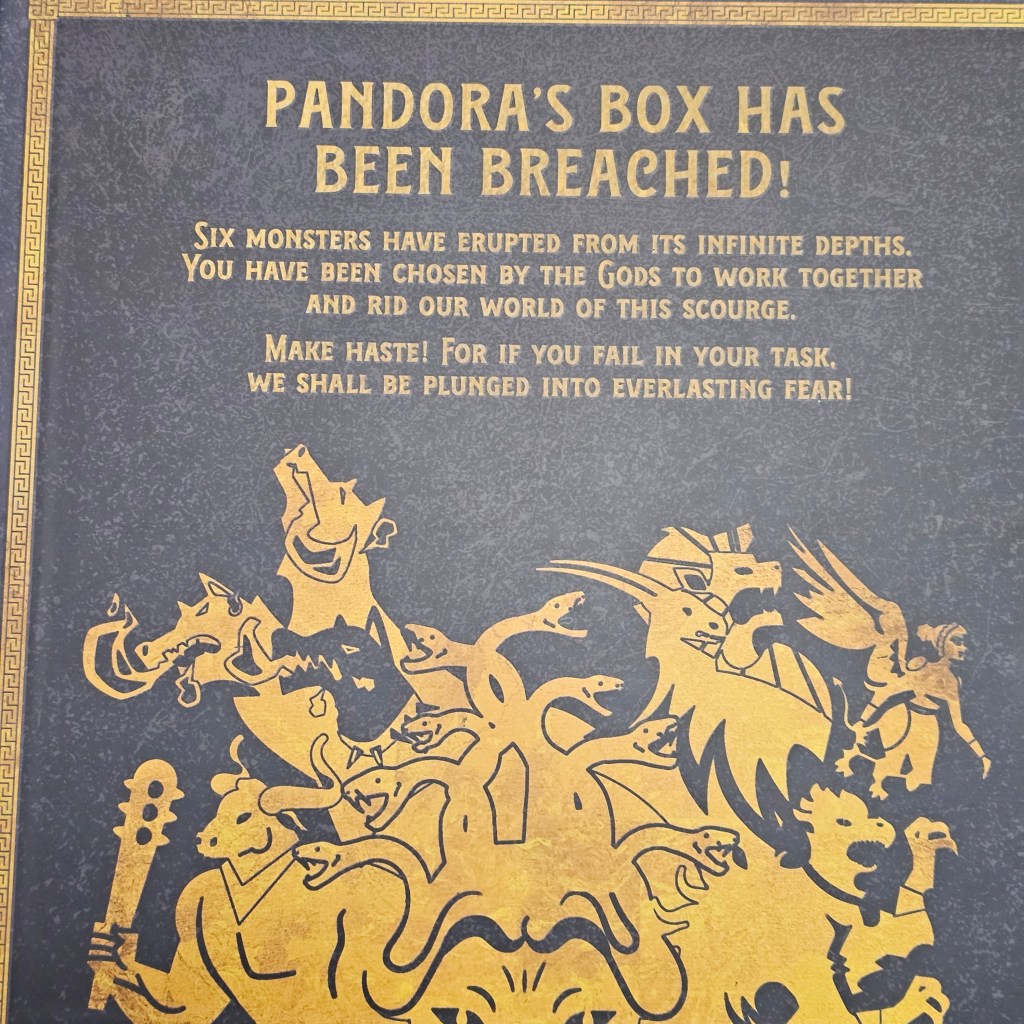
Pandora’s Box

In the third installment of the Horrified series we go to Ancient Greece to deal with Gods, face monsters from tales and meet legends. How much this changes from the formula of the game?

Gameplay

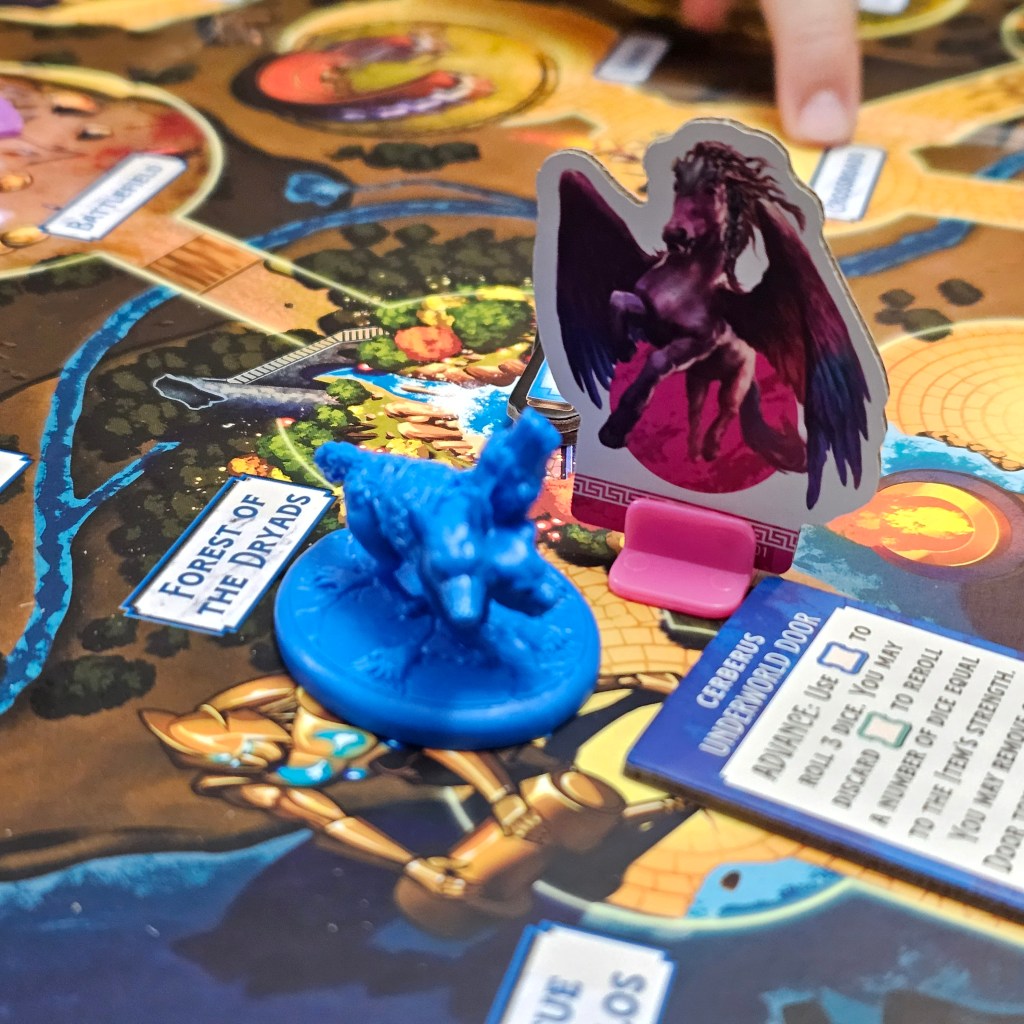
Pegasus VS Cerberus

If you are not familiar with Horrified, basically you have 2-4 monsters to defeat, each with their unique mechanisms. On a players turn, they use their actions to collect items, move around, guide people to their safe places and do monster specific actions. Then a card is turned for the monsters which adds more items, some event happens, then some of the monsters activate and may attack the heroes. You win the game by defeating all monsters, or lose if the monster deck runs out or if the terror rises to 7.

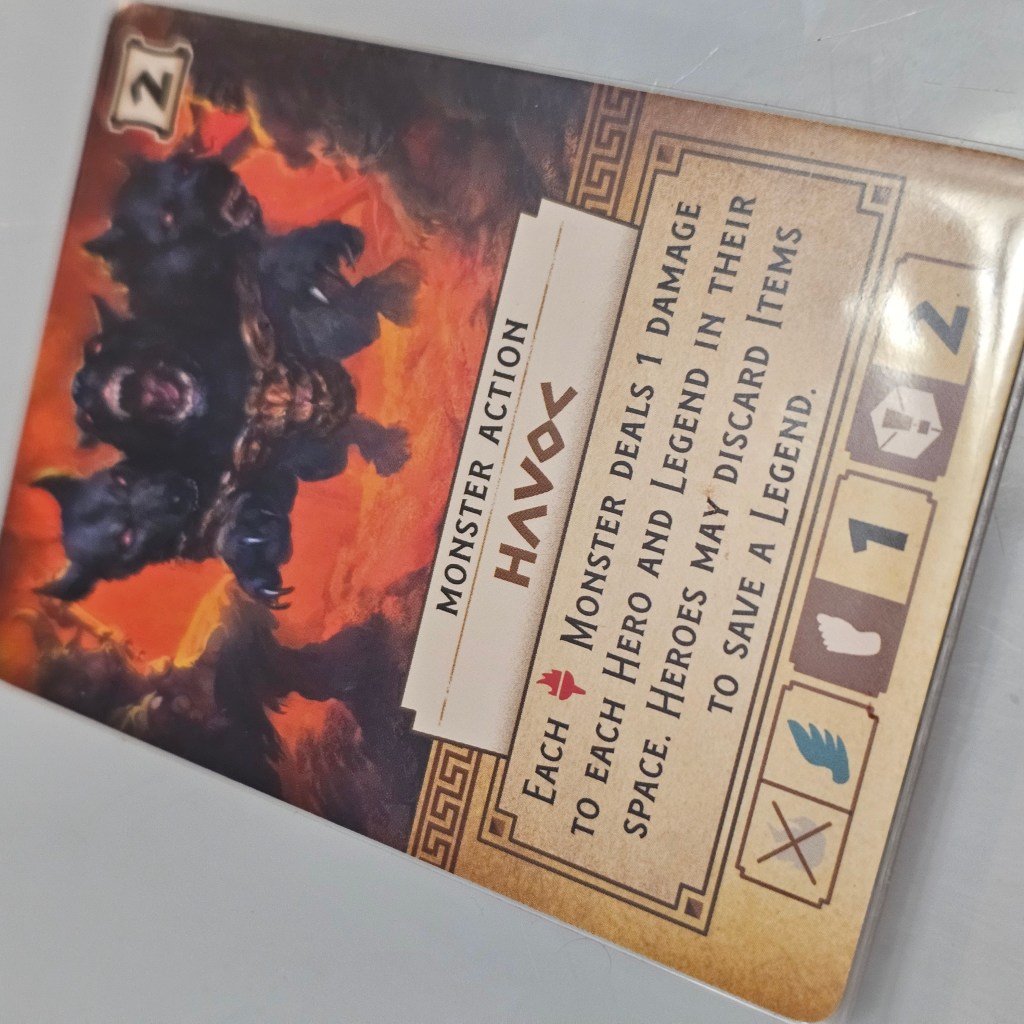
Monster cards

If you are familiar and wondering what are the differences, there are mainly two. First, events and activations are not tied to a specific monster, but to symbols present on each one. Each symbol is present twice, and each monster have three. Second, monster specific locations are not static, instead there are 4 lairs in every game, and you have to fine the lairs to your monsters in one of 4 locations.

Solo Gameplay

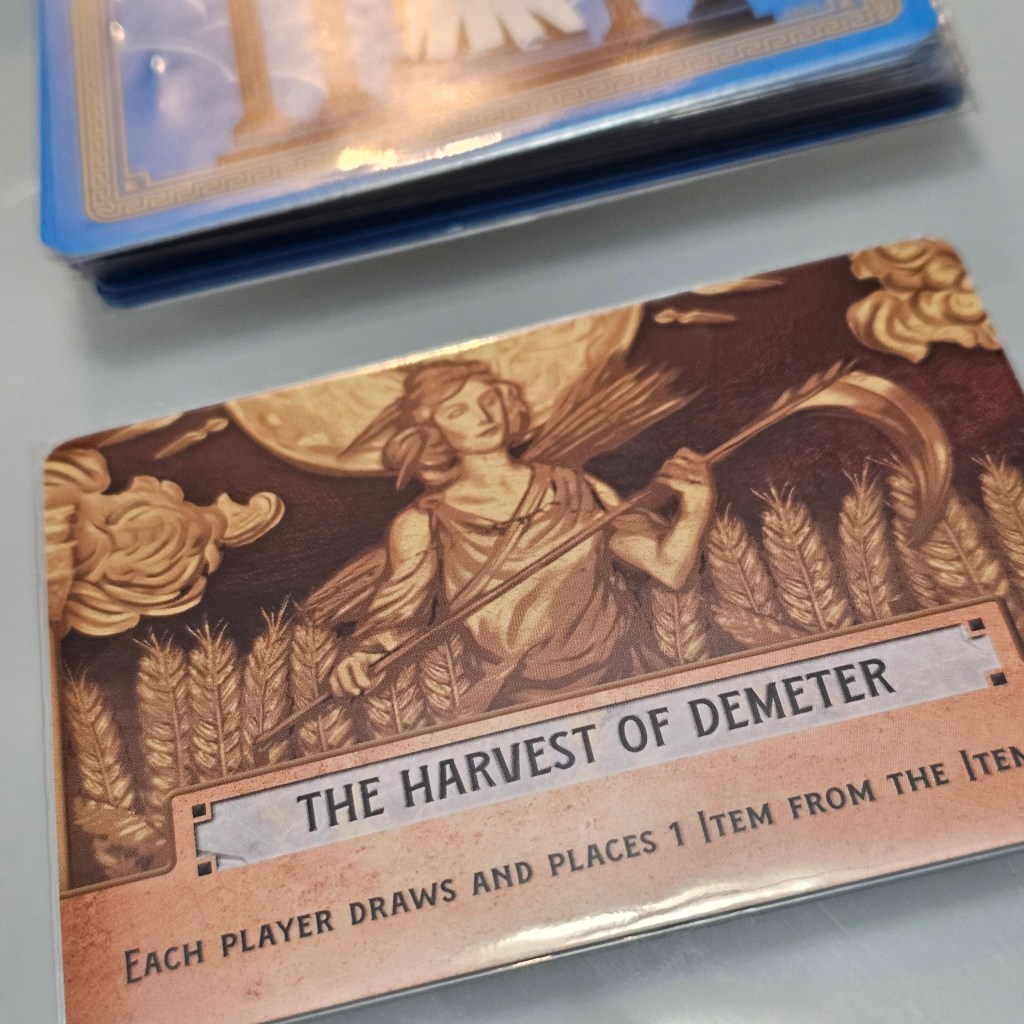
Divine Perks

As with previous entries, solo game is exactly the main game, except that the terror level starts at 3. But, unlike American Monsters, Greek Monsters feel well adjusted for solo play, even with the additional tasks such as the lairs and the legends needing to go farther.

Components

The infamous DogDogDog

Ravensburger really nails the high quality low cost niche. The cards have good quality, the tokens are good, clear and thematic and work well. The exception is the Minotaur’s maze, there are some ambiguous spots. But nothing too bad.

A big improvement is the rulebook. I like bow even though the theme is different, they kept the same main concepts. But the monsters are clearer in their specific rules, and there is little ambiguity.

Conclusion

First, let’s discuss the whole Horrified system. All three games are, mostly, the same mechanically, and even somewhat redundant. Is this better than adding expansions for the base game? I’m not sure. Horrified is a great gateway game for co-ops, and adding expansions would increase complexity. This way you have variety, and they can keep exploring entirely new themes and settings.

But how is Greek Monsters when compare to the rest of the series. Well, I have good and bad things to say.

On the good part, the change in the activations and events is excellent. Every monster feels more a part of the game, and cards never seem out of place. It’s a simple change, but one that works like a charm. Also, the monster complexity is closer to the original than American Monsters, and that is good. Every monster feel natural and intuitive.

However, I do feel like there was room for more, specially considering the theme. One big miss for me thematically is the Legends. One thing is having innocent villagers that you need to save and don’t have anything going for them. Another is having mythology heroes like Circe and Chiron, and they don’t do anything. They should.

I still feel like if you want just one Horrified game, just pick whatever theme seem more fun to you. But, comparing on the series, I feel like this one is just as good as the first. There is a bit more randomness and challenge this time around, but the game is balanced well for new players and veterans, big groups or solo.

Score: 8/10

Review

Quick Review: Tiny Epic Crimes

1-4 Players

Designer: Scott Almes

Artist: Nikoleta Vaszi

Publisher: Gamelyn Games

About the Game

I will be honest, I was skeptic when Gamelyn announced Crimes as their next Tiny Epic. The theme was unlike all others, it was centered around a gimmick, and it has again co-op and competitive plays, which is always risky. Were they successful?

Gameplay

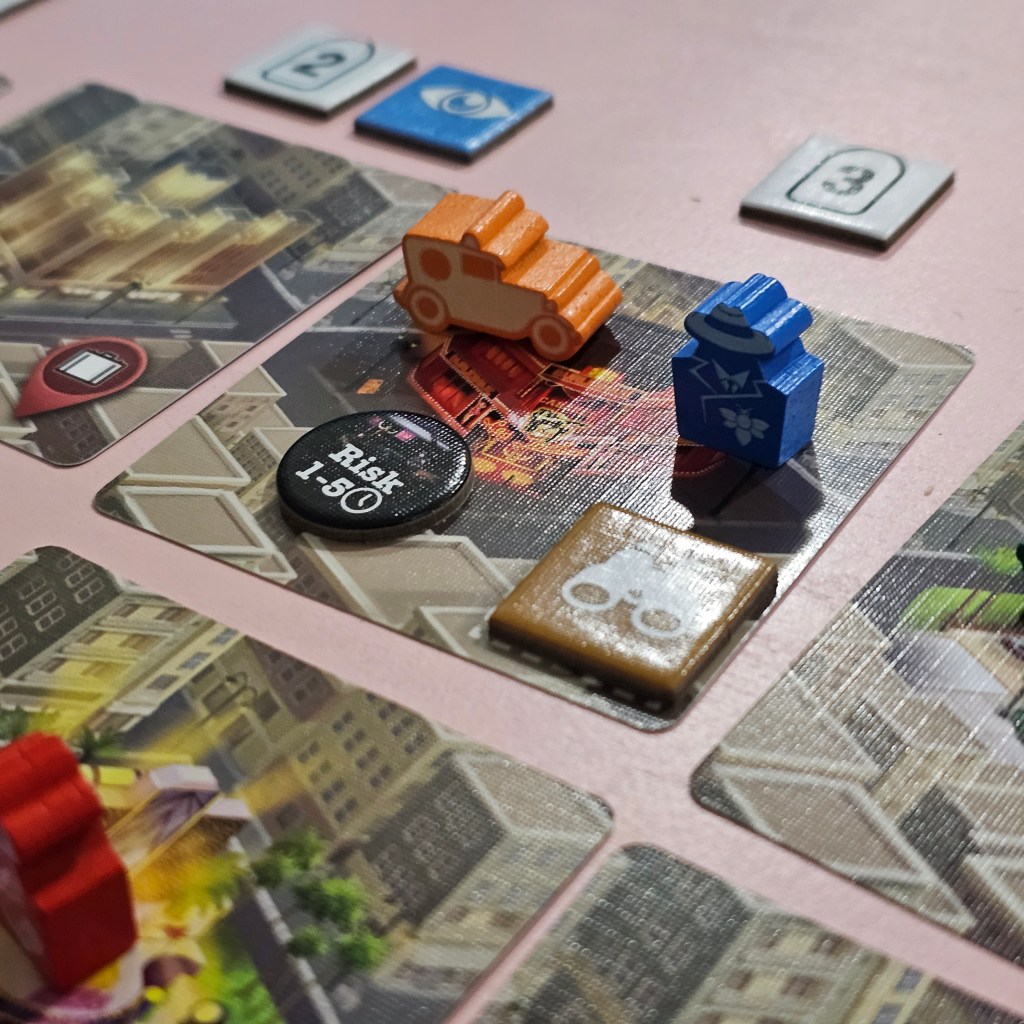
Arresting a mobster

Tiny Epic Crimes uses the “active player is the last in the time tracker”, mechanism, and on their turn a player moves any amount, spending that much time, then additional time to perform an action, usually arrestijg mobsters, gathering evidence in many ways, or resolving events. Then a new mobster is placed and a new event is revealed if all players are after a threshold.

The competitive mode uses a night and day system, where certain actions can only be performed in the correct time of day. The evidence is shared, but only the last person can review it at all times, and there is a bigger influence of individual suspects (which are private.

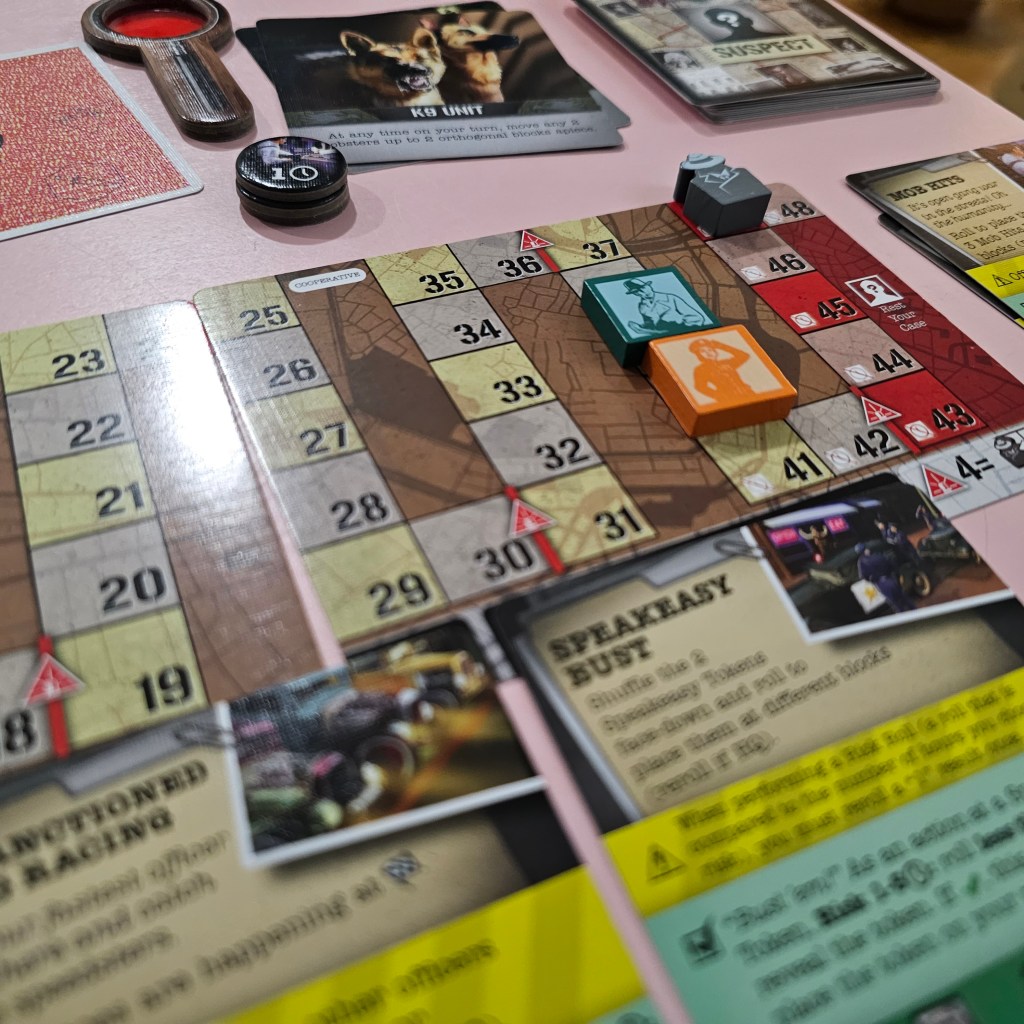
The cooperative mode doesn’t time of day, instead each player can only perform certain actions. Also, the time can be reduced if there are too many events or mobsters on the city.

Solo Gameplay

Cooperative time tracker

Solo is basically two player co-op, like most of the cooperative Tiny Epics. A really smart decision was to have the only “hand”, the force cards, be shared for both 1 and 2 players. It simplifies the game a lot without too much hit on the balance.

Components

Decoder System

Very standard Tiny Epic affair. Big cards for the players and trackers, squares for evergthing else. The wooden pieces for the players and mobsters are screen printed and great quality, and there is about a gazillion cardboard tokens for everything. Each individual event has its own unique counters, which is nice. Though some are a little tough to identify at a glance.

But, let’s talk about the Epic Decoder System, the big gimmick. It’s not anything innovative. It’s a red filter on many spots to identify characteristics or identity. It’s basically the same filter on games like Decrypto. It is simple, and it works. For the most part… Under certain lights, it is tough to make out, specially the name of the criminal.

Conclusion

Bullet dice!

To put it very simply, this is the 21st century version of Cluedo. Run around, collect evidence, accuse. It was Eve, with a knife, escaping in a bike.

As far as Tiny Epics go, this is on the simpler side. Move, spend some time, do action, spend some time. Some are fixed, some are wagers, but everything is smooth sailing. The events can get a little convoluted, but that’s good to keep this from being too same-y.

But it works, and it’s a lot of fun! Unlike Zombies, both co-op and competitive work equally well, with their unique challenges and adjustments. There is an element of semi co-op on the competitive, but you’re never getting out of your way to benefit the group.

Color me surprised. This is one I see getting attention often. I play a lot of Tiny Epic with a younger crowd, and this will fit right in their alley. But, even for me as a solo player, it’s snappy, quick and a good challenge.

Score: 8/10

Review

Quick Review: TradeWorlds: Exterra Edition

1-4 Players

Designer: Kristopher R. Kycia

Artists: Charles Vinh

Publisher: Outer Limit Games

About the Game

Tradeworlds is a game that has a very complicated Kickstarter history, among mismanagement and personal tragedies, and being delivered 6 years later. However, today I’m going to focus only on the game itself, but the 6 year period will be actually relevant.

Gameplay

The game follows a very simple and easy to remember ABCD structure. First, you select a role and perform its (A)ction, then you (B)uy cards from your own personal market, then you can (C)onfigure a ship using a ship, a crew and a weapon card, and finally you (D)iscard as many cards as you want and draw back up to five. You keep doing that until someone achieves the goal of the scenario, be it a number of credits banked or destroy every other homeworld.

Solo Gameplay

Solo play against AI

The base game comes with a solo scenario where you try to defeat a single menacing ship before it either destroys your home world or hit critical mass. The expansion that comes with the Kickstarter also has a solo AI that simulates the roles and ships the human player has, but in a more condensed form.

Components

Most of the components of the box are fine. The cards have a good finish, not great but feel sturdy and durable. The artwork is generic sci-fi, but it has a cohesive look and the visuals are nice.

Designwise, I do have some issues. First is the fact that flavor text and game text are written with the same font. It makes it harder distinguish at a glance what is relevant for the game and what is not. Also, I don’t see the need for the double sided cards. Almost all of the information on the back is present on the font, and the aspects that do use the back are fairly minor. I feel like this could have been changed and given a better experience without it.

The rulebook is also a problem. It’s vague and not well organized, making some aspects of the game confusing. It also uses a lot of terminology without actually defining it, leaving it to the players to have to understand by context. The good thing is that the designer is active on BGG, so most of these are just a search away.

Conclusion

Homeworld board

This was a messy Kickstarter campaign, with so many falso promises and the unfortunate passing of one of the designers. His father took on the task of getting this game out in memory of his son, and I am glad that it’s being delivered.

But this game was promised for 2018, and I got it five years later. So let’s talk about it. Tradeworlds has elements of many other games, but sadly they are too simplified. There is role selection like Race for the Galaxy, but no actual tension and play / counter-play thinking. It’s just an action you can do that turn, and there are no restrictions around it. There is also upgrading your empire like in Tiny Epic Galaxies. But banking is just a threshold to launch more ships or to achieve a goal in the scenario. The homeworld board goes to the hundreds of banked credits, but there is very little reason to go above 100, ever.

And there is the deck-building aspect. It lacks my favorite aspect of deck-builders, which is creating a refined engine. In the end, Tradeworlds is just a numbers game. There are 4 types of cards, 3 of them used to build ships. While its fun to create ships with different parts, they’re just different configurations of vanilla creatures. You can launch a ship that has 2 attack and 5 resistance, or 3 attack and 1 resistance, and so on. And the fourth type, tactics, are mostly one time modifications of those attributes for combat. It’s all just numbers.

And the reason that I mention that this game was in production for over 5 years is that it could have been given to more people to. Play and refine those issues. TradeWorlds is not a bad or broken game, it’s fine, fun even. But also tame and forgettable. And, because of that, it will not leave the shadow of its campaign.

Score: 4/10