Meteor Incoming
Preview

Let’s Preview More: Doomsday Manager

1 Player

Designer: Dennis Kurdiukov

Artist: Dennis Kurdiukov

Publisher: Nuka Zombee Games

So, you would think that a giant meteor coming straight for us would be a big deal, but no… It’s your job to manage the crisis, get funds, bri.. convince politicians and feed the media, without going overboard of course, to have a chance of survival. But is this crisis manageable or should we just let the meteor do its thing?

How To Play

Weapons Grid

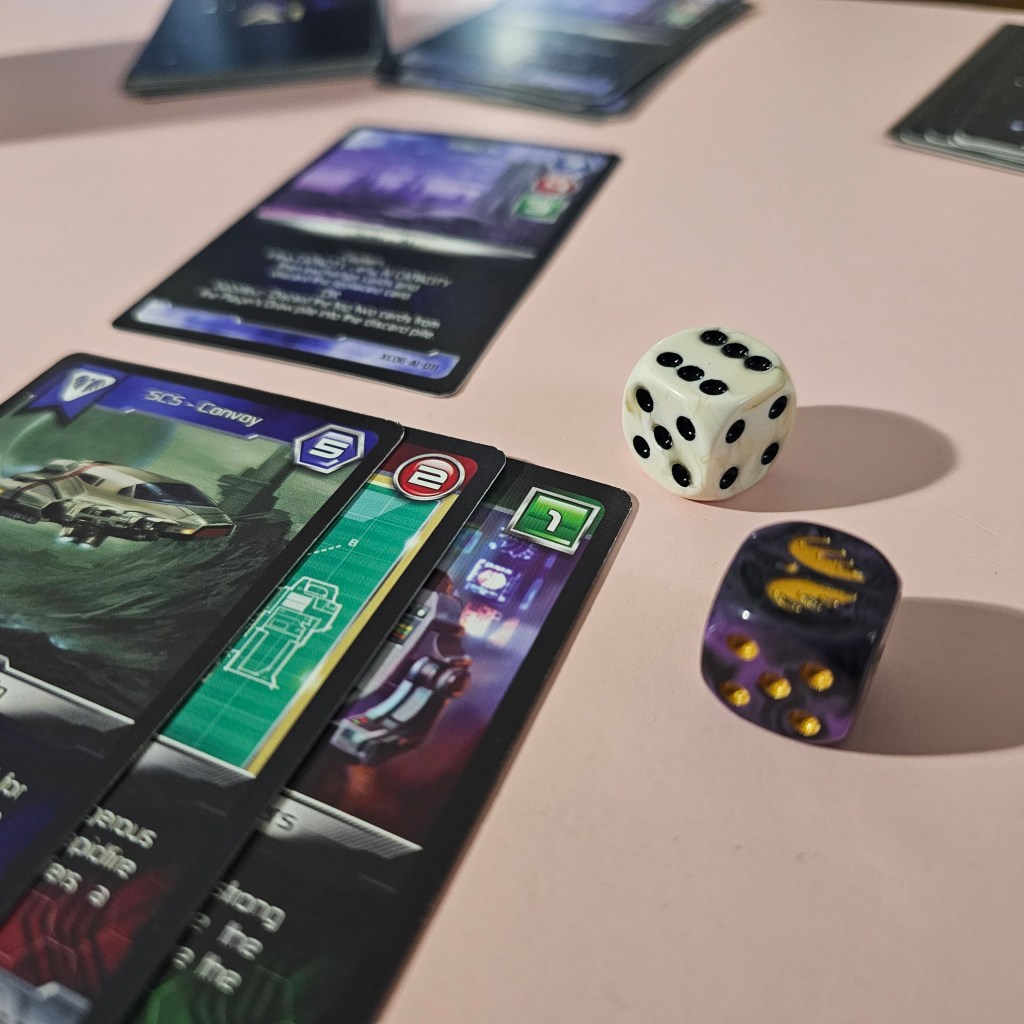
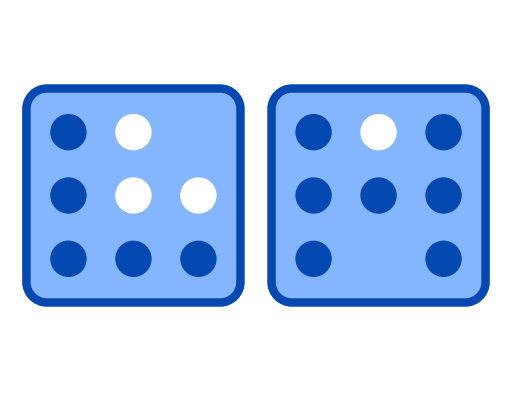
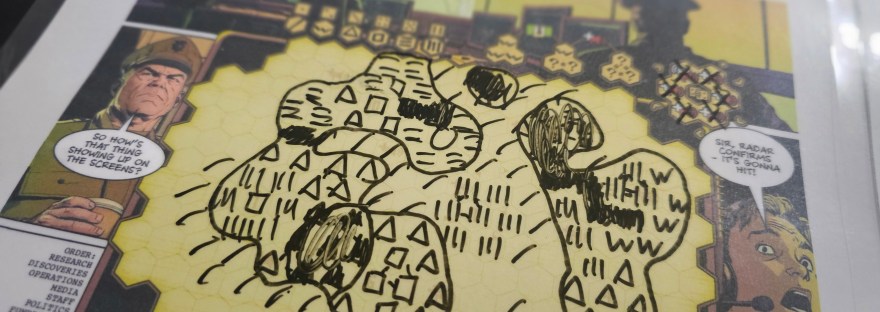
To setup, you just need three sheet and a whole bunch of dice. Each turn is comprised of whopping 8 phases, but all but media phases are optional. On research you roll a pair of dice for each worker, one being the material and the other how many will be added in a spiral shape. Once a shape cannot grow anymore, you start from the next numbered origin. Once all numbers are used and the meteor cannot grow anymore, it’s fully mapped. Doubles will tell the direction of the meteor, that will help spread media attention.

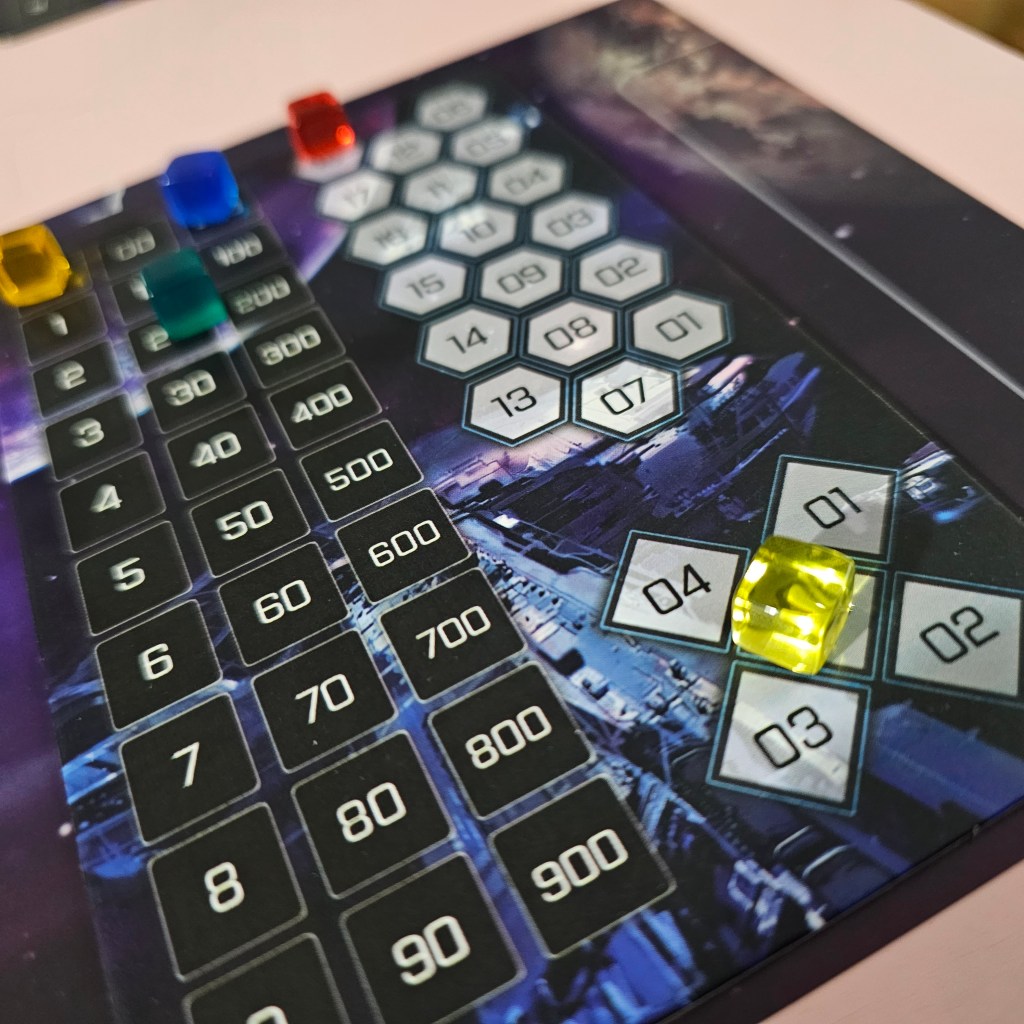
On operations, you roll a die for each worker and add that to one of the weapon matrixes. Each matrix need to be complete and all equations correct for the weapon to be active. During the media phase, you again roll a die for each worker. Ones mean loss of future money, while fives and sixes make will allow you to bump one of the media channels of your current influence level. These can give you money or cause crisis. Once all of one color are filled, the next influence level is unlocked.

Staff phase will allow you to spend money to upgrade one of the previous three departments or get more workers for that department, unlocking more dice. Politics allow you to, well, direct money to one of the politicians so that they can see your point of view more clearly. Each one will have immediate or triggered ability that will activate once they are marked. Once all boxes of one person are marked, it will increase your influence over a certain ideology as well as triggering one political favor.

Fundraiser will allow you to invest money to get a return on the next year. Finally, attack will allow you, once the meteor is mapped, weapons are unlocked and the correct bills are passed, to spend money to use the weapons against the meteor. Different weapons will target in different manners, but the goal is to have all of the meteor destroyed. Some weapons target big areas, while others will break it into smaller chunks, as any area 7 hexes or smaller can be destroyed automatically.

The only way to win is to destroy completely the meteor, and you lose if time is up and the big rock does its thing.

Rules and Components

Influencing Politics

As I usually stress, this a preview from a prototype so things are bound to change. But this is quite complete at this point I believe.

Usually print and play games are one or two pages long, and I appreciate Dennis spreading to a third. Though there is a lot happening, every section is well displayed and nothing feels cramped. Wording for a few abilities and effects could be clearer, but even at the first few plays, everything feels in place and make sense.

Different from previous games, this time rules are laid out in a more standard manner and I appreciate for a game on this complexity. Every section is well explained, but some wording can be vague or left to interpretation at this point. I did reach out to the designer, and most of my interpretations were correct, and I do hope the final version is even clearer than it is now.

Gameplay

Political Bills

Starting to play Doomsday Manager can be a bit daunting, but its a game that when you start playing is quite more intuitive than it first look. Each section is its own mini-game almost self contained and easy to manage. This is half of the game. The other half is managing funds and investment on each section, and having the proper support on all of them according to needs.

One aspect that I noticed is that the dice mitigation is mostly done through additional rolls, but not through dice manipulation. In a game where specific rolls are needed and, often, crucial, this can make you feel like you’re at the mercy of the dice. Brutal, but on the other hand, thematic.

Theme and Art

Media Frenzy

Theme is odd and unique, for sure. Honestly, the way it develops is quite like a cheesy classic disaster movie, and I love that the game leans on it and uses that to its advantage. It’s at the same time cinematic and, in a way, administrative, and somehow both work really well together.

Art again falls into the same feel. It uses the Nuka Zombee Classic Comic Book Flow (patent pending) to evoke dramatic moments to highlight each section as a scene, and elevate that from just another system.

Conclusion
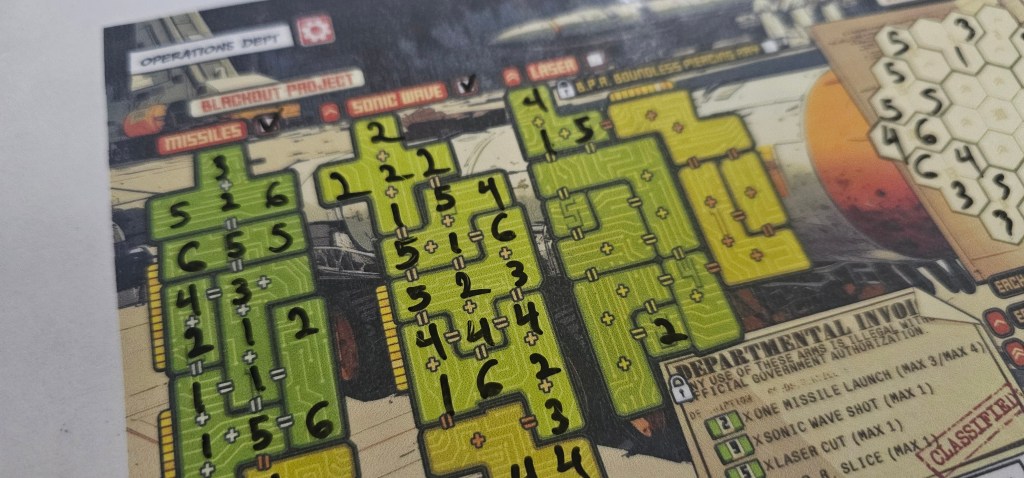
Weapon Matrix

Doomsday Manager is epic, out of control and, honestly a bit frustrating at times. It’s absolutely a game that takes its unique premise and runs with it the whole way. Each individual section is simple and almost mundane. That really forces you to look at the game from a higher perspective, seeing the big picture, almost like setting up a situation and just running the results. The biggest decisions and where the heart of the game lies is the runaround of funding and resources, timing and long term plans.

It’s also a game that breaks expectations in a big manner. It gives you impression of being a big lengthy and grind-y experience, specially knowing one of their previous games, like Recycled. However, it’s not that at all. Turns fly by, and often with little change between them. It’s not a game of epic turns, but a game of slow flow and long term plans materializing over time. It requires a whole type of approach and smart plays, and, honestly, I see so many branching paths to both victory and defeat that I can’t wait to explore it more.

PnP Review, Review

Let’s Review More: The Tracker

1 Player

Designer: Denis Kurdiukov

Artist: Denis Kurdiukov

Publisher: Nuka Zombee

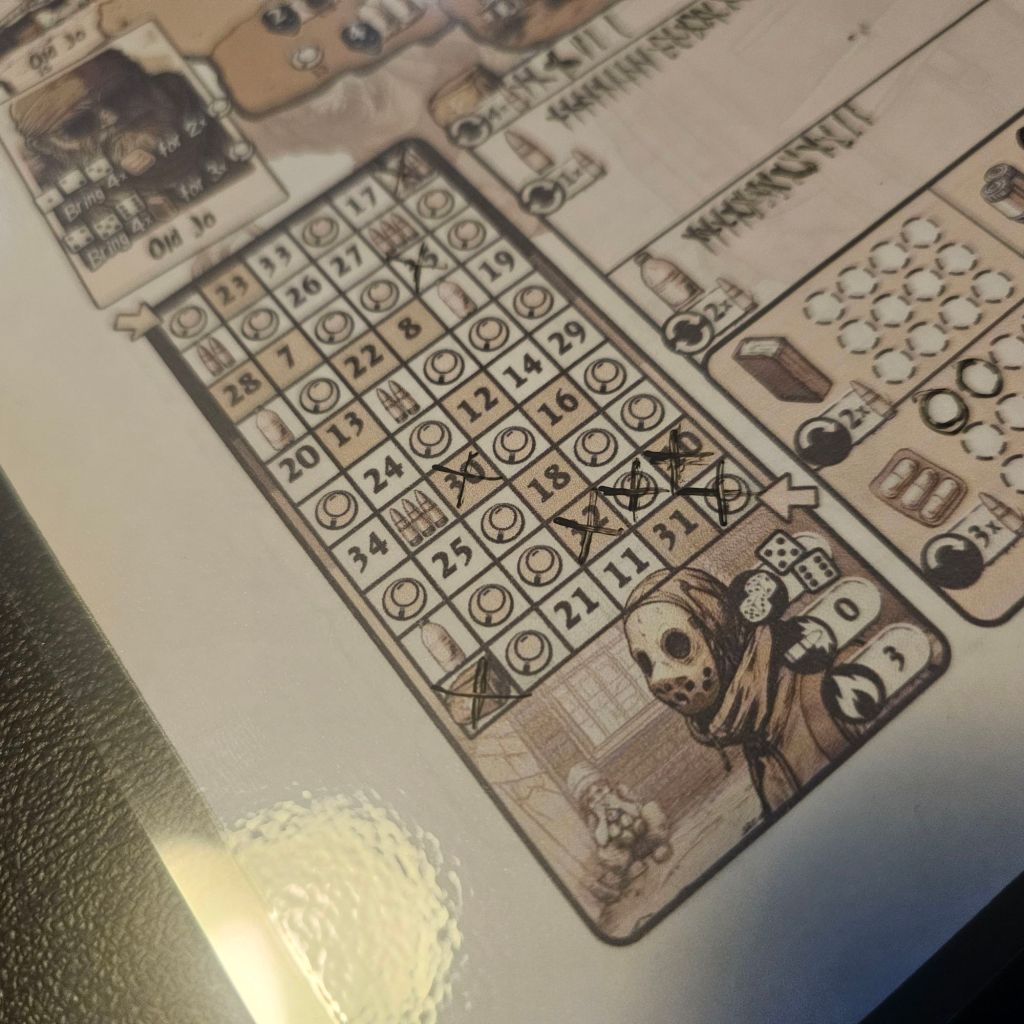
The world outside is a horrible nightmare, full of zombies, mutated beasts, and horrible people just waiting to take you and everything you have. But you insist in going on and trying to find a way to save a little girl. But is your will strong enough or are you going to succumb along the way?

How To Play

Scouting

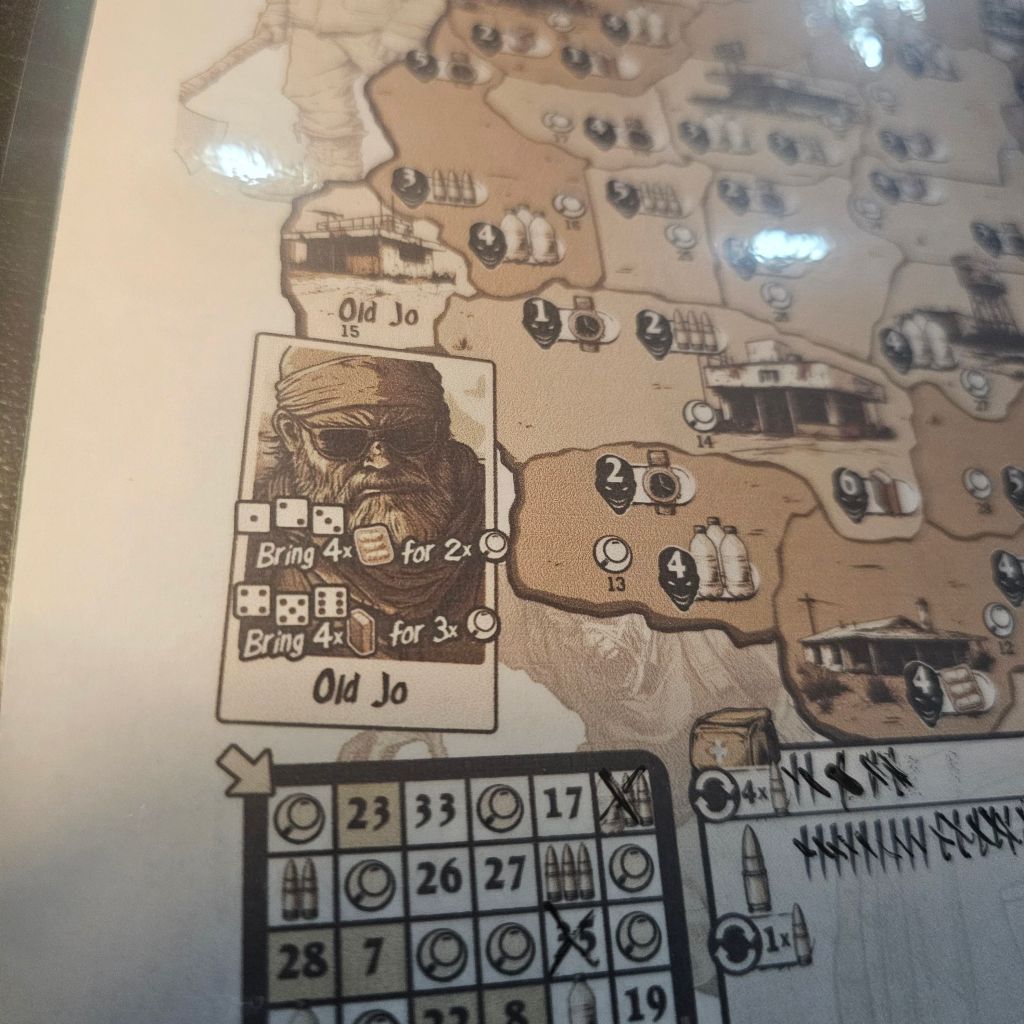
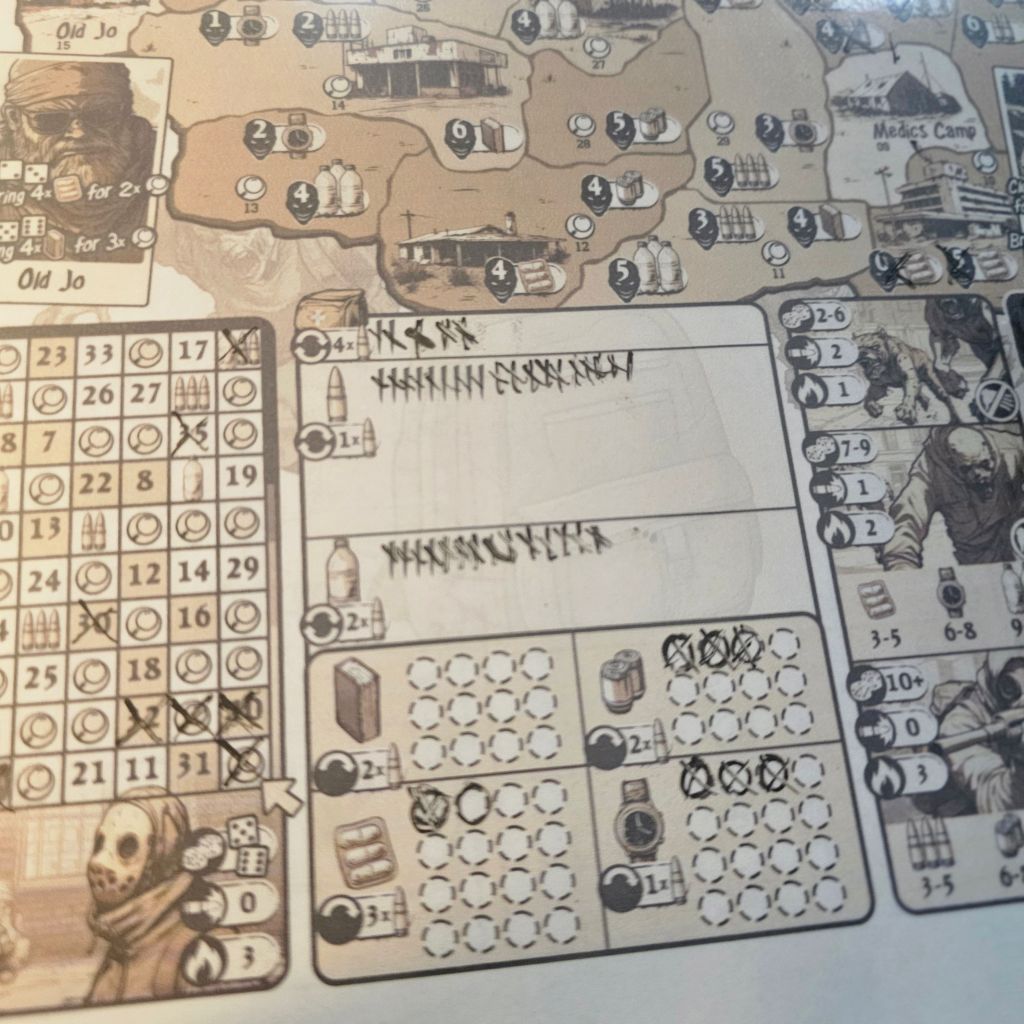
Setup is just getting the sheet, it already has all the resources and starting situation. You also need 8 dice, 4 of each color and a marker for your position. On each turn, you may do some trades with the locals for clues, but most often you will try to go to a new area for clues are resources.

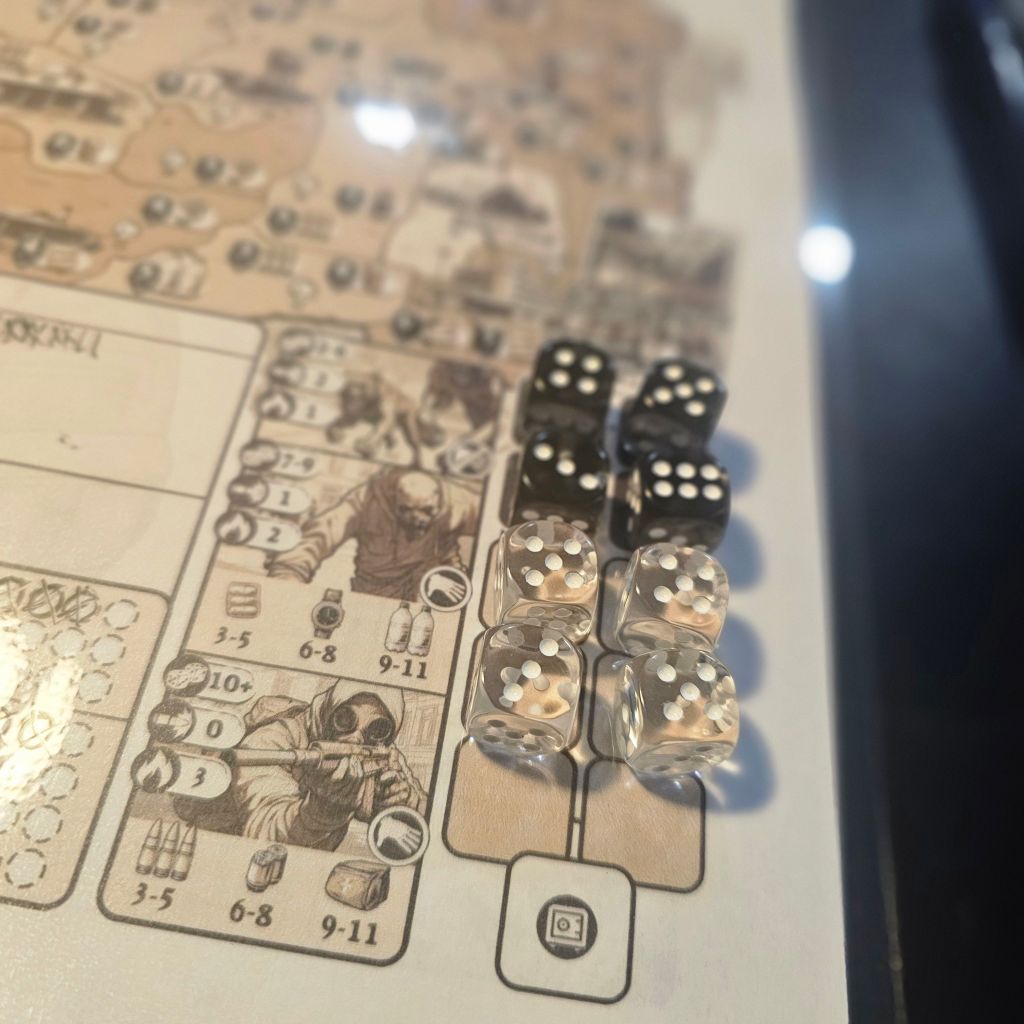
To get into a dangerous area, first you spend a water roll your 4 dice to create your pool, and set one of the enemy dice as the danger of the area as stated on the map. One die at a time, you assign one die for the scout test, roll another for the enemy and assign a final one if needed. If you match or exceed, scout is successful and you proceed to battle. If not, you just lost time and a water.

Battle is similar, you assign your dice then roll two for the enemy. If it is enough, you win the loot, if not you lose a medpack and, if able, spend bullets to finish off or accept defeat.

Each time you get a clue from locals or secure an area, you mark the clue or number into the main quest grid. Your goal is to make a continuous path from the starting arrow to the finish where the girl is. If you are able to do that and defeat the final boss, you win. If you ever run out of resources, you lose.

Rules and Components

The mission

The iconography is pretty clear for the most part, and it may seem overwhelming at first it does make sense once you start playing the game. Even though there are a ton of icons, I never felt the game got too cramped or messy as I went along.

Rules are, as usual for Nuka Zombee, laid out nicely in a kind of a comic book flow type of way. Rules are organized progressively, as if you are playing the game and reading the rules along for the first time, explaining as they are needed in the play. It’s an interesting approach, but not the most friendly at times.

It takes a bit to really internalize everything, but this is a game with a fairly unique flow and I honestly don’t know if any other layout would be better beneficial. I do appreciate the lengths they go for different examples.

On the other hand, there are terms and functionalities there are left to be understood by context, and I usually prefer things clearly laid out, like spending bullets to adjust dice or finishing off enemies.

Score: 7.5/10

Gameplay

Rolls

Unlike many games within the genre of apocalyptic survival, this game never feels oppressive. Instead it takes the other common facet of such games, dwindling resources, and makes it the heart of the problem. You know what is your dice pool BEFORE deciding where to go, and it’s up to you to be open in terms of choices and how much you’re willing to spend to achieve a certain objective.

It is a slow and analytical game, where along with the resource management, luck mitigation is key. You will have to take risks, no questions, but it’s all about how and when. That being said, it is also a game of patience and repetition, and getting into the game knowing that it is not going to be an in and out situation. You will never win quickly, and very rarely will lose quickly either.

Score: 9/10

Theme and Art

Old Jo

The artwork is stark and evocative, and it does a great job in setting the mood. The muted color scheme also adds to the feel, while also helping the game sheet feel less overwhelming.

The setting is left vague, only with a brief explanation of what is the current situation and not how it got there. It is left to the player to fill in the gaps. But I didn’t feel that this stopped me from being immersed into the theme and caring for the characters around me.

Score: 7.5/10

Conclusion

Resources

The Tracker is a tense, methodical and analytical roll and write with a continuous sense of dread and slowly building up your path to the end. And I described this game as slow many times during this review, but yet not once I felt the game was sluggish. Instead, it is a game that takes its time in progressing, and encourages the player to do the same. It is also engaging for the whole duration, and the scouting and combat setup is both thinky and exciting.

In the PnP realm, this one for me easily stands out if you read the description and see yourself in this world and you understand the pace of the game you’re getting into. But, if those things are for you, you will find here a well crafted and well designed game that will reward smart plays and will engage your brain (or leave them on the floor if you’re not careful enough).

Rules and Components: 7.5/10

Gameplay: 9/10

Theme and Art: 7.5/10

Score: 8 / 10

Review

Let’s Review More: Storyburg

1-4 Players

Designer: Kyle Walters

Artist: Kyle Walters

Publisher: Dancing Koala Games

On Storyburg, you will take characters from different stories to try to face the perils that are breaking the world. Foes will appear, tough choices will be made, and pages of the story will grow. But will your story have a happy ending?

How to Play

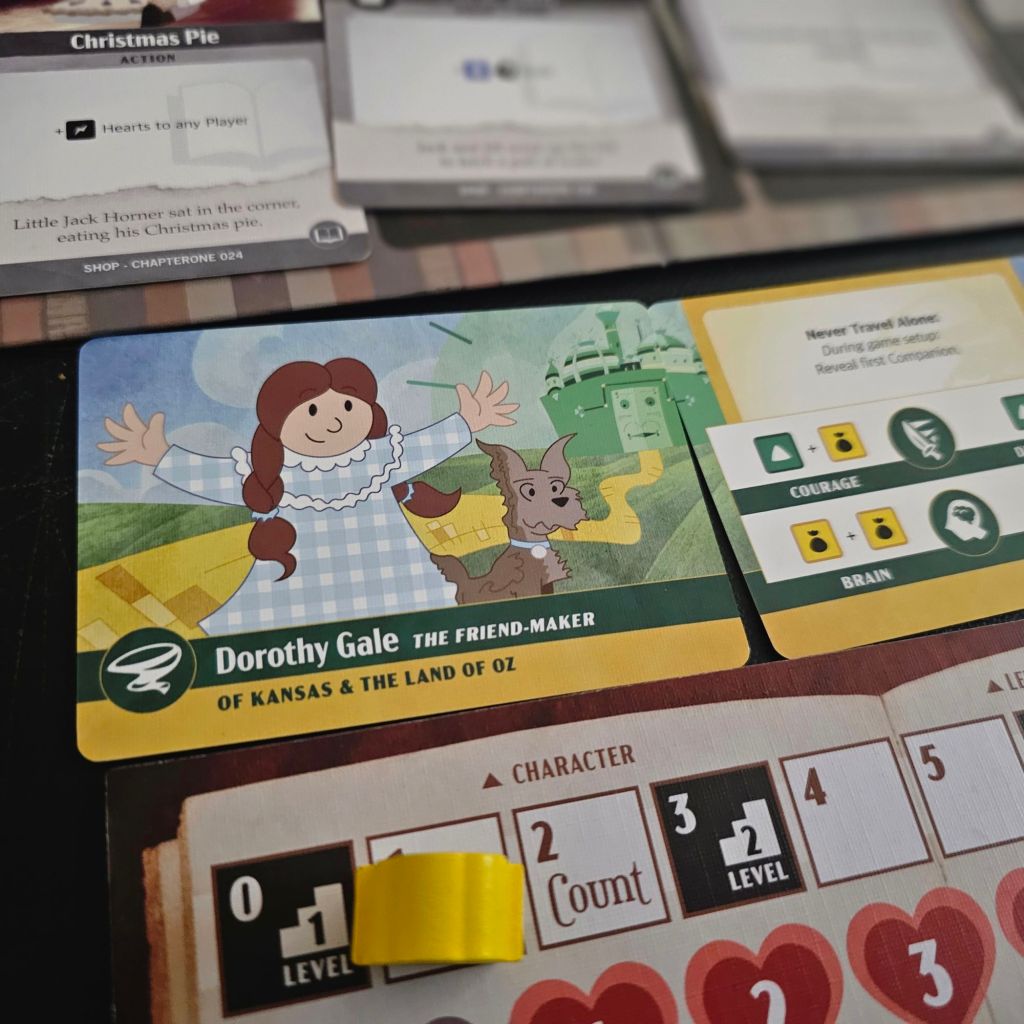
Dorothy

Perhaps the most unique aspect of Storyburg is that there is no fixed play pattern. Players will follow the story book, make decision and navigate to chapters. On some of those chapters, a challenge or enemy will be presented, and only then players will take their turns.

Turns are a mix of playing cards, equipping items, purchasing new cards and preparing your dice pool. Challenges are a single roll depending on the attribute, while combat are a simple rolling attack versus defense back and forward between characters and enemies.

The end of each chapter is also variable depending on the choices of the players and where the story leads you. The whole campaign goes for 5 chapters, but how to navigate these chapters can vary from play to play.

Rules and Components

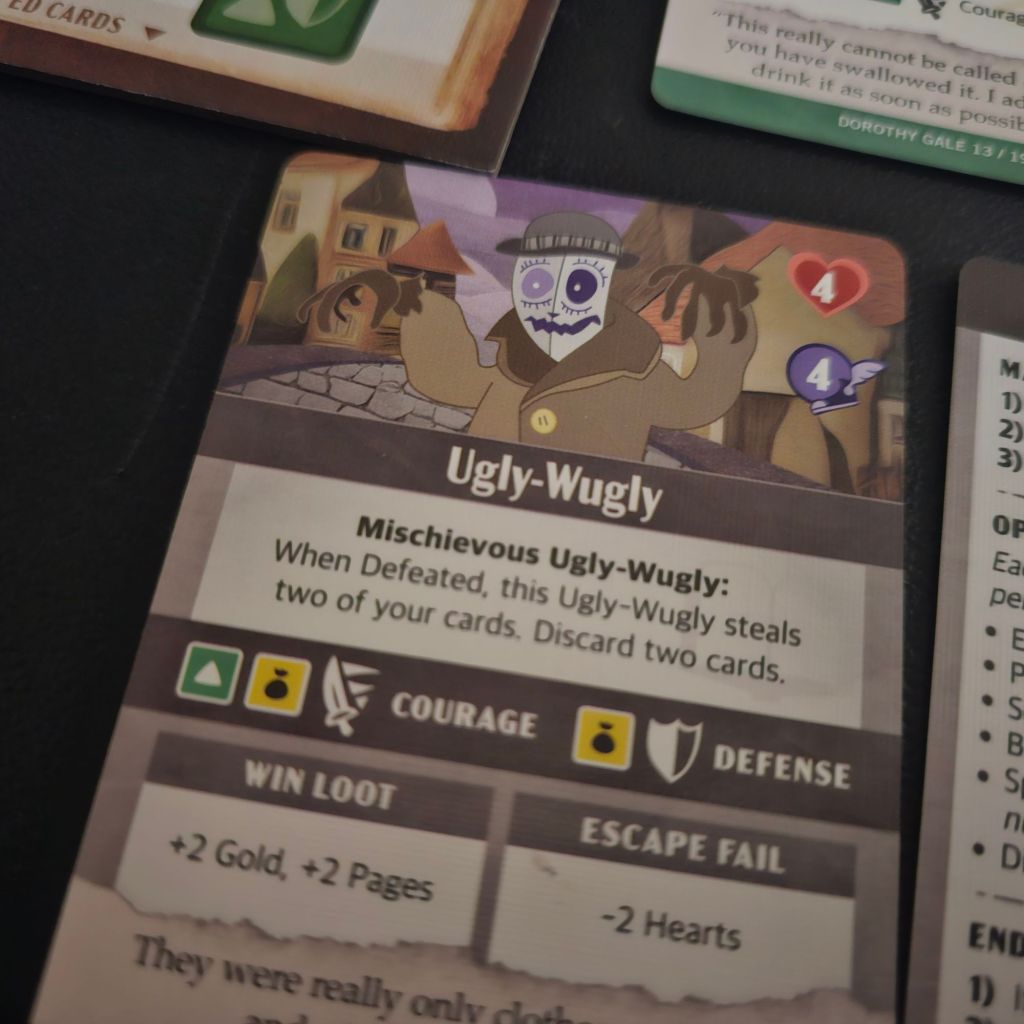
Enemy Cards

The main issue on the rules of Storyburg is that, by the very non-linear nature of the game, rules are explained in chunks without any of the flow. That can a bit overwhelming at first, so it starts to really click once you playing it makes more sense. The game is, however, not particularly complex so one read before reading and a few consultations on the first few games are enough. However, there are a few spots where the rules are vague or not clear enough, mainly on what occasions players take full turns and when they do not.

One thing I wish it was clearer on the rules or any appendix is the initial organization of cards once you first open and setup the game. It would help to set the initial flow and organization.

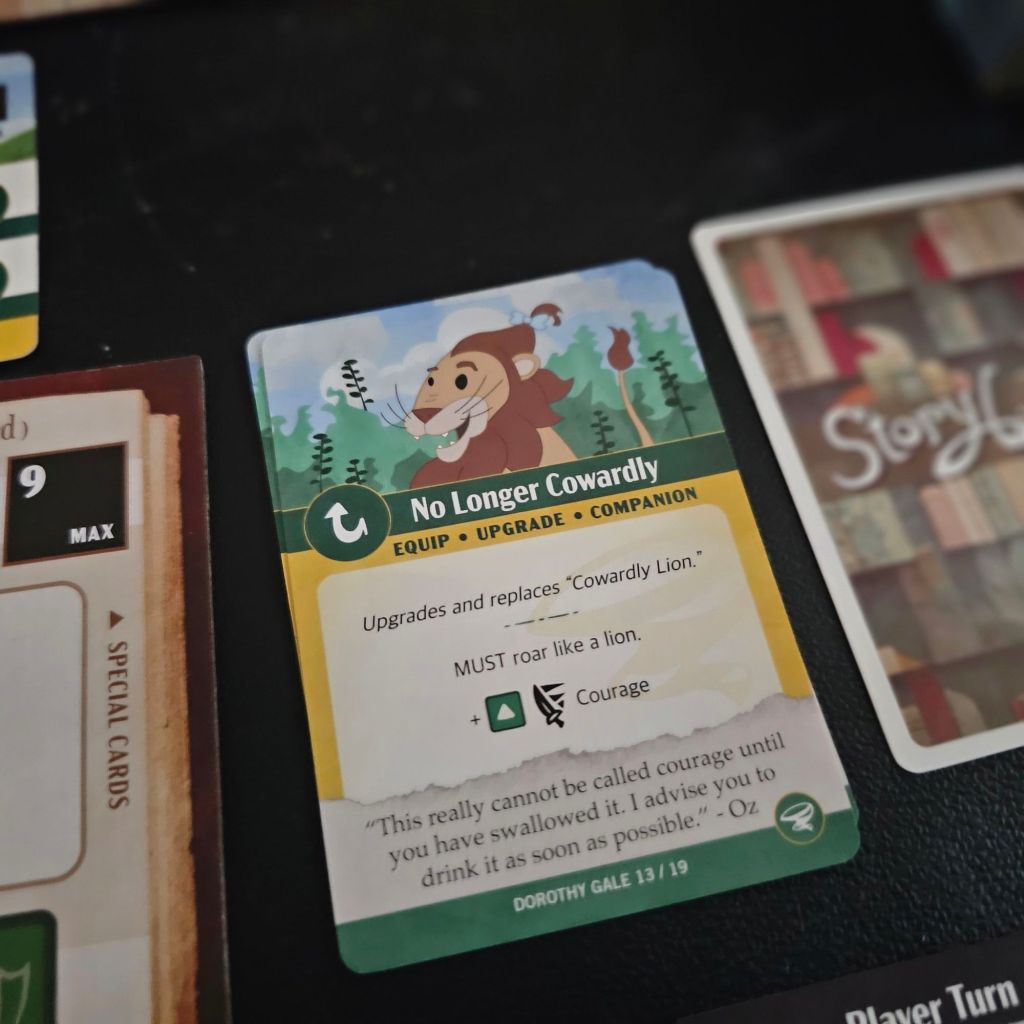
The cards are fine quality, not great, but they are well laid out and organized with a good mix of iconography and text. The player boards could be a little bigger and more well organized. The main example of this is the fact that you can only have one item of each type, but there is no spot for each type. Not a huge deal, but not ideal either.

Score: 7.0 / 10

Gameplay

Dice Assembly

I’m going to preface this section to make something very clear: Storyburg will not be for everyone. This is a narrative experience backed by a game, not the other way around. If you go by a strictly gameplay perspective, this game is a bit on the simplistic side, with quite a bit of randomness from the dice rolls and a slow paced deck-building and character progression flow.

When you take that, and combine with the actual narrative flow and use that as the main driving force of the game, it makes much more sense. Gameplay is designed to be unobstructive and direct, making the actual narrative choices the main gameplay element of the game. In a sense, this is an elevated version of the old choose your own adventure books.

Since this is a story driven gameplay, your enjoyment will depend on how much you enjoy the narrative aspect of the story, as both cannot be considered separately. As I am a theme driven gamer, my score on this will be reflected as such.

Score: 7.5/10

Theme and Art

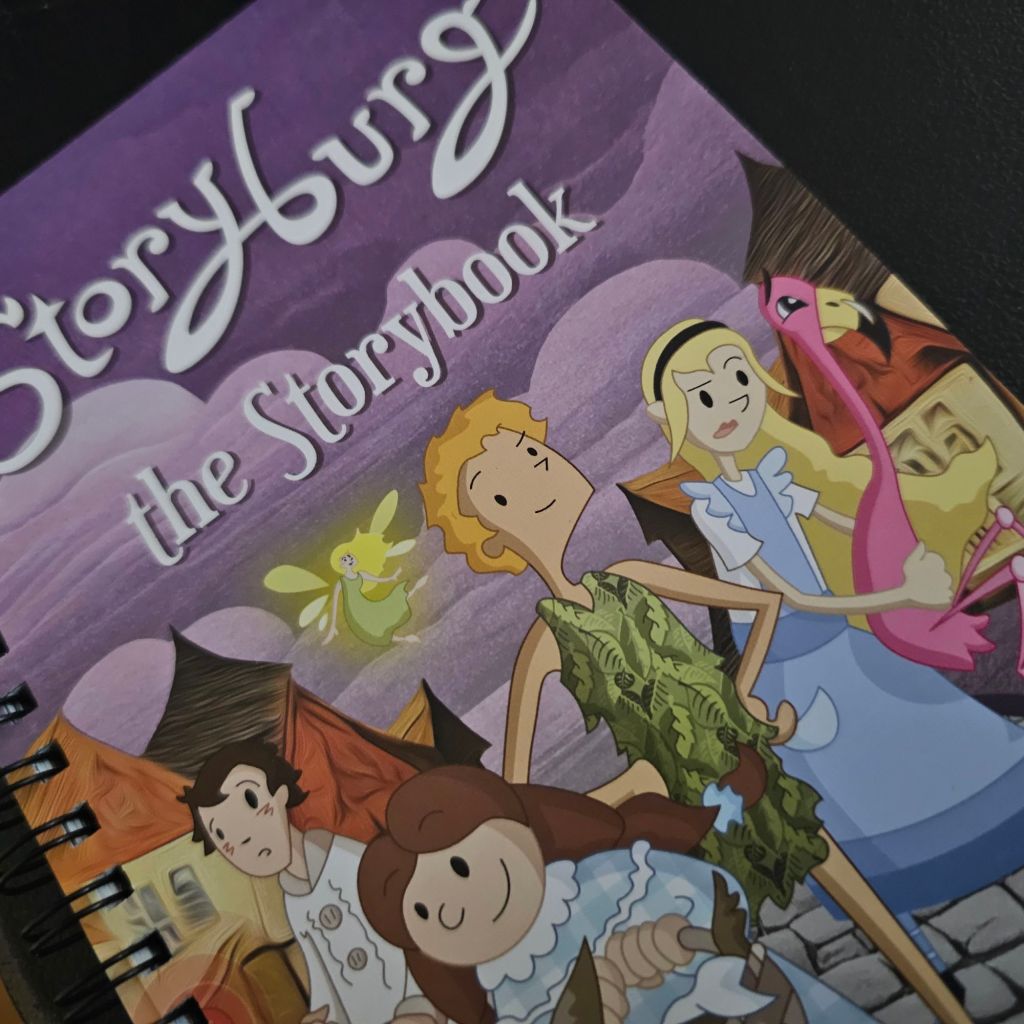
The Storybook

I will be brief here on the theme so I won’t discuss much on the actual narrative choices on the storybook. That is a big part of the game, so I will analyze that but not give much context.

Before getting into that, I will start by saying that I absolutely love the art. It is whimsical and child-like, as if they were actually part of a children’s book. That helps to set the tone of the whole adventure. Even the iconography and dice faces follow this style.

On the narrative side, between the book, events and enemies you face, it does still follow this same whimsical feel, but it has just enough depth to keep players interested and engaged.

Score: 7.5/10

Conclusion

I can’t be clear enough on this: this is a game about narrative and theme, so your enjoyment of this game will depend completely on how you are engaged by the story elements. Even though it is meant just to be an introduction, you will know on chapter one if this game is for you or not. This is, in my opinion, a niche game.

It is my niche though. I love the unique flow of the gameplay, the simple game choices that are there to aid the narrative choices, and the story kept me engaged throughout. I never took this game too seriously, nor do I think it takes itself too seriously. This is a cozy game to enjoy over a cup of hot cocoa (with a lid, please, don’t endanger the components).

It works great as a simple solo adventure, but I do feel like having more people to share the narrative and choices enriches the game a lot. I had a great time going through all the chapters, and I can easily say that I don’t feel like even after concluding the story that it is done. I feel like coming back, approaching it through different lenses, make different choices and see where it will take me that time.

Rules and Components: 7/10

Gameplay: 7.5/10

Theme and Art: 7.5/10

Score: 7.3/10

PnP Review

Let’s Preview More: Rollin’ Campus

1-5 Players

Designer: Rafael Lozano

Publisher: My Turn Games

Link for the Campaign

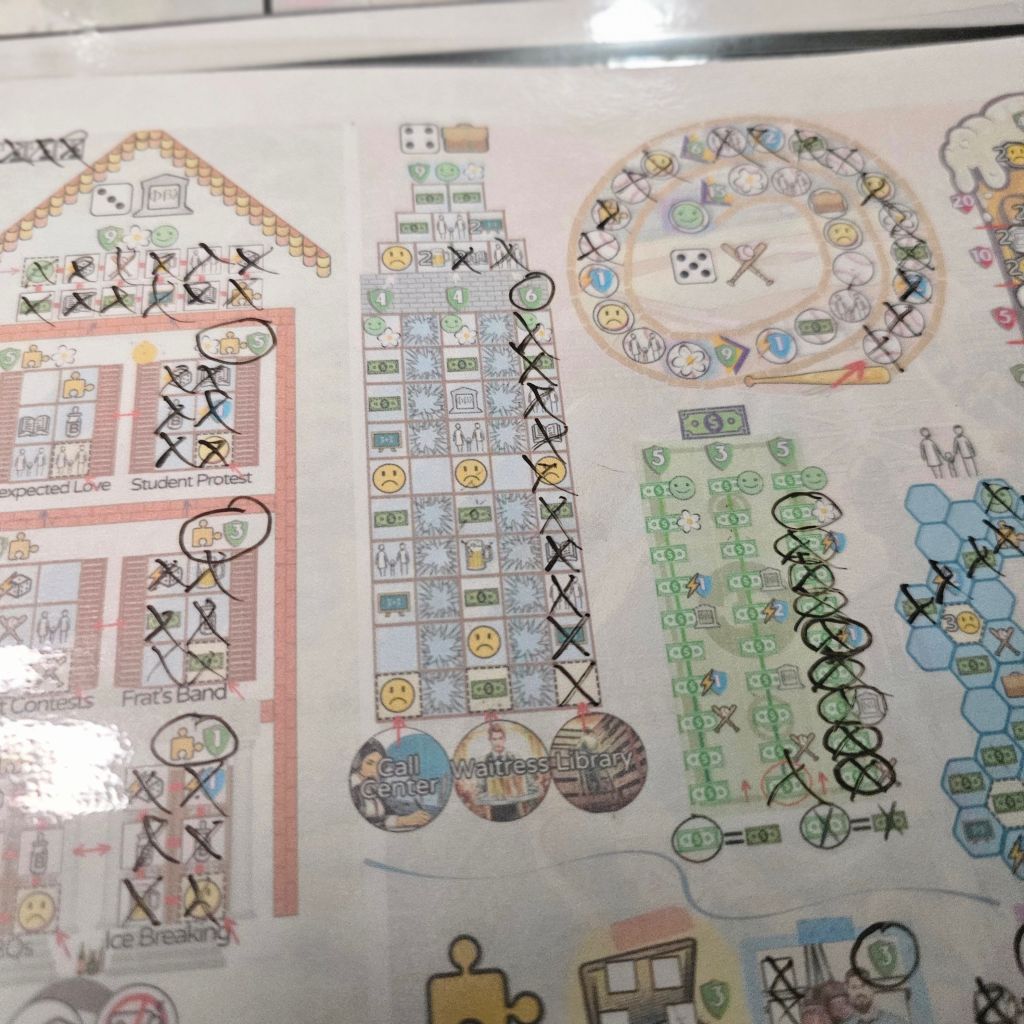
Live (or re-live) the days of university in Rollin’ Campus. Using dice, live the Greek life, get a lousy job, try to live up to your family expectations, and maybe, just maybe, go get some study done. But is this an A+ effort or does it just flunk the rest?

How to Play

Help Sheet

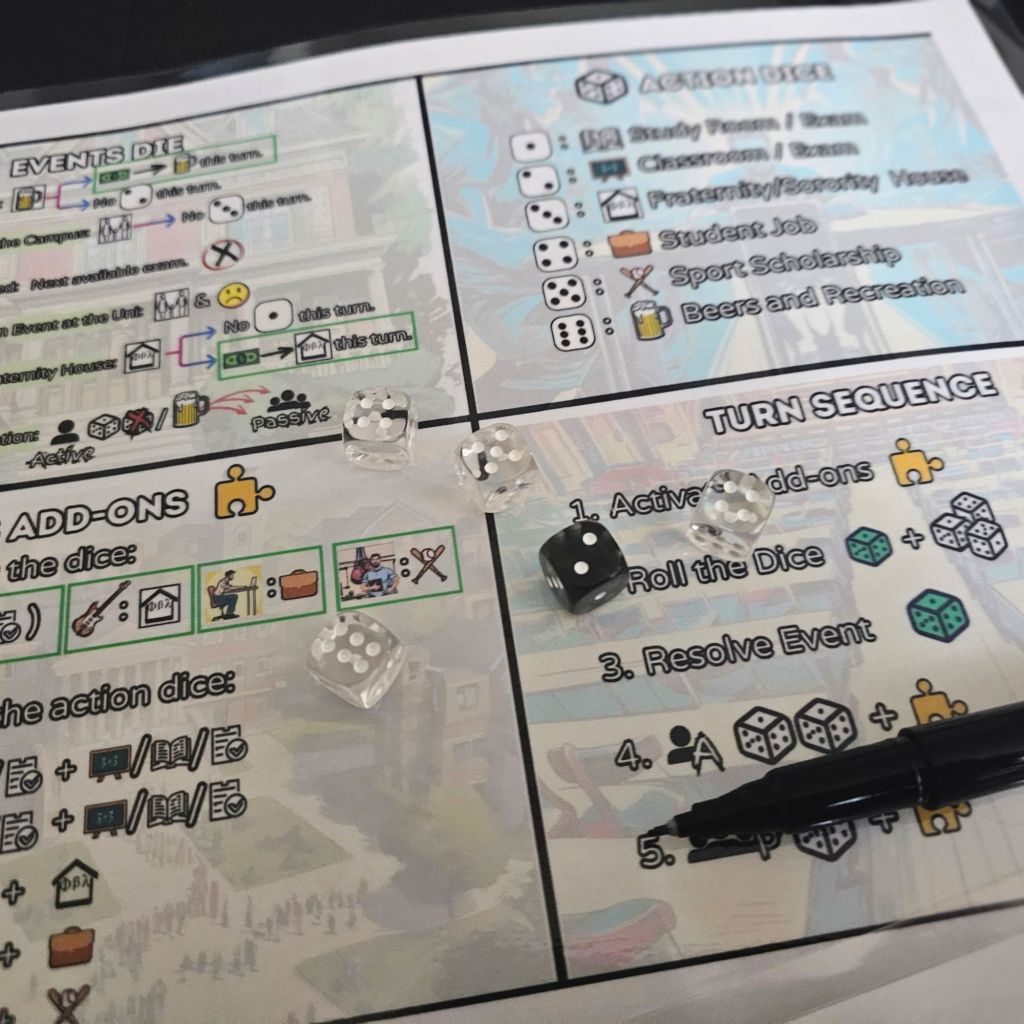
At the start of each turn, first thing is to activate your add-ons. These will give you free bumps on their respective tracks and additional moves if you assign dice to them.

Then the active player rolls the event dice and all the regular dice. The events affect everyone, adding some tracks, preventing others from being used or other various effects.

Then the active player will use a number of dice depending on the player count. Each dice is associated to one of six tracks: study, classroom, Greek life, student job, sports and, least but not less important, PARTY TIME.

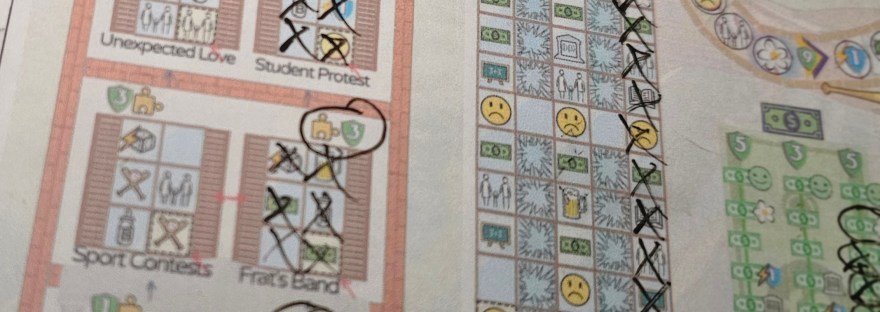
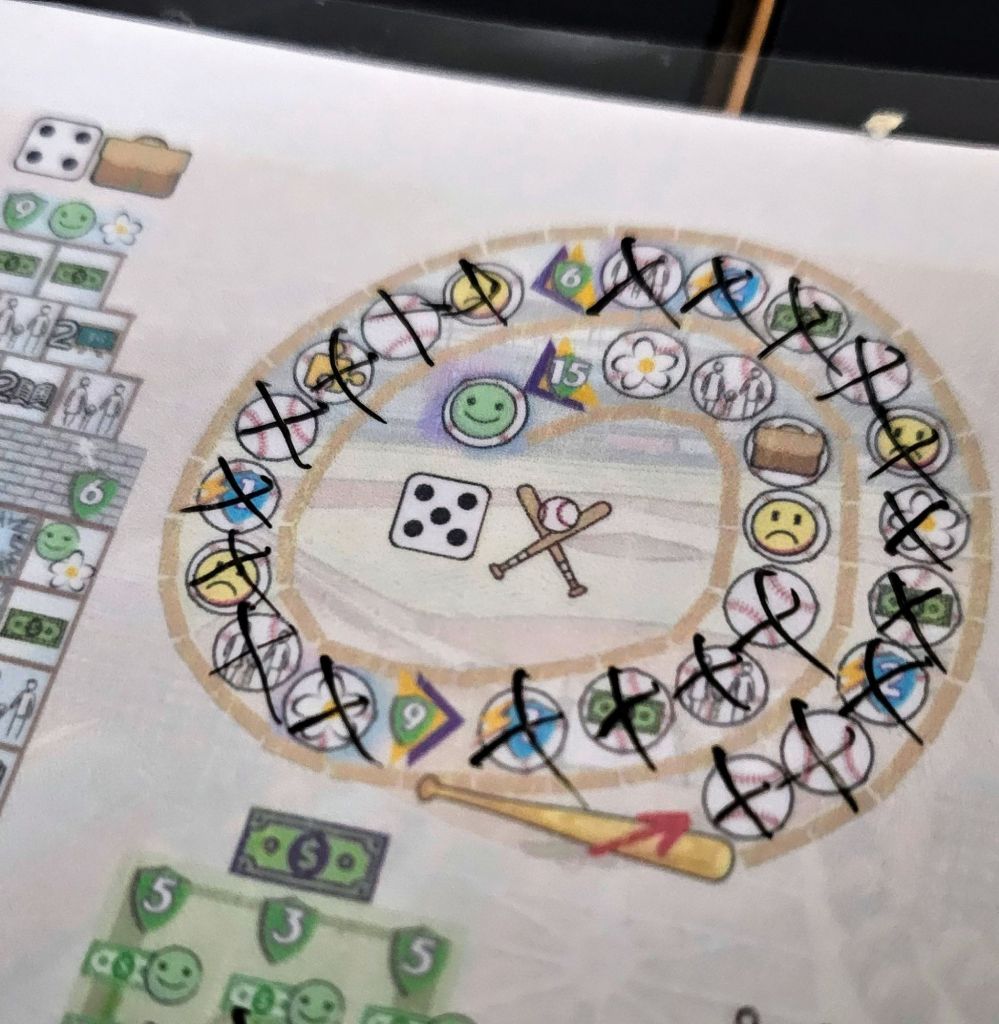
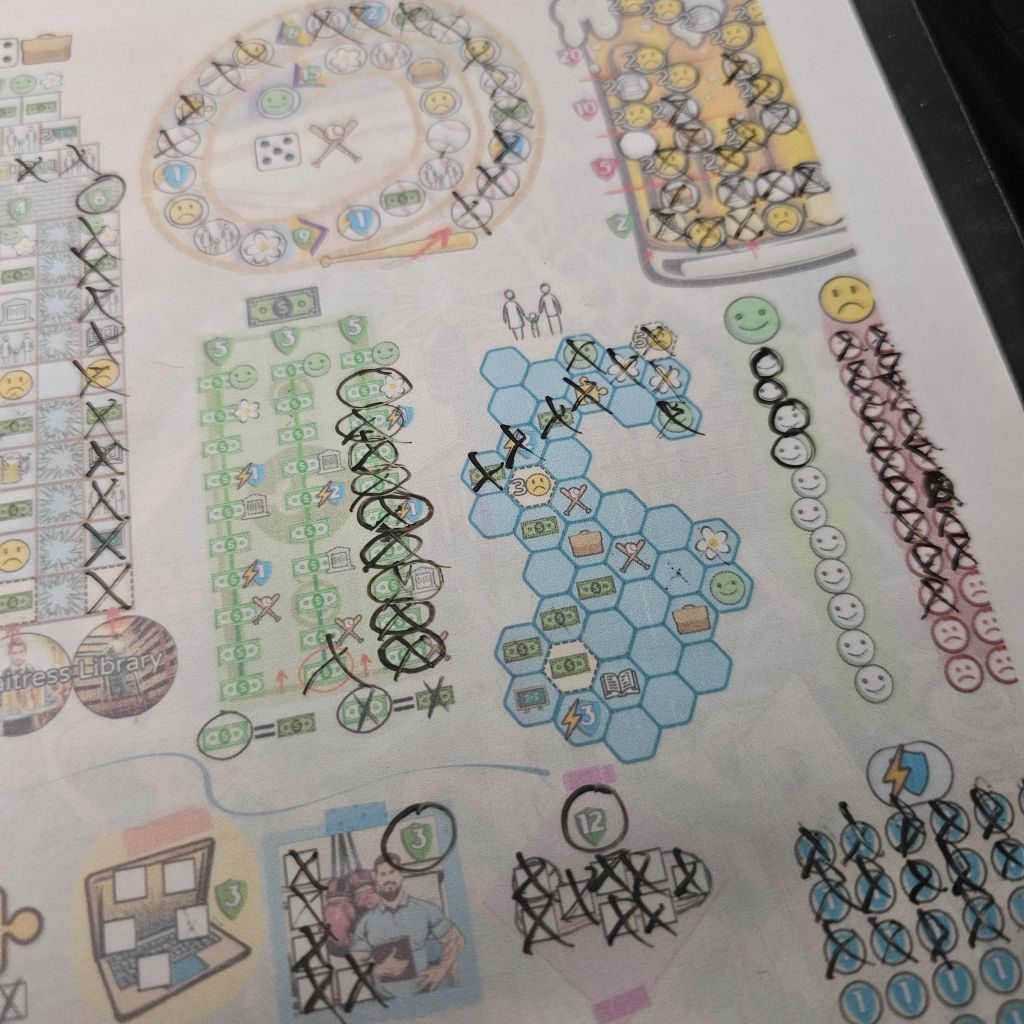
Each track will move in different ways. Study and classroom are complementary to advance in classes, sorority / fraternity house will move up in groups, sport are a simple linear (well, spiral really) and so on. Moving up the tracks will also give you movement on other tracks. There are also three tracks that cannot be directly be assigned but move according to the others: money, family expectations and maturity.

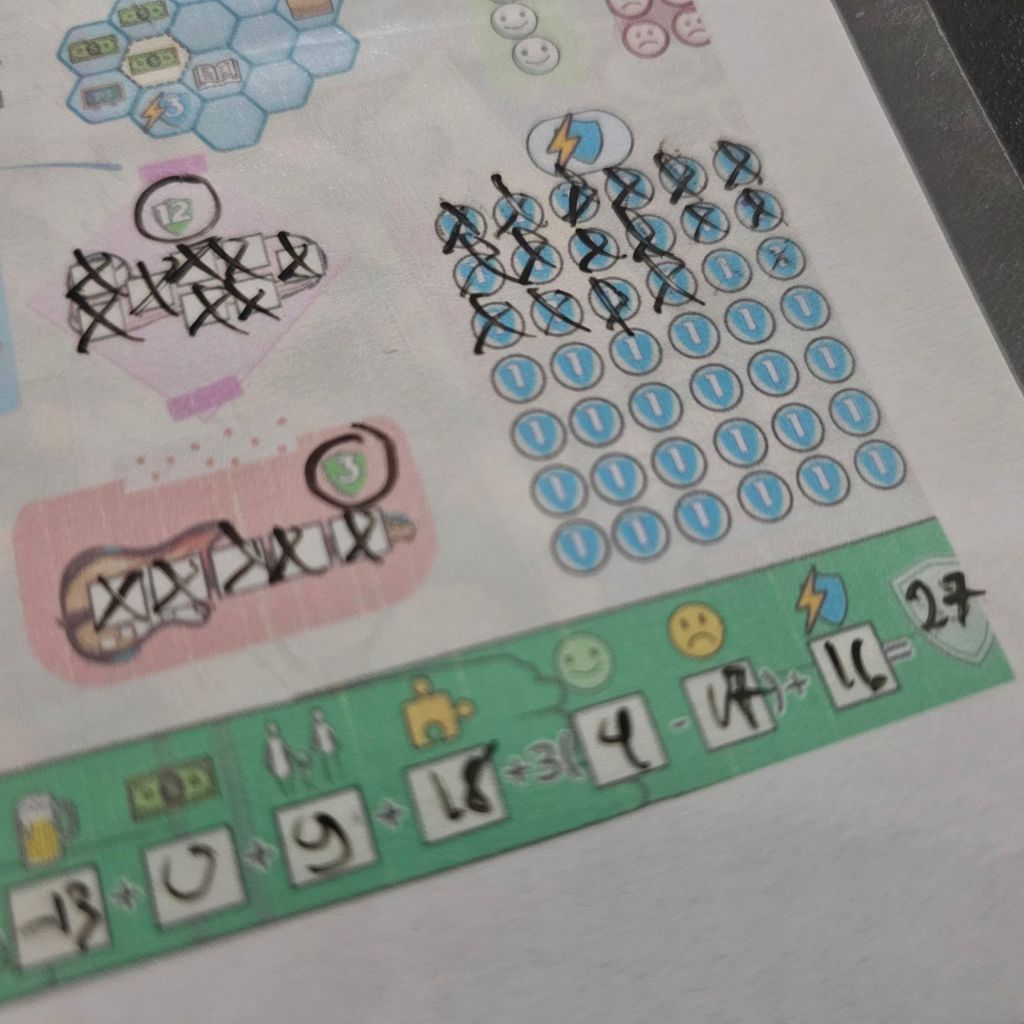
After a certain number of turns, game ends. Each track gives you a number of points according to completion. There is also happiness and sadness tracks that are accounted, most points win.

Rules and Components

Sports Track

Rules are well organized and nicely illustrated. They are a bit sparse, leaving some areas unclear, but this is an early prototype and, as it appears with my interactions with the designer, they are quite keen on improving quickly.

The sheet itself is super duper busy. I mean, we have tracks and tracks and tracks. But, I appreciate how the iconography is clear and easy to distinguish, and I feel a big Hadrian’s Wall influence, which is always a compliment.

I would love to see this as a double sheet just to have bigger icons. That might be my old man’s eyes, but I prefer to have clearer glance. And, again, that might be a possibility in the future.

Gameplay

Different tracks

As I mentioned earlier, this takes great influence in big ping-pong-y comborific roll and writes and condenses it down to a 10-15 ordeal which, at least for me, the exact length it needed to be. Most games I end with that feeling that I wish I just had a turn or two more to squeeze in more points. That leaves you wanting to be even better next time.

I also quite enjoy how different the tracks feel. While I’m not totally sure about the balance as it is now, that is something that could be easily tweaked. But in my many games, be it as a nerdy hard working fellow or a party time jock, my scores have been all within a fine range.

Theme and Art

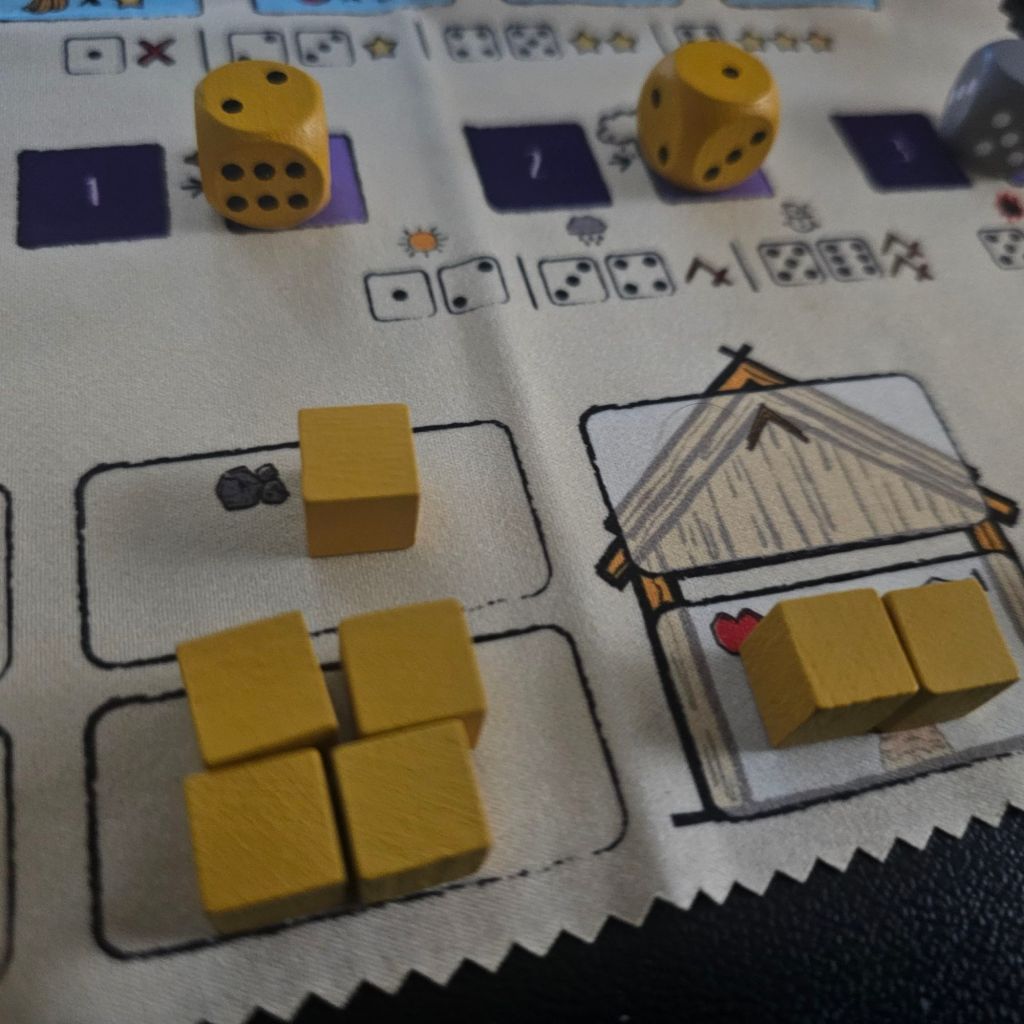
Job and Money

The way each track abstracts the experience with it is really smart. Some jobs earn more, but leave you unhappy, while working on the library pays nothing, but it does make you smarter. Being good at sports is tiresome, but makes you mature and your family proud. And you have to party either too little or so. much to become a legend. Anything else is just waste of time.

The sheet itself has a nice sloppy look, it does feel like college. The icons are a bit bland and generic, but then again they look very Microsoft Word-ish, which is entirely appropriate. That’s how I would put it: this looks, very thematically, as a college student was creating it.

And the reason why I say it is like this by design is because the rules are other materials related to the game are beautifully illustrated with very refined art.

Conclusion

Score

Rollin’ Campus is a game with purposed contradiction: it is comborific but quick, smart but chaotic, tense but silly. It’s great game if you want something the offers the feel of intricate strategy but in a coffee break (or beer break more appropriately) timeframe. There are some refinements needed from now to release, but not that gets in the way of fun.

Preview

Let’s Preview More: SkyCraft

1-99 Players

Publisher: NukaZombee

After a few very bleak releases, NukaZombee comes out with a whimsical journey through a land of orcs, alchemy and air balloons. But is this journey going to soar but is the orc’s curse is just too much?

EDIT: A few corrections due to a rules misunderstanding.

How to Play

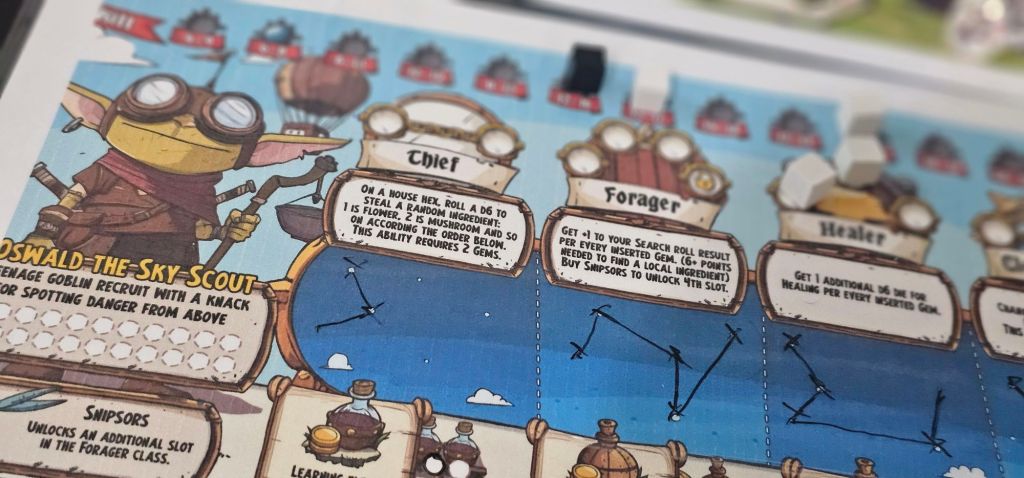
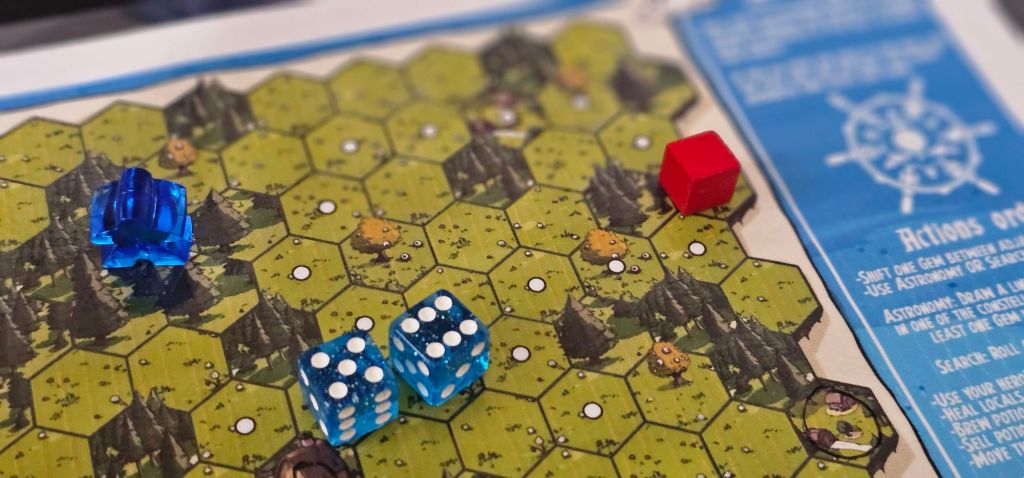
To setup, put the enemy on the first spot on its path, your character in the middle and gems on the spots on the player sheet and map. Each turn is broken into three steps: move, actions and enemy movement.

To move, the player rolls two dice, one sets the destination and the other for the move amount. If the player acquired any constellations they can use them to change one or both of the values to get to specific spots.

On the actions, first the player can move one of the gems between the classes to get different bonuses, then getting ingredients or mapping stars. Then, depending on where the player is, they can get more ingredients or heal the villagers . Finally, the player can craft items and brew/sell potions. After that, the orcs advance one space, two if the player went off of the edge of the map.

The player wins if they are able to get the healing skill to max and do one more healing, and lose if the orcs reach the final spot, the King.

Rules and Components

Take this section with a grain of salt, since this is an early preview copy and lots can and will change. As of know, the rules have a great and vibrant layout and use a lot of visuals to show each element of the game. However, as of now, they feel incomplete and a few spots are unclear. Again, early preview copy. The game is perfectly playable, even if a mistake or two are there.

As I mentioned, the visuals are clear, vibrant and rich. There are two sheets, one for the map and one for the player. The player sheet works great, rules are embedded on each spot and they work really well. The map, while beautiful, lacks a bit of usability, specially a spot to clearly see which villages are there.

Gameplay

SkyCraft is not rules heavy, but it’s surprisingly thinky and requires a lot of planning to be successful. Movement is the main challenge, just getting to the right place and getting the right ingredients or skills at the right time. There are four skills, and you can only move laterally and one gem per turn. Having flexibility with the movement will probably mean that you are not healing or foraging as well.

Healing is a bit odd. You have one die, plus one for each gem on the healer class, and you have to roll within a range, not less or more. Whenever you succeed you advance on the skill, if not you move back. The odd part is while you do move towards having more gems as your skills increases, it also requires more dice and a harder roll. It’s not always advantageous to skill up.

Even with these hurdles, as of know the game is fairly forgiving in terms of the challenge of completing the goal before the orc gets to the final spot, specially when there is a potion that moves back the orcs a whopping 20 spots.

Theme and Art

I absolutely love the art for this game! The characters, both the one available on the preview and the ones announced, are goofy and have a lot of personality. The map is also interesting, with even spots that share a type being unique.

The theme for the most part comes through as well, with the character just flying around the land and, in my mind, tossing healing potions right to villagers head. There are a few spots that I feel it could be better.

One, it bothers me to no end that we are stealing from the villagers we are trying to save. It could be donations or something else, but stealing just feels wrong. Also, the orcs as of now feel mostly just like a timer. They are not a looming scary presence that can cause havoc, they are just walking around up until the next step.

Conclusion

Despite my criticisms, I feel like SkyCraft is a blast to play. It’s a game where you take very little to get into, but then slowly start to realize that if you don’t plan right, you will not do well. It’s a game about understanding the odds and planning your turns ahead of time, and when you are able to pull it off you it’s exciting.

Unsurprisingly, there are a few balance issues, but even with those the game feels rewarding and complete. And, on top of it, knowing that there will be extra characters I’m super excited to see what they are going to bring to the skies.

NukaZombee has a knack for making longer roll and writes feel like a breeze, and I feel engaged the whole playthrough. If a thinky but whimsical adventure is up your alley, you will find a great game here!

Review

Let’s Review More: Deck of Wonders

1-2 Players

Designer: Dennis Furia

Artist: Lauren Brown

Publisher: Furia Games

Deck of Wonders gets the whole idea of dueling TCGs and boils it down to one single deck, shared by the player and the rival. But is this deck really or wonders or does it leave you wondering?

How to Play

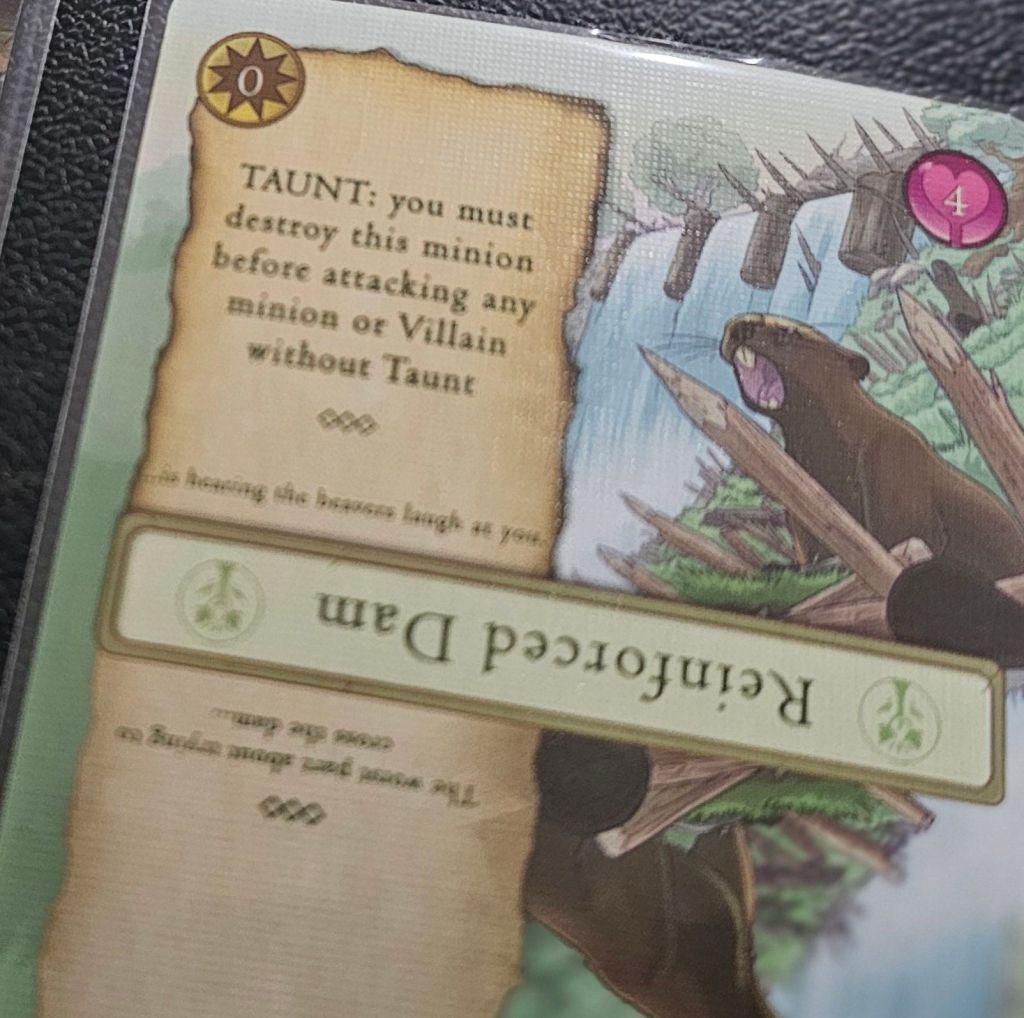
Minion card

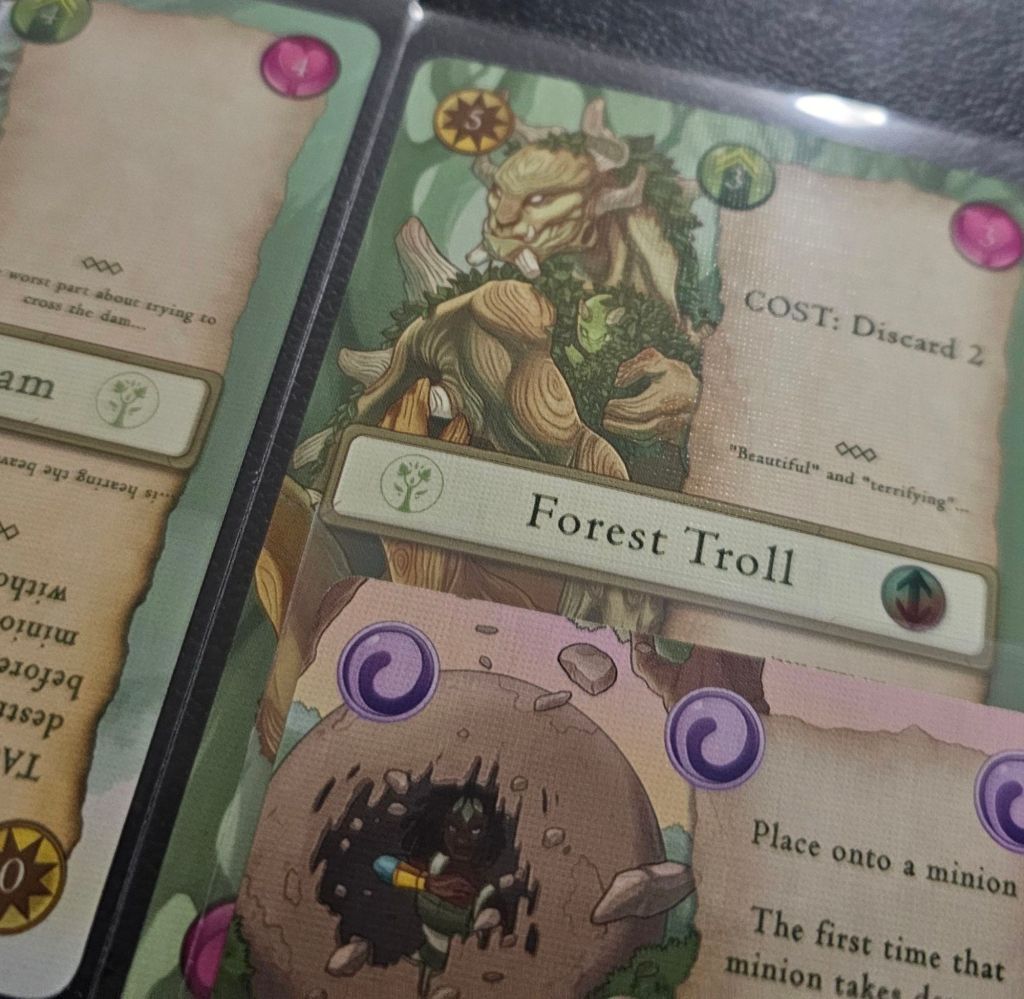
To setup the game, you first to setup the deck. You get all the cards for the villain you’re facing, then a number of base cards. The base cards have a “suggested color” so the base cards with the green icon go well with the green villain, but they can be mixed in any way.

You then shuffle and deal 4 cards to the player and the game begins. At the player’s turn, they can play any number of cards they want and are able to. Cards are paid by discarding other cards. Creatures you play are ordered by their priority, and cards with the same priority you decide. Then you can use your ready creatures to attack either the villain’s cards or the villain itself freely.

Then it’s the villain’s turn, where you simply draw and resolve the top card (except for the first turn, when 3 are drawn). Then their creatures try to attack your highest priority creature they can kill. Any left over attack you directly.

Game continues until either the player or the villain  are reduced to 0 life. The game comes with a campaign mode where you unlock more cards and modification to cards by achieving certain conditions during the game.

Rules and Components

Minion on Enemy Side

I found the rules clear and well written, but they do lack in examples and illustrations that would make the understanding easier. However, I didn’t find myself lacking for the most part, but there are some doubts regarding specific cards and interactions that deserved an appendix or FAQ.

The game is all based on the cards, and thankfully they are very readable and easy to understand, even being double sided. It helps that the texts are never too wordy.

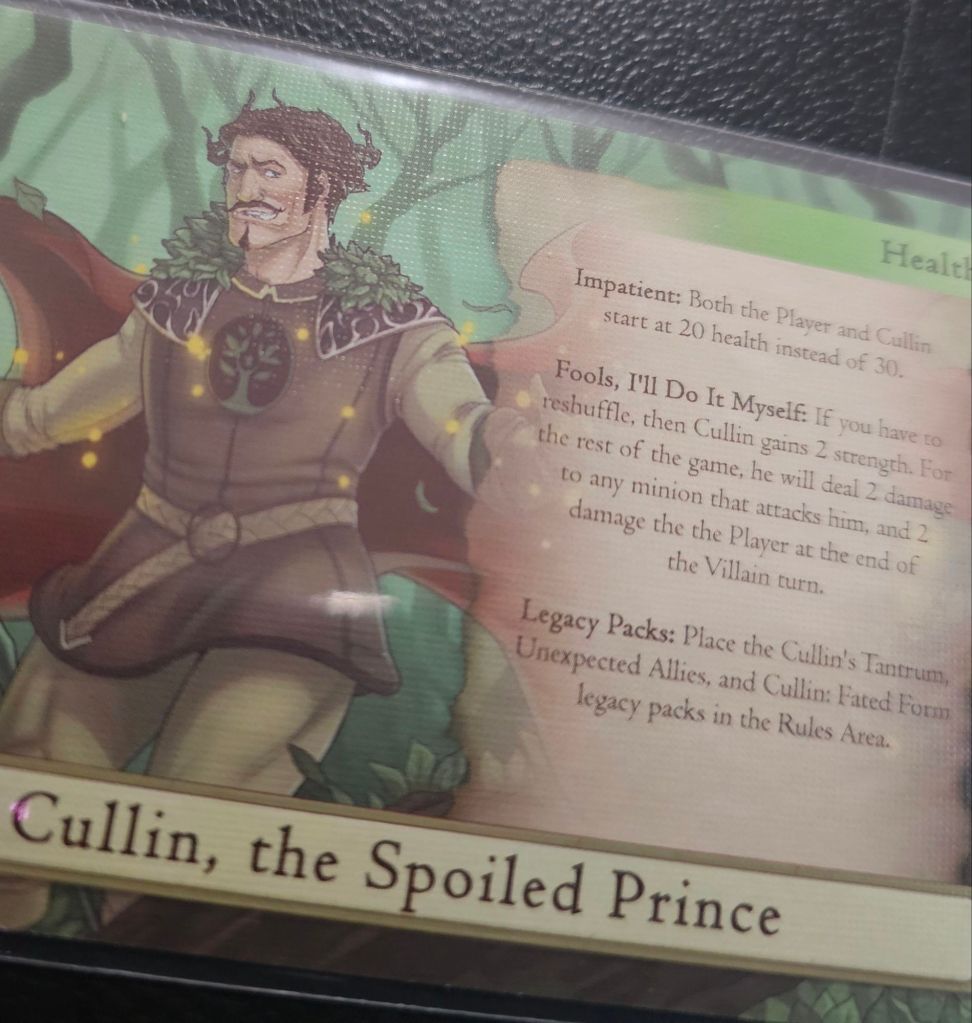
That being said, the font used is too small. That is noticeable on the minions, but it’s even more so on the villain cards. There is a lot of text regarding setup and gameplay elements, and the font is super tiny. In my opinion it would have been better to have more cards or use it double sided.

Finally, a minor quibble, but I think cards that don’t go on the main deck should not have the same cardback as cards in the main deck.

Score: 7.5/10

Gameplay

Villain Card

The game inspiration is clear, being Magic the Gathering and other dueling TCGs. But it threads a thin line between having all those elements available for the player while simplifying the villain side. And it does so very well. Villain’s cards attack in a predicate manner and are organized by the player, while the spells have very specific targets.

The players decision space is all about resource management and figuring out how to outsmart the villain. The cards on the villain side are both more dangerous and attack immediately, while the player’s minions have to wait a turn. But the player controls its own minions in terms of priority and how the enemies attack.

The decision space is quite interesting, with a lot for the player to decide on the risks they are willing to take. But the game has a steep learning curve, not for the rules, but for its tactics and strategies.

Part of that is because the game can be very swingy. The cards are well balanced for the player in terms of utility and cost, but there are some that are just better. If the villain happen to draw those or draw certain spells at the right time, the game can get to an unwinnable situation, sometimes even from the start.

Score: 7.5/10

Theme and Art

Theme and Art

There is a lot of theme in this game. It takes its time in setting up the world and each villain. Not only that, but as the campaign progresses, each new pack brings in cards that not only add mechanically, but make sense thematically and evolve the characters and scenario presented.

Adding to that, the art on the game is really high quality. And, despite the game being packed with information they need to convey, the art is on full display. Not only that, the art is color coded. Cards from the green base set and green villain have lots of greens, so at a glance you can identify and place them.

All cards are double sided, and each side shows almost the same art, but one for the player and one for the villain side. The change between each side is subtle. It’s not as simple as good side and bad side. It’s things like a wolf just running or running with its teeth bare.
Score: 9/10

Conclusion

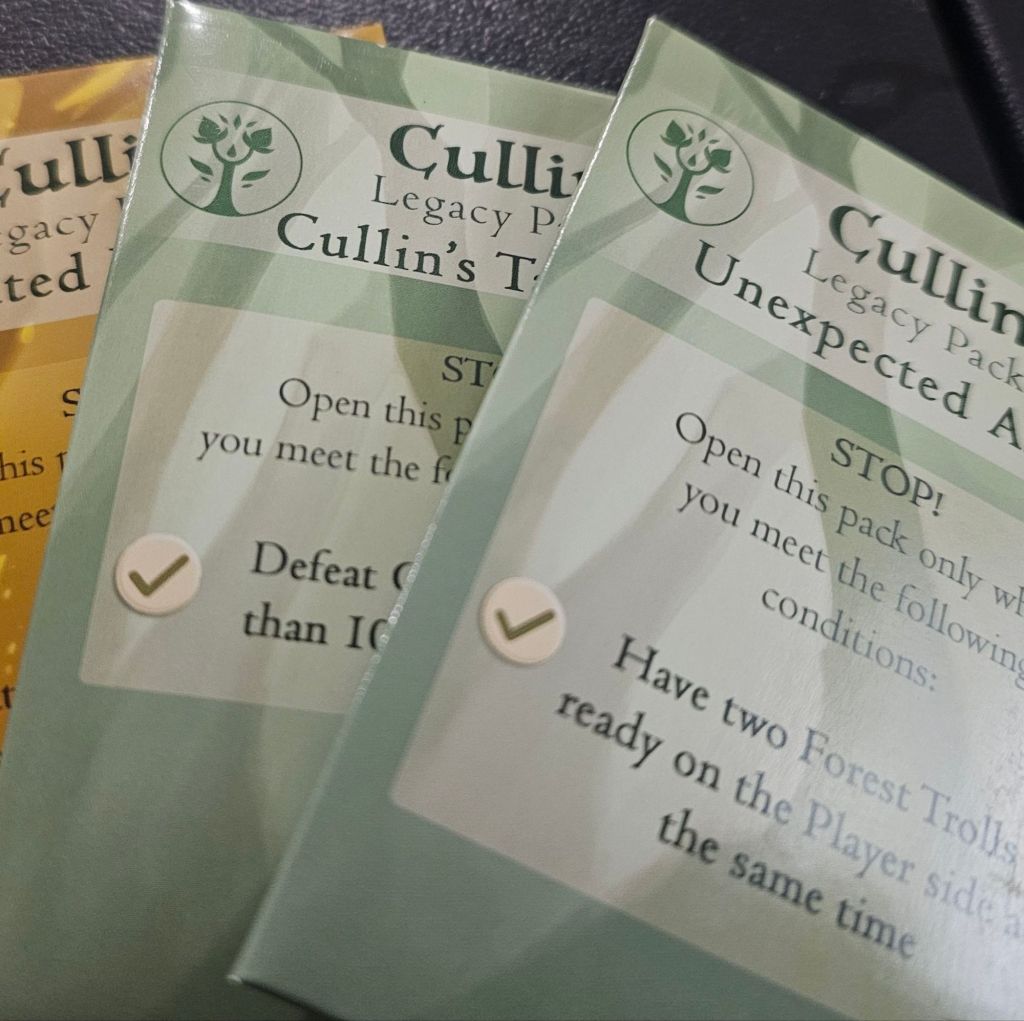
Legacy Packs

Deck of Wonders is a small game with big ambitions. Trying to boil down a full game to a single deck is a tall order, but it does so smoothly and successfully. It has, by its own design, a lot of luck involved. It is unmistakably a big factor, sometimes too big. But, then again, it’s a quick game, so it’s forgivable in my view.

In addition to that, the ambition goes beyond just the initial set. It has deck building aspects, cards to unlock, a legacy mechanism to it. This is a small box with a big heart.

Rules and Components: 7.5/10

Gameplay: 7.5/10

Theme and Art: 9/10

Score: 8 /10

Review

Let’s Review More: Dieson Crusoe

1 player

Designer: Jinhee Han, Heewon Kang

Artist: PASIO

Publisher: Best With 1 Games

Crusoe is lost in an island full of danger, dice and rondels, and it’s for him and his friend to overcome this and survive. Is this game a great adventure or should it be fed to the wild animals?
How To Play

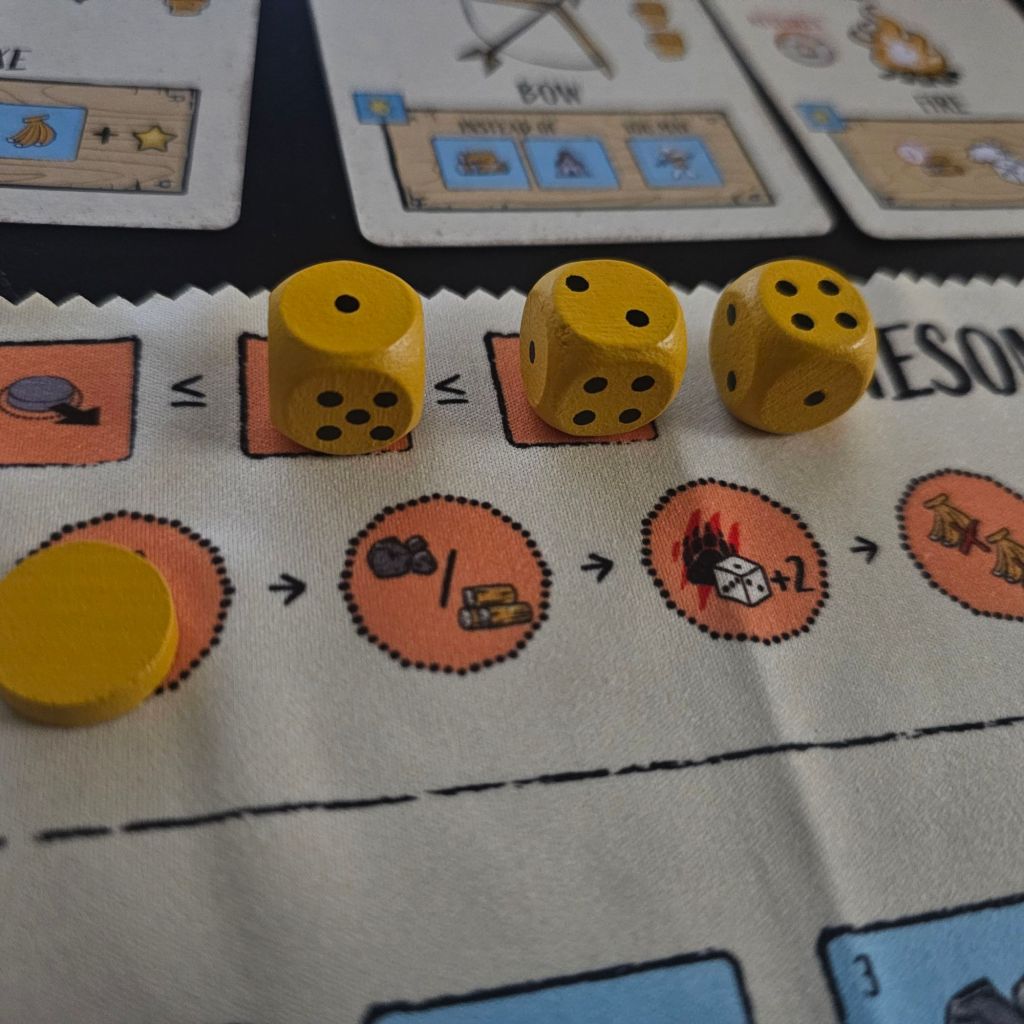
Dice and event rondel

To setup the game, put the two cloth mats side by side. Put the meeples on the map on the action rondel, and markers on the event rondel and day tracker. Also get all tools and pick one character, one friend and one mission card.
Every day is split in morning, afternoon and evening. On mornings you roll the 3 available dice and put them in crescent order. The lowest value moves the event marker on the rondel and triggers a new event.

Then on the afternoon, the player chooses one die at a time, advance the meeple in the action rondel and either take the action, advance the marker on your friend or build a tool. Each die value gives the player 0-3 stars to use in certain actions. The actions vary on building your shelter, getting resources, moving on the map or hunting. The stars also determinate which tools you can build.

During night, you first eat a food, then depending on the value of the die placed there on the turn before it’ll trigger the weather (which will damage your shelter or you) and animal ambush (which varies by the area your in).

You win if you achieve the mission on your quest card, which usually is building a specific tool, getting to certain area on the map, hunting a certain animal, etc. You lose if you run out of health or out of days.

Rules and Components

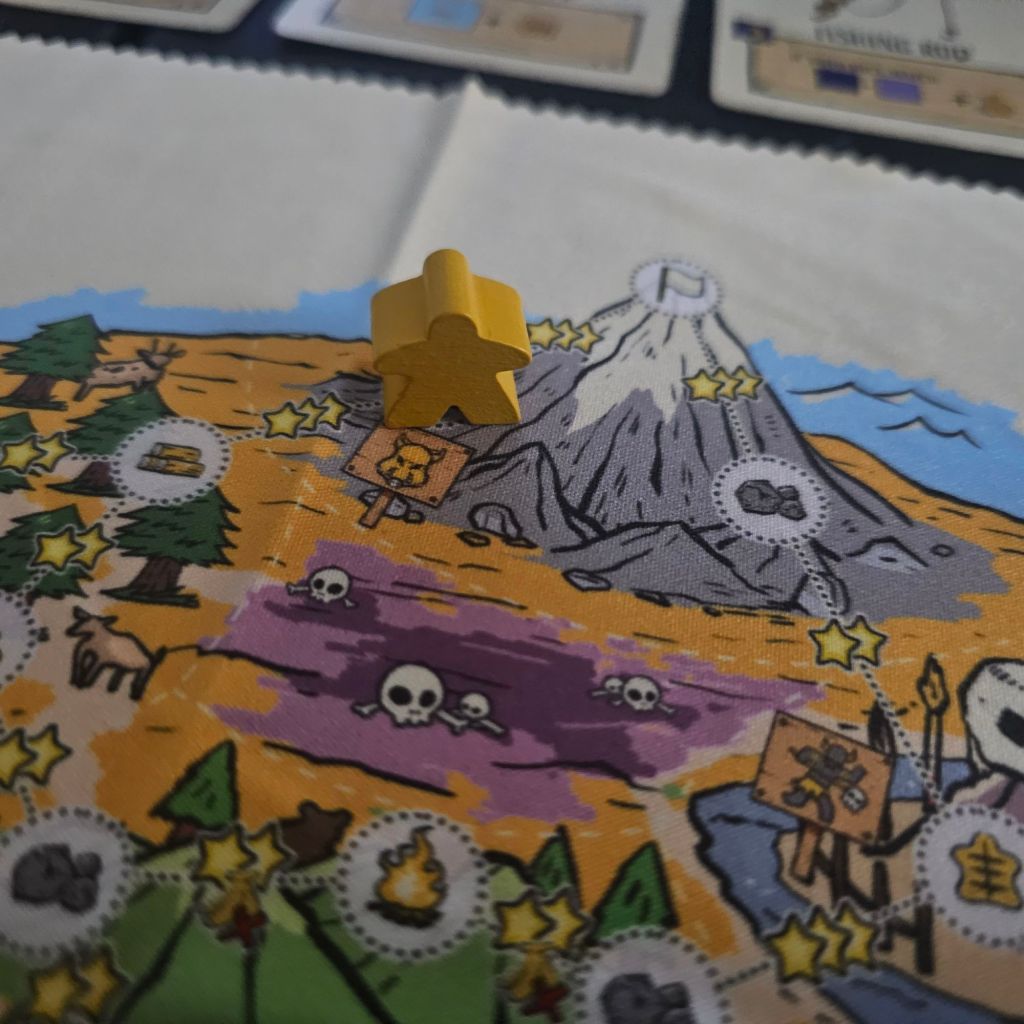
Meeple on the map

This was originally a PnP, and just now got published. I think during this time the rules were tweaked and refined by the designers and it shows. Rules are clear, concise and, for the most part, comprehensive. There is also a big section for individual cards, which I appreciate.

The game comes with two cloth boards, which are super nice, but they are small and that causes a few problems. The map is hard to read from a distance and the spaces for the resources can get cramped and block their information.

All the rest is relayed through icons and they very functional and clear, specially after a few games under your belt.

Score: 8/10

Gameplay

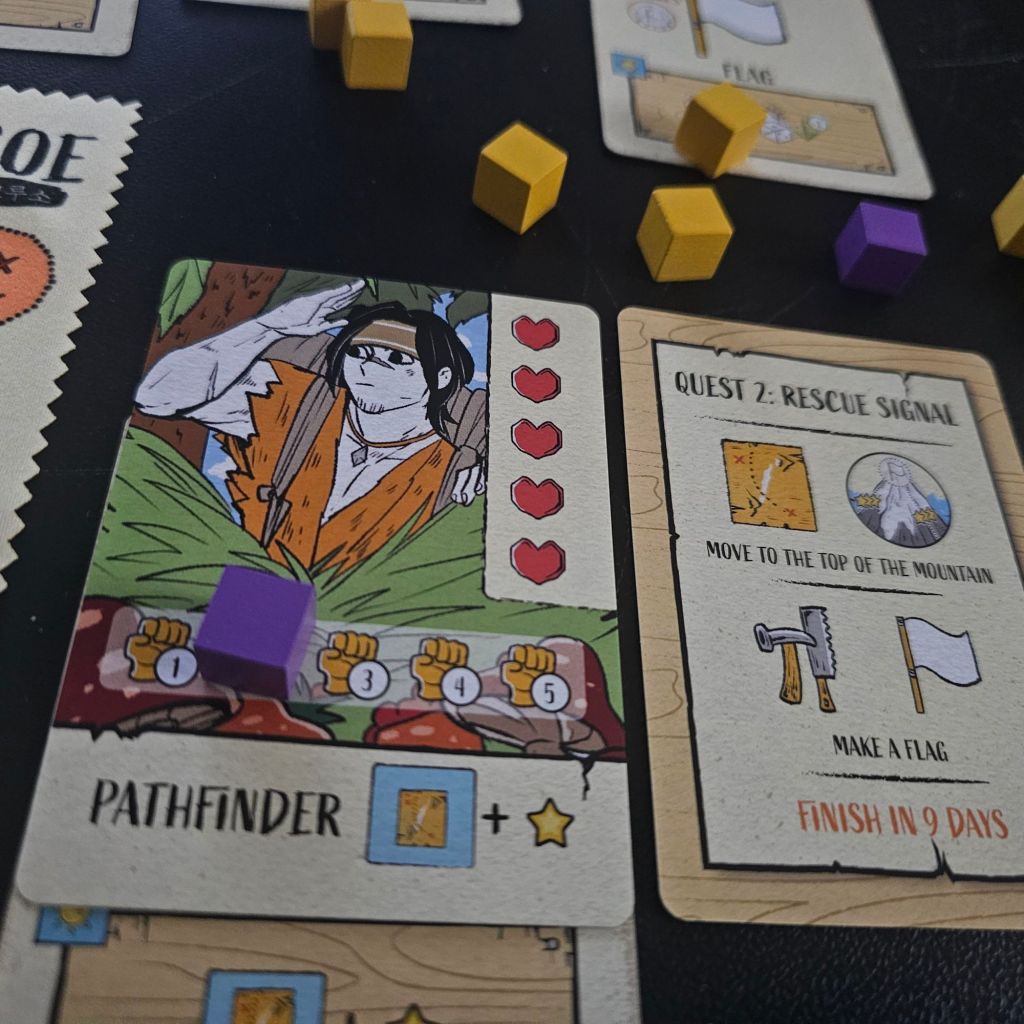
Character and Quest

Dieson Crusoe is an intense game for its duration. It’s an interesting mechanism to have larger numbers on the dice be better for actions, but also more dangerous. Also, I like that every resource has a secondary effect to manipulate the game state in some manner, but it’s also something that you will not use often as things can get tight and you need them for tools and buildings.

It has a nice tension arc, where the danger rises as you progress through the island and through the days. It gets more dangerous, but you also yield more resources for exploration and hunt. I feel like this is a well balanced, albeit tough game. Don’t let quest 1 fool you.

Score: 8.5 /10

Theme and Art

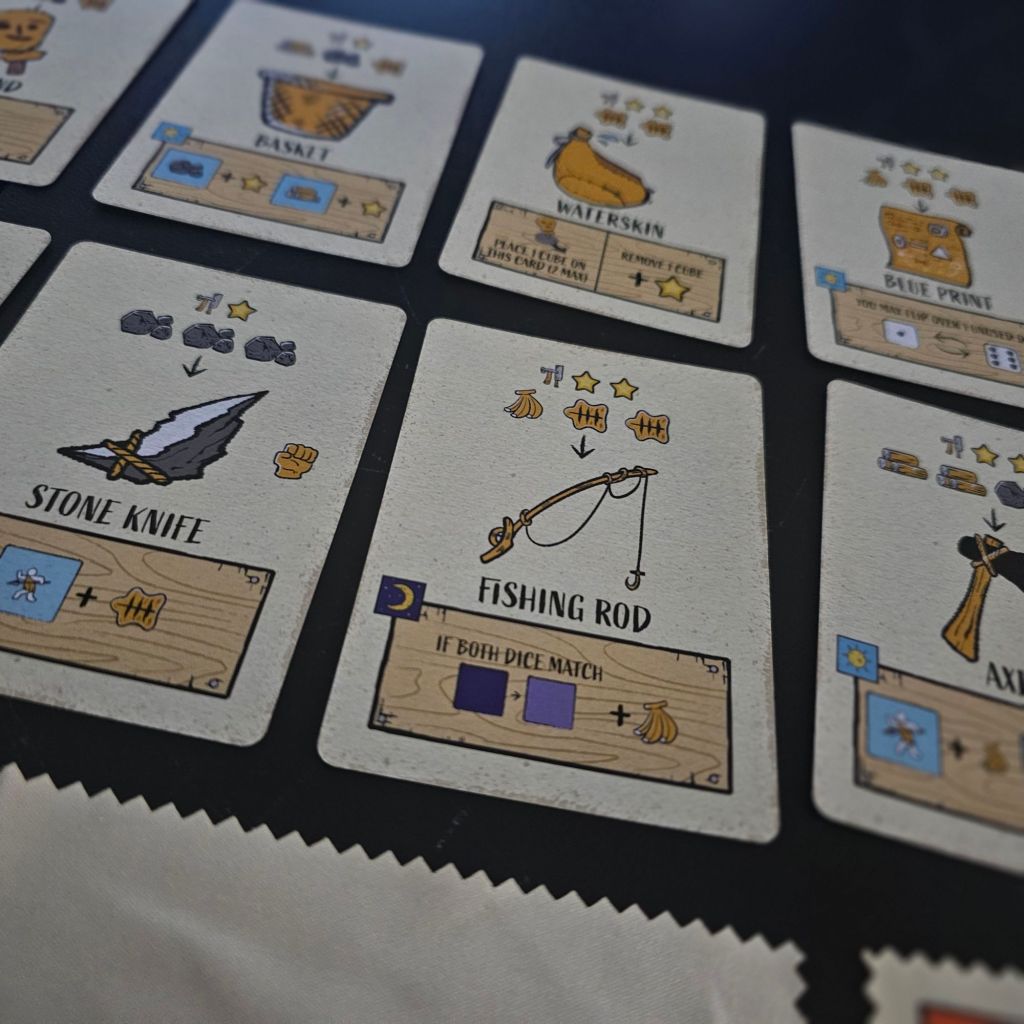
Tool Cards

The artwork and design is fairly simplistic and quite clean, but it does have a very distinctive look. It for the most part favours usability, but the game still looks great on the table.

The map is where you will find the most details, but it is very evocative of illustrations on books. Robinson Crusoe is a story told many times on baord games, so it’s well known. Dieson Crusoe takes that and uses just the right elements to evoke parts of the story without being too complex.

Score: 7.5/10

Conclusion

Resources

I think it’s no secret that this game was inspired by Robinson Crusoe: Adventures in the Cursed Island by Ignacy Trzewiczek, but condensed down into a 30 minute adventure. You can recognize easily the DNA, and I felt right at home instantly.

But that’s not all it is. It has its own unique mechanisms that are engaging and fun. I really like the action rondel and the way the dice used determinate the bad things coming your way. Knowing when to be risky and when to play safe is a huge part of the game.

I feel like this is a very solid and tense solo experience that will have you coming back to beaten time and again. My impression is that this game was designed by and for players, as lots of PnPs are, and got a deserved polished release.

Rules and Components: 8/10

Gameplay: 8.5/10

Theme and Art: 7.5/10

Score: 8/10

PnP Review

PnP Review: Warriors & Writings

1-4 Players

Designer: Nathan Wells

Artist: Murzabaev Roman

Publisher: Nice @ Dice Games

Pulling out from the old days of TTRPGs, Warriors & Writings throw you in a dungeon to find treasures, fight monsters and confront the big boss. But is this a treasure to be hoarded or does it deserve its place in the darkest of pits?

Disclosure

A copy of the base game was very generously donated by the designer for this review. However, I will do my best to give my full honest opinion.

How to Play

Goblin’s Den Map

To setup the game, each player needs their own character sheet (that can be different) and a map sheet (that should be the same), as well as one map reference and one action reference to be shared.

The game goes for 40 turns, and during each turn two dice are rolled, and players use them to take actions. There are no basic actions in the game, all actions available are in the character sheets, and they are mostly about moving or attacking. Players go around the map fighting monsters, getting treasure and exploring. The goal is to defeat the map boss, and then have the most gold.

Solo gameplay is the same, you’re just aiming to beat your own score in gold while still defeating the boss under 40 turns.

Rules and Components

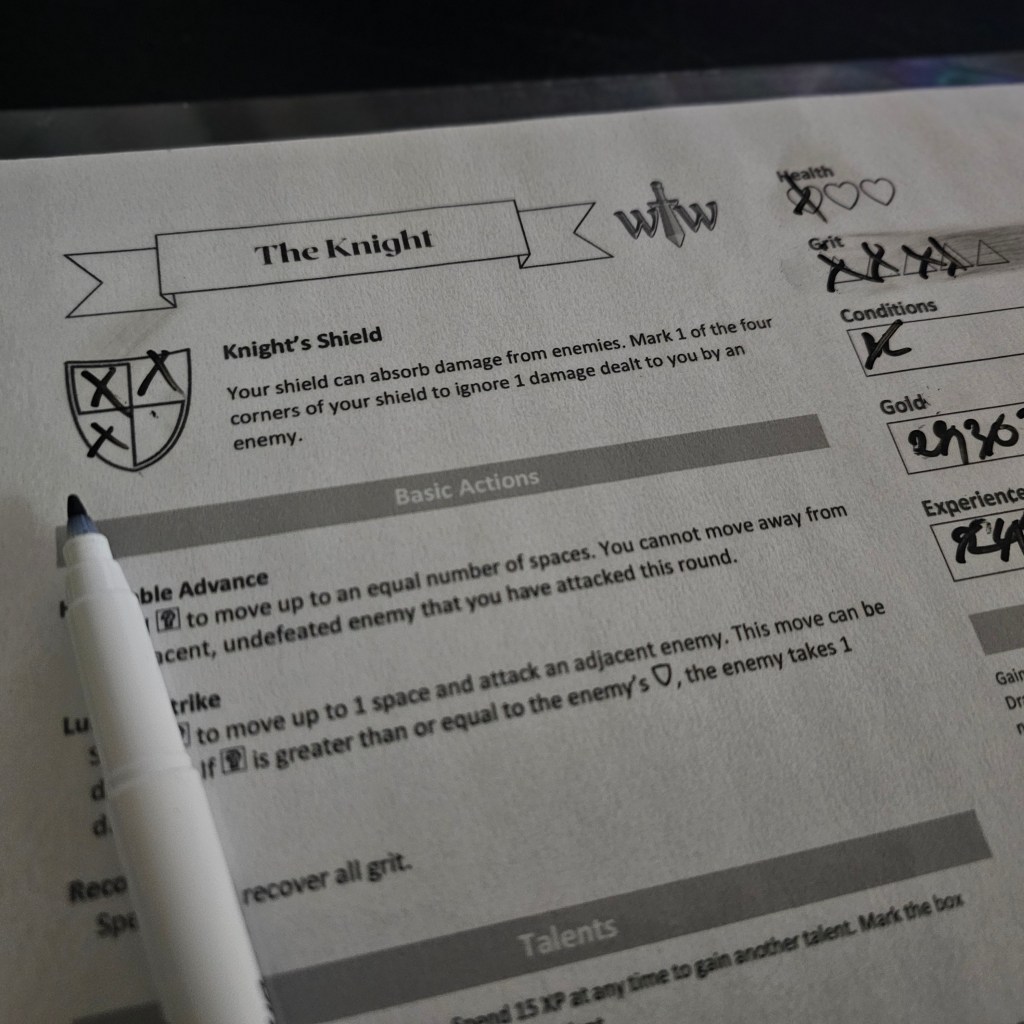
Knight Character Sheet

Rules are well written and clear, leaving little room for doubts even on initial plays. They also have plenty of examples of gameplay, which is always appreciated.

Components are easy to use, with simple symbology and plenty of references to simply consultation during play. Unlike most print and play games that you could just print and use as a one time use, W&W is a game that requires laminating, specially the character sheet. There is a lot of writing and erasing resources, and can get quite messy at times.

For the map, the way it’s intended to be used is to write your path as you go, but I found that this too can get messy and confusing, specially if you are returning a lot to the same places. There is one particular map, the Wizard’s Tower, where this becomes particularly bad as it requires you to walk the same paths multiple times. I found that using a meeple or token makes it considerably better.

SCORE: 8/10

Gameplay

Character on map

It can seem that 40 turns is a lot, but this game is snappy. Turns are lightning fast, and those 40 turns go quickly. It is a thinky one though, as on one hand you’re trying to bolt to the boss, but you also need to get treasure along the way. Time is your main enemy here, and often you need to leave stuff behind or just tank the hits.

Also, each character and map require its own strategy, and it does change a lot. One thing, more noticeable on solo than on multiplayer, is that the rolls can really make or break a run. Yes, there is mitigation in the form of grit, but if you’re rolling a lot of lows you’re going to move slower and have a harder time.

Still, it’s a game where you rarely feel out of options or just going through the motions. It’s engaging and a ton of fun.

SCORE: 8.5/10

Theme and Art

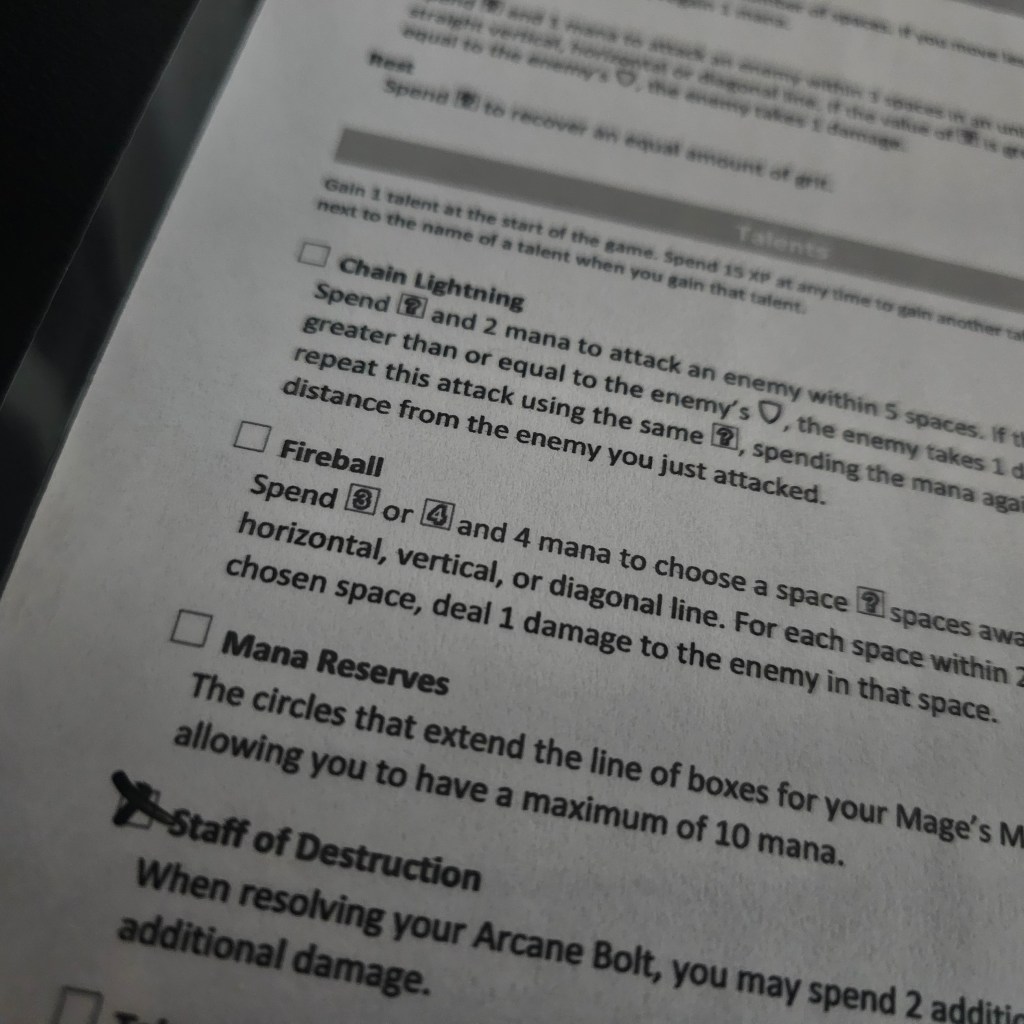
Mage Talents

I’ll preface this section saying that will be a huge caveat on my analysis. Bear with me.

Theme is clear, it unapologetically evokes the old TTRPGs in every aspect, and it does so very successfully. It is a distilled down version of a dungeon run on those games, but every aspect feels thematic. The two characters are very distinctive, with the knight lunging forward while the mage needs to move slower and manage their mana. The three maps on the base game are also filled with unique and interesting twists that make them come alive.

This game art is pretty bare bones. Aside from the illustration on the cover of the rules, everything is just black and white writing, boxes and icons. There is no illustration of the characters, no backdrops or details on the map or on the characters.

But, as for the caveat, this look is exactly what you would get on the TSR age of Dungeons and Dragons. A cool artwork for the cover, and just black and white inside. If you lived that, like I did, it feels right at home. It was a bold, but I feel like a deliberate one. But it’s one that needs that nostalgia from the player to work.

SCORE: 7.5/10

Conclusion

I tried my best to keep my review as neutral as possible, analyzing the game on a modern lens, and on that we find a simple looking but intensely engaging and highly thematic dungeon crawler.

But I feel like I am the exact niche this game appeals to. I didn’t just play TTRPGs, that was my childhood and teenage years. So I felt at home, every aspect clicking in a special way that triggers my nostalgia bad.

In either case, I would give this one a go. The decision space alone is enough to make interesting games.

Rules and Components8/10
Gameplay8.5/10
Theme and Art7.5/10
Final Score8/10
Review

Quick Review: Tiny Epic Crimes

1-4 Players

Designer: Scott Almes

Artist: Nikoleta Vaszi

Publisher: Gamelyn Games

About the Game

I will be honest, I was skeptic when Gamelyn announced Crimes as their next Tiny Epic. The theme was unlike all others, it was centered around a gimmick, and it has again co-op and competitive plays, which is always risky. Were they successful?

Gameplay

Arresting a mobster

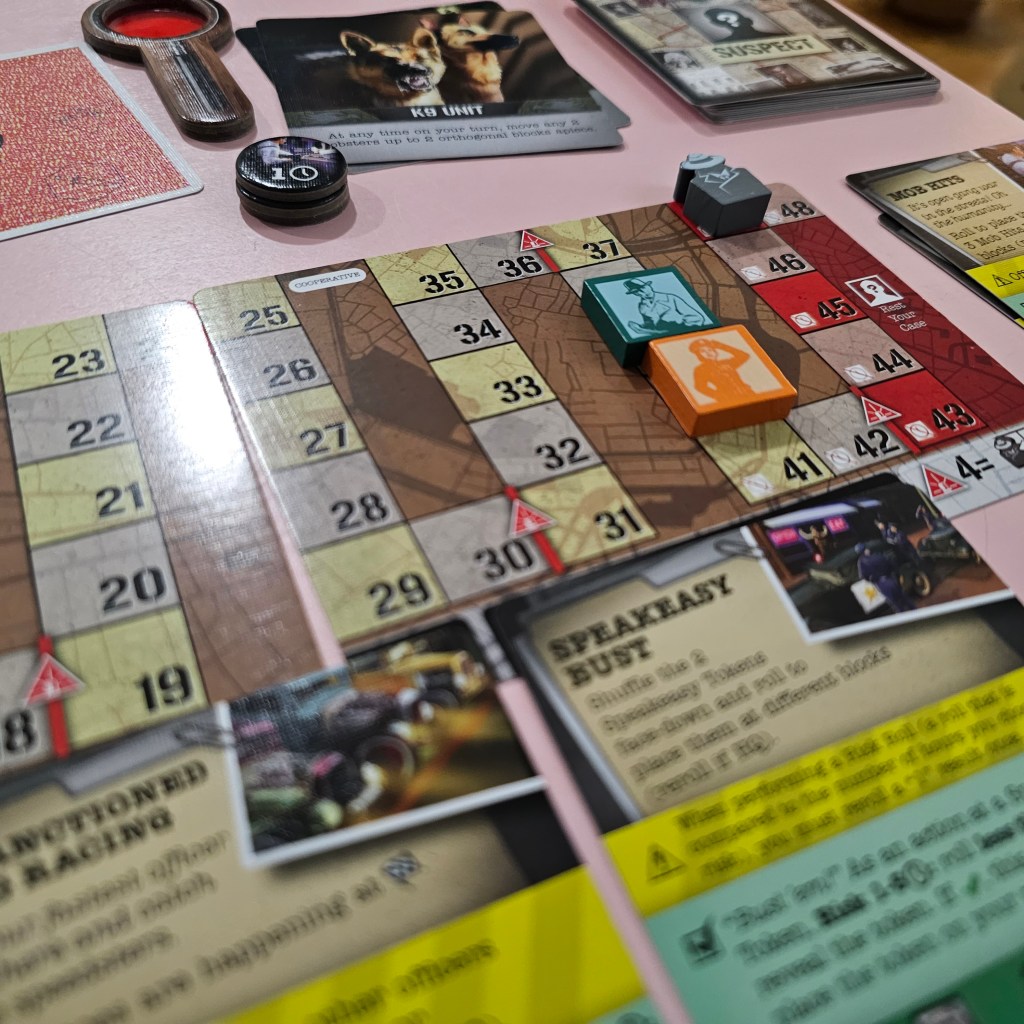
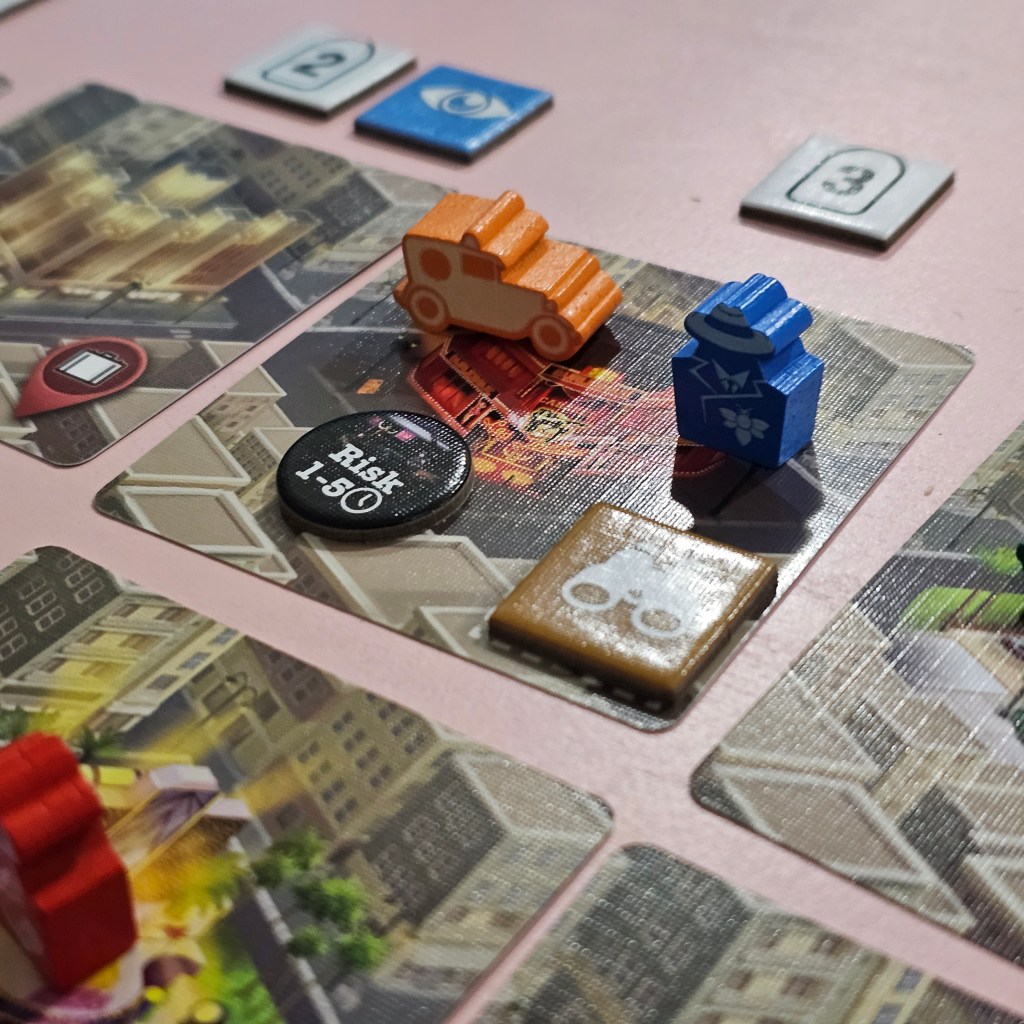
Tiny Epic Crimes uses the “active player is the last in the time tracker”, mechanism, and on their turn a player moves any amount, spending that much time, then additional time to perform an action, usually arrestijg mobsters, gathering evidence in many ways, or resolving events. Then a new mobster is placed and a new event is revealed if all players are after a threshold.

The competitive mode uses a night and day system, where certain actions can only be performed in the correct time of day. The evidence is shared, but only the last person can review it at all times, and there is a bigger influence of individual suspects (which are private.

The cooperative mode doesn’t time of day, instead each player can only perform certain actions. Also, the time can be reduced if there are too many events or mobsters on the city.

Solo Gameplay

Cooperative time tracker

Solo is basically two player co-op, like most of the cooperative Tiny Epics. A really smart decision was to have the only “hand”, the force cards, be shared for both 1 and 2 players. It simplifies the game a lot without too much hit on the balance.

Components

Decoder System

Very standard Tiny Epic affair. Big cards for the players and trackers, squares for evergthing else. The wooden pieces for the players and mobsters are screen printed and great quality, and there is about a gazillion cardboard tokens for everything. Each individual event has its own unique counters, which is nice. Though some are a little tough to identify at a glance.

But, let’s talk about the Epic Decoder System, the big gimmick. It’s not anything innovative. It’s a red filter on many spots to identify characteristics or identity. It’s basically the same filter on games like Decrypto. It is simple, and it works. For the most part… Under certain lights, it is tough to make out, specially the name of the criminal.

Conclusion

Bullet dice!

To put it very simply, this is the 21st century version of Cluedo. Run around, collect evidence, accuse. It was Eve, with a knife, escaping in a bike.

As far as Tiny Epics go, this is on the simpler side. Move, spend some time, do action, spend some time. Some are fixed, some are wagers, but everything is smooth sailing. The events can get a little convoluted, but that’s good to keep this from being too same-y.

But it works, and it’s a lot of fun! Unlike Zombies, both co-op and competitive work equally well, with their unique challenges and adjustments. There is an element of semi co-op on the competitive, but you’re never getting out of your way to benefit the group.

Color me surprised. This is one I see getting attention often. I play a lot of Tiny Epic with a younger crowd, and this will fit right in their alley. But, even for me as a solo player, it’s snappy, quick and a good challenge.

Score: 8/10

Review

Quick Review: TradeWorlds: Exterra Edition

1-4 Players

Designer: Kristopher R. Kycia

Artists: Charles Vinh

Publisher: Outer Limit Games

About the Game

Tradeworlds is a game that has a very complicated Kickstarter history, among mismanagement and personal tragedies, and being delivered 6 years later. However, today I’m going to focus only on the game itself, but the 6 year period will be actually relevant.

Gameplay

The game follows a very simple and easy to remember ABCD structure. First, you select a role and perform its (A)ction, then you (B)uy cards from your own personal market, then you can (C)onfigure a ship using a ship, a crew and a weapon card, and finally you (D)iscard as many cards as you want and draw back up to five. You keep doing that until someone achieves the goal of the scenario, be it a number of credits banked or destroy every other homeworld.

Solo Gameplay

Solo play against AI

The base game comes with a solo scenario where you try to defeat a single menacing ship before it either destroys your home world or hit critical mass. The expansion that comes with the Kickstarter also has a solo AI that simulates the roles and ships the human player has, but in a more condensed form.

Components

Most of the components of the box are fine. The cards have a good finish, not great but feel sturdy and durable. The artwork is generic sci-fi, but it has a cohesive look and the visuals are nice.

Designwise, I do have some issues. First is the fact that flavor text and game text are written with the same font. It makes it harder distinguish at a glance what is relevant for the game and what is not. Also, I don’t see the need for the double sided cards. Almost all of the information on the back is present on the font, and the aspects that do use the back are fairly minor. I feel like this could have been changed and given a better experience without it.

The rulebook is also a problem. It’s vague and not well organized, making some aspects of the game confusing. It also uses a lot of terminology without actually defining it, leaving it to the players to have to understand by context. The good thing is that the designer is active on BGG, so most of these are just a search away.

Conclusion

Homeworld board

This was a messy Kickstarter campaign, with so many falso promises and the unfortunate passing of one of the designers. His father took on the task of getting this game out in memory of his son, and I am glad that it’s being delivered.

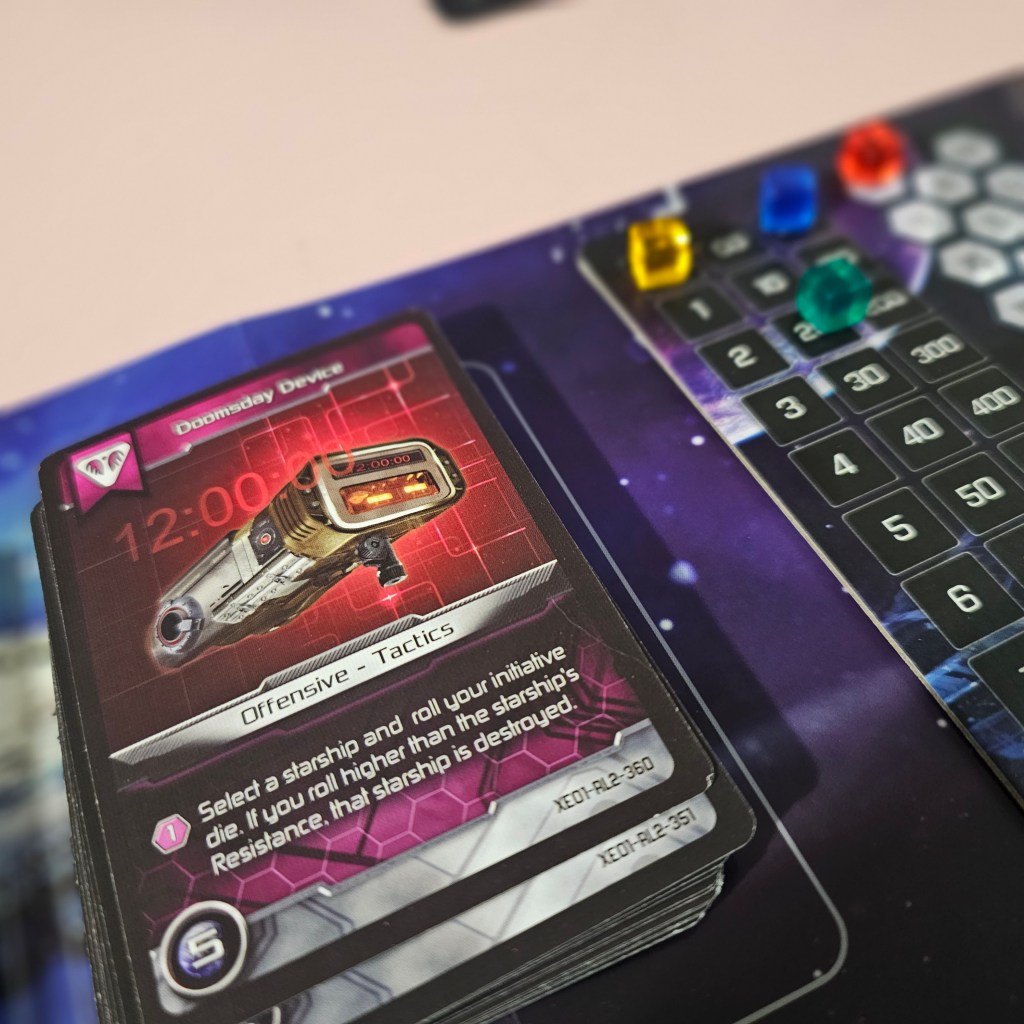
But this game was promised for 2018, and I got it five years later. So let’s talk about it. Tradeworlds has elements of many other games, but sadly they are too simplified. There is role selection like Race for the Galaxy, but no actual tension and play / counter-play thinking. It’s just an action you can do that turn, and there are no restrictions around it. There is also upgrading your empire like in Tiny Epic Galaxies. But banking is just a threshold to launch more ships or to achieve a goal in the scenario. The homeworld board goes to the hundreds of banked credits, but there is very little reason to go above 100, ever.

And there is the deck-building aspect. It lacks my favorite aspect of deck-builders, which is creating a refined engine. In the end, Tradeworlds is just a numbers game. There are 4 types of cards, 3 of them used to build ships. While its fun to create ships with different parts, they’re just different configurations of vanilla creatures. You can launch a ship that has 2 attack and 5 resistance, or 3 attack and 1 resistance, and so on. And the fourth type, tactics, are mostly one time modifications of those attributes for combat. It’s all just numbers.

And the reason that I mention that this game was in production for over 5 years is that it could have been given to more people to. Play and refine those issues. TradeWorlds is not a bad or broken game, it’s fine, fun even. But also tame and forgettable. And, because of that, it will not leave the shadow of its campaign.

Score: 4/10