This is an usual situation for my previews and I already talked about this game before. It was actually one of my favorite games of 2024. But now they’re coming up with a fancy and improved version, which is enough of an excuse to talk about this game again.
Cartographers, For Real Now
This is actually not that bad for me…
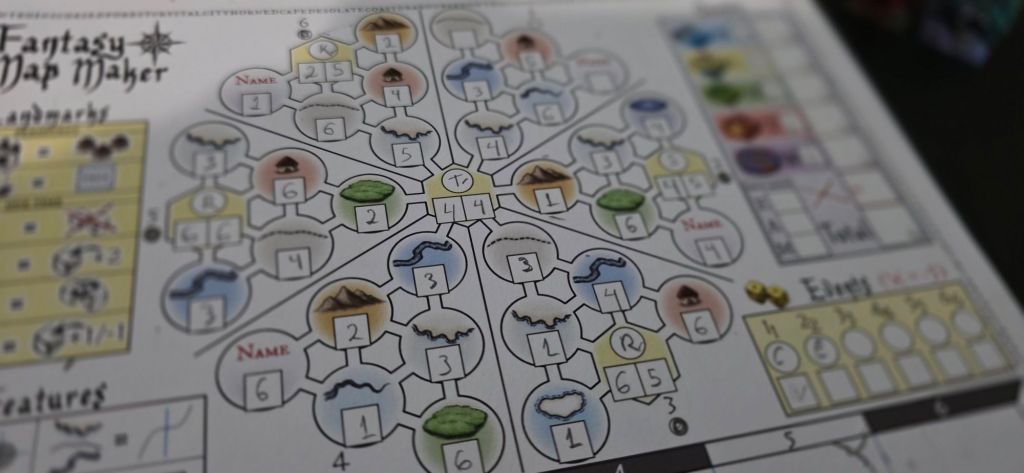
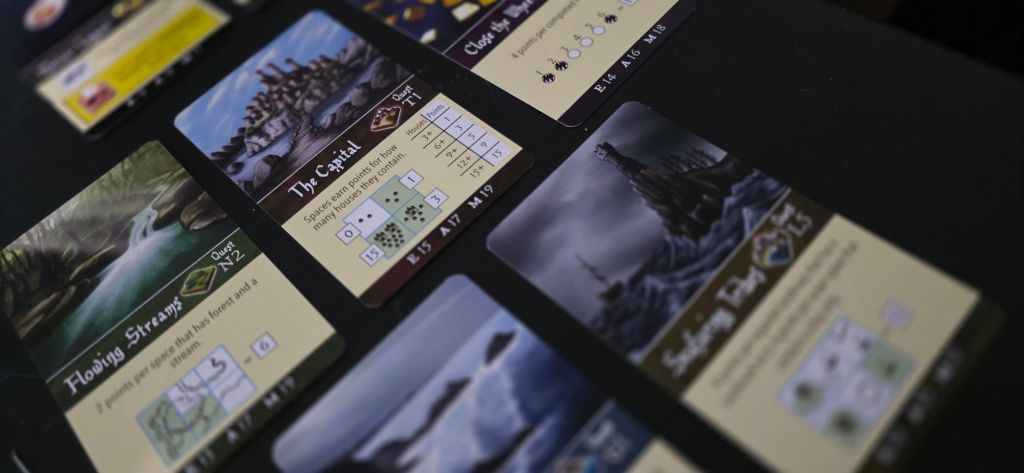
In Fantasy Map Maker, each game will have 5 goals related to various aspects of the map. Each turn two dice are rolled, one will select which wedge of features are available, and the other the size of the feature.
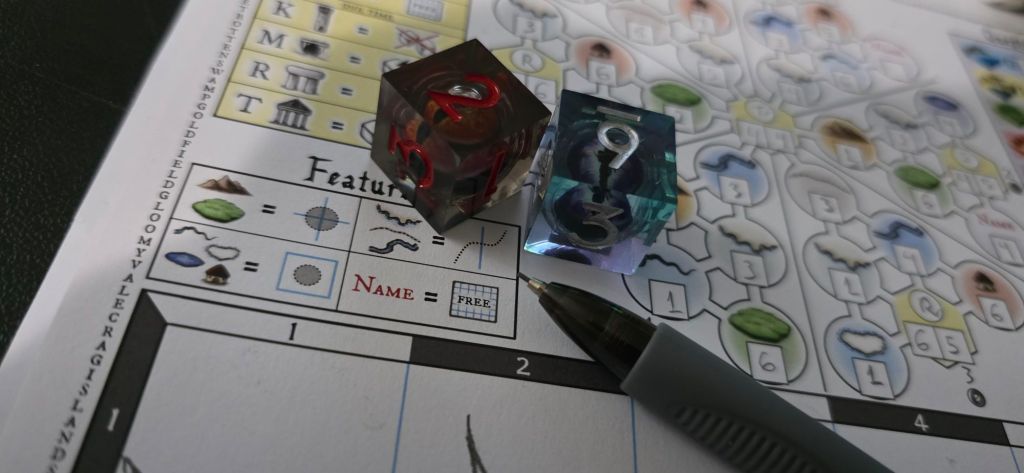
Features come in 3 basic types, each with basic restrictions on how to be drawn. Big features cover intersections, long features cross vertical lines, small features individually need to be in the same square, but can be spread. There are also features that are drawn according to coordinates, and give you special abilities.
Each type of quest awards points for how the features are drawn and interact, and the player loses points for map errors, such as rivers starting from nowhere, incomplete shorelines and similar issues.
Featuring: Features
Like a Geographic Cheese
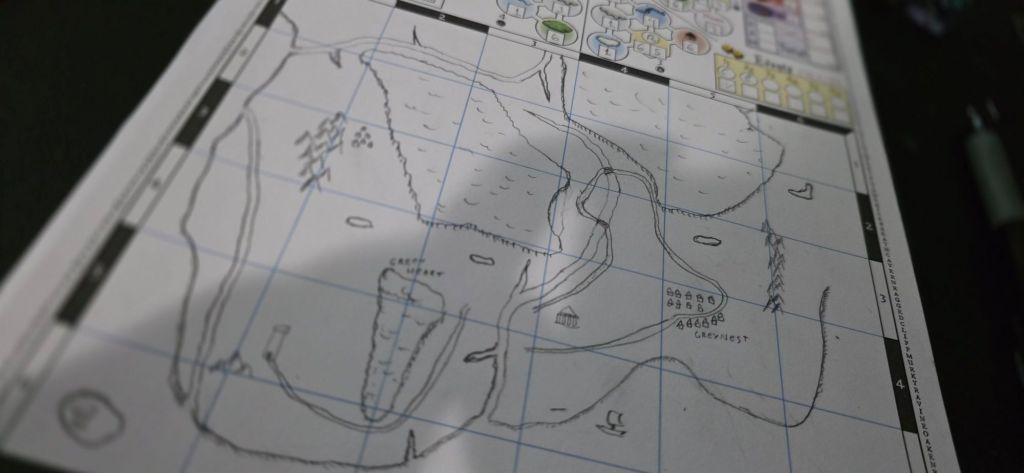
The thing I enjoy about the most about Fantasy Map Maker is the artistic liberty. As long as you keep simple guidelines, your map is your own. You can have skinny mountain ranges or huge crags, dinky little streams of rivers so large they can house islands. Even if you’re being strategic and thinking just about the points, there is still a lot of room for creativity.
The wedge of features system is really interesting. You need to balance what you use to have more opportunities open, while still thinking about the numbers you associate with each feature. Space is limited, so if you care about forests, you need to be putting on small mountains for example.
The Improved Edition
Big Cards Big Games!
This improved edition changes little of the gameplay, but it adds so much in terms of quality. First, the obvious one, big tarot sized cards for the quests and events. The art is gorgeous, the layout is clear and the examples drive the point home.
But just as good are the sheets. The layout is the same, but now each sheet has an unique configuration of the wedge, giving each game its our structure and strategy.
Epic, Once Again
Get Ready for Cartography (no, not that one)
Fantasy Map Maker keeps its place in one of my favorite print and plays of recent years. It’s clever, but yet so approachable. You can bring this out to any group and I think it’s going to be a hit, specially if they have this artistic itch.
But, artistry is not necessary. I mean, I’m awful at drawing, but I still get to look at my finished sheets and see not only a fun game I played, but this fragment of a world I want to be part of.
The boxed edition will be on crowdfunding on February 1st. Don’t miss it!
Do you ever feel the need of dueling your friends with a deck of cards, and throwing it at them just doesn’t feel right? Well, worry not, as Postmark Games brings us 52 Duels, where 1 or 2 players will fight as classic fantasy characters wielding the power of poker!
It’s Time To D-d-d-duel
Poker Face? No, Poker RAGE
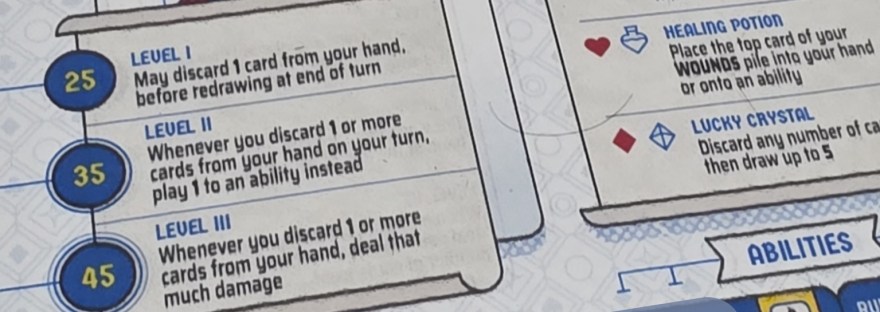
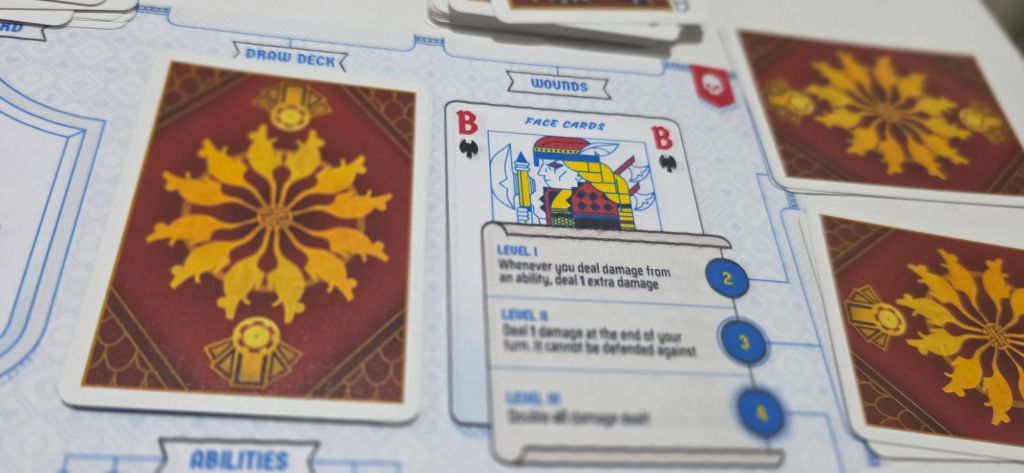
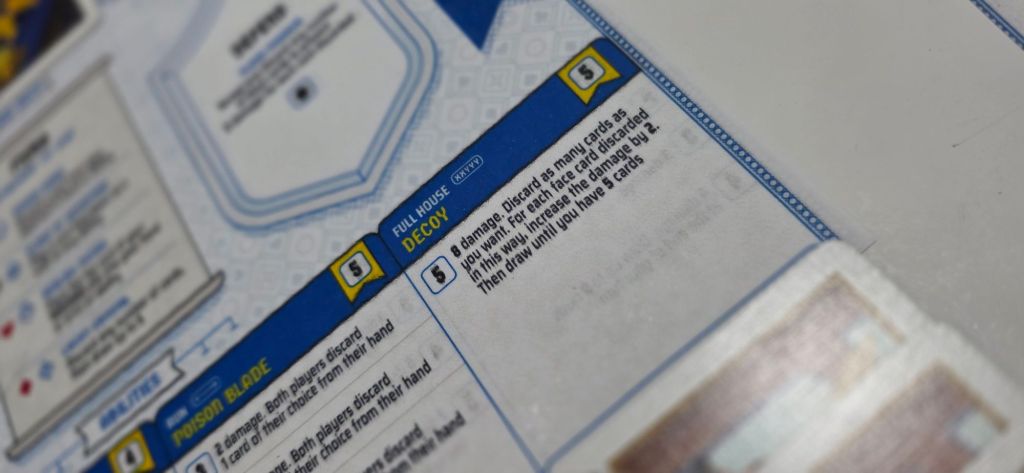
Each player gets a character mat and their poker deck, shuffling and getting a hand of 5 cards. Every turn you can do two actions: using a card for their suit power, add cards to your level to unlock permanent bonuses, or add cards to your attacks. Each attack has thresholds of cards to activate and what cards can be played, be it same suit, rank, runs, full houses, etc. Whenever you add a card to your abilities, you can discard them and activate, usually dealing damage to your opponent.
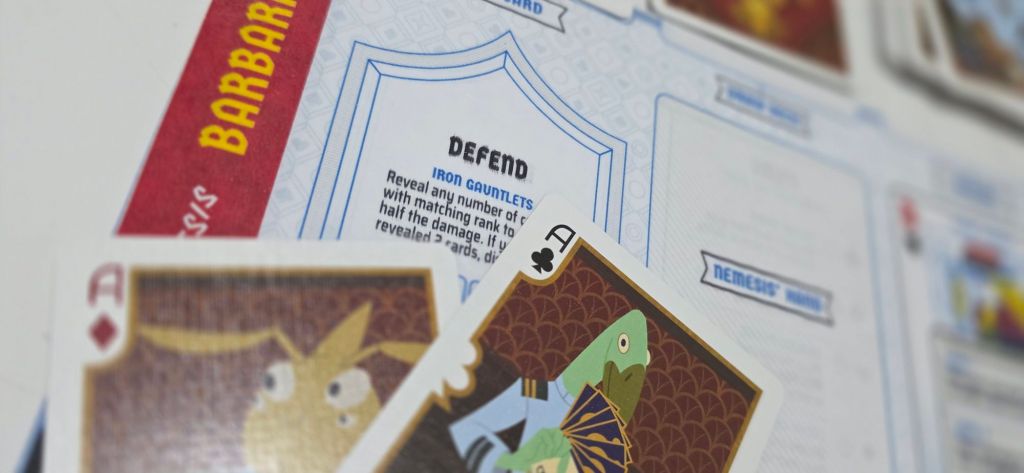
Whenever a player is attack, they can use their chatacter’s defense, and any remaining damage is dealt by putting that amount of cards in the damage pile. At the end of the turn, the player draws back to their hand limit, usually 5. If the deck is empty, just shuffle the discard and continue drawing. If at point a player needs to draw or take damage and there aren’t enough cards, it’s game over.
Solo game is almost the same. The Nemesis adds cards by suit to the abilities, while face cards are added to levels. Each character has their own Nemesis side to their sheet, but they play almost identical to the regular side.
Pulling Straight Punches
I have this full hand… In your FACE!
The game starts out simple and intuitive, since you have all of your deck you can decide to invest in any ability or level. However, this is an explosive game, where a few turns really change how to handle your investments as damage taken is out of the deck almost for good.
It’s an interesting balance as doing lots of small weaker attacks is not the most effective, but defense usually entails discarding cards so it can also be a way to slow down the enemy. There is an intense push and pull of setting up, unleashing attacks and getting ready for defense.
There are currently two characters in this preview, and each does play very differently. The rogue tends to set up abilities quicker and turn around more hands, and also soaks damage more easily. Meanwhile the barbarian hits HARD and hits harder and harder as the game goes. Knowing Postmark Games, there will be even crazier characters with lots to explore in each.
A Solo Duel? Monoel?
Ace Defense!
The concept of an automated duel opponent is not novelty, but they are often either too simplifies and a bit dumb or complex and natural. Well, not here. The Nemesis side distributes cards differently, but the abilities and level up powers are as close as their player side can be. The feel of each character is pretty much the same and, as a mostly solo gamer, that excites me. Victories do not come by exploiting the system, but by out maneuvering and playing to your strengths.
Again, Postmark is pretty much a Seal Of Gauranteed Design, but this might be one of my favorites. It’s light, tense, high adrenaline card play with explosive and exciting turns, and that is just the start.
So, you would think that a giant meteor coming straight for us would be a big deal, but no… It’s your job to manage the crisis, get funds, bri.. convince politicians and feed the media, without going overboard of course, to have a chance of survival. But is this crisis manageable or should we just let the meteor do its thing?
How To Play
Weapons Grid
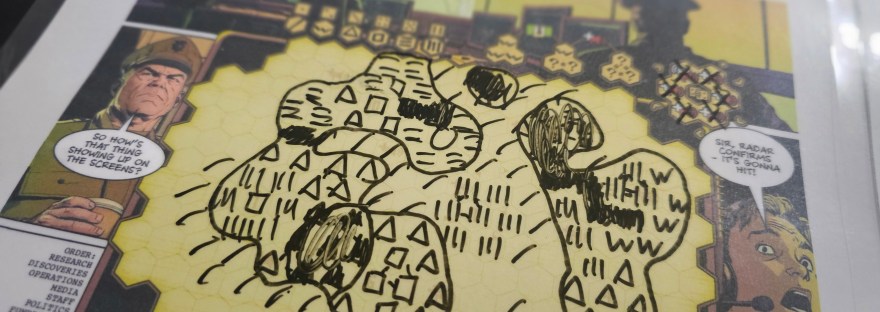
To setup, you just need three sheet and a whole bunch of dice. Each turn is comprised of whopping 8 phases, but all but media phases are optional. On research you roll a pair of dice for each worker, one being the material and the other how many will be added in a spiral shape. Once a shape cannot grow anymore, you start from the next numbered origin. Once all numbers are used and the meteor cannot grow anymore, it’s fully mapped. Doubles will tell the direction of the meteor, that will help spread media attention.
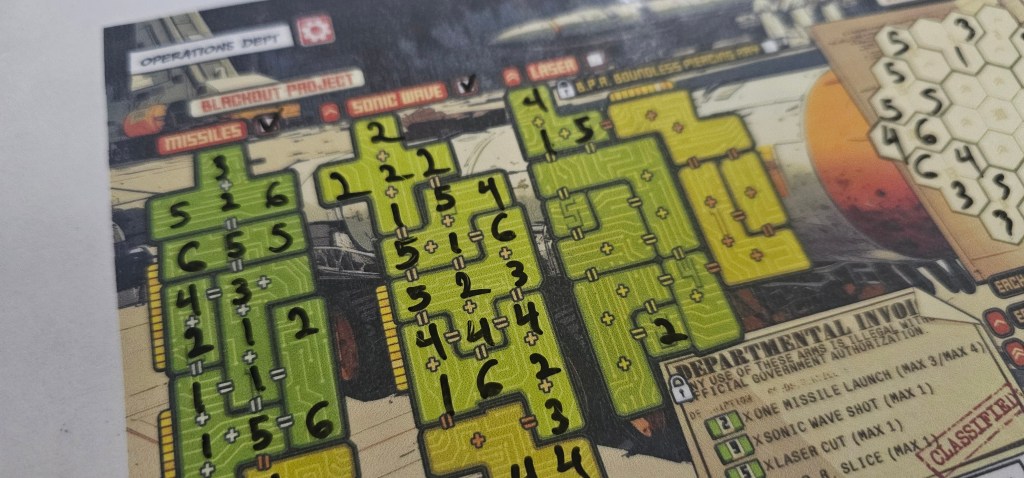
On operations, you roll a die for each worker and add that to one of the weapon matrixes. Each matrix need to be complete and all equations correct for the weapon to be active. During the media phase, you again roll a die for each worker. Ones mean loss of future money, while fives and sixes make will allow you to bump one of the media channels of your current influence level. These can give you money or cause crisis. Once all of one color are filled, the next influence level is unlocked.
Staff phase will allow you to spend money to upgrade one of the previous three departments or get more workers for that department, unlocking more dice. Politics allow you to, well, direct money to one of the politicians so that they can see your point of view more clearly. Each one will have immediate or triggered ability that will activate once they are marked. Once all boxes of one person are marked, it will increase your influence over a certain ideology as well as triggering one political favor.
Fundraiser will allow you to invest money to get a return on the next year. Finally, attack will allow you, once the meteor is mapped, weapons are unlocked and the correct bills are passed, to spend money to use the weapons against the meteor. Different weapons will target in different manners, but the goal is to have all of the meteor destroyed. Some weapons target big areas, while others will break it into smaller chunks, as any area 7 hexes or smaller can be destroyed automatically.
The only way to win is to destroy completely the meteor, and you lose if time is up and the big rock does its thing.
Rules and Components
Influencing Politics
As I usually stress, this a preview from a prototype so things are bound to change. But this is quite complete at this point I believe.
Usually print and play games are one or two pages long, and I appreciate Dennis spreading to a third. Though there is a lot happening, every section is well displayed and nothing feels cramped. Wording for a few abilities and effects could be clearer, but even at the first few plays, everything feels in place and make sense.
Different from previous games, this time rules are laid out in a more standard manner and I appreciate for a game on this complexity. Every section is well explained, but some wording can be vague or left to interpretation at this point. I did reach out to the designer, and most of my interpretations were correct, and I do hope the final version is even clearer than it is now.
Gameplay
Political Bills
Starting to play Doomsday Manager can be a bit daunting, but its a game that when you start playing is quite more intuitive than it first look. Each section is its own mini-game almost self contained and easy to manage. This is half of the game. The other half is managing funds and investment on each section, and having the proper support on all of them according to needs.
One aspect that I noticed is that the dice mitigation is mostly done through additional rolls, but not through dice manipulation. In a game where specific rolls are needed and, often, crucial, this can make you feel like you’re at the mercy of the dice. Brutal, but on the other hand, thematic.
Theme and Art
Media Frenzy
Theme is odd and unique, for sure. Honestly, the way it develops is quite like a cheesy classic disaster movie, and I love that the game leans on it and uses that to its advantage. It’s at the same time cinematic and, in a way, administrative, and somehow both work really well together.
Art again falls into the same feel. It uses the Nuka Zombee Classic Comic Book Flow (patent pending) to evoke dramatic moments to highlight each section as a scene, and elevate that from just another system.
Conclusion
Weapon Matrix
Doomsday Manager is epic, out of control and, honestly a bit frustrating at times. It’s absolutely a game that takes its unique premise and runs with it the whole way. Each individual section is simple and almost mundane. That really forces you to look at the game from a higher perspective, seeing the big picture, almost like setting up a situation and just running the results. The biggest decisions and where the heart of the game lies is the runaround of funding and resources, timing and long term plans.
It’s also a game that breaks expectations in a big manner. It gives you impression of being a big lengthy and grind-y experience, specially knowing one of their previous games, like Recycled. However, it’s not that at all. Turns fly by, and often with little change between them. It’s not a game of epic turns, but a game of slow flow and long term plans materializing over time. It requires a whole type of approach and smart plays, and, honestly, I see so many branching paths to both victory and defeat that I can’t wait to explore it more.
In this cozy game, we are trying to create a classic cheesy romantic comedy where two people fall in love over Christmas, snow, cookies and caroling. But is this movie going to warm everyone’s heart or will everyone just change the channel?
How to Play
Scenes
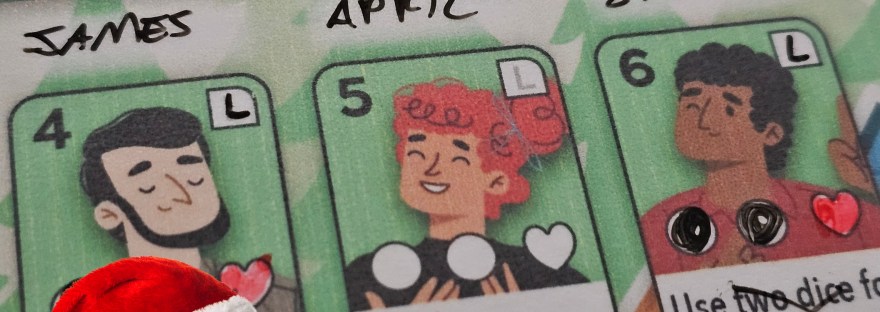
Before starting the game, just select three out of six characters to be the leads. For those characters, their once per game ability is available from the start. Then you’re ready to go.
Each turn you roll 3d6, one of one color, two of a different color. Obviously those need to be christmas colors.
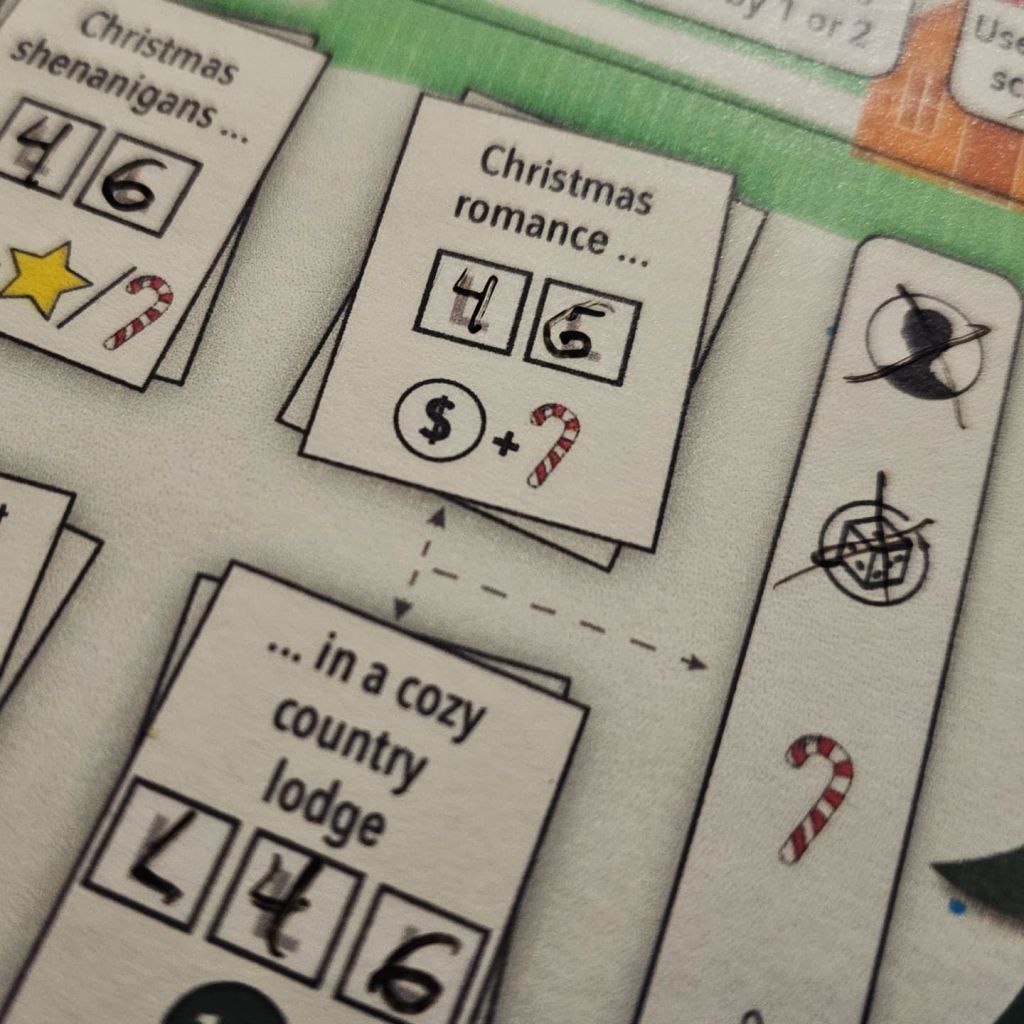
With the singular die you can add a character to one scene. You can add them in any order, but within each scene values need to be ascending. Some spots are also just for the leads. Each time you add a character their development goes up by one. On the third spot, you will advance in the development track, and you unlock the once per game ability for the secondary.
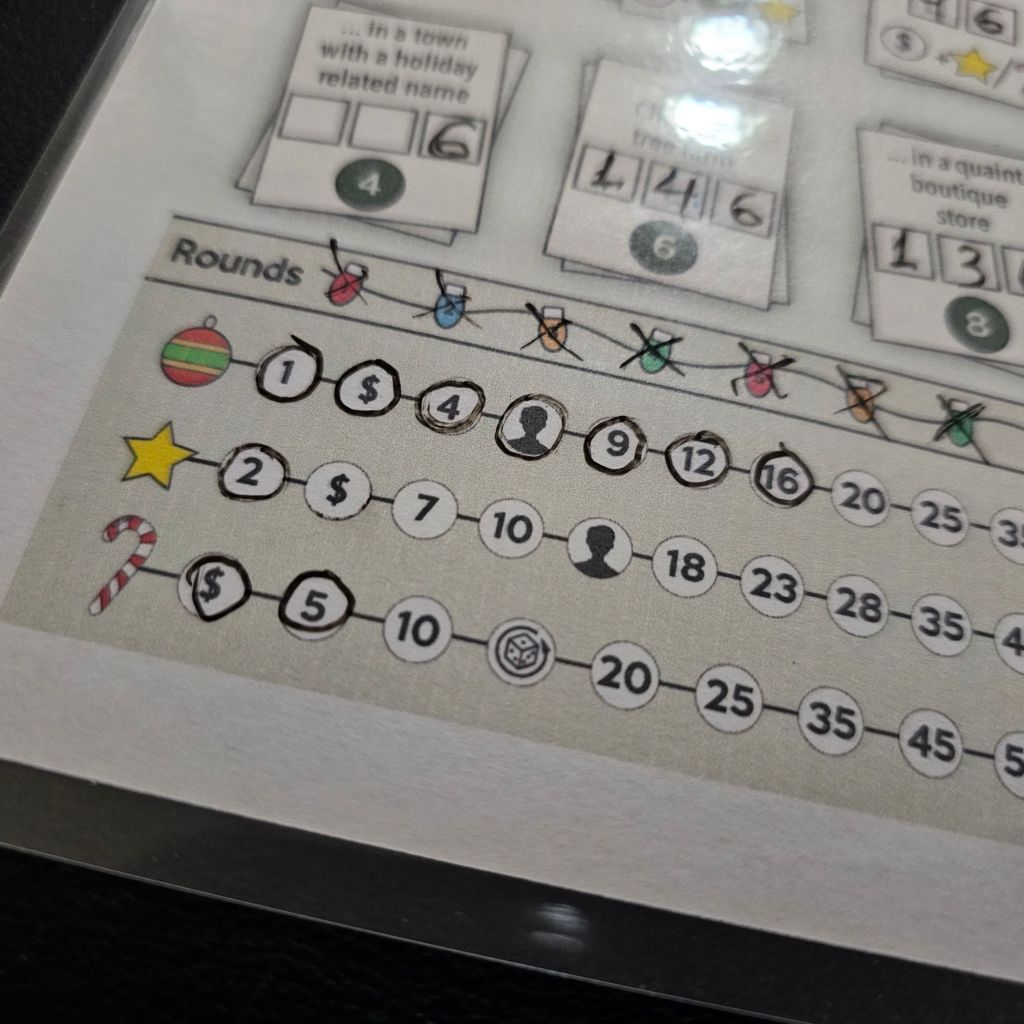
Once a scene is complete, you get their bonus. For the top row, it’s ornaments (more on it later), reuse of dice or money (that allow you to modify the rolls). For the bottom row, it’s points. Once you complete both top and bottom on the same column, you get an extra bonus.
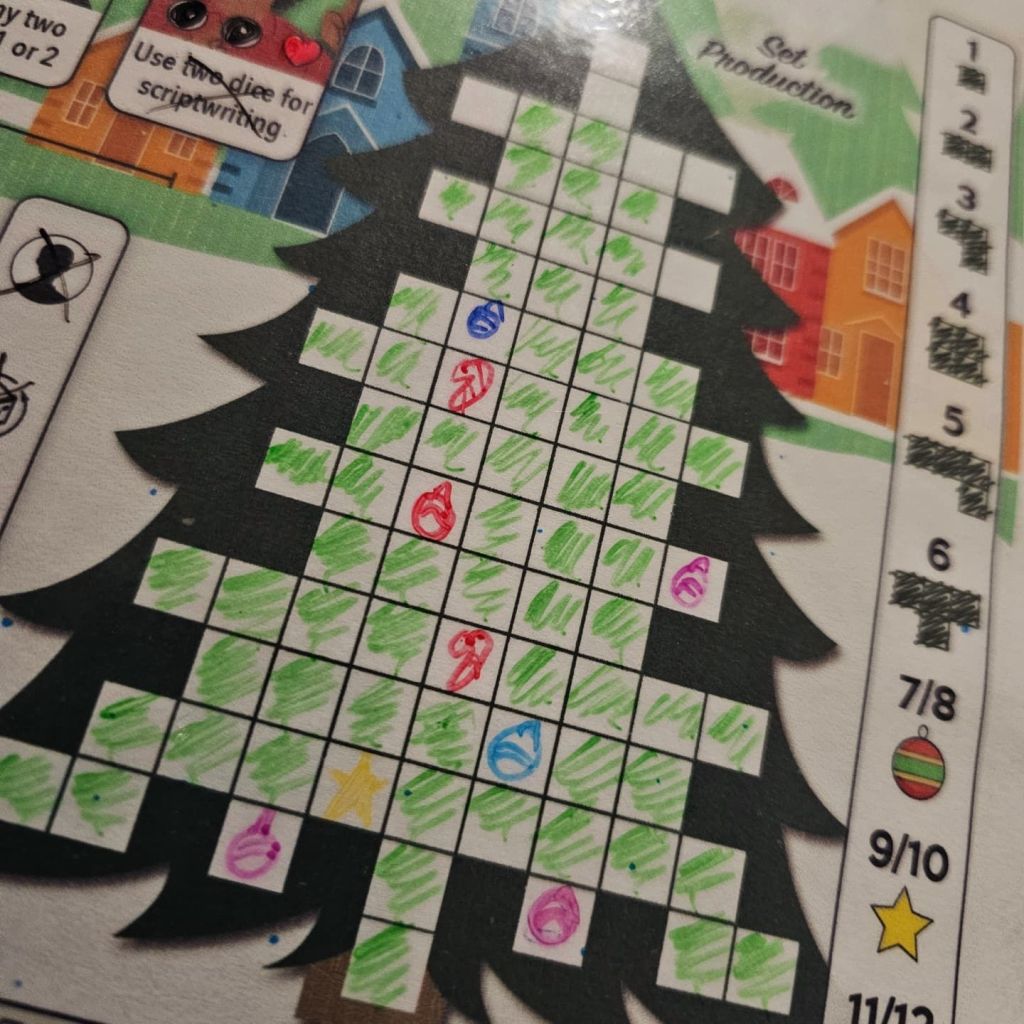
With any dice (including the singular one if you wish), you can add to your set. Those values can be used separately or combined. These are either shapes, that will allow you to complete more of the tree, or ornaments that will advance in their individual tracks.
After 15 rounds, game is over. You tally the points for the ornament and development tracks, scenes completed and left over money, losing points for an incomplete set.
Rules and Components
Set Decoration
The component is, basically, just a sheet. It’s simple, cute, very Christmas-y and all the game information is clearly laid out. It’s nothing super crazy and unique, but it does get the job done.
The rules are a pleasure to read. They are infused with charm, wit and made-for-tv lingo, but also do a great job in conveying the rules of the game in a clear manner. Even for a prototype, I was able to get into the game and play without any issues or doubts.
Gameplay
Ornament Scoring
The game if fairly straight forward at first. With your singular dice, you pretty much always want to go for a scene, then fill up as much as possible of the tree with the other two. There some tricky aspects though.
For the scenes, it’s quite tough to fill them all, so you need to decide when to go for the bonuses (and which ones), and when to go for points. Setting yourself up for later is key. Also, you will need to use characters if you want to maximize scenes, specially the leads, after the third time, which is a bit inefficient since you don’t get development benefits, so it is not always obvious.
For the tree, you have to balance advancing in the tracks (since they require high dice combination), or just filling up a lot. Also, setting up proper shapes and how to fit them is important, specially in late game.
Overall, this is a quick playing easy to learn game, but I was very gladly surprise to see a good decision space. As I mentioned earlier, I hope there will be additional content for this game to expand this even further and add variety.
Theme and Art
Movie Name
I absolutely love the theme here. It is cheesy silly Christmas comedy in a nutshell. Personally, I always randomize the leads and try to come up with the stories from there. I honestly wish the scenes were a bit more open, mad-libs style, to take that even further. I mentioned that to the designer, and he did say something like this was coming, not only for the scenes but for the character themselves. And I’m here for all the silly stories to come!
The art style is a bit too simple for me, with the icons being a bit on the generic side, but the elements on the sheet are done in a cohesive and very charming way. The art on the six characters is lovely and fun, though.
Conclusion
Scoring
Ever since the designer contacted me I can’t stop playing this game. It takes the theme and really runs with it. If you are a theme first gamer looking for a quick and satisfying time, you are not going to be disappointed. It is not, and nor does it try to be complex, the same way made-for-tv movies are not meant to be blockbusters. It is charming and dainty with a small town charm to it.
I noticed I repeated some words on this preview: charming, lovely, cheesy. This game not only is themed like a made for tv movie, it’s designed like one. That should tell you all you need to know if want to back this or not.
After a few very bleak releases, NukaZombee comes out with a whimsical journey through a land of orcs, alchemy and air balloons. But is this journey going to soar but is the orc’s curse is just too much?
EDIT: A few corrections due to a rules misunderstanding.
How to Play
To setup, put the enemy on the first spot on its path, your character in the middle and gems on the spots on the player sheet and map. Each turn is broken into three steps: move, actions and enemy movement.
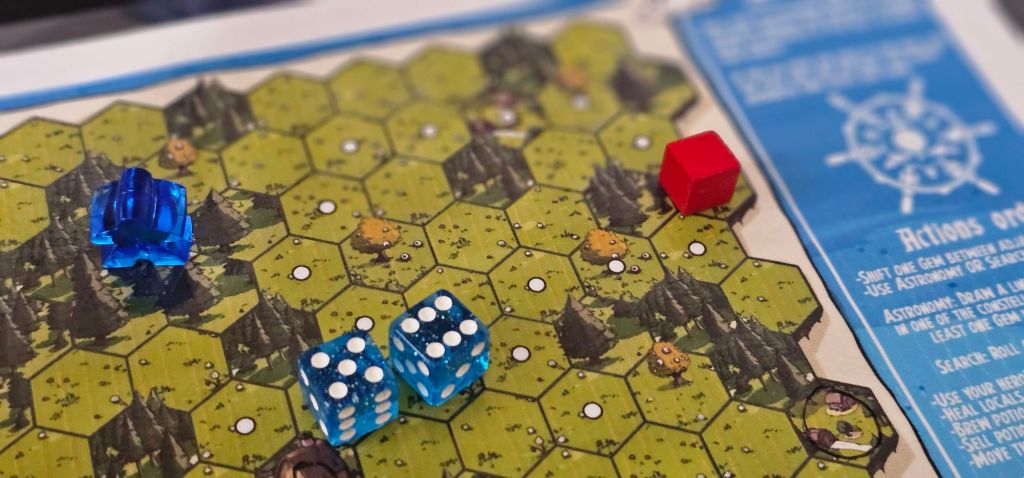
To move, the player rolls two dice, one sets the destination and the other for the move amount. If the player acquired any constellations they can use them to change one or both of the values to get to specific spots.
On the actions, first the player can move one of the gems between the classes to get different bonuses, then getting ingredients or mapping stars. Then, depending on where the player is, they can get more ingredients or heal the villagers . Finally, the player can craft items and brew/sell potions. After that, the orcs advance one space, two if the player went off of the edge of the map.
The player wins if they are able to get the healing skill to max and do one more healing, and lose if the orcs reach the final spot, the King.
Rules and Components
Take this section with a grain of salt, since this is an early preview copy and lots can and will change. As of know, the rules have a great and vibrant layout and use a lot of visuals to show each element of the game. However, as of now, they feel incomplete and a few spots are unclear. Again, early preview copy. The game is perfectly playable, even if a mistake or two are there.
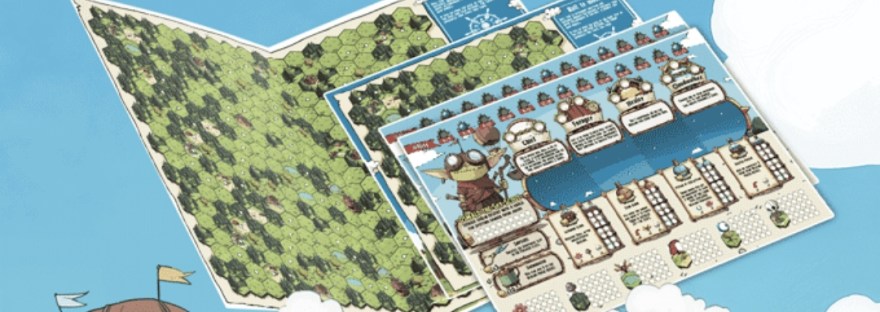
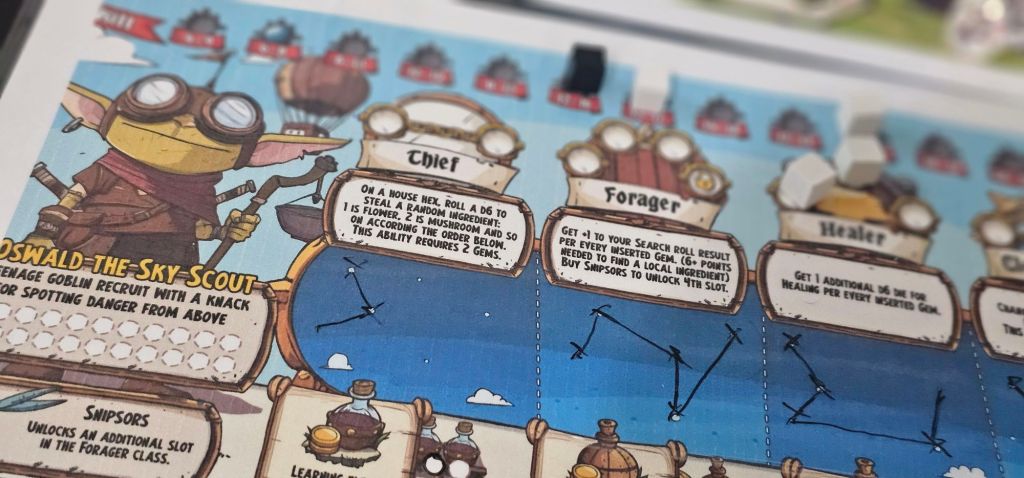
As I mentioned, the visuals are clear, vibrant and rich. There are two sheets, one for the map and one for the player. The player sheet works great, rules are embedded on each spot and they work really well. The map, while beautiful, lacks a bit of usability, specially a spot to clearly see which villages are there.
Gameplay
SkyCraft is not rules heavy, but it’s surprisingly thinky and requires a lot of planning to be successful. Movement is the main challenge, just getting to the right place and getting the right ingredients or skills at the right time. There are four skills, and you can only move laterally and one gem per turn. Having flexibility with the movement will probably mean that you are not healing or foraging as well.
Healing is a bit odd. You have one die, plus one for each gem on the healer class, and you have to roll within a range, not less or more. Whenever you succeed you advance on the skill, if not you move back. The odd part is while you do move towards having more gems as your skills increases, it also requires more dice and a harder roll. It’s not always advantageous to skill up.
Even with these hurdles, as of know the game is fairly forgiving in terms of the challenge of completing the goal before the orc gets to the final spot, specially when there is a potion that moves back the orcs a whopping 20 spots.
Theme and Art
I absolutely love the art for this game! The characters, both the one available on the preview and the ones announced, are goofy and have a lot of personality. The map is also interesting, with even spots that share a type being unique.
The theme for the most part comes through as well, with the character just flying around the land and, in my mind, tossing healing potions right to villagers head. There are a few spots that I feel it could be better.
One, it bothers me to no end that we are stealing from the villagers we are trying to save. It could be donations or something else, but stealing just feels wrong. Also, the orcs as of now feel mostly just like a timer. They are not a looming scary presence that can cause havoc, they are just walking around up until the next step.
Conclusion
Despite my criticisms, I feel like SkyCraft is a blast to play. It’s a game where you take very little to get into, but then slowly start to realize that if you don’t plan right, you will not do well. It’s a game about understanding the odds and planning your turns ahead of time, and when you are able to pull it off you it’s exciting.
Unsurprisingly, there are a few balance issues, but even with those the game feels rewarding and complete. And, on top of it, knowing that there will be extra characters I’m super excited to see what they are going to bring to the skies.
NukaZombee has a knack for making longer roll and writes feel like a breeze, and I feel engaged the whole playthrough. If a thinky but whimsical adventure is up your alley, you will find a great game here!
In more nature related partnership of Joey and Postmark, we go and try to create forests and rehome our adorable furry friends. But is this a game of good koala-ty?
Disclaimer
The team at Postmark Games very graceously provided me with this first sheet as a preview copy for me to play and analyze. There was no additional compensation.
All components and rules presented here are in prototype form and subject to change as the project develops.
How to Play
Shapes table
Setup is simple, each player needs a sheet, and one single d6 that will be shared by everyone.
The game goes for 2 rounds of 15 turns each. On each turn, a d6 is rolled, and player draw the relative shape either in circling uncircled trees or circling the koalas in already circled trees. You cannot mix both, and the shape needs to be used in full.
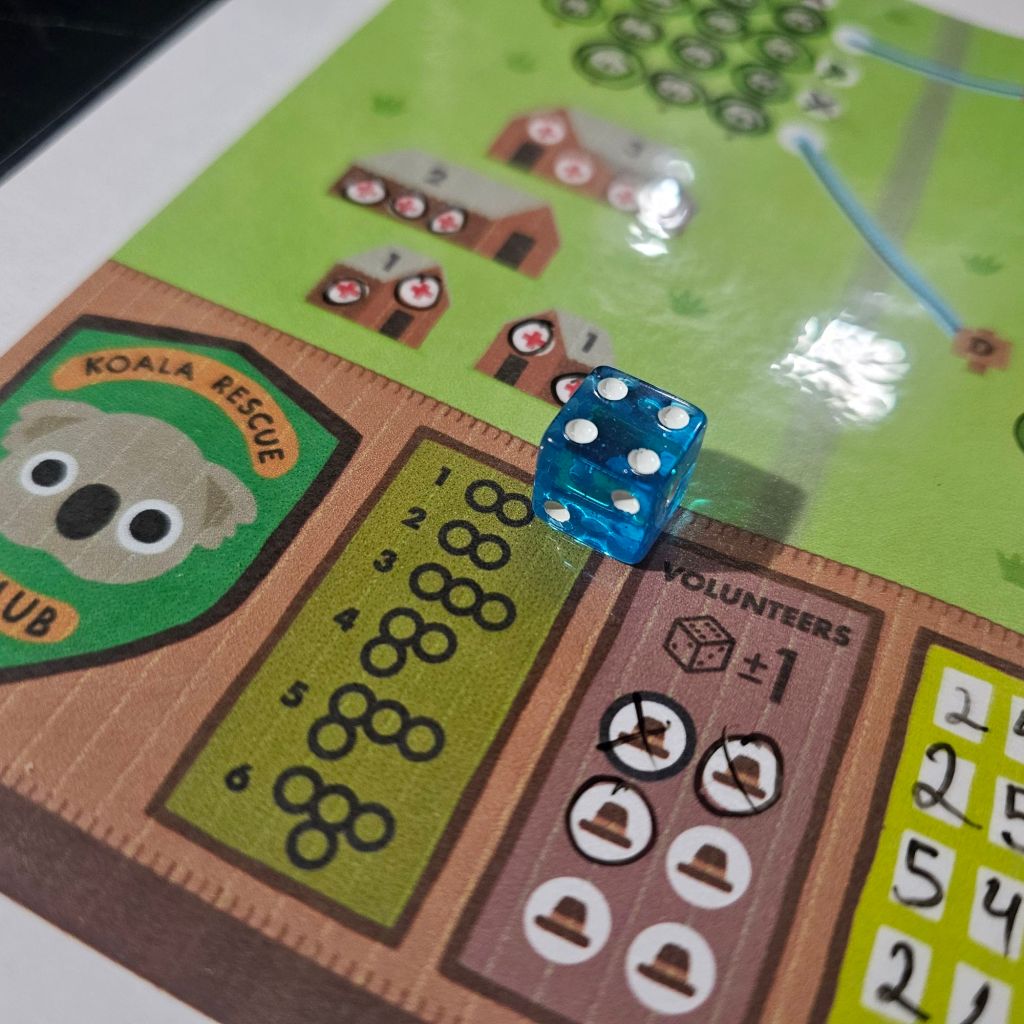
After drawing the shape, if the player completes a row or column of koalas (not just trees) they get the bonus, that can be access to new areas, circling hospitals for bonus points, volunteers to manipulate the die or additional circles. The player can also earn merit badges if they complete certain criteria.
At the end of each round, player score for areas full of trees, full of koalas and hospitals. Most on both rounds score plus the merit badges wins.
Rules and Components
Trees and Koalas
The rules have that very specific Postmark look and style, being mostly white, text with a few illustrations as examples. It does mostly require you to have the sheet besides you, but they are clear.
The sheet is big and bright, and icons are clear on what they do. My only problem is that since you have to double circle everything, the circles are a bit small, leading to a messy sheet.
Score: 7.5/10
Gameplay
Rolls and Scoring
I’ll say right away that my analysis is for this first map and rules. I’ll explain why this distinction later on.
Koala Rescue Club is all about fitting the shapes. There is plenty of good decisions of where, when to go for trees or Koalas, and what to invest in to score in each round. But it is undoubtedly a family weight game, very light and fast. It’s not a bad point in any case, as far as simple roll and writes this one is immensely fun and satisfying.
But here’s the thing. This is a Postmark Games, and I know that each additional map. will have its own changes and quirks to make use of this very simple and clean base. I don’t think it will anything but a family weight game, but there will probably be some interesting twists.
Score: 7.5/10
Theme and Art
Merit Badges
I mentioned how the gameplay is very family oriented, and I feel the same for the art. It’s cartoony, colorful and adorable.
That is the second game Postmark and Joey make to not only feature a particular animal (we had Scribbly Gum about moths before), but also to actively bring information and funds to the conservation of said animal, and I fully appreciate that.
Score: 7.5/10
Conclusion
There is just something satisfying about fitting shapes in different manners, and this game features that front and center. It’s a very cute and accessible game that still feels satisfying to more gamer-y brains.
As it is, the replay value is limited, as each game will be mostly the same. But, as I mentioned, this is the first map. Replay and variety will probably come later.
But even just as it is, it’s a game that is fun, inexpensive and helps a cause. What’s not to like about that?
On this expansion, Warriors and Writings add in the magic duelist Bladecaster and we venture in the River. But does it add to the flow of the game or is it just a bit fishy?
Disclaimer
I have received an advanced copy of the expansion from the publisher to review, but the opinions expressed here are my own.
This is an advanced copy, so every presented here is subject to change. Also, no stretch goals will be reviewed.
The Bladecaster
The Bladecaster
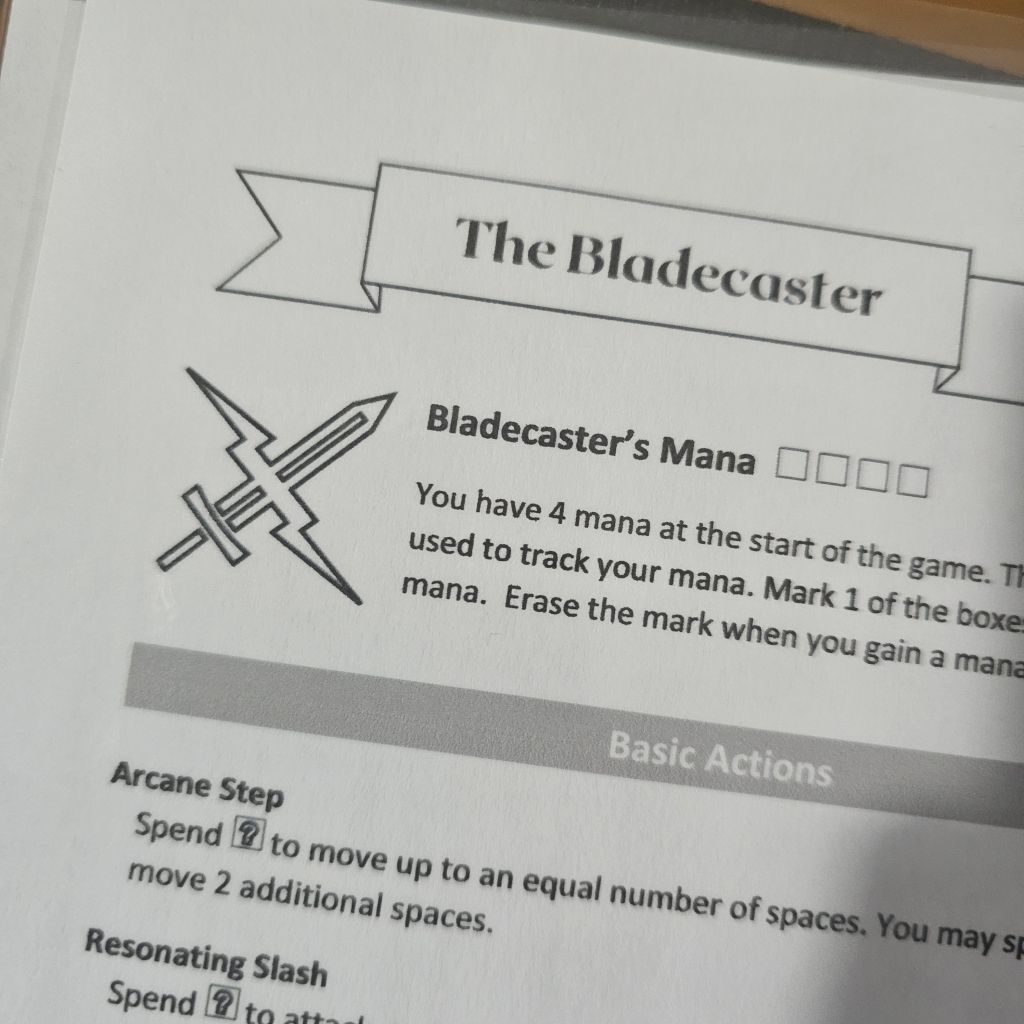
This character is an agile one, focusing on movement and quick melee hits. It is inspired by one of my favorite specializations from D&D and I do feel like it does it justice.
Comparing to the heroes before, it’s just slightly more complex than the two initial ones, and definitely more straightforward than the ones from the first stand-alone expansion. However, it has very interesting gameplay. To be honest, I think it’s my favorite of them all so far.
The River Rush
The River Map
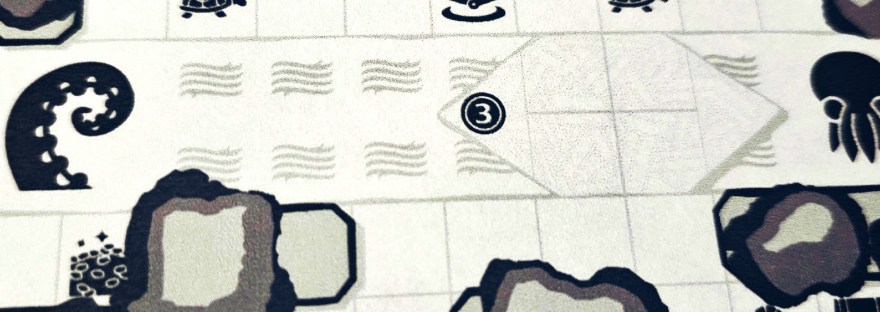
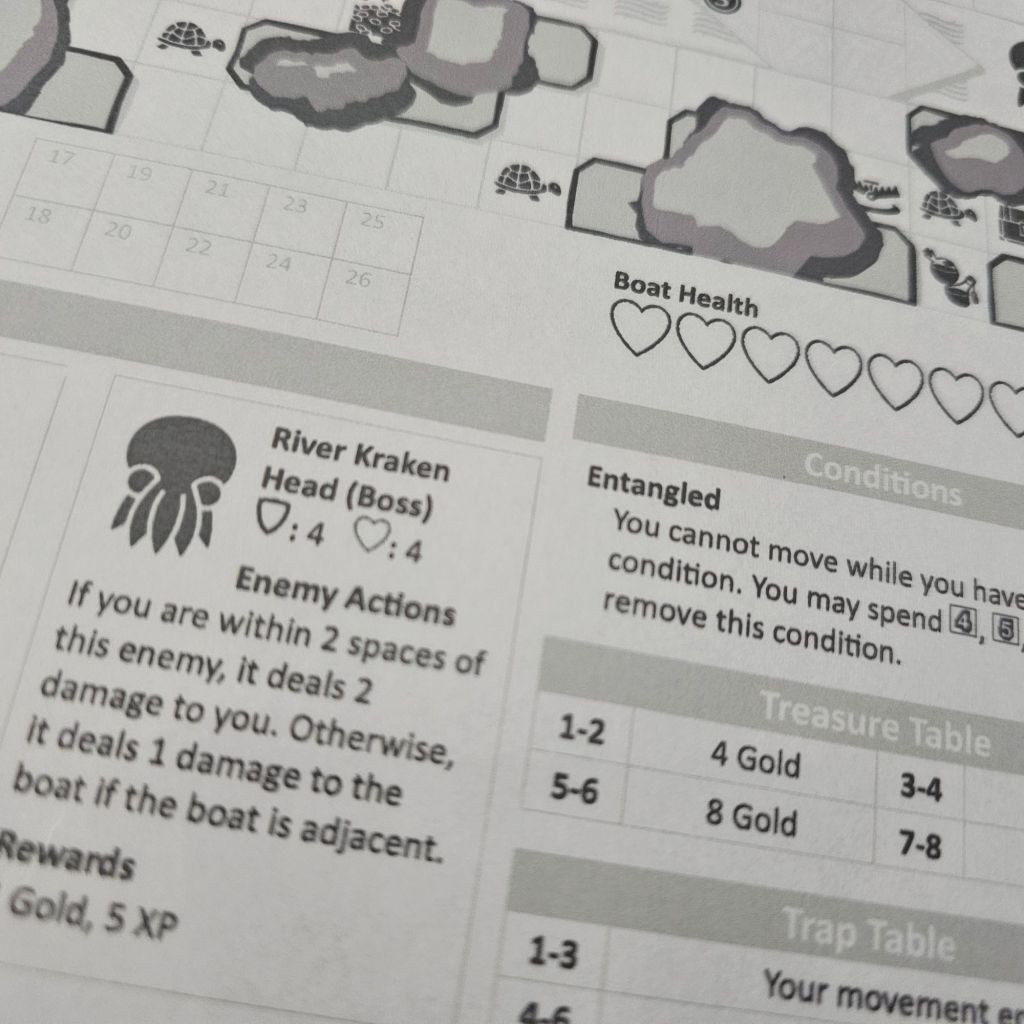
It’s a long map with a river going through where you’re fighting a huge kraken. The main change is that there is a boat that is only available during certain rounds, and if you don’t move it in time you get stuck.
I like how it forces you into decisions of what to go after, and it adds an element of urgency from the very start.
That being said, I do have one big issue: why are we killing tortoises? Couldn’t it have been anything else?
Conclusion
Kraken Head
If you read my review of Warriors and Writings you will have an idea if the game is for you or not. There is nothing in this expansion that will change your perception on that.
Personally, I love it. The two additions do not add a unnecessary complexity, but they do add a ton in terms of interesting decision space and thematic flair.








 Let's Game More