Review

Let’s Review More: Ark Nova

1-4 Players

Designer: Mathias Wigge

Publisher: Capstone Games / Feuerland Spiele

I’m slowly venturing into the heavier side, specially on euros. Ark Nova is a game that has made a big impact on BGG, but is the fame deserved or is it hype?

Gameplay
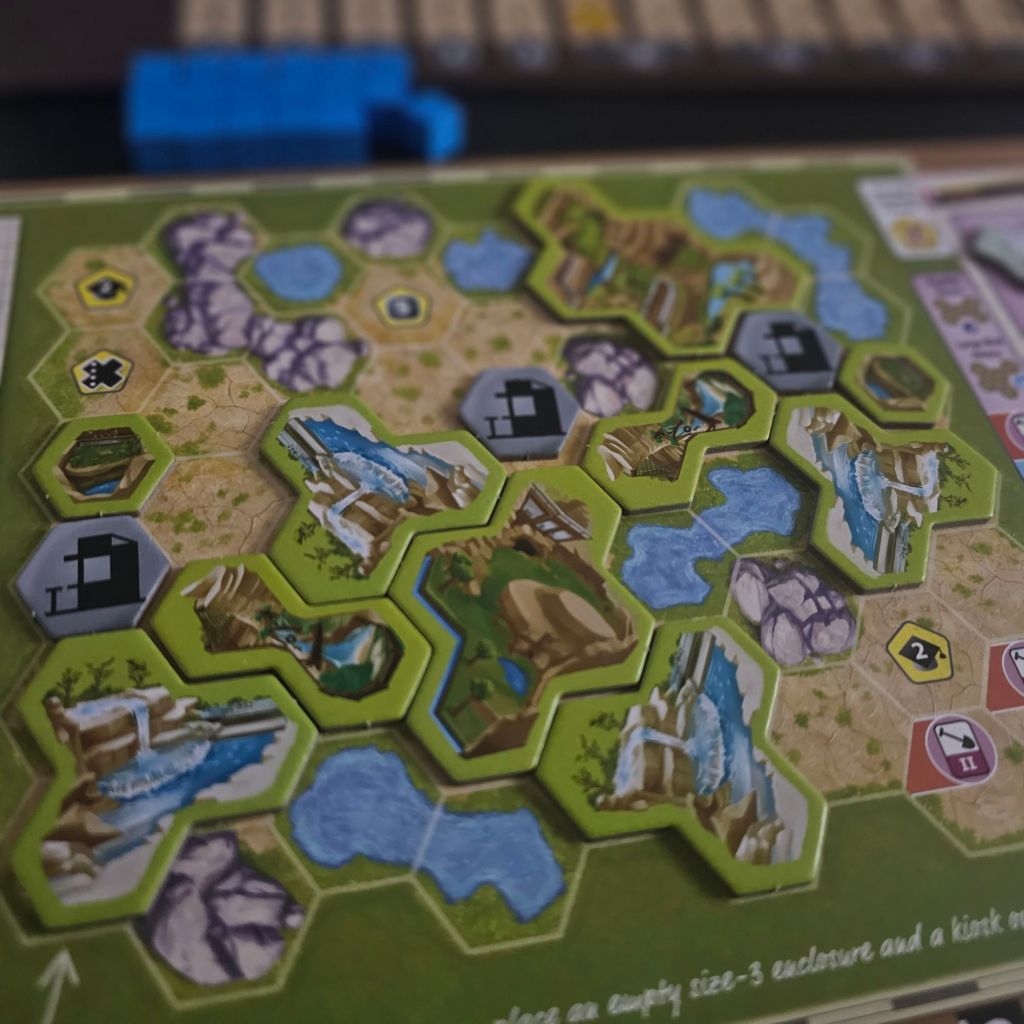
Ark Nova player board

In Ark Nova, you are managing a scientific zoo, by playing animals, acquiring sponsors and making deals with universities and other zoos. This is all based on a very interesting 5 action card system, where each card lies under a position 1-5 that determines the strength of the action. When you take the action, it goes to the 1 position, pushing all others one space up. Each action can also be upgraded to a more versatile version where you can usually do multiple things at a time.
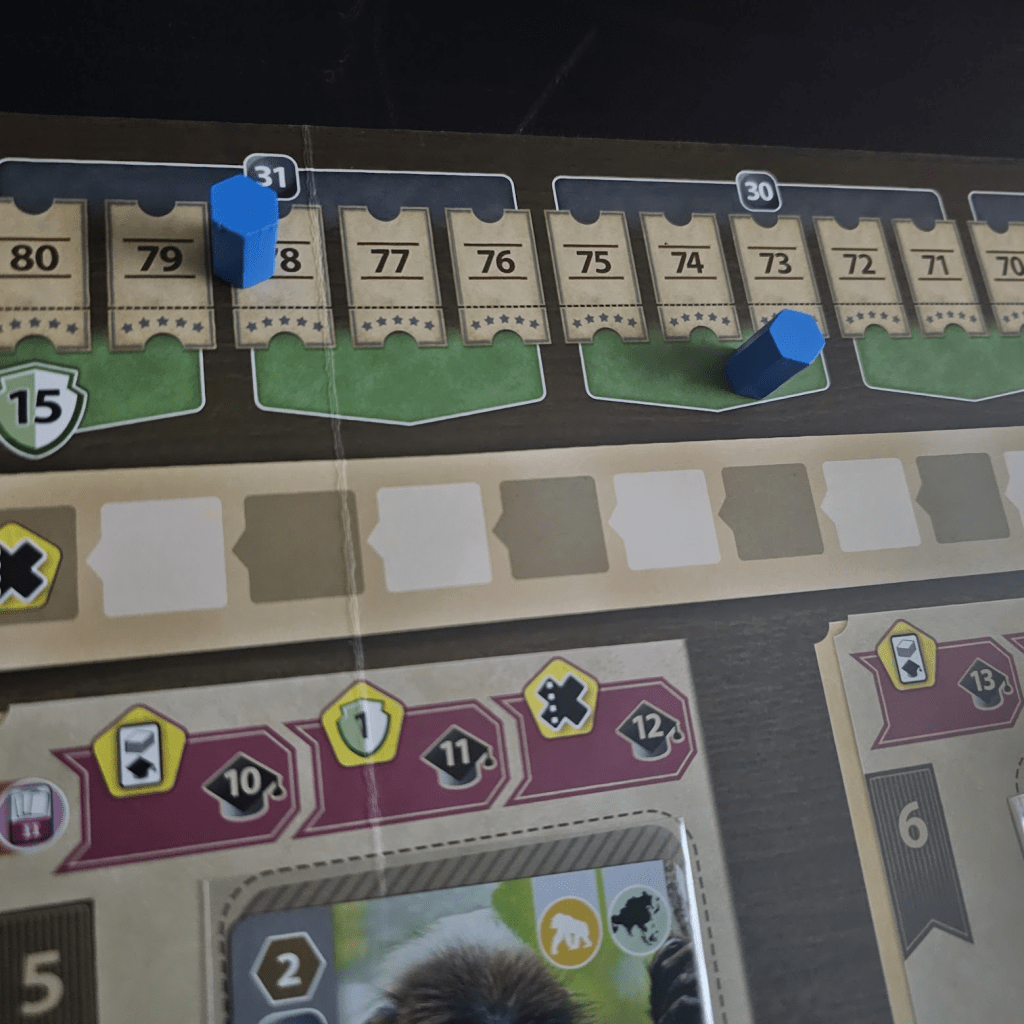
Ark Nova's points tracks

By playing cards and doing many actions, you go up on two different scoring tracks, appeal and conservation. Appeal is your actual points, and also your income, while conservation gives you bonuses and has ranges that subtract from your score. Once those two meet, the game will end, and the score will be your appeal minus the lower range of your conservation, which can be negative.

Solo Gameplay
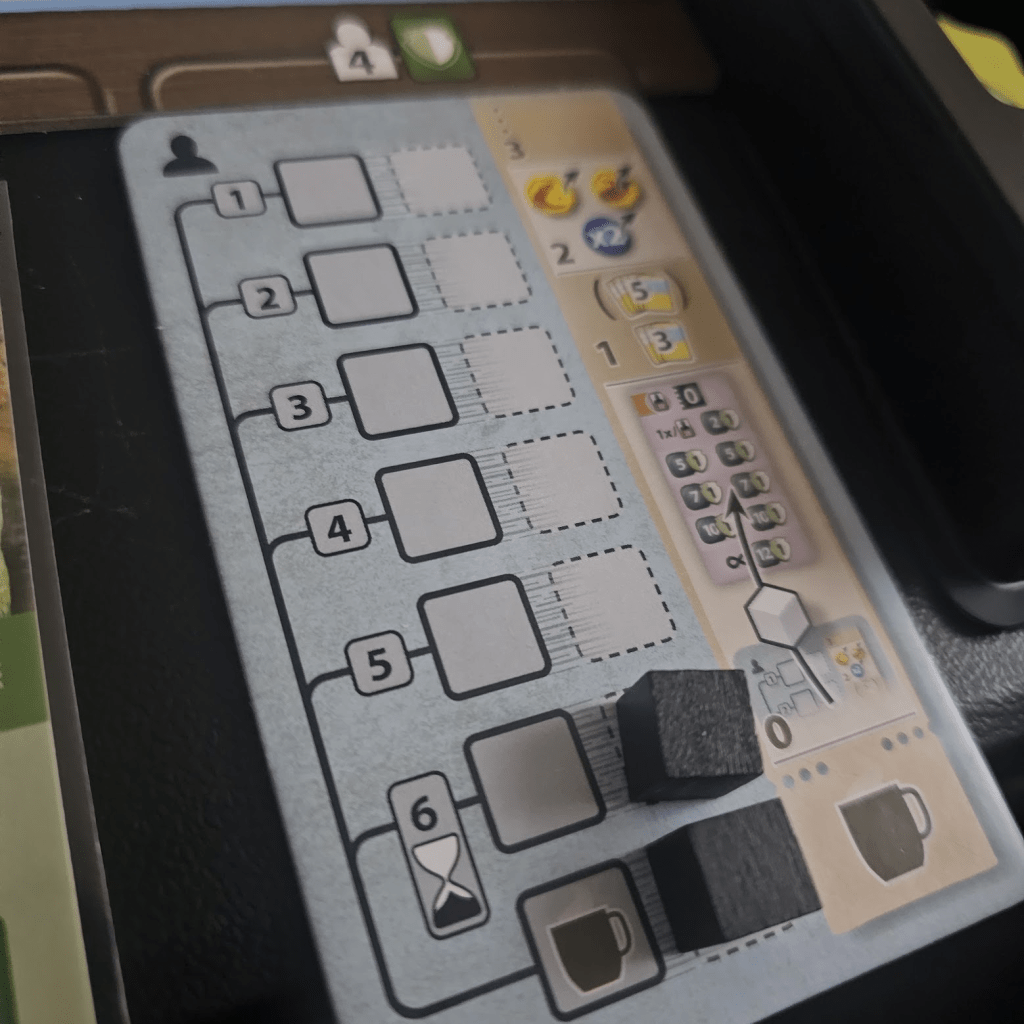
Solo board

Solo play replaces the break system that some action use to move the game forward and activate income with a fixed time system. You start with seven cubes, and each action moves one to the left. After the last one is moved, the break is triggered like on the multiplayer game, the top cube goes to the main board, and you reset with one cube less. At the end of the sixth round, game is over. You have to be positive to win.

Components
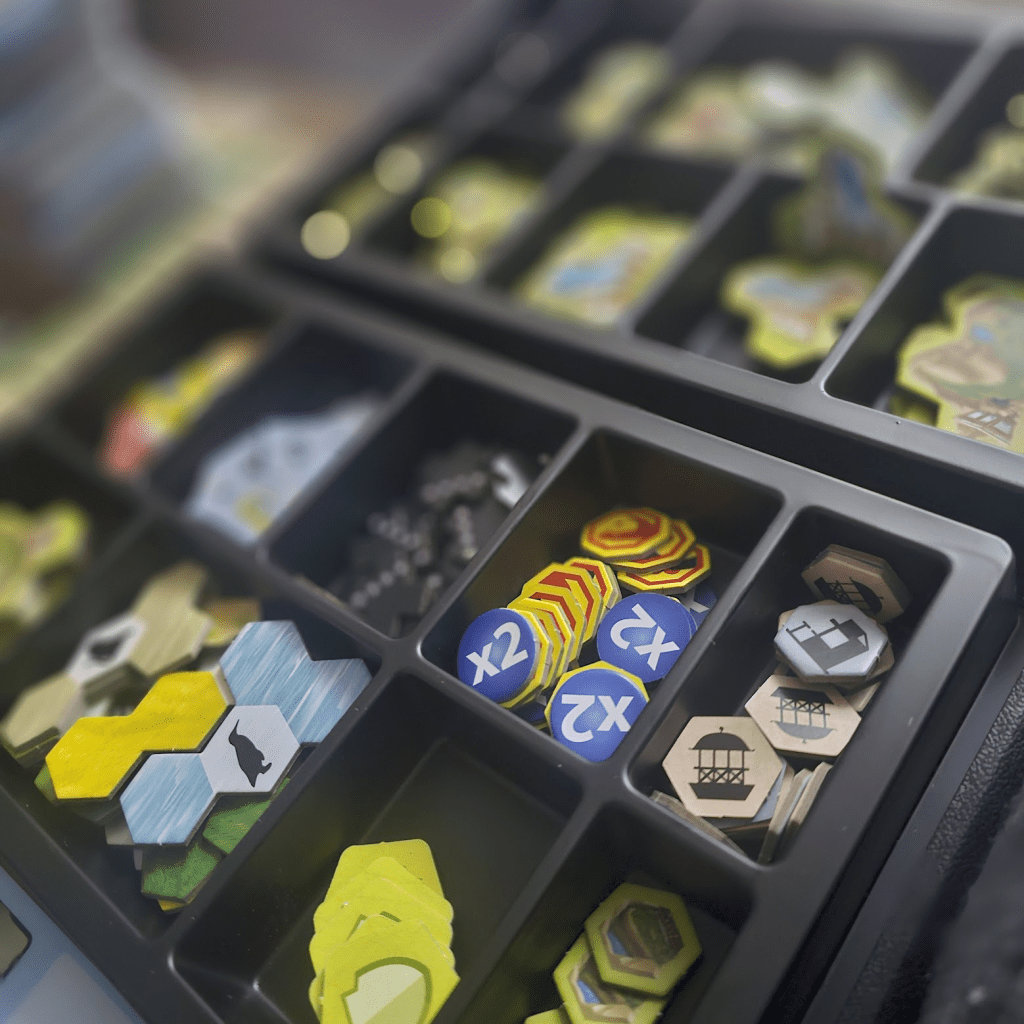
Component tray

Ark Nova has a ton of pieces, from habitats from sizes 1-5, special habitats and other diverse tokens. Thankfully, it comes with two trays where you can organize them and make them super quick to both setup and tear down the game. Components have a simplistic look, very euro-y, but are very effective in their usage.
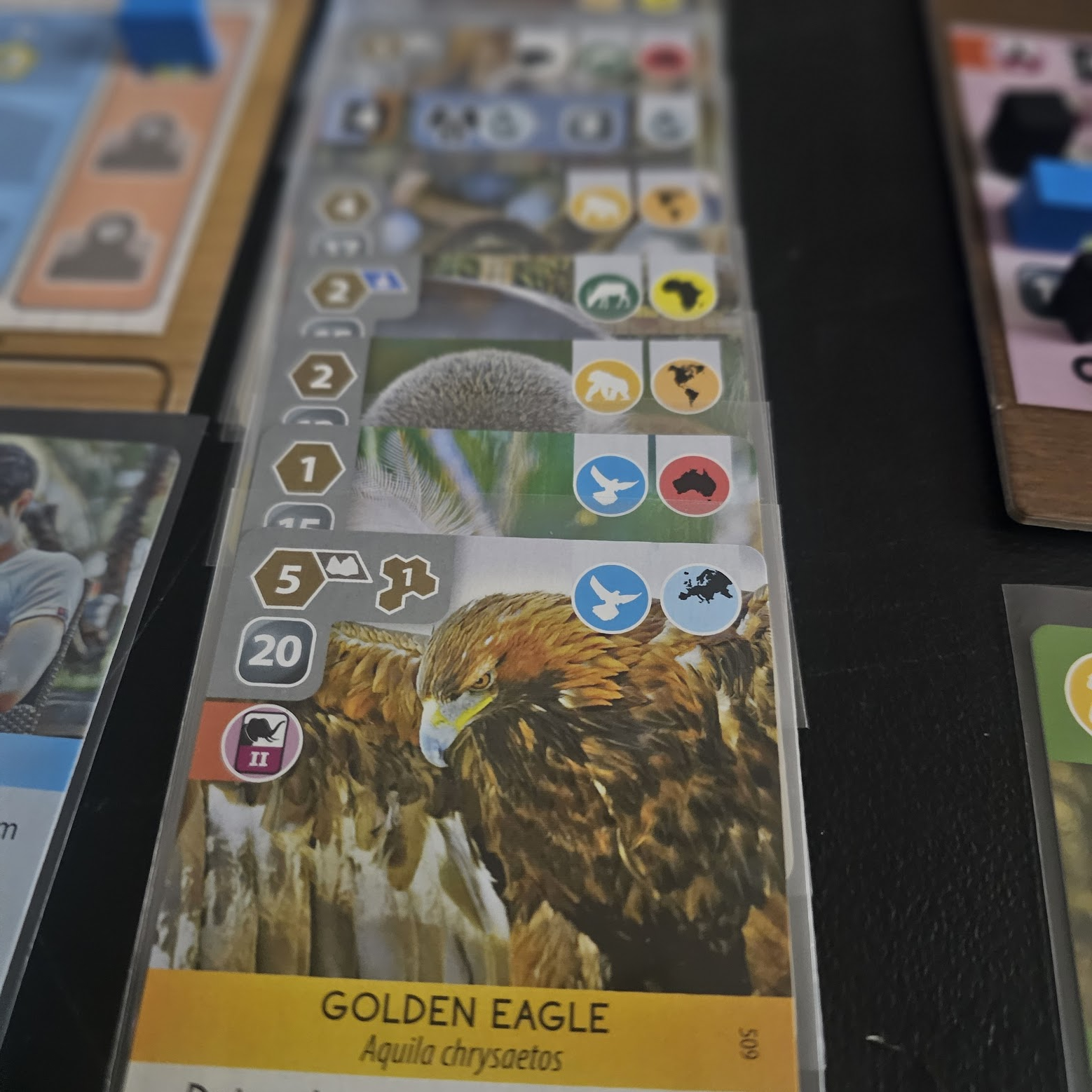
Card play

This is a card based game, and believe it there is variety. The pile of cards is absolutely huge! Normally this can be good or bad, but Ark Nova does not require specific cards, but actually is all about collections of symbols, and there is a nice spread. Cards also present some scientific information and try to be as thematically accurate as possible.

Just a little quibble though: this has to be the blandest and uninspired money ever. It doesn’t even look like money. But, honestly, it’s not the star of the show anyway.

Conclusion
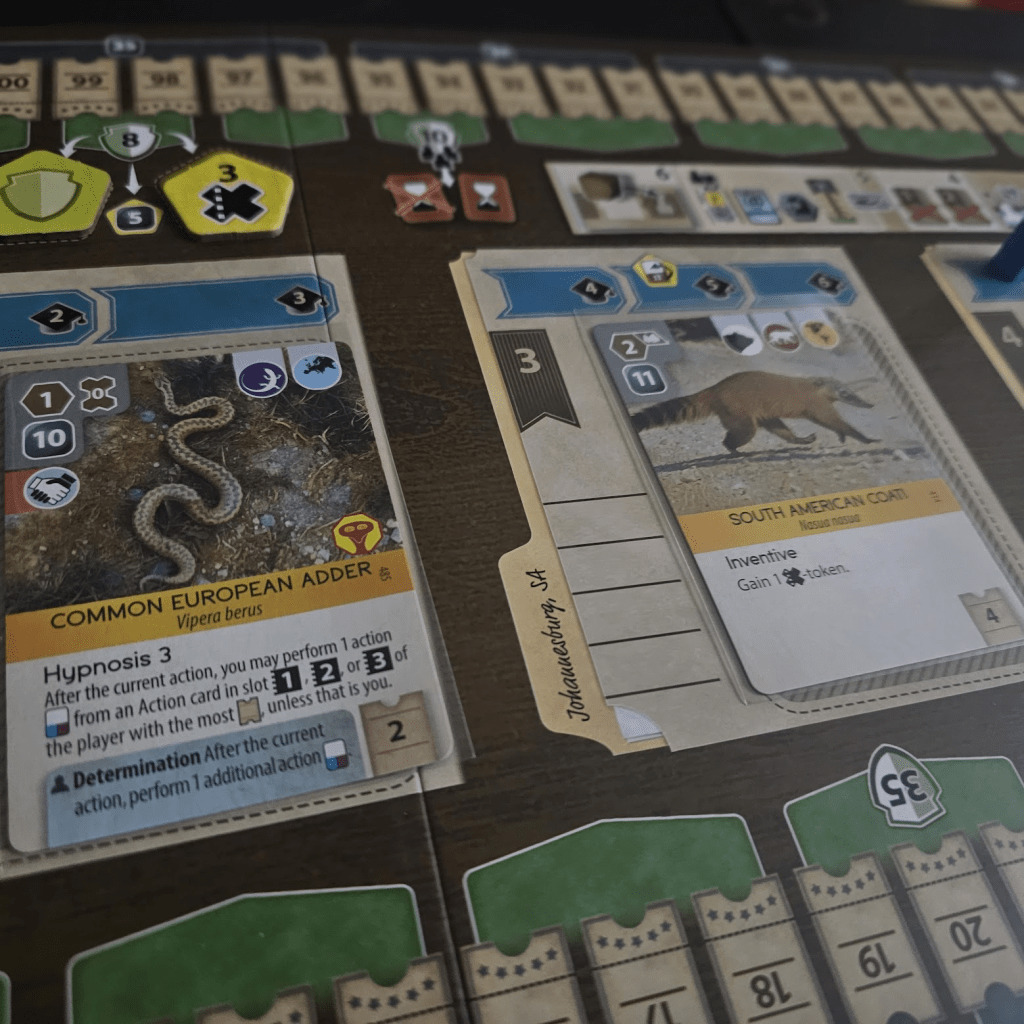
I love card based euros, so there is a lot of competition on this area. Does Ark Nova shine? Oh, yes, it does. Before playing I was a bit intimidated by the many things happening in this game, but it takes but a few rounds to get adjusted, and its heart it is a very fluid game. The action card system is the big differential, and it works beautifully, creating a lot of tension and very interesting decision spaces throughout the game.

Also, this is a game where you can’t do everything. That’s not just a statement, it’s a built in mechanism. You can only upgrade 4 out of the 5 cards, you can only partner with 4 out of the 5 zoos. You upgrade or have more workers for the influence board, but not both. However, you never feel out of options. Every turn feels relevant and rewarding.
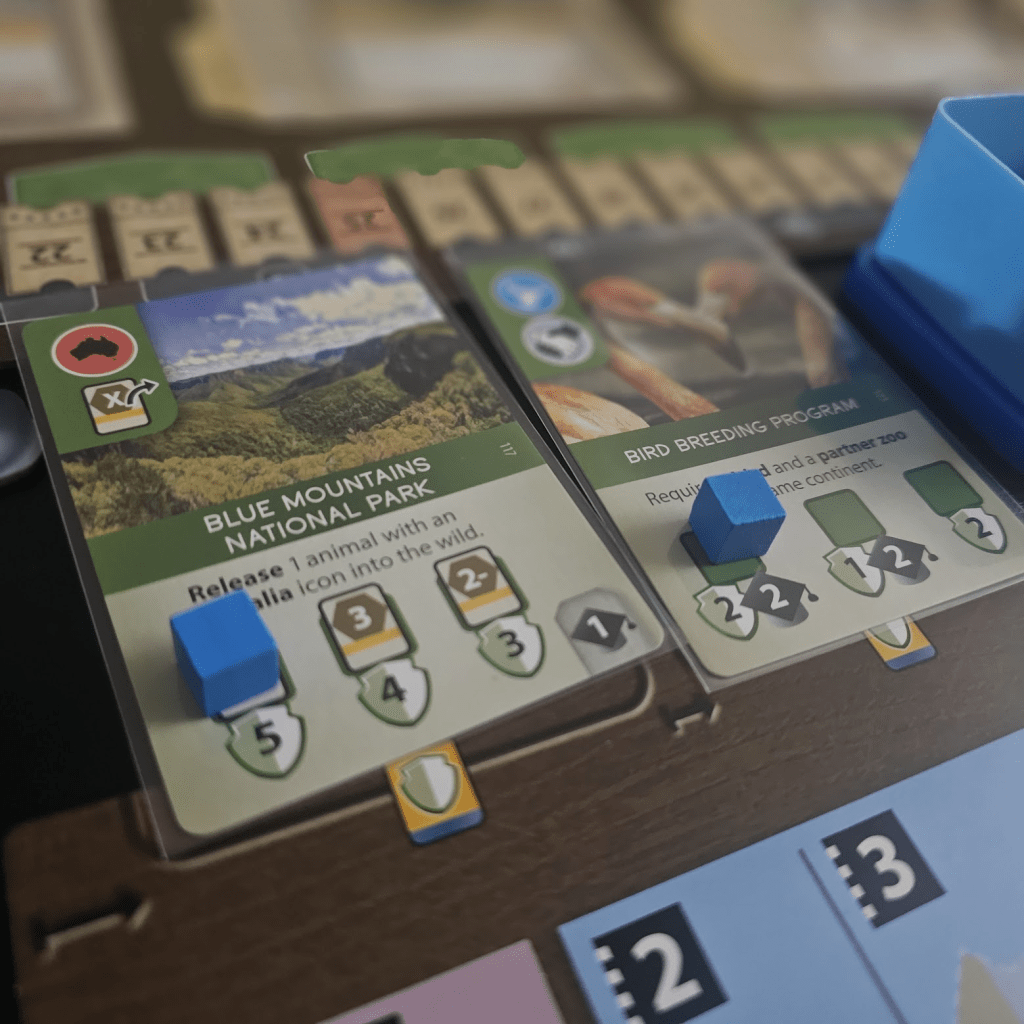
The sheer amount of cards is impressive, and it could be a good or a bad thing if not well balanced. I have now played with I believe most if not all of the deck, and I never had a game where I felt that I couldn’t do anything. The fact that the spread of the symbols is well done, there is always a route you can go to, and very rarely is the same. Just be aware that the deck is a pain to shuffle…

Score: 9.5/10

PnP Review

PnP Review: Evil Lab

1-99 Players

Designer: Kristopher Lagarto

Publisher: Polterdice

Link: https://shop.dicepen.pl/shp/products/details/prd:471

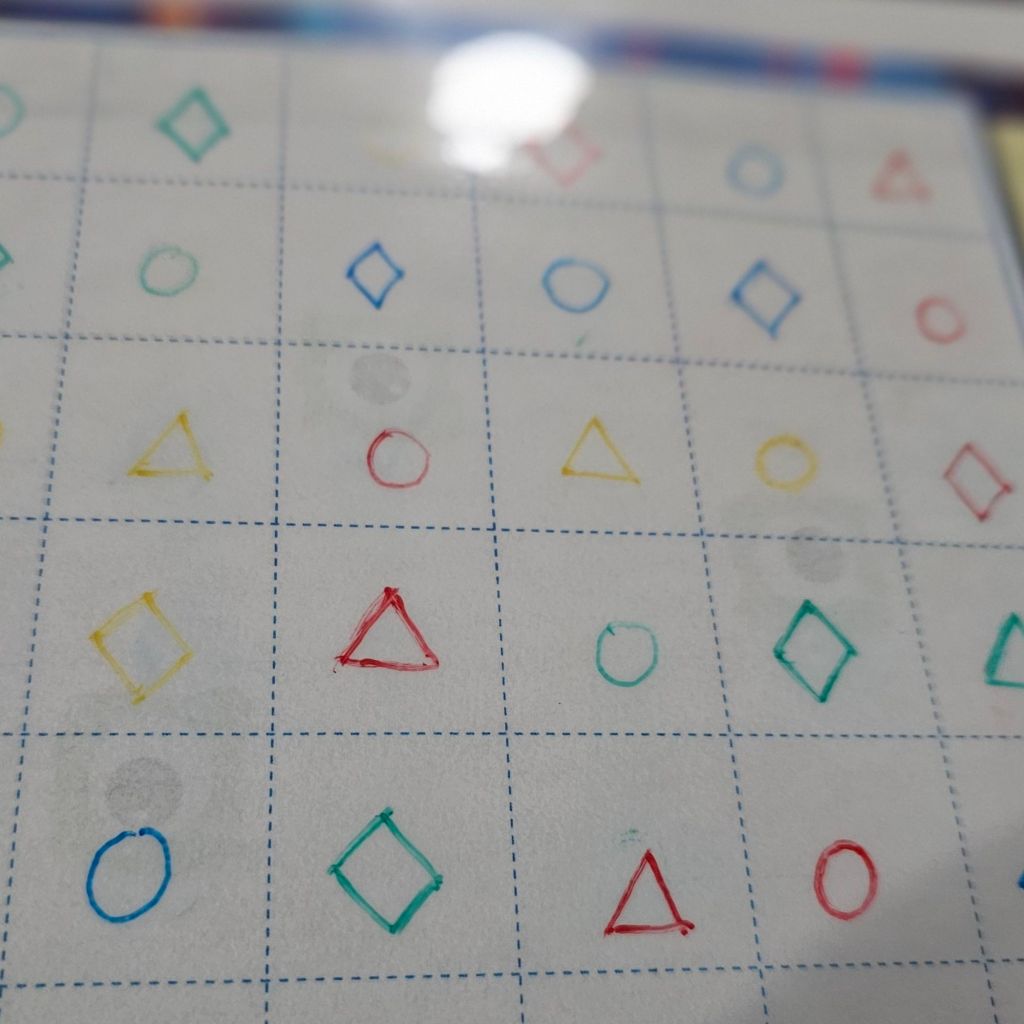
The premise is simple. Be evil, do evil manipulations of genes. But, actually, fill up coloured shapes and try to get formations. Evil-y, of course!

Components

Play area

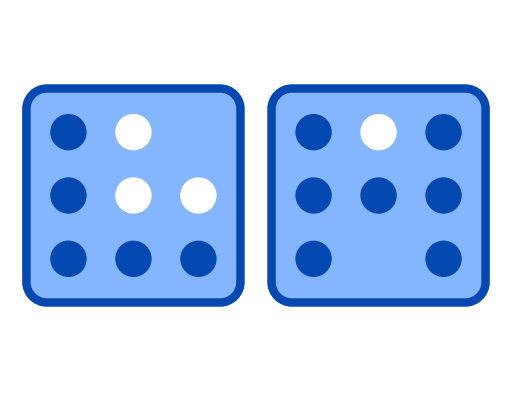
Evil Lab just need one sheet per player. There also many variation sheets available, each need to be printed separately. Aside from that, you just need two d6s and writing utensils.

Gameplay

Evil Lab is actually a very simple game. Someone rolls two dice, and each player uses one to chose a shape and the other for option between two colours. The caveat is that no shape can be placed besides the same shape. At the end of the game, you get point for each shape, shapes that you have one of every color, and for sequences of shapes of the same color.

Solo Gameplay

No change, it’s a high score deal, with each sheet having its own specific chart.

Conclusion

If you are just foraging in the PnP world, this is a great start. Evil Lab is simple, but intriguing and fun. I also enjoy each variation, though I think it could have been implemented in a different manner, more printer friendly, but that’s a minor quibble.

Score: 7.5

Review

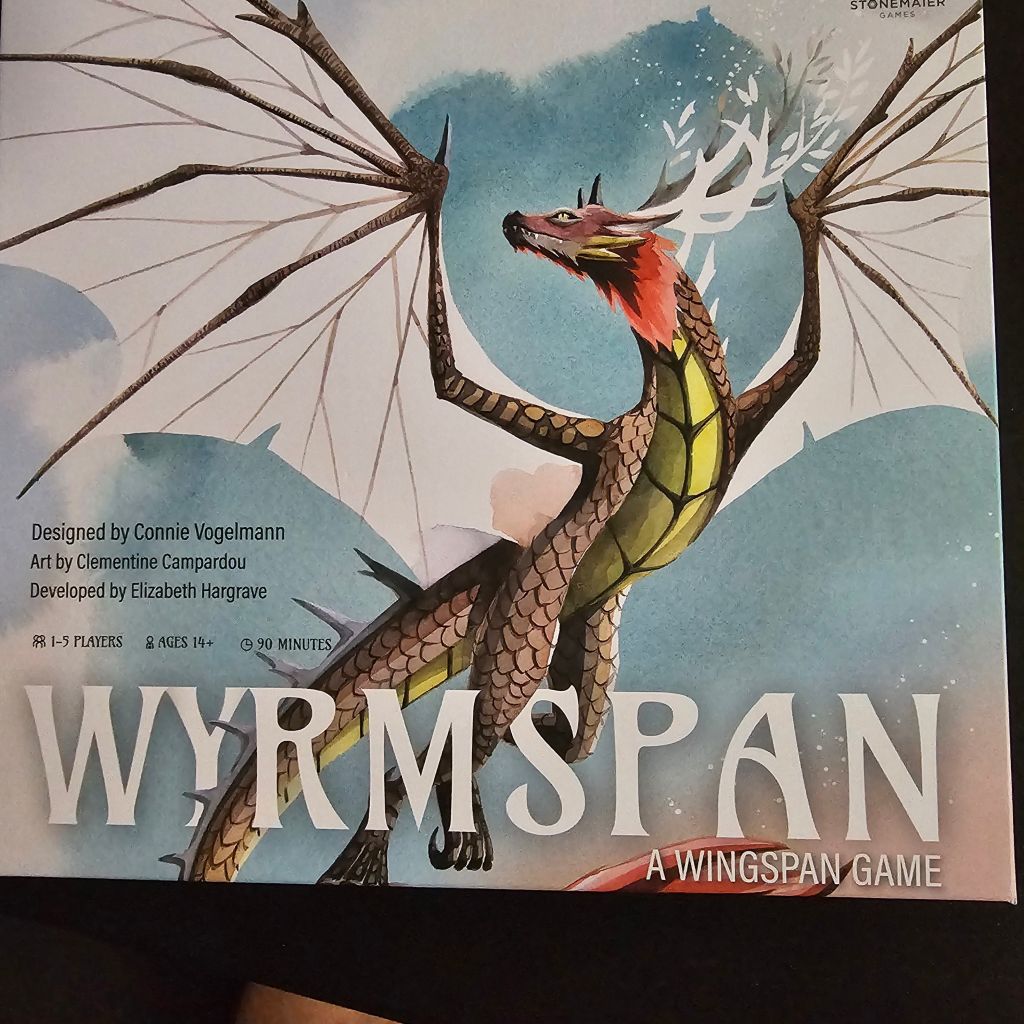
Let’s Review More: Wyrmspan

1-5 Players
Designer: Connie Vogelman
Publisher: Stonemaier Games

Following both the big hit Wingspan, Stonemaier got together again with the designer of the fantastic Apiary to create a follow up based on dragons. Does it take flight or does it fail to scale well?

Gameplay


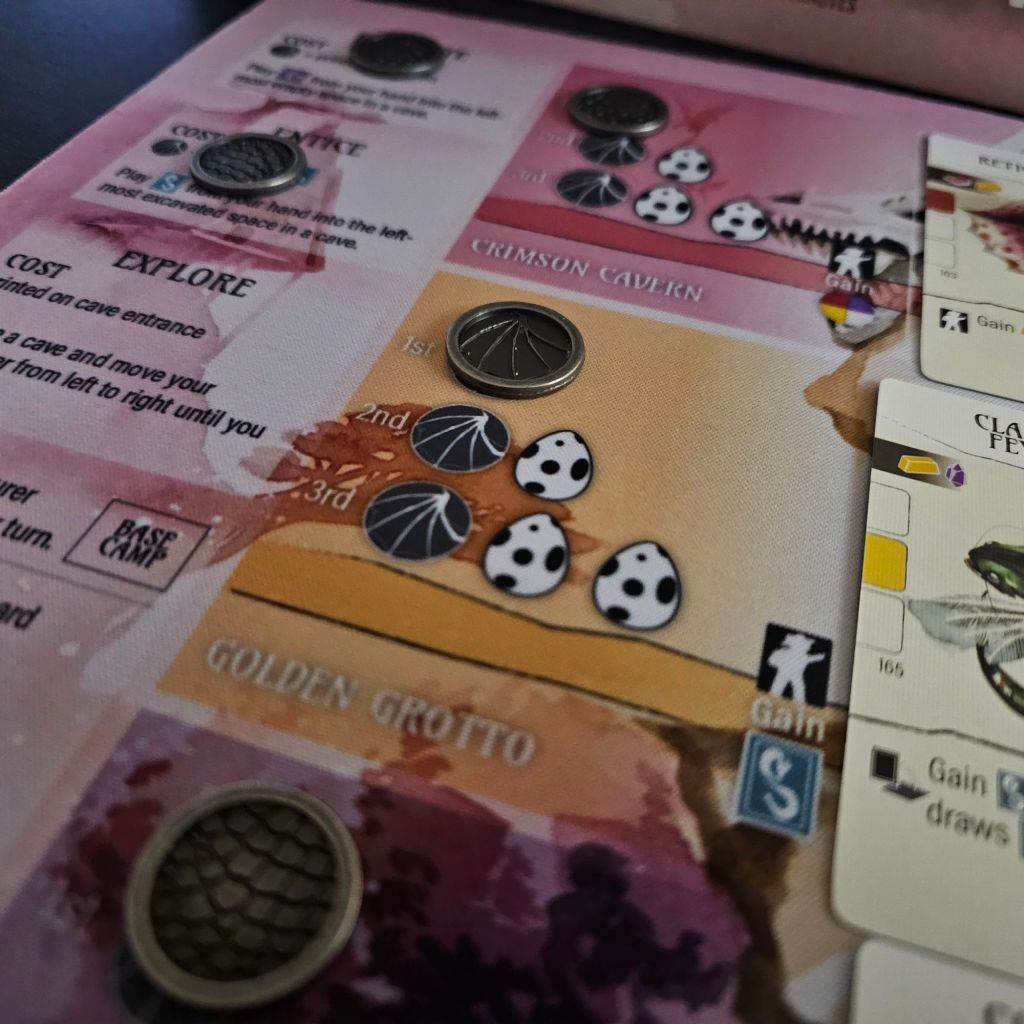
During 4 rounds, players first spend their coins to take one of three actions. You can play cabe cards to one of your three caves, play dragons on your caves, or explore each location, activating each space up until where you have dragons. At the end of each round players dispute in end of round criteria, like Dragons that are friendly, cave cards played, etc.


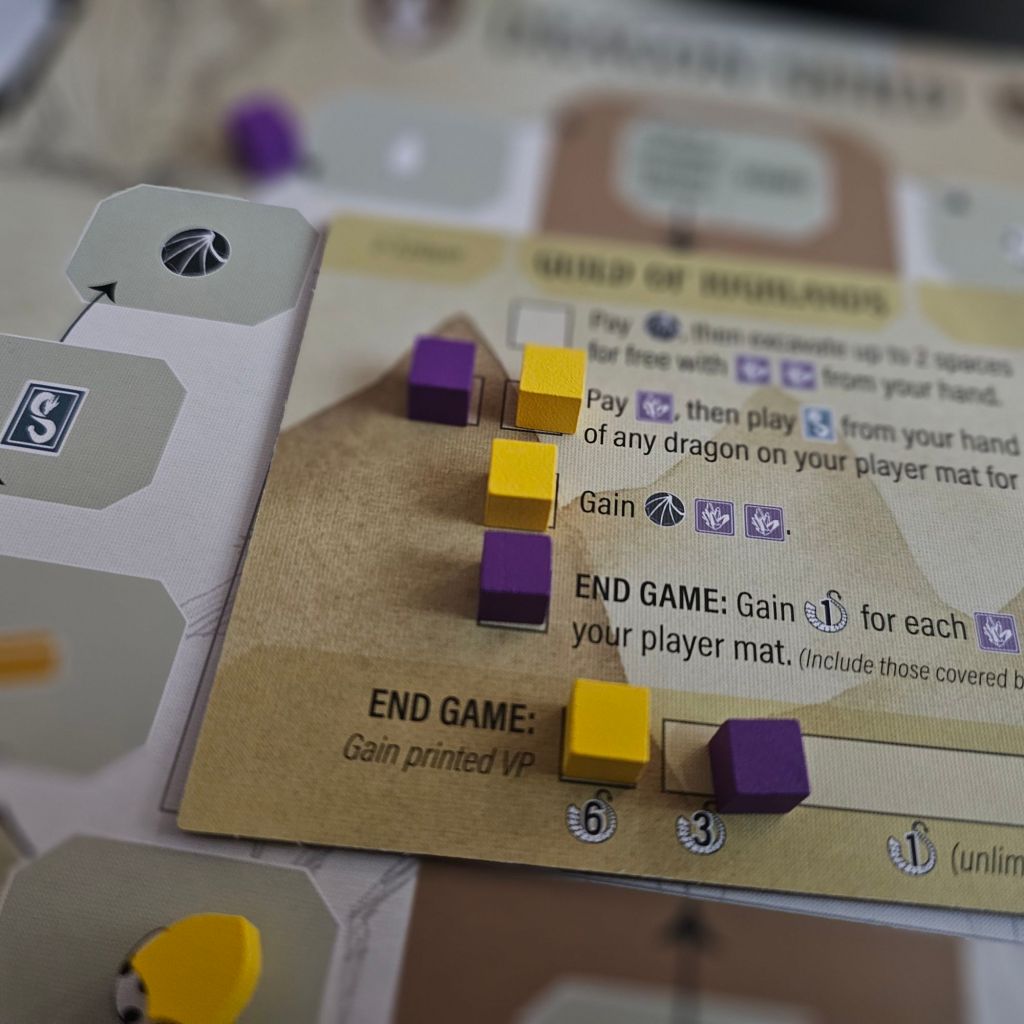
Exploring and lots of dragon and cave abilities will have players go around a guild. Most spaces have resources to get, but on top and bottom are spaces where you place a cube to either get a one time ability or end game points

Solo Gameplay


Well, I am a huge fan of Automa Factory, and my absolute favorites are Wingspan and Apiary. Well, to no one’s surprise, the solo mode is just as clean and elegant. With two modes, but basically the Automa focuses on going around the guild mat, and it does do it quite fast. At each brown location, it will either get some cards for endgame points or place a cube on the guild.

Components

Stonemaier went fairly minimalistic. All tokens are cardboard, and there is no fancy card tray or dice tower. What it does offer is a huge deck or unique dragons with gorgeous artwork and a lot more usability. And while Wingspan had factoids on the cards, Wyrmspan left that to a totally unnecessary but just as much awesome book with individual facts for each creature. I don’t mind the lack of storage, specially since expansions will come and all, and I very much appreciate the option to upgrade to premium components separately.

Wyrmspan or Wingspan


Of course this moment would come. Well, how close are they? I’d say 70%. They share the same DNA, but there is enough to differentiate to avoid redundancy.

But which is better? It’s a hard question. On one hand, Wyrmspan comes with a ton of adjustments based on feedback for Wingspan. On the other hand, Wingspan has so many cool expansions that add a lot.

Comparing base to base, it will come down to play style and preference. Wingspan has the idea of diminishing actions with increasingly explosive turns. Wyrmspan breaks down a lot of the habitats explosive capabilities between the exploration, caves and more dragons with played abilities. This means less explosions but more constant bursts.

Wingspan is also the tighter of the two games, being harder to make exactly the plays you need. Wyrmspan is more giving, with a variety of resources always coming your way. Also, Wyrmspan has a bigger interaction with the guild.

Conclusion


If you already have an opinion on Wingspan, the chances of having the same on Wyrmspan are quite big. That being said, for me it was love at first play. Each game I appreciate more the changes Connie Vogelman brought to the system created by Elizabeth Hargrave. It all feels familiar, yet novel. My only criticism is that the solo play felt a bit easier, specially when comparing the top difficulties.

Score: 9.5/10
Review

Let’s Review More: Micro Cosmos

Designers: Michał Jagodziński and Kamil Langie
Artist: Jarosław Wajs
Publisher: Thistroy Games

Sometimes is good to take a look at not only new games, but ones that flew under people’s radars. I feel like that is the case with Micro Cosmos. I was a big fan of the light but compelling game Thistroy previously releases, Micro City. Is their take on space also good?

Gameplay

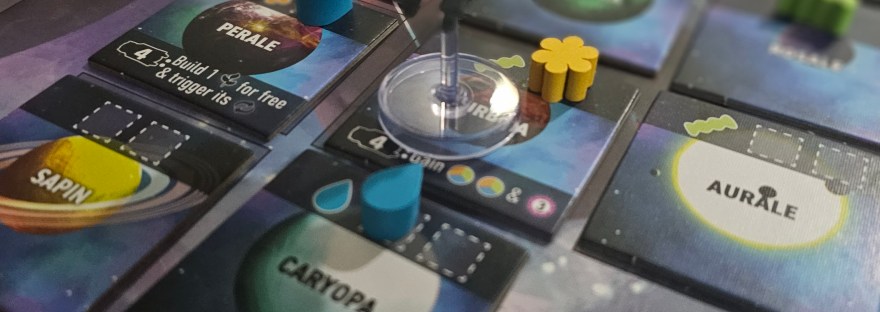
Micro Cosmos Gameplay

On your turn, first you may upgrade your ship, then you must move. After moving, you may at up to two cards with a very interesting system. You have two rows of 3 cards in your cargo, and each cards have colors on the bottom and top. If the color of your location matches the color of the part of the card touching the cargo, you get to activate it. Cards played or used from the bottom row go to the top, ones on top are discarded.

Then you may take one or two actions, depending on your location. You can gather resources, find and settle survivors for more resources and points, add colonies and trading posts that get you points and also increase your terraforming capabilities and get you also points.

Terraforming is the last action, where in each planet you may spend resources to contribute to that planet. Each resource contribute bumps you up in the track for that planet, and when all have been added, it is terraformed. Then each point on the track gets you a vp, and the ones who contributed the most get a bonus. Game ends when either 3 or 4 planets have been terraformed.

Solo Gameplay

Automa Deck

Automa has their own dedicated ship and deck. Their turn couldn’t be simpler. Turn a card, do what it says. Resource decisions have just a couple of rules, and it’s mostly doing the same things as you. In my experience, scoring for the Automa has been very close to my own pretty much all games, which feels like a very well tested effort.

Components

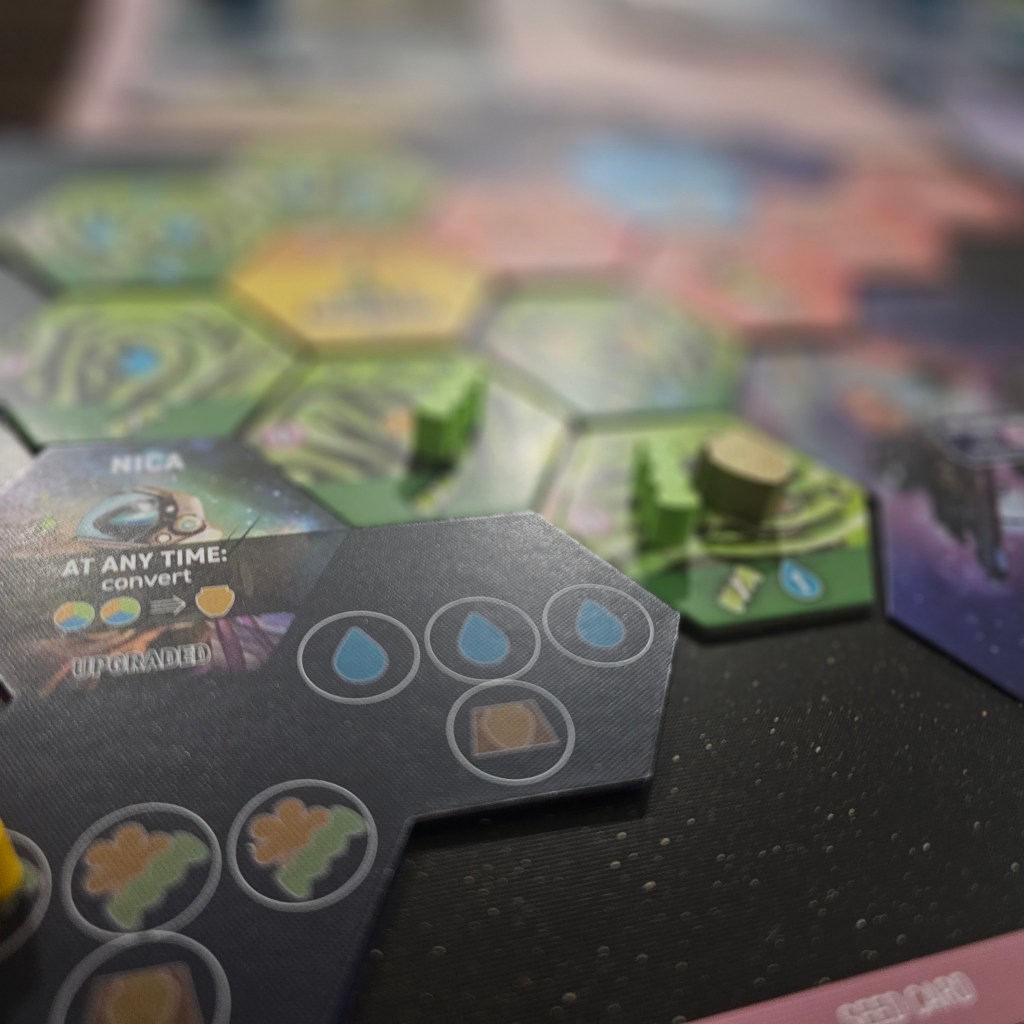
Resource Track

I am always curious on how small box games deal with component usage and storage, but this one is quite good. It’s a small but tall box, with a great tray system which makes setting up and tearing down very easy. Symbology is mostly clear and, while it’s not the easiest rulebook to read, I felt it left me with little doubts.

A few minor quibbles, though. First, tokens are obviously small, so it’s a game susceptible to bumps, so be aware if you, like me, are clumsy. Second, a way to keep track of your terraforming rate would be good to avoid counting your colonies and trading posts every time. Finally, the reference card is quite good, but could have a quick description with costs of each action. You get the hang of it easily, but it would have been helpful.

Conclusion

I was expecting a light game like Micro City, but this is a much more involved beast. It’s very much a resource management game, where you spend as quickly as you earn them. It’s also a lightn and ing fast ordeal where every opportunity counts. As far as little box big game goes, there is very little here not to recommend. Micro Cosmos is a game that leaves me impressed after every game.

Score: 9/10

Uncategorized

Let’s Review More : The Royal Limited

1 Player

Designer: Scott Almes

Artist: Taylor Stone

Publisher: Button Shy Games

About the Game

The 5th game in Scott Almes partnership with Button Shy of solo only games with simple rules and deep game play, The Royal Limited has some big expectations on it. How successful this little train game is?

Solo Gameplay

Timer of the game

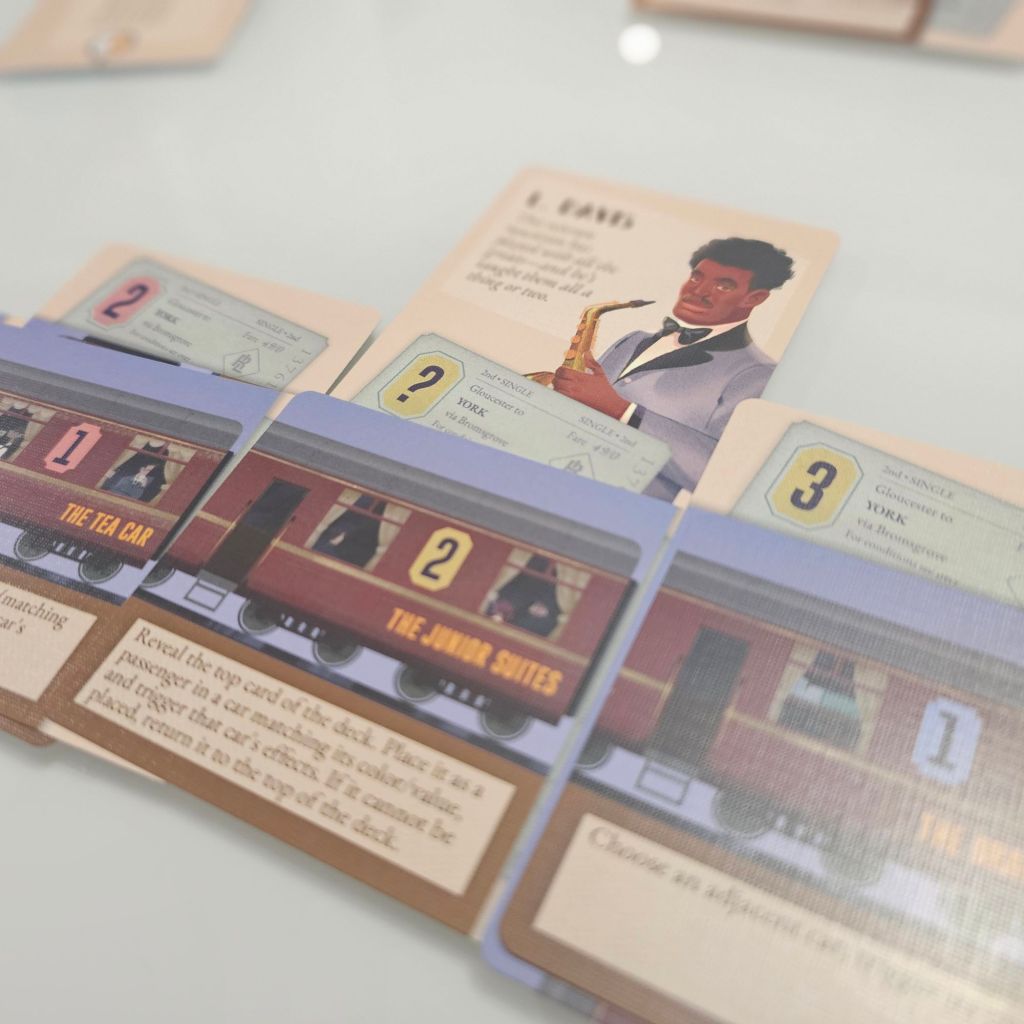
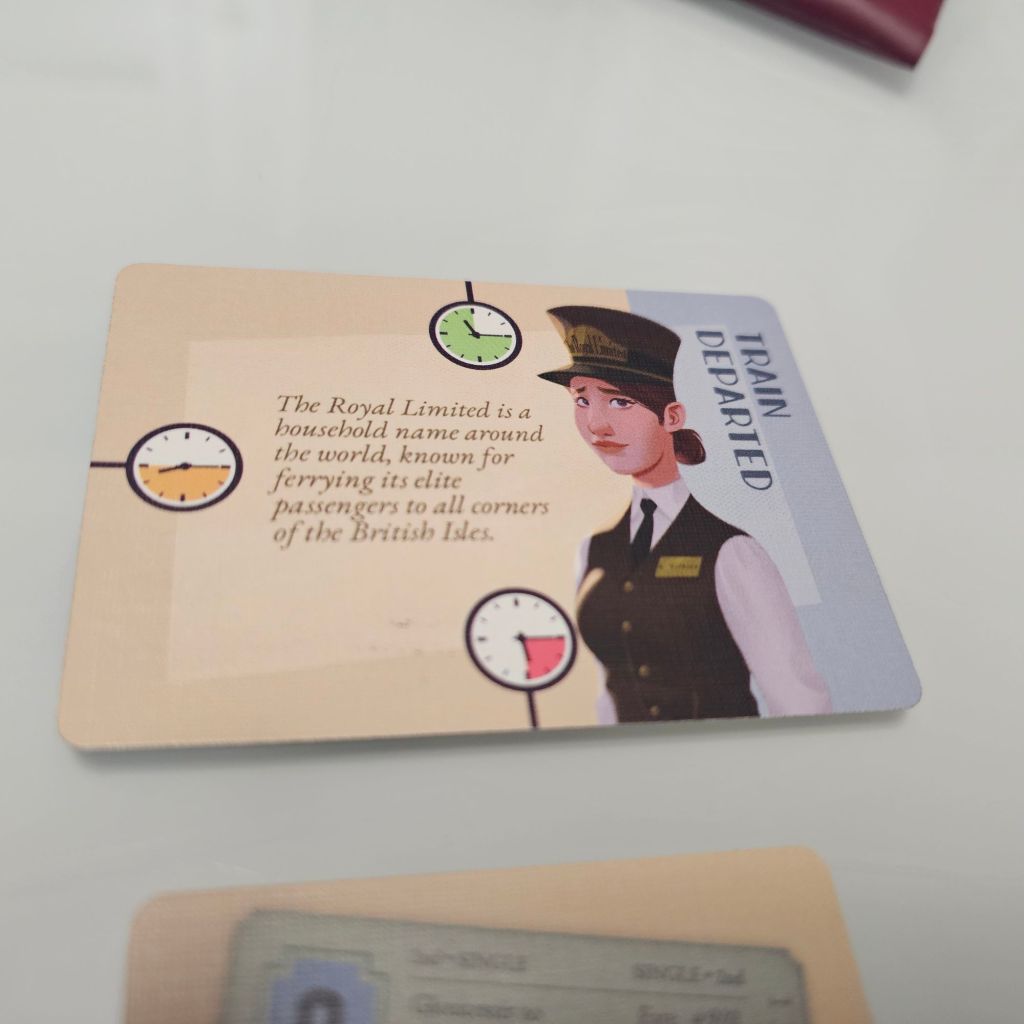
On this properly named game, you have a very limited number of turns, 4 to be precise, where you will take actions with a hand of 5 cards. You can either play trains, discarding cards equal to the value, or adding passengers to a train with the same color and activating it. You will also have two specially passengers that have their own unique set of placement rules. When you’re done, you draw 5 more cards and advance the timer. On the end, your score is the number of unused cards and train cars, and your goal is score 0.

Components

Royal Limited cardback

Aside from the usual great wallet with great quality cards, I really enjoy the art style of the game. It walks a fine line between elegant and cartoony, which works well with the theme.

The train and passengers are a little wordy, and because the art takes a good space it’s a little crammed. Nothing too bad, but it’s not the best.

Conclusion

The Royal Limited is a very quick but surprisingly thinky game. You have very limited choices, and each misstep is a point you have to deal at the end of the game. On that, there is an incredible elegance in balance. Since there are only 3 colors and 4 unique values, every resource you use you have to account for in terms of opportunities later.

Comparing to the rest of the line, I feel this is on the middle of the pack. Which, on a line this good, is a big big compliment. But, of all of them, I feel this one has the most potential of growing on me, specially as expansions start to come.

Score: 8.5/10

Review

Let’s Review More: Raiders of Scythia

1-4 Players

Designer: Shem Phillips

Artist: Sam Philips

Publisher: Garphil Games

About the Game

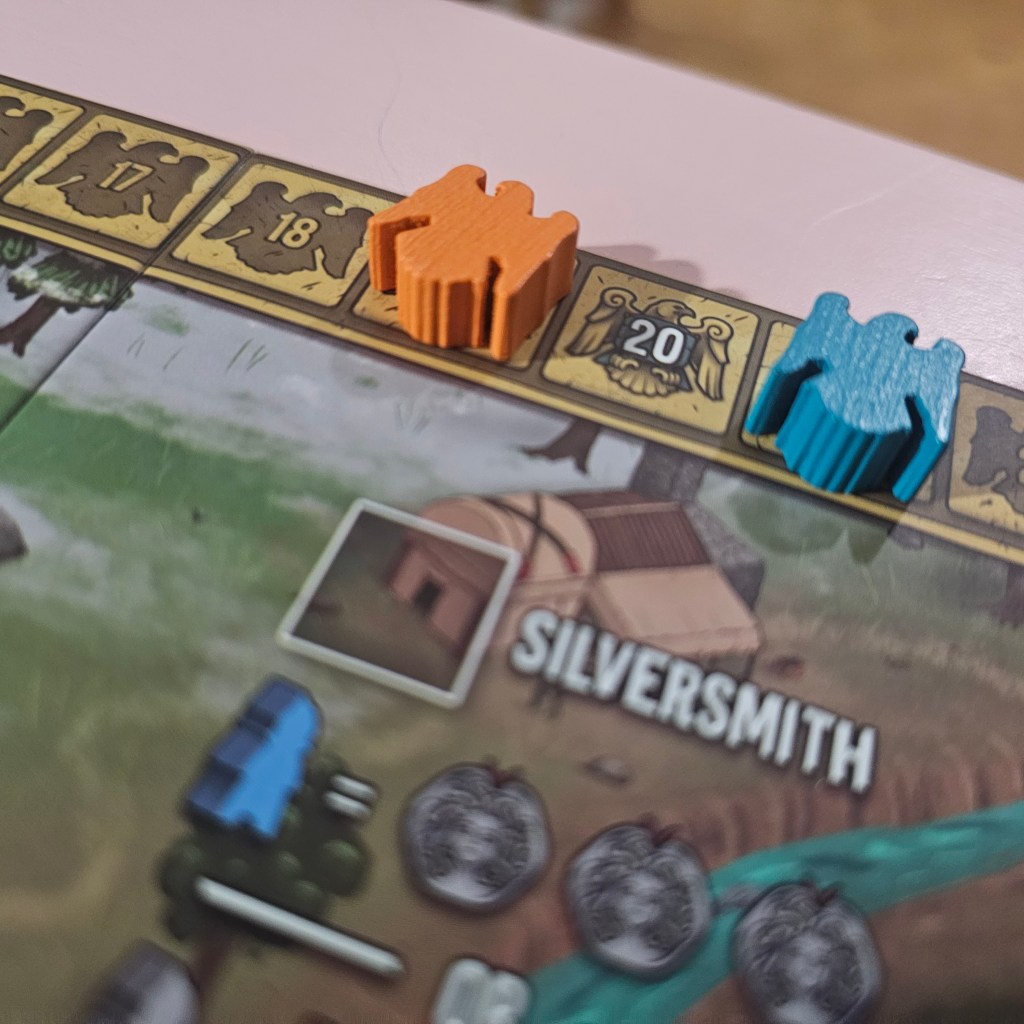
Scoring eagles

Garphil Games released an amazing game called Raiders of North Sea with two expansions and it’s still regarded as a modern classic. Then they went back on the system and released Raiders of Scythia. How does it fare against its predecessor and on its own?

Gameplay

Raiding is fun

The core premise remains: you start your turn with a single worker, you end with a single worker. One of your options is to work, where you will place your worker on one of the top locations and activate that to get or trade resources and cards, play crew or solve Quests. Then you pick up a worker from a different space and activate that too. Or you can raid, where you must have a number of crew members and spend provisions and Wagons to get all resources in one place and points depending how strong your crew is plus the dice from that region. However, the dice also place wounds on your crew, reducing their strength or even killing them.

Solo Gameplay

Solo cards

On the AI turn, they will block off one space, where you can’t place or pick workers from, and then proceed to try to raid. They check if there is an available spot on the right region, if they have enough provisions and enough strength from horses. If any of these are false, they either get a quest or more of whatever is missing. Otherwise, they clean up the spot and get a fixed amount of victory points.

Components

For the most part, the components are Garphil level quality. Great cards, great art, meaningful symbology. I love the Kumis and provision tokens, and the coins, specially on the Deluxe, are amazing.

There are some snags though. Unlike North Sea, all bag resources are hexes, just with different colors. However, the brown and black are hard to tell apart in some lights. This is specially jarring since brown ones (Wagons) are necessary to raid lower regions.

I also feels like the board is way too crowded. The art is great, but it is a busy background and can be visually overwhelming.

Comparing Raiders

Raiders of Scythia is basically Raiders of the North Sea with some of expansions integrated, but there are new things.

The heroes now are not one special type of crew, but your character that has an unique action that can be taken on the Town Centre without discarding a card. Also, gone is the armor and Valkyrie tracks (not big fans of Odin those Scythians). Instead, the damage from Fields of Fame are integrated on all raids. Also, you now can get horses and eagles to boost strength, provide victory points and add more actions to the Town Centre.

From Hall of Heroes, mead to strength up your attacks becomes Kumis, and the Quests are mixed with the chieftain tributes and are a single thing.

So, strictly speaking, do you need both? No, you don’t. There is plenty of overlap between them that having one makes you not miss out big on the other. But is there space for both? Absolutely. I own both and play them in different times for different reasons.

For me, if you want to pick one it boils down to if you will get just one box of each, or if you would get North Sea complete. As a base game, Scythia is more robust and interesting. But, when complete, I like the options of North Sea better. Also, visually I like North Sea way better.

Conclusion

What about on its own? Raiders of Scythia is absolutely fantastic. It gets a simple premise with simple rules, and transforms it into this game with an ebb and flow play style where every turn is a question of efficiency and opportunity. And it took its big brother and condensed into this fantastic amalgam that is truly bigger and better than all its parts.

It’s not without its faults, components being the biggest. But, in the grand scheme, those are fairly minor

Score:9/10

Review

Let’s Review More: Raiders of Scythia

1-4 Players

Designer: Shem Phillips

Artist: Sam Philips

Publisher: Garphil Games

About the Game

Scoring eagles

Garphil Games released an amazing game called Raiders of North Sea with two expansions and it’s still regarded as a modern classic. Then they went back on the system and released Raiders of Scythia. How does it fare against its predecessor and on its own?

Gameplay

Raiding is fun

The core premise remains: you start your turn with a single worker, you end with a single worker. One of your options is to work, where you will place your worker on one of the top locations and activate that to get or trade resources and cards, play crew or solve Quests. Then you pick up a worker from a different space and activate that too. Or you can raid, where you must have a number of crew members and spend provisions and Wagons to get all resources in one place and points depending how strong your crew is plus the dice from that region. However, the dice also place wounds on your crew, reducing their strength or even killing them.

Solo Gameplay

Solo cards

On the AI turn, they will block off one space, where you can’t place or pick workers from, and then proceed to try to raid. They check if there is an available spot on the right region, if they have enough provisions and enough strength from horses. If any of these are false, they either get a quest or more of whatever is missing. Otherwise, they clean up the spot and get a fixed amount of victory points.

Components

For the most part, the components are Garphil level quality. Great cards, great art, meaningful symbology. I love the Kumis and provision tokens, and the coins, specially on the Deluxe, are amazing.

There are some snags though. Unlike North Sea, all bag resources are hexes, just with different colors. However, the brown and black are hard to tell apart in some lights. This is specially jarring since brown ones (Wagons) are necessary to raid lower regions.

I also feels like the board is way too crowded. The art is great, but it is a busy background and can be visually overwhelming.

Comparing Raiders

Raiders of Scythia is basically Raiders of the North Sea with some of expansions integrated, but there are new things.

The heroes now are not one special type of crew, but your character that has an unique action that can be taken on the Town Centre without discarding a card. Also, gone is the armor and Valkyrie tracks (not big fans of Odin those Scythians). Instead, the damage from Fields of Fame are integrated on all raids. Also, you now can get horses and eagles to boost strength, provide victory points and add more actions to the Town Centre.

From Hall of Heroes, mead to strength up your attacks becomes Kumis, and the Quests are mixed with the chieftain tributes and are a single thing.

So, strictly speaking, do you need both? No, you don’t. There is plenty of overlap between them that having one makes you not miss out big on the other. But is there space for both? Absolutely. I own both and play them in different times for different reasons.

For me, if you want to pick one it boils down to if you will get just one box of each, or if you would get North Sea complete. As a base game, Scythia is more robust and interesting. But, when complete, I like the options of North Sea better. Also, visually I like North Sea way better.

Conclusion

What about on its own? Raiders of Scythia is absolutely fantastic. It gets a simple premise with simple rules, and transforms it into this game with an ebb and flow play style where every turn is a question of efficiency and opportunity. And it took its big brother and condensed into this fantastic amalgam that is truly bigger and better than all its parts.

It’s not without its faults, components being the biggest. But, in the grand scheme, those are fairly minor

Score:9/10

Review

Let’s Review More: Scholars of the South Tigris

1-4 Players

Designers: S. J. MacDonald, Shem Phillips

Artist: Mihajlo Dinitrievski

Publisher: Garphil Games

About the Game

Science Tracks

We have the second game on Garphil’s third trilogy, this time about transcribing knowledge from all around the world. As usual it’s hard to follow up a great first game in Wayfarers, so how do Scholars fair?

Gameplay

Scholars Card Play

On your turn, you either play a card or rest. To play a card, you chose one of the actions on you board and play a card and 1-2 dice. The dice will not only determine the value of the action, but also the color. Some actions care about just value, some just color, some both. Primary color dice will also combine color to secondary ones. Each dice can also be modified by up to two works to either change their color or to improve its value. There are less actions this time, mainly getting more translators, adding scrolls to be translated and translating them, and going up on the different scientific tracks.

When you rest, you rest, you get the income of all the cards you play. Those are either getting some dice or activating the income of one of the tracks. This dynamic makes the timing of acting and resting really interesting.

Solo Gameplay

Solo Board

As usual, we have a dedicated solo board, and it uses the 2 color system that Wayfarers used. This 6 card solo deck means that the AI is just interested in getting translators and dealing with scrolls, ignoring the science tracks. However, it still feels like a realistic, though abstracted, opponent.

One big difference is that we don’t have “personalities” this time around, but difficulty levels. I appreciate that route, as it would be difficult to isolate or incentivize too much one aspect.

Components

Translators

This is a standard Garphil production, with all the good stuff that comes with it. Great art, great components, lots and lots of symbols but a pretty good rule book with a back dedicated to symbology. It also uses all the familiar components, with the little flag for tracks, asterisks for influence and lots of familiar symbols.

One aspect I think they did great is accessibility. For a game that uses color as one of its central mechanisms, I believe that the way the symbols of the primary and secondary colors differ on more than just color, and the color of the dice and pips were chosen make this fairly color blind friendly. I’m no expert in the matter though.

Conclusion

Scholars feel smaller in scale, but that is actually a good thing. All systems in Scholars feel tighter and more connected. When comparing to Wayfarers, Scholars felt a bit more intuitive though no less of a challenge to optimize.

There is not much to criticize here. It’s what you expect from SJ and Shem, but it feels like a step towards a cleaner and less comborific fashion. And it works really well.

Score: 9.5/10
Review

Let’s Review More: Horrified Greek Monsters

1-5 Players

Designer: Michael Mulvihill

Artist: Victor Maristane

Publisher: Ravensburger

About the Game

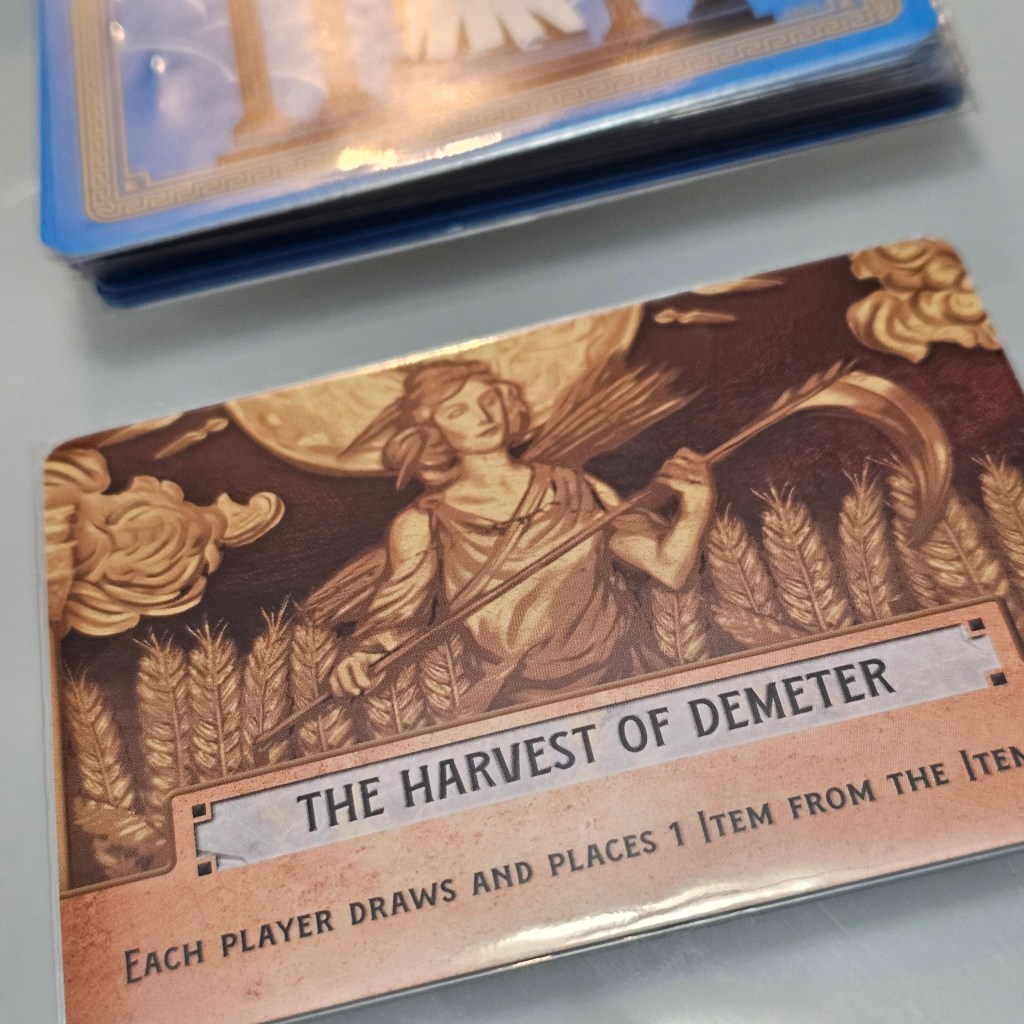
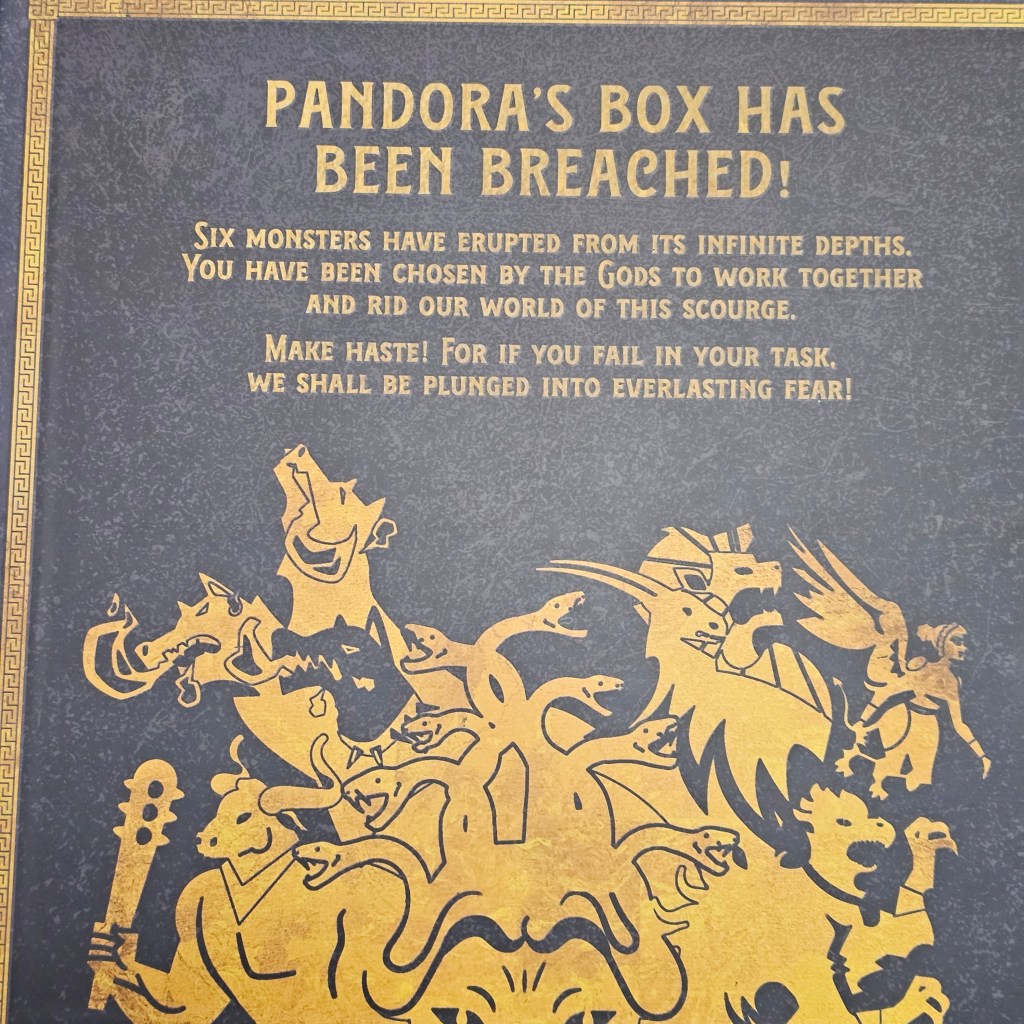
Pandora’s Box

In the third installment of the Horrified series we go to Ancient Greece to deal with Gods, face monsters from tales and meet legends. How much this changes from the formula of the game?

Gameplay

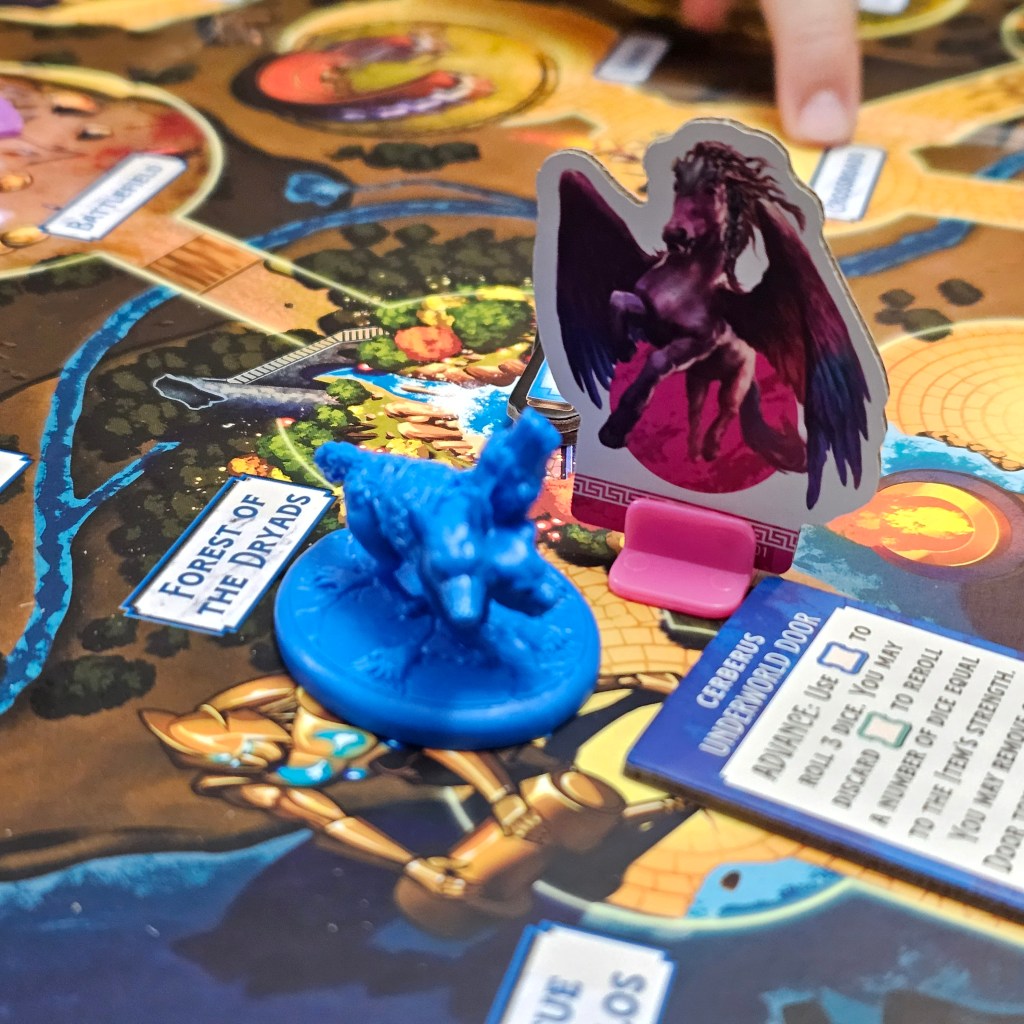
Pegasus VS Cerberus

If you are not familiar with Horrified, basically you have 2-4 monsters to defeat, each with their unique mechanisms. On a players turn, they use their actions to collect items, move around, guide people to their safe places and do monster specific actions. Then a card is turned for the monsters which adds more items, some event happens, then some of the monsters activate and may attack the heroes. You win the game by defeating all monsters, or lose if the monster deck runs out or if the terror rises to 7.

Monster cards

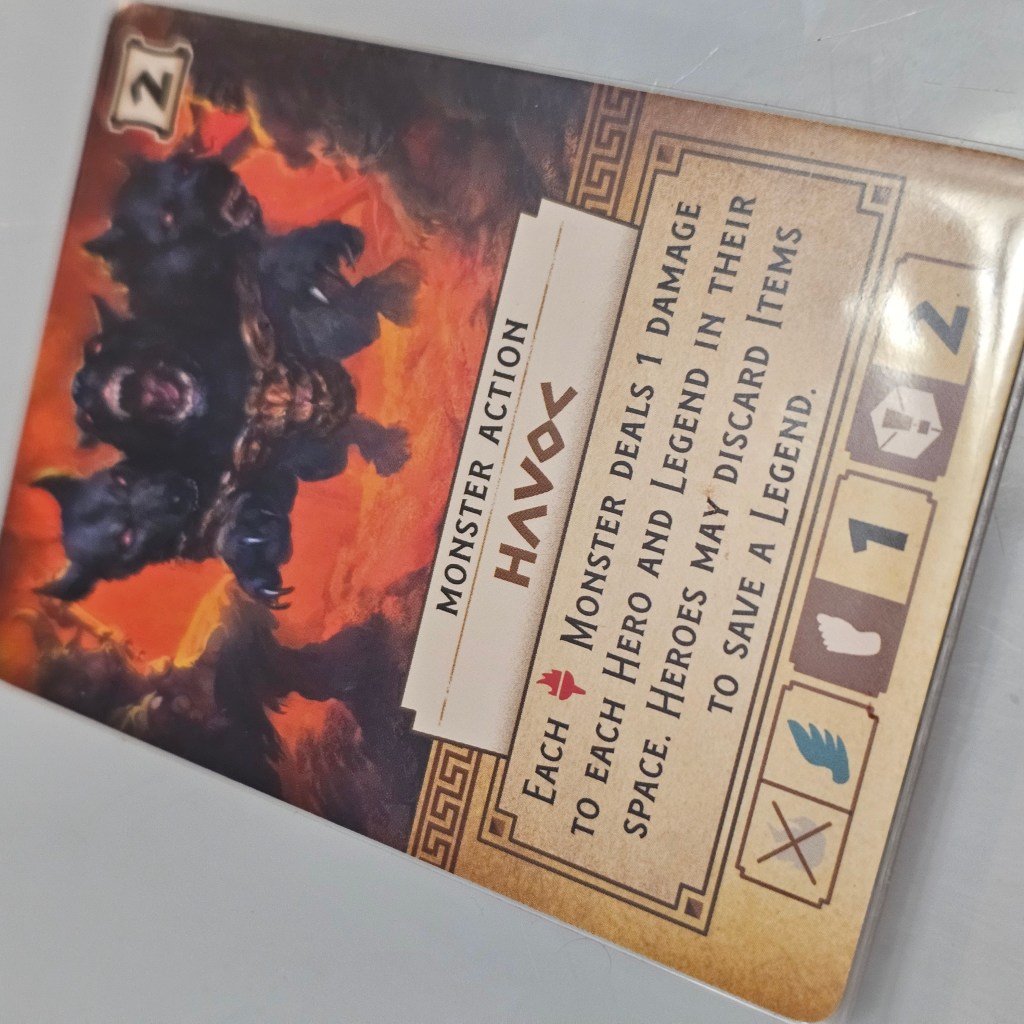
If you are familiar and wondering what are the differences, there are mainly two. First, events and activations are not tied to a specific monster, but to symbols present on each one. Each symbol is present twice, and each monster have three. Second, monster specific locations are not static, instead there are 4 lairs in every game, and you have to fine the lairs to your monsters in one of 4 locations.

Solo Gameplay

Divine Perks

As with previous entries, solo game is exactly the main game, except that the terror level starts at 3. But, unlike American Monsters, Greek Monsters feel well adjusted for solo play, even with the additional tasks such as the lairs and the legends needing to go farther.

Components

The infamous DogDogDog

Ravensburger really nails the high quality low cost niche. The cards have good quality, the tokens are good, clear and thematic and work well. The exception is the Minotaur’s maze, there are some ambiguous spots. But nothing too bad.

A big improvement is the rulebook. I like bow even though the theme is different, they kept the same main concepts. But the monsters are clearer in their specific rules, and there is little ambiguity.

Conclusion

First, let’s discuss the whole Horrified system. All three games are, mostly, the same mechanically, and even somewhat redundant. Is this better than adding expansions for the base game? I’m not sure. Horrified is a great gateway game for co-ops, and adding expansions would increase complexity. This way you have variety, and they can keep exploring entirely new themes and settings.

But how is Greek Monsters when compare to the rest of the series. Well, I have good and bad things to say.

On the good part, the change in the activations and events is excellent. Every monster feels more a part of the game, and cards never seem out of place. It’s a simple change, but one that works like a charm. Also, the monster complexity is closer to the original than American Monsters, and that is good. Every monster feel natural and intuitive.

However, I do feel like there was room for more, specially considering the theme. One big miss for me thematically is the Legends. One thing is having innocent villagers that you need to save and don’t have anything going for them. Another is having mythology heroes like Circe and Chiron, and they don’t do anything. They should.

I still feel like if you want just one Horrified game, just pick whatever theme seem more fun to you. But, comparing on the series, I feel like this one is just as good as the first. There is a bit more randomness and challenge this time around, but the game is balanced well for new players and veterans, big groups or solo.

Score: 8/10
Review

Let’s Review More: Apiary

Apiary Box

1-5 Players

Designer: Connie Vogelman

Artist: Kwanchai Moriya

Publisher: Stonemaier Games

About the Game

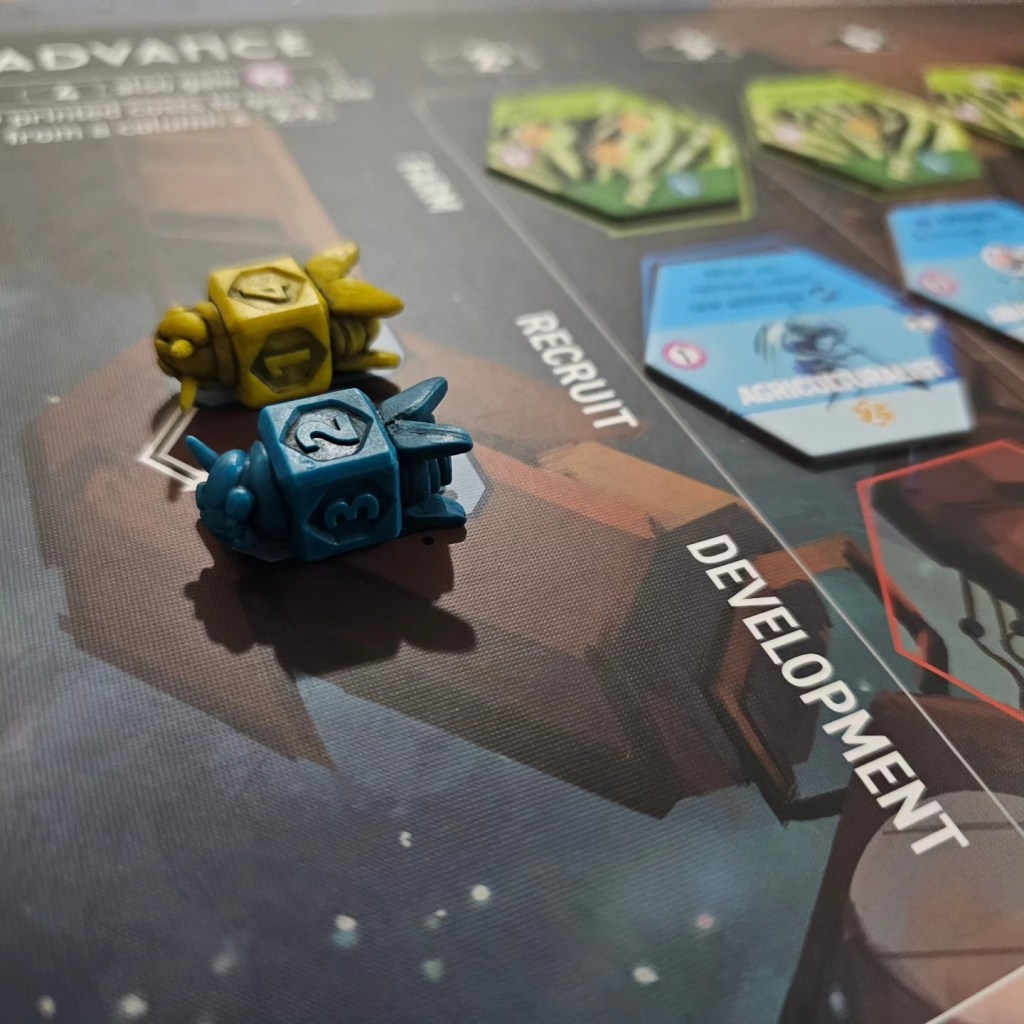
When I was wondering about the next Stonemaier game, space faring bees was not in my guess list. But here we have a worker placement / tile layer with variable worker values. Is it worth the buzz?

Gameplay

Apiary Home Mat

On your turn, you either place one of your bee workers or recall all of your workers to your mat.

When placing, you chose a worker, all with values 1-4, and place them in any action on the board. No spaces are ever blocked, instead if it’s already occupied you bump the existing one. Spaces are not complex, are mostly about getting or trading resources and cards, or adding tiles to your base.

When workers go back to the active pool, either by being bumped or when you recall them, their value increases by one. Level 4 workers trigger special bonuses when played, but when their value would increase instead they hibernate. You lose that worker, but you get a bonus on tracks on the main board. Game ends when all the hibernate spots are taken or when a player uses all 7 of their hibernate tokens.

Solo Gameplay

Bee Workers

Automa Factory is amazing, everyone knows that, but that might be the smoothest of them all. You setup with 3 grey and 2 yellow with values depending on the difficulty. On your turn, you flip over a card and do the first action you can, using the top of the deck to see what color will activate and other decisions.

Basically, every automa card will recall and get some points depending on how many of that color they have placed, or carve if they have a level 4 worker, or one of the other actions. When the Automa performers an action, they will mostly get points or some tiles or explanation tokens. Also, most of the actions are clearly are right there on the card, so they are super simple.

Components

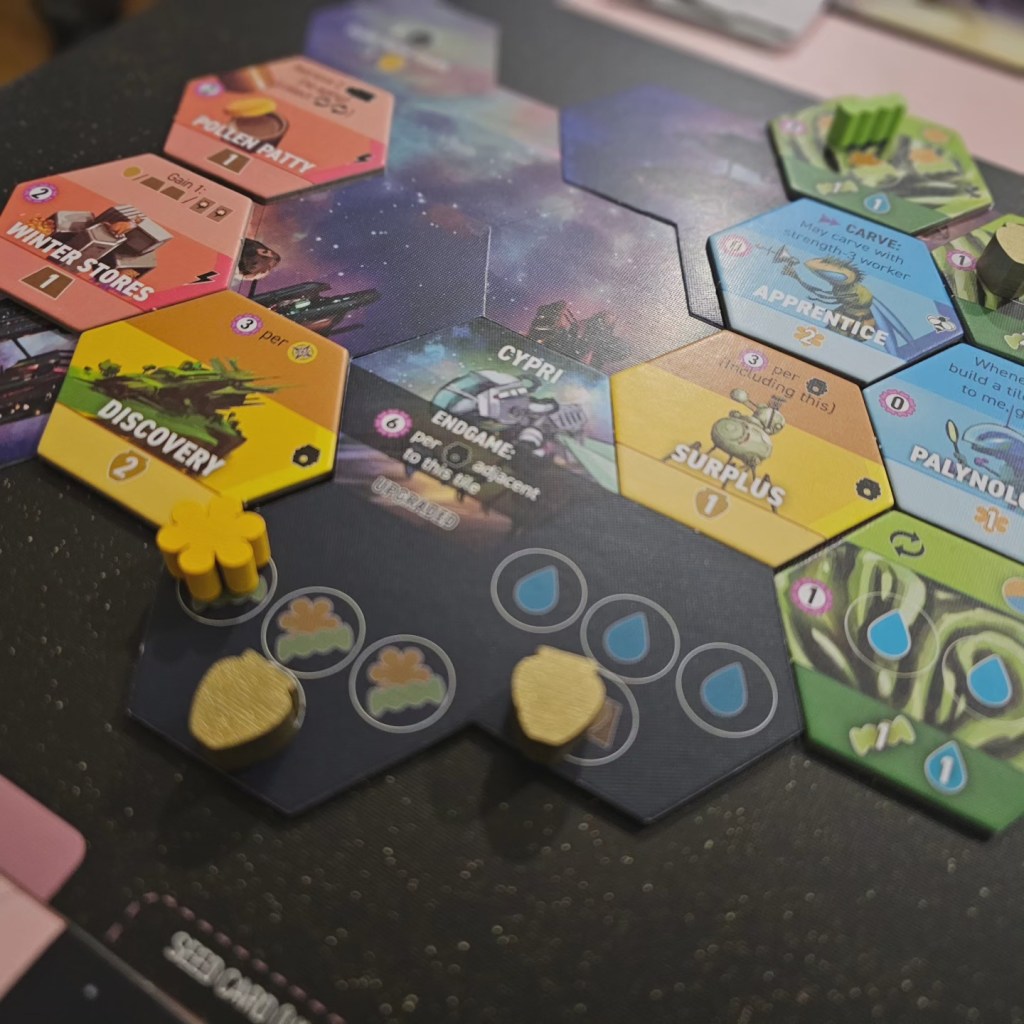
Components

That part is almost obvious, Stonemaier has always great components. But Apiary is an interesting case, specially after Expeditions. It’s minimalistic.

The tiles are small, have simple drawings in the middle, and there is a lot of blank space. However, it’s a game with a lot of simultaneous components in the table, so I think overall the approach works beautifully, specially from an usability stand point.

Conclusion

Queen Bee Exploration

Reviewing Stonemaier games is always a tough deal. There is a ton of excitement and expectations. So I tried to go in as blind as possible, not seeing gameplay or reviews, or even following the design diary.

My initial feeling is that even though it seems overwhelming, about 3 turns in I understood the flow. Is a very intuitive game, and a bit on the light side for the most part.

However, it’s a rich game. Navigating the flow of the bees, yours and others, is the key here. Sometimes a less effective action can absolutely worth in the big picture.

The downside on this game is that the individual mats and factions are important, but not game changing. The flow feels mostly the same. Not a huge deal, but it’s something that I hope gets expanded.

In the end, I feel like this is one of the most approachable or their games. Specially with the great insert, the game can be setup very quickly, and it’s not a long game, but every minute feels interesting and rewarding.

Score : 9/10