Review

Let’s Review More: Mech Bunny

1 Player

Designer: Gabe Barrett

Artist: Jake Lawrence

Publisher: Best With One Games

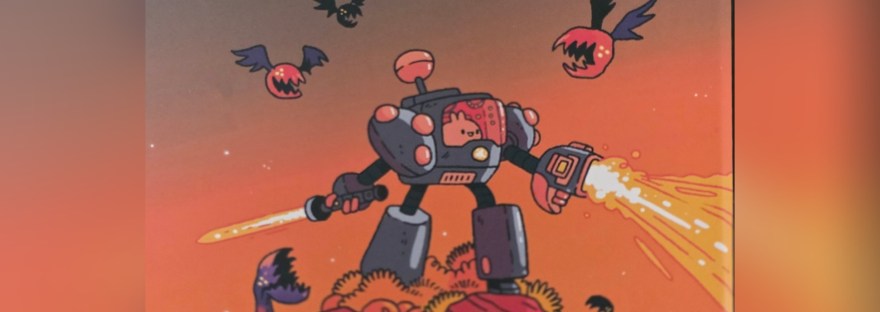
A desolate planet, unknown, with dangers lurking in every corner. Who better for that role than a BUNNY IN A MECH SUIT! But is this game a hare find or is just a hop away from dust bunnies?

How to Play
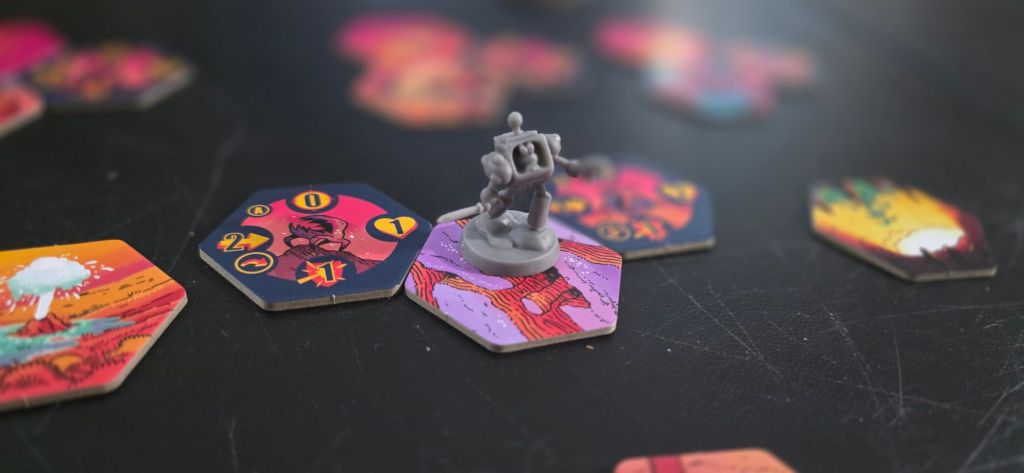
Danger? I don’t carrot at all!

Mech Bunny takes place over sequential scenarios on a campaign, where you unlock new weapons and bigger challenges.

Each game have specific missions and setup, but the basic structure is the same. On your turn you have four cards, and you can use energy to play these cards for their effects, usually attacking in some capacity. The first 3 of energy are free, the rest gives you heat, which just clogs your deck.

After your turn, enemies on your location or your spaceship attack. Attacks on you give you heat, on your ship causes it damage. Too much of either and its game (and run) over.

One of the main mechanisms is upgrading cards. Whenever you kill an enemy, you get XP. With enough XP, you get a transparent upgrade that permanently (well, for that run at least) improves your cards.

Rules and Components

Leeeroy Flufiiiiiins

The core of the game is fairly straight forward, and slowly introduces its more complicated aspects through the different scenarios. It’s a good ramp and it eases you in with complexity along with difficulty. However, the rules could be better written. Some definitions are too vague or ambiguous.

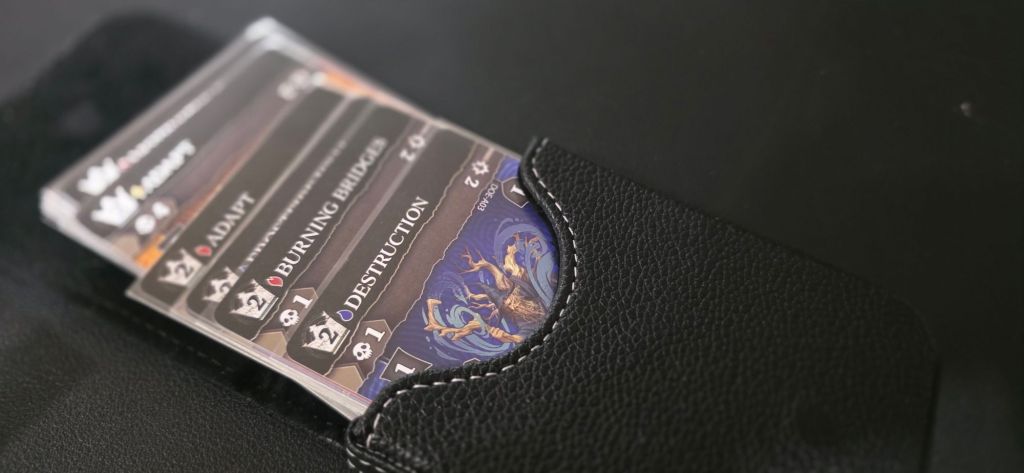
Components are interesting. Card and token quality is good, and tokens and locations don’t have any icons to make them flexible in the scenarios. The transparent cards are sturdy, but maybe too thick when you start piling the on the cards. Small issue, as you don’t usually put more than 2 or 3, but it gets noticeable.

Score: 7/10

Gameplay
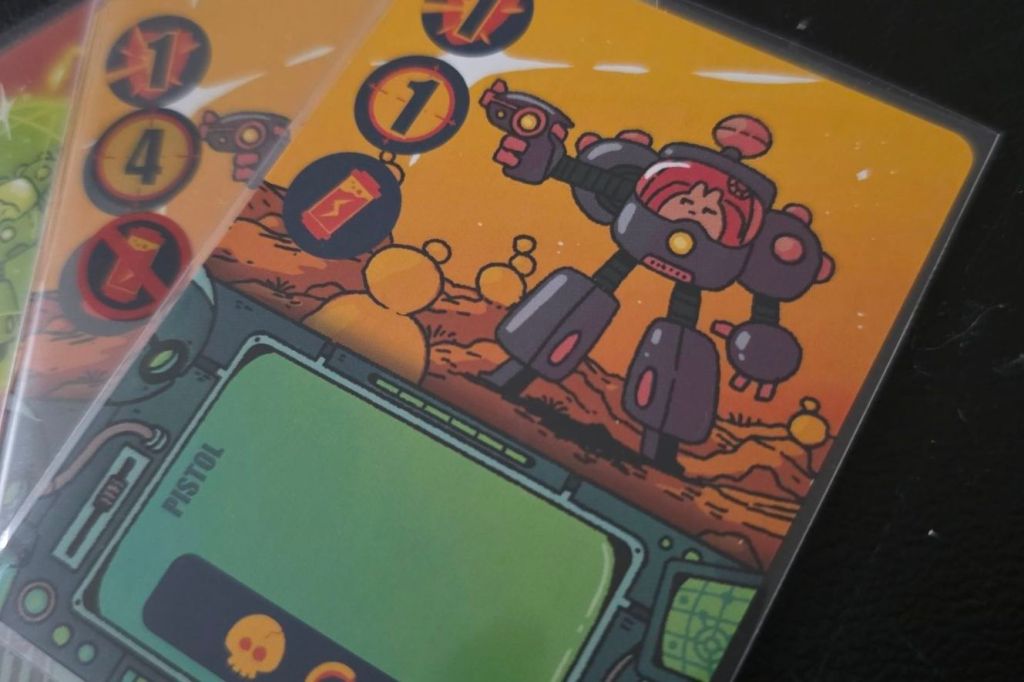
Destruction never looked so adorable

I played this game a lot more than I usually do when I’m doing reviews so I could get a clear impression. This is because the first few games are fun, but they don’t really shine. But as the scenarios progress, you can really see rhe variety of concepts and ideas that never weight down on the complexity. The new mechanisms roll right in the gameplay, but they force you to look at the strategy in a different light.

I don’t feel Mech Bunny implements any of its mechanisms in an unique way, but they are more then the sum of their parts. It both makes you feel indestructible with the firepower you accumulate, but also overwhelmed by all the enemies and tasks to win.

Score: 8/10

Theme and Art
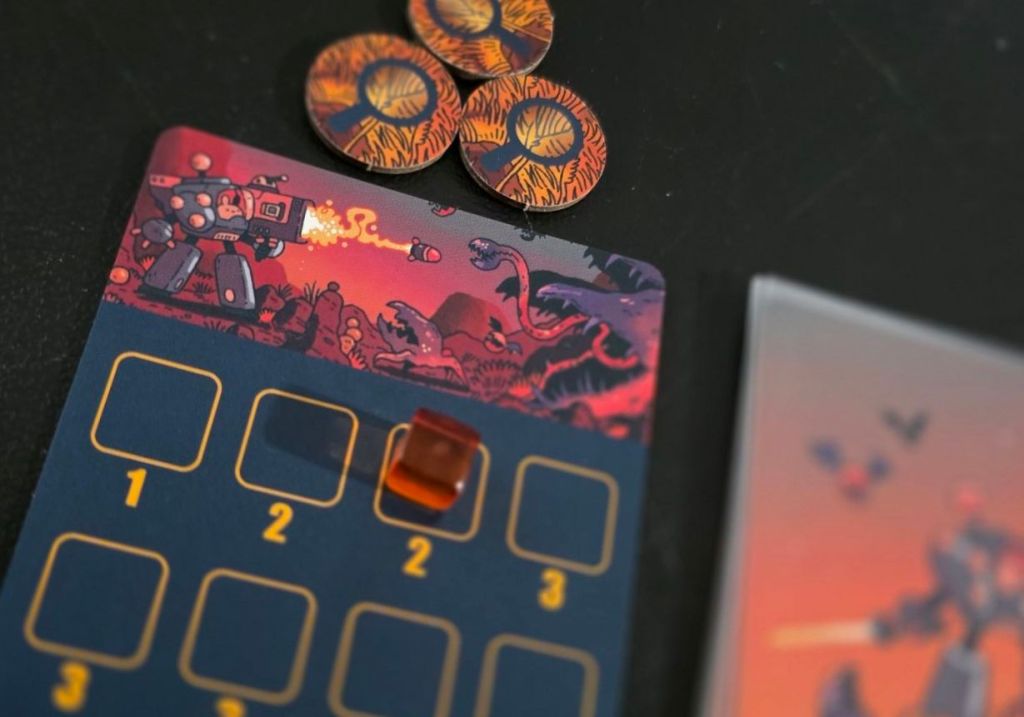
Mission: Red Planet

The theme is minimalistic. It’s a bunny in a mech suit exploring a new planet. No info on the planet or the mech or the bunny. And that feels on purpose, it’s supposed to be whimsical and, in a sense, almost fairy tale like.

That allows the story to be told through the mechanisms. The way your cards work, the enemy abilities, the new challenges you face, all tell what needs to be told, which I appreciate.

Score: 8 / 10

Conclusion

This bunny is on fireeee!

Mech Bunny strikes a great balance of being a campaign game that is both easy to get into and also offers enough to keep you entertained through each run. It’s also a great show of flexibility, since after going through the campaigns you can actually mix and match challenges to create your own.

Score: 7.6/10
Review

Let’s Review More: Dragons of Etchinstone

1 Player

Designer: Joe Klipfel

Artist: Frederico Pompili

Publisher: Chip Theory Games

Bring sorcery and Dragons into your hand in this battle of wits of your magic against ancient wyrms, all without ever needing a table to help. But will you tame the dragons or will you just drop all the cards like a clumsy buffoon?

How to Play

FROM A LACERATED SKY 🤘

You will run 4 times into different regions to prepare to face your chosen dragon in the end. During each region turn, you will draw a hand of four cards, and reveal the top of a fifth one that will determine the challenge you will face. You can face any of the 4 enemies or 4 Journeys.

From your 4 cards, you will use 3. One for the element and initiative (only relevant for enemies), one to get either attack or movement, and the last one to add as a bonus  to any of the values generated. If you generate less than half of the target value, you take only penalties. If you have more than half but not the total, you get both penalties and bonuses, and if you get the whole value you just get the bonuses.

Penalties for Journeys make you discard cards from your deck, which makes you have less turns. For enemies, it’s damage that forces you to downgrade your cards. Both types of encounters give you experience, that you can use to upgrade your cards.

When you get to the dragon, you face two phases, each with double hands that are combined. First you draw 7 cards and make two distinct journey hands, combining their total amount. You have three tiers of result, each with a resulting discard penalty. Next you draw the remaining cards and make two attacks, combining both the attack values and initiative. This will tell you how much damage the Dragon sends your way. If you’re able to soak up all the damage, you have won.

Rules and Components

So much info!

This is a fairly complicated game, doing a lot with not too many components. Thus, the rules have to cover a lot of details. Thankfully, they do it quite well. Plenty of examples and diagrams and reference tables to cover all cases. It takes a bit to fully understand everything, but once you play a game or two the flow becomes instinctive.

The cards are well illustrated with foil details and we’ll structured for gameplay, but they do feel a tad flimsy in the hands. The deck box it comes it holds everything, including expansions quite well. However, that is a preference of mine, not a lot of room for sleeves. Not a big deal, but I am a serial sleever, specially for a game with so much shuffling and handling.

Score: 9/10
Gameplay

More like Burning Pandas, am I right? 😂

This is a sequence of non-trivial puzzles to solve each challenge where you’re trying to maximize the value of your cards by taking minimal damage, extending your plays and having just the right balance of upgrades to prepare for the big showdown. It’s a fast game, but it’s quite thinky and the decisions are not obvious. There are so many factors to consider and how to have the best turn each time. For such a compact game, it’s dense in terms of gameplay.

And this is a so called in-hand game. What about that aspect? Well, it’s easy to handle, comfortable and doesn’t get in the way of the gameplay at any point. Perhaps the final hands where you are creating two sets can be a bit fiddly, but totally manageable.

Score: 9.5/10
Theme and Art

Vuur! Vuur Hast! Vuurhast Mich!

I would love to see each spell having its own unique art and flavour, but from a functionality perspective, I absolutely understand why they chose. Still, the illustrations are high quality and each element has its own flair. The dragons art awesome, very unique and quite menacing. The foil details help the images pop, but are not too forward to help with the readability of the cards.

The rulebook does give some brief details about the world and what you’re doing, but still the dragons have no more and your enemies don’t even have names. Again, very understandable for its compact size, but still a bummer.

Score: 8.5/10

Conclusion

PHENOMENAL POWERS, itty bitty storage space

I’m a big fan of Klipfel and it’s compact designs, but of his in-hand games this is by far the best. It’s tense, crunchy, brain exercise, but fluid, intuitive and comfortable. There is a lot to like, and this Chip Theory version brings in top notch components and extra content.

If you want a portable game that still delivers every time, look no further. I feel this is one that will live in my backpack and pockets for years now.

Score: 9/10

Review

Let’s Review More: Tokaido Duo

1-2 Players

Designer: Antoine Bauza

Artist: Xavier Gueniffey Durin

Publisher: Stonemaier Games

Disclaimer: This copy of the game was very generously provided by Stonemaier Games for review purposes.

How to Play

Dicey Journeys Ahead

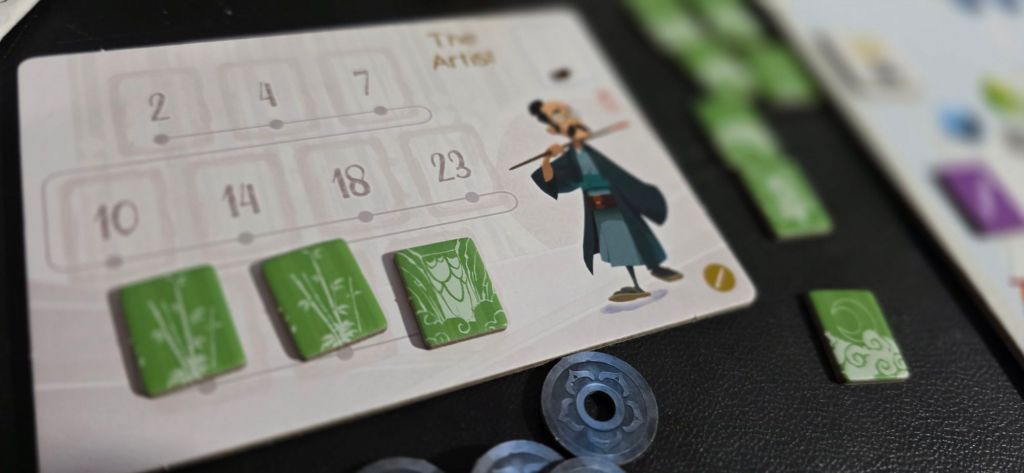
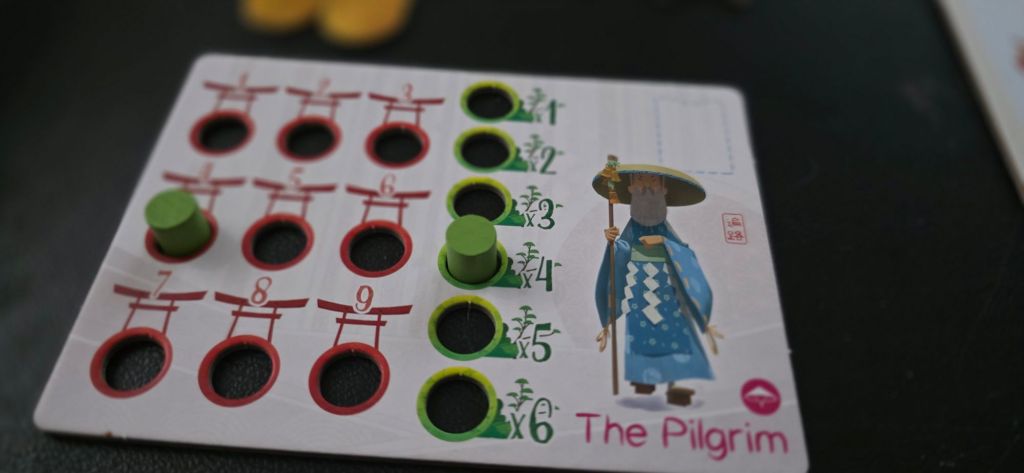
Each player controls 3 different characters. Pilgrims just wander improving two different stats, painters flip and deliver paintings around town, and the merchant acquires and then sell products to specific towns.

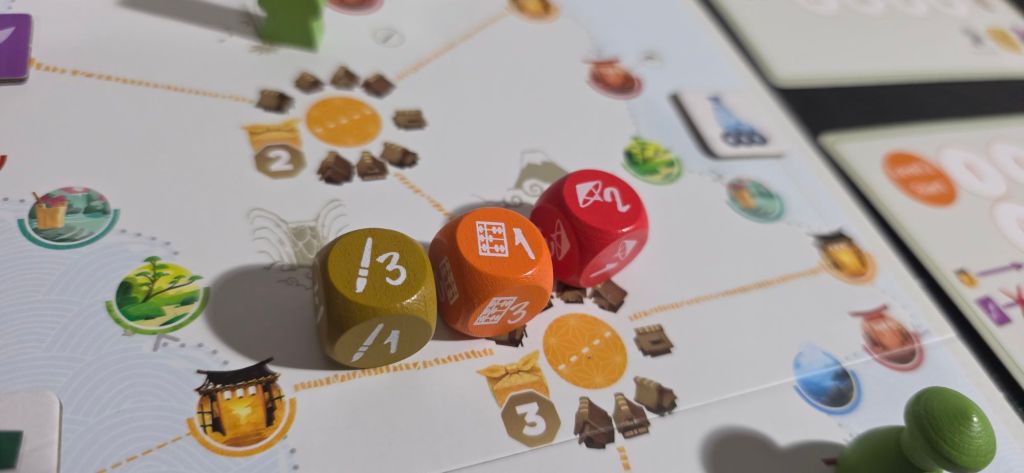
Every turn, the active player rolls the three dice, then drafts one moving the related character. Then the other player takes the second die and the active player takes the final one. Play continues until one of the characters reaches the end of their respective scoring track.

Rules and Components

A New Meaning for “Check in the Back”

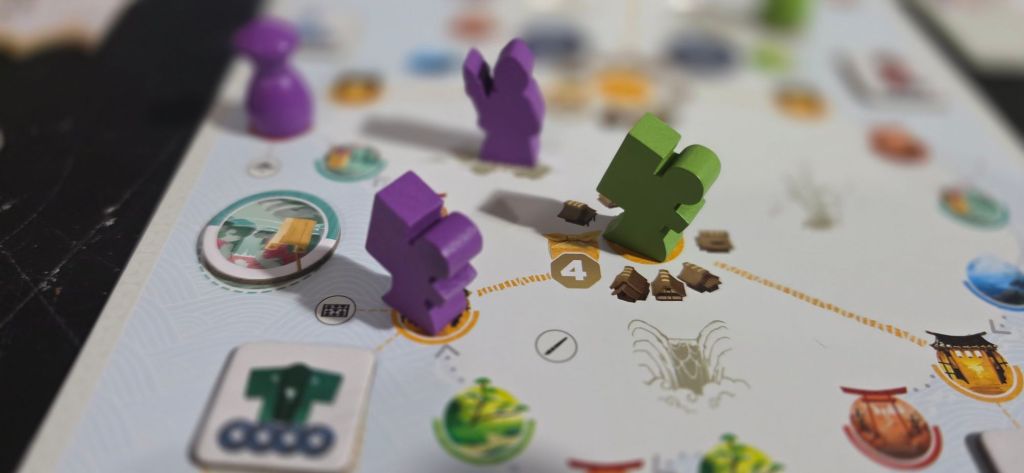
I’m not sure how the components compare to the previous Funforge version, but it’s what I come to expect from Stonemaier. Characters are nice and distinct, board is solid, dice and quite nice, and the cardboard tokens are sturdy. Rules are printed in high quality paper, and there is one set for each character for each player for ease of consultation.

Rules, however, are a bit lacking, which is unusual. Overall flow and actions are there, but some minute details are left to be interpreted or are just very briefly mentioned.

Score: 7.5/10

Gameplay

Green Paint was on Sale

Let’s get it out of the way: this only barely feels like the original Tokaido. The journey characters, yes, but the flow is completely different. It’s not good or bad, it’s just what it is.

But, as its own game, it’s a very interesting dueling game. It’s not aggressive in terms of interaction, but rather being tactical in the movement and dice drafting to force your opponent to be suboptimal. You’re always progressing for the most part, but in this quick game being slightly better is usually enough to secure a victory.

There are three different characters, and they feel overall balanced, but not totally. Experts in the game can correct me, but I feel the painter is usually the easiest to handle, followed by the merchant. The pilgrim progresses slower, but has more utility to help the other characters.

Score: 8/10

Theme and Art

Gates and Gardens Guy

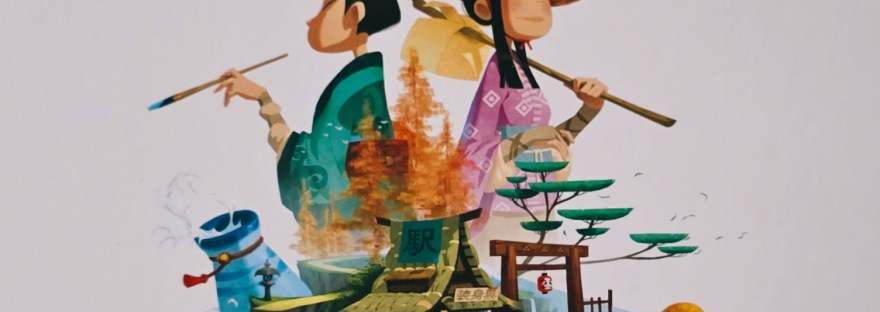
Naiade’s art is, as usual, amazing. It’s a very classic and distinctive look with lots of white contrasting with the heavy colors of the details. I love that even the same characters have very distinctive interpretations between the two players.

The theme also comes through well. In its simplicity, each character does feel like what they gameplay reflects. The Pilgrim is just passing by, admiring locations and having the longest journey. The Painter finds inspiration in peers, and gifts to those interested in their art. The merchant is just going around, getting wares and selling in the right cities.

Score:8/10

Conclusion

Duo, but Solo

I’m evaluating this game not as a version of Tokaido, but as its own thing. I feel like other than the art, the connection is just not there enough. So, just so everyone knows, your opinion about Tokaido has very little bearing on your enjoyment of Tokaido Duo.

But, as far as duel games go, this is a very solid one. While none of the individual systems are unique, their interaction and the whole package is very well done.

And, as usual for Automa Factory, the solo experience is stellar. Easy to understand, very little overhead, and great balance.

Tokaido Duo is a fast and compact game that packs a huge punch. It uses interaction in a very interesting way, allowing it to be competitive without being cut-throat.

Score: 7.8/10

Preview

Let’s Preview More: Fantasy Map Maker: Improved Edition

1-100 Players

Designer: Harry Metcalf

Artist: Harry Metcalf

Publisher: Doopy Games

Crowdfunding Link

This is an usual situation for my previews and I already talked about this game before. It was actually one of my favorite games of 2024. But now they’re coming up with a fancy and improved version, which is enough of an excuse to talk about this game again.

Cartographers, For Real Now

This is actually not that bad for me…

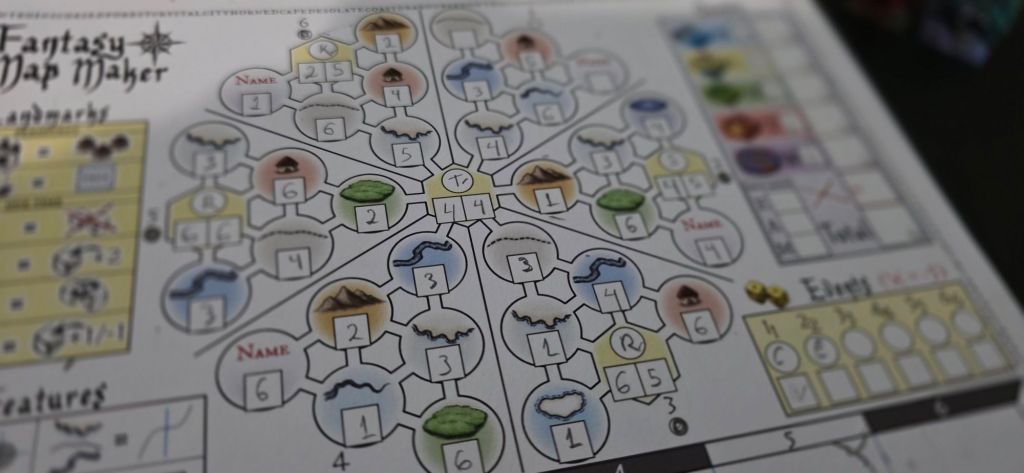
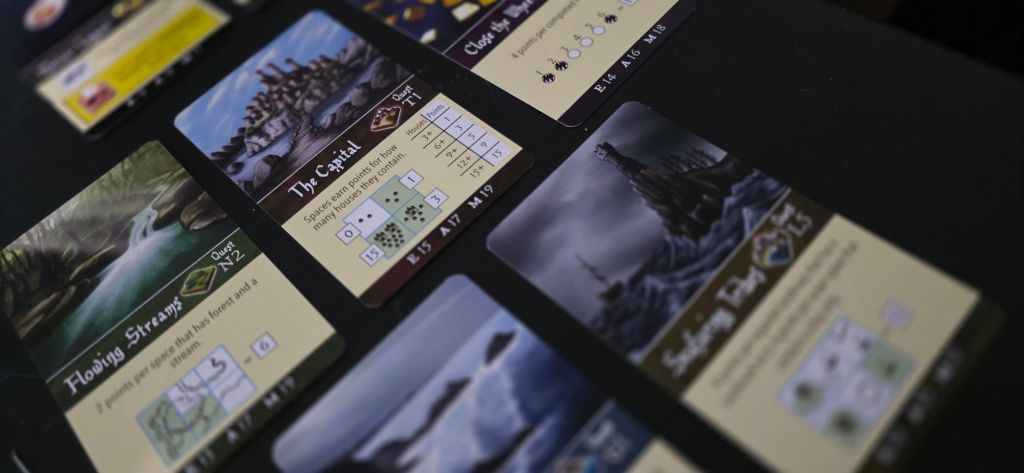
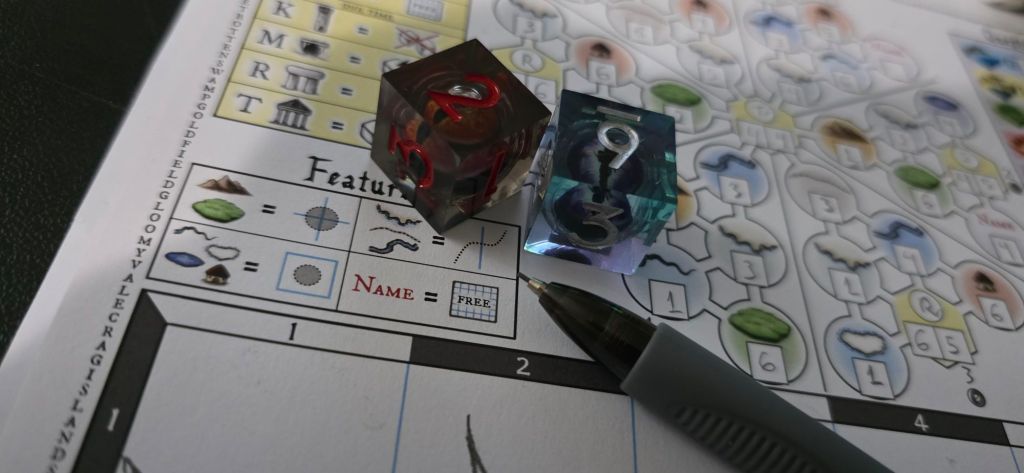
In Fantasy Map Maker, each game will have 5 goals related to various aspects of the map. Each turn two dice are rolled, one will select which wedge of features are available, and the other the size of the feature.

Features come in 3 basic types, each with basic restrictions on how to be drawn. Big features cover intersections, long features cross vertical lines, small features individually need to be in the same square, but can be spread. There are also features that are drawn according to coordinates, and give you special abilities.

Each type of quest awards points for how the features are drawn and interact, and the player loses points for map errors, such as rivers starting from nowhere, incomplete shorelines and similar issues.

Featuring: Features

Like a Geographic Cheese

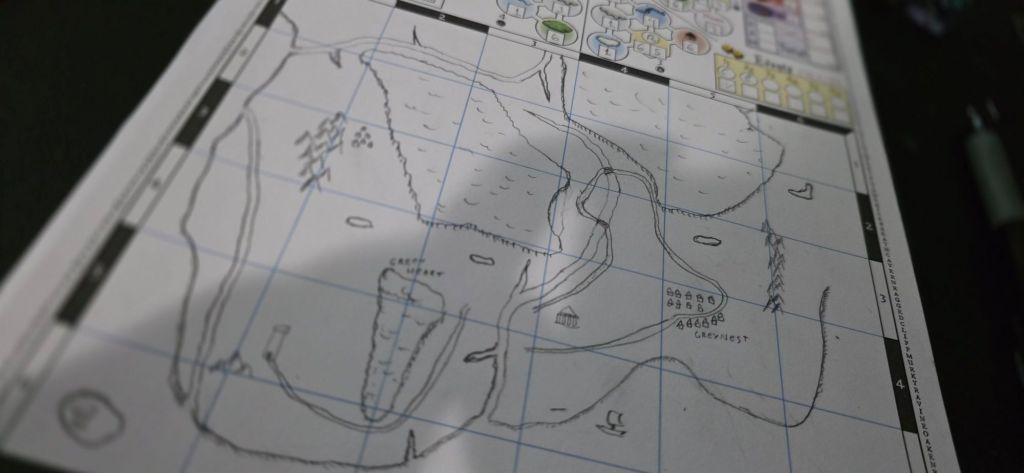
The thing I enjoy about the most about Fantasy Map Maker is the artistic liberty. As long as you keep simple guidelines, your map is your own. You can have skinny mountain ranges or huge crags, dinky little streams of rivers so large they can house islands. Even if you’re being strategic and thinking just about the points, there is still a lot of room for creativity.

The wedge of features system is really interesting. You need to balance what you use to have more opportunities open, while still thinking about the numbers you associate with each feature. Space is limited, so if you care about forests, you need to be putting on small mountains for example.

The Improved Edition

Big Cards Big Games!

This improved edition changes little of the gameplay, but it adds so much in terms of quality. First, the obvious one, big tarot sized cards for the quests and events. The art is gorgeous, the layout is clear and the examples drive the point home.

But just as good are the sheets. The layout is the same, but now each sheet has an unique configuration of the wedge, giving each game its our structure and strategy.

Epic, Once Again

Get Ready for Cartography (no, not that one)

Fantasy Map Maker keeps its place in one of my favorite print and plays of recent years. It’s clever, but yet so approachable. You can bring this out to any group and I think it’s going to be a hit, specially if they have this artistic itch.

But, artistry is not necessary. I mean, I’m awful at drawing, but I still get to look at my finished sheets and see not only a fun game I played, but this fragment of a world I want to be part of.

The boxed edition will be on crowdfunding on February 1st. Don’t miss it!

Review

Let’s Review More: Shred of Redemption

1 Player

Designer: Artem Safarov

Artist: Cole Munro-Chitty

Publisher: Best With 1 Games

Shred of Redemption tells the tale of a knight who long lost his way and got corrupt, only to look back and try to atone for his acts and end his life in righteousness. But does this game have too many wins or are its virtues enough to rise above?

How to Play

Virtues like Doves and Hammers

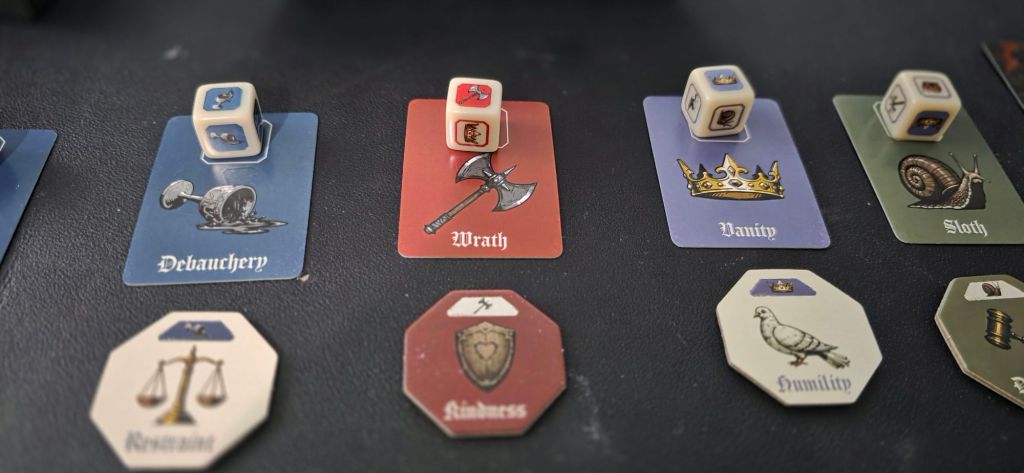
To setup, draw one vice die from the bag, without rolling it and set aside. Each dice have 3 faces of its main vice, and a combination of other 3. After that, draw two cards, picking one and discarding the other. Each card gives you a one time ability, as well adding some virtue tokens to the bag. Repeat this 4 more times, then use the cards to populate the token bag, and only the roll each die in order.

You start the game with 5 tokens from the bag, which are a mix of virtue and regret. The goal is to have the token underneath each vice dice to be its corresponding virtue token, and no regrets in the line.

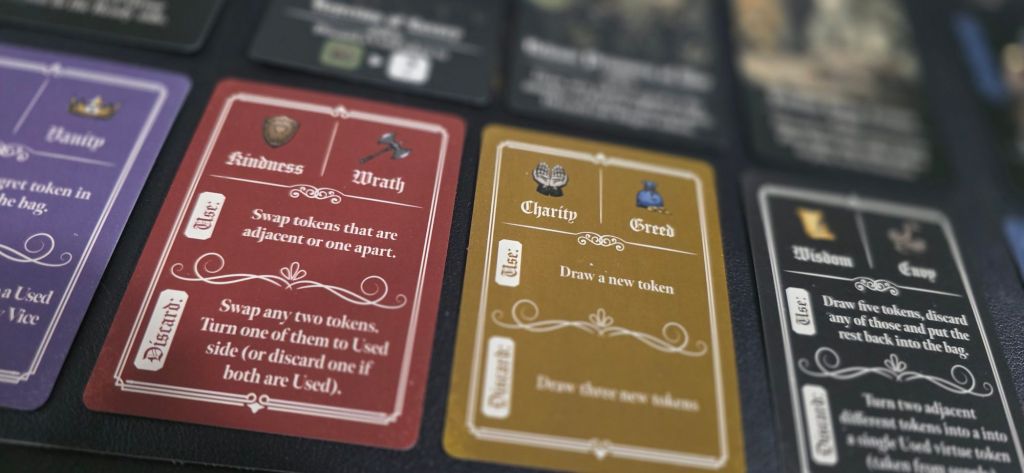
You do that by using tokens and cards to manipulate the row. Each virtue has an effect when you use it, like swapping cards and dice, discarding regrets or drawing more tokens. Each card has one unique effect you can discard it to use or they can be used to draw more tokens too.

If you manage to reach the wining position, you still have one final trial to face that will mess up your position. Reach the wining position again and you win.

Rules and Components

Hexes beat Cubes

The rules of the game are fairly short, but well illustrated and organized, with good structure and flow. I was able to understand the game on the first read and very little issues. There are a few points that are left implied, but nothing critical.

The dice are a bit small, but functional and clear enough. The faces are visible and distinguished from one to the other at a glance.

The tokens on the other hand are quite large, which is great for visualization and manipulation. However, the draw bag is quite small, and thus shuffling the tokens inside is a pain. Honestly, if possible get a bigger bag.

The color usage is a big miss. It’s so easy to get the colors mixed and more unique choices could have been used. Color is never a critical information, though, the symbols are, so this is not game breaker.

Score: 7.5/10

Gameplay

Treat your tokens with Kindness

This is an interesting puzzle like a Rubik’s Cube. You have 5 dice to fulfill, and you need to analyze what needs to done a few steps advance so all fall in place in the same time.

You also need to understand well the contents of the bag and probability. Since the seeding is varied, some abilities will be more common than others. Drawing is often necessary, but almost always comes with the risk of Regret, and you have to be ready.

Efficiency is always important, as there is the reckoning that will wreck your well laid plans and you have to have wiggle room. Without it, the game could feel a bit too trivial, but that adds just the right amount of challenge without adding too much playtime.

Score: 8.5/10

Theme and Art

He Had Monopoly in his Collection

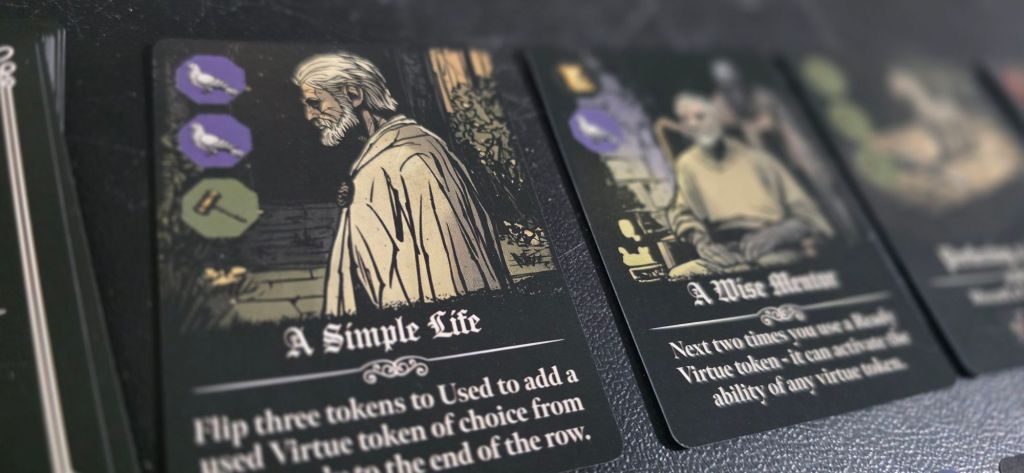
I think the theme is fascinating. It’s all about this unknown figure that led a life of sin and darkness trying to find the Redemption at its end, with time running out. It’s well punctuated not only with card names, but the gameplay feels like a reflection.

That is helped by a beautiful artwork on each illustration, and even the iconography supports well and keeps the somber and melancholic tone. It all ties well and tells a story with relatively few words.

Score: 9.5/10

Conclusion

Let me get one thing out of the way. I’m so glad to have this game. After the whole chaos and everything terrible surrounding Unbroken and The-Company-That-Shall-Not-Be-Named, I was afraid that Artem would not be able to rise above, and I feel he was just a honest designer caught in a bad situation. So, in a big way, Redemption is fair for his journey.

That being said, this is a really good game. It’s quick to setup and play, but there is a lot here. And because of the combination the cards and dice, each game is a very unique puzzle and will offer very unique style of solutions.

Score: 8.5/10

Preview

Let’s Preview More: 52 Duels

1-2 Players

Designer:Matthew Dunstan, Rory Muldoon

Artist: Rory Muldoon

Publisher: Postmark Games

Kickstarter Campaign

Do you ever feel the need of dueling your friends with a deck of cards, and throwing it at them just doesn’t feel right? Well, worry not, as Postmark Games brings us 52 Duels, where 1 or 2 players will fight as classic fantasy characters wielding the power of poker!

It’s Time To D-d-d-duel

Poker Face? No, Poker RAGE

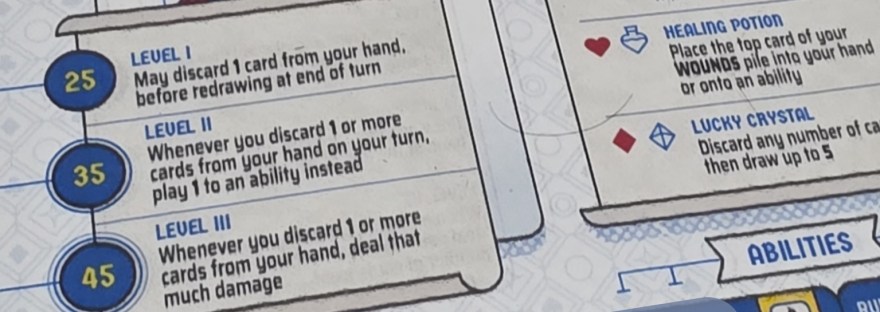
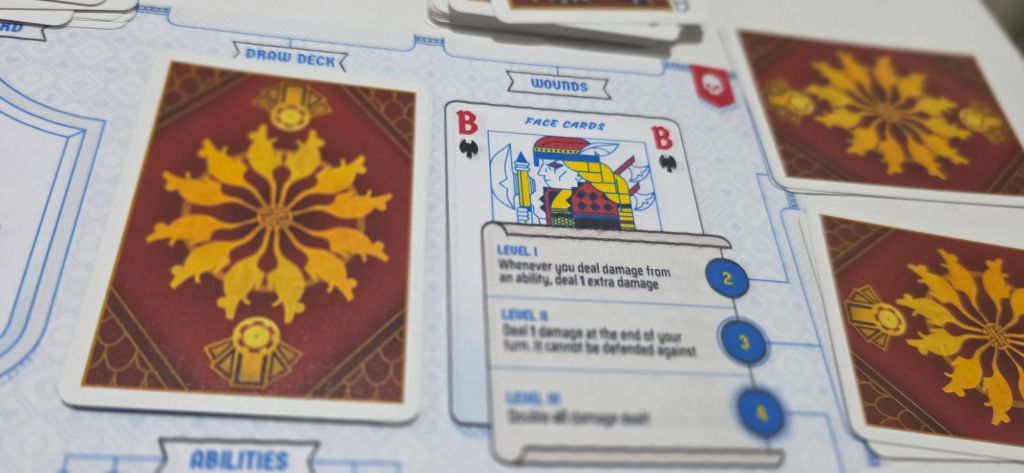
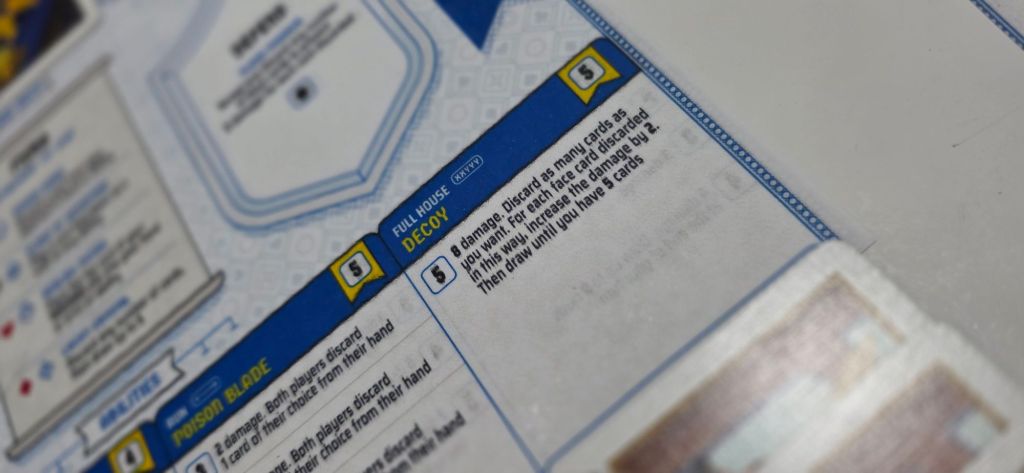
Each player gets a character mat and their poker deck, shuffling and getting a hand of 5 cards. Every turn you can do two actions: using a card for their suit power, add cards to your level to unlock permanent bonuses, or add cards to your attacks. Each attack has thresholds of cards to activate and what cards can be played, be it same suit, rank, runs, full houses, etc. Whenever you add a card to your abilities, you can discard them and activate, usually dealing damage to your opponent.

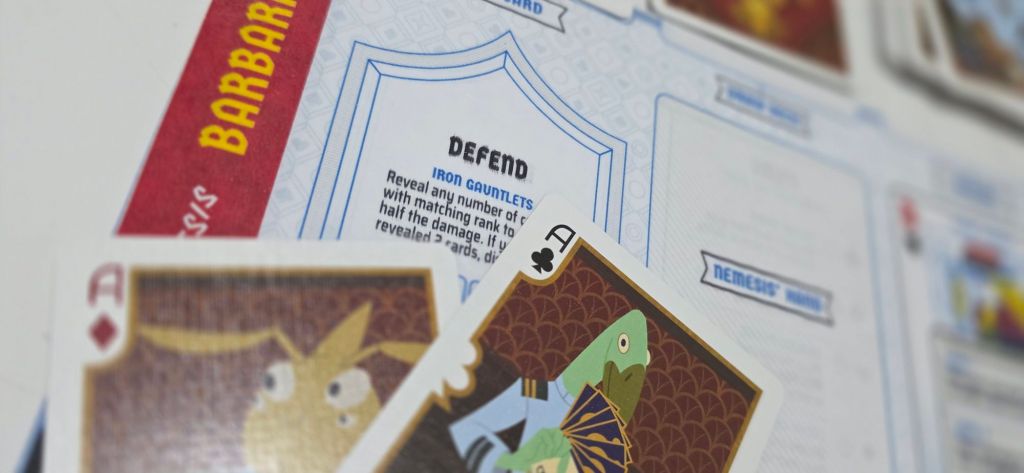
Whenever a player is attack, they can use their chatacter’s defense, and any remaining damage is dealt by putting that amount of cards in the damage pile. At the end of the turn, the player draws back to their hand limit, usually 5. If the deck is empty, just shuffle the discard and continue drawing. If at point a player needs to draw or take damage and there aren’t enough cards, it’s game over.

Solo game is almost the same. The Nemesis adds cards by suit to the abilities, while face cards are added to levels. Each character has their own Nemesis side to their sheet, but they play almost identical to the regular side.

Pulling Straight Punches

I have this full hand… In your FACE!

The game starts out simple and intuitive, since you have all of your deck you can decide to invest in any ability or level. However, this is an explosive game, where a few turns really change how to handle your investments as damage taken is out of the deck almost for good.

It’s an interesting balance as doing lots of small weaker attacks is not the most effective, but defense usually entails discarding cards so it can also be a way to slow down the enemy. There is an intense push and pull of setting up, unleashing attacks and getting ready for defense.

There are currently two characters in this preview, and each does play very differently. The rogue tends to set up abilities quicker and turn around more hands, and also soaks damage more easily. Meanwhile the barbarian hits HARD and hits harder and harder as the game goes. Knowing Postmark Games, there will be even crazier characters with lots to explore in each.

A Solo Duel? Monoel?

Ace Defense!

The concept of an automated duel opponent is not novelty, but they are often either too simplifies and a bit dumb or complex and natural. Well, not here. The Nemesis side distributes cards differently, but the abilities and level up powers are as close as their player side can be. The feel of each character is pretty much the same and, as a mostly solo gamer, that excites me. Victories do not come by exploiting the system, but by out maneuvering and playing to your strengths.

Again, Postmark is pretty much a Seal Of Gauranteed Design, but this might be one of my favorites. It’s light, tense, high adrenaline card play with explosive and exciting turns, and that is just the start.

Review

Let’s Review More: Oliva

1-4 Players

Designer: Costa, Rôla

Artist: Marina Costa

Publisher: PYTHAGORAS

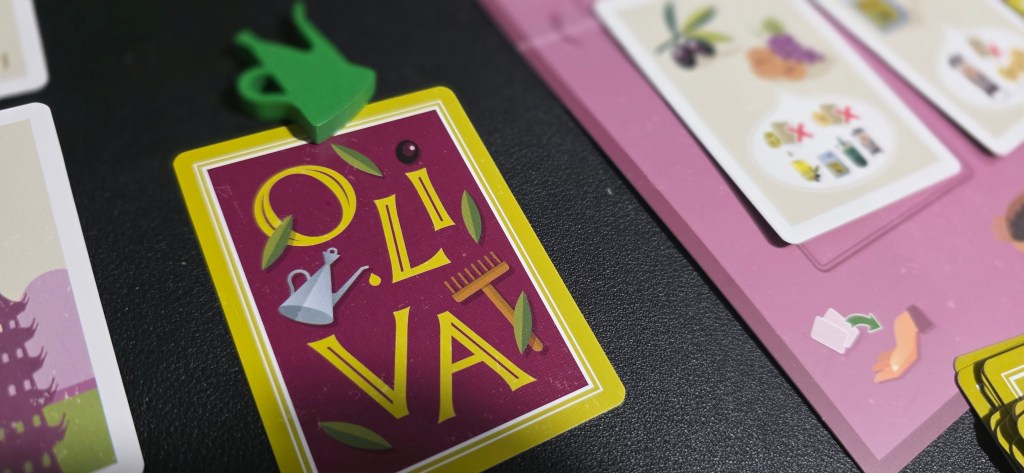
Pythagoras brings us the third game in the Cinco Quinas line, full of Portuguese themes, cubes and odd rules. But, as an official hater of olives, does this leave a bad taste or does it flow well like a good Portugese olive oil?

How to Play

Olive-ing La Vida Loca

You play a number of turns depending on the player count, and each round starts with revealing a new nation card. Then players play cycles, once with each player leading.

Each cycle starts with players drawing five cards from their deck and playing two face down on their board, discarding the rest. Then, they go around revealing a card and activating its action. But, here’s the fun part, you activate the card you revealed and every card that shares it’s symbol.

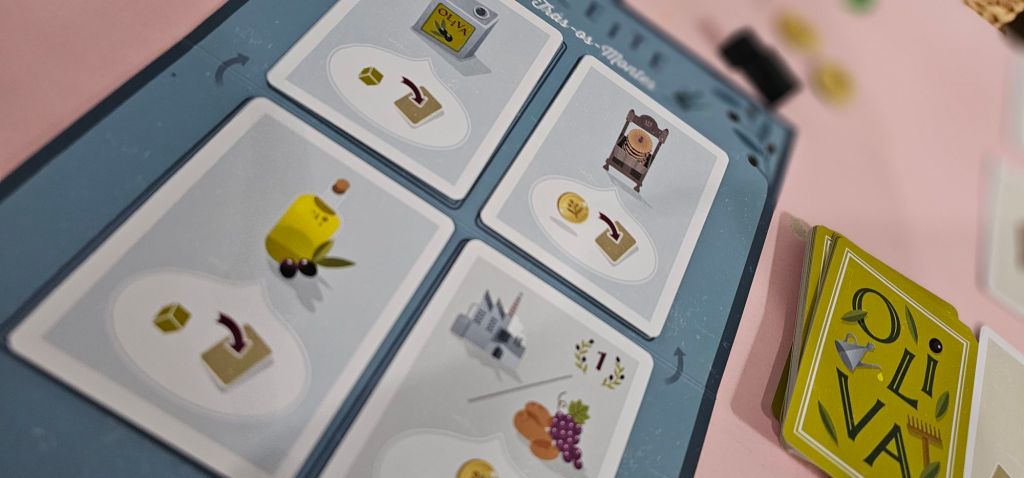
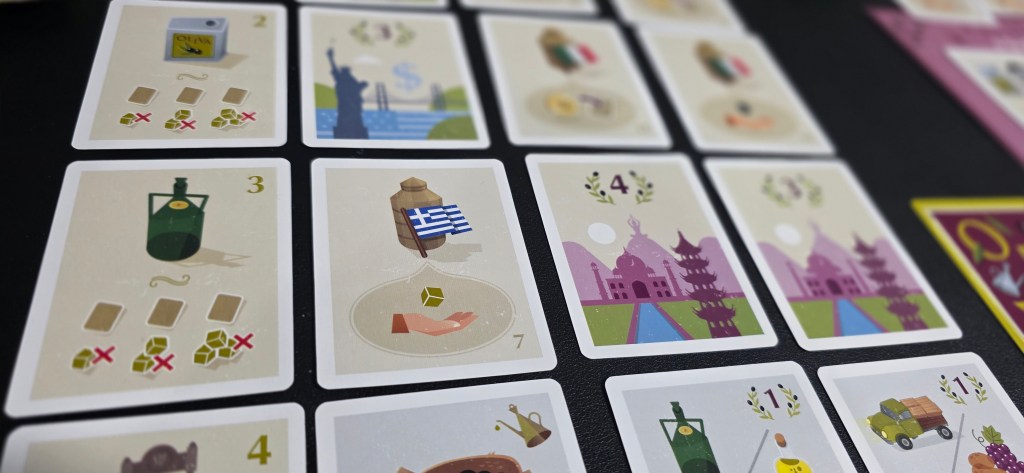
The actions are pretty standard production business. Get olives, convert them into olive oil, get money, or use those to get cards from the display, which can be advanced actions or scoring opportunities.

After each player revealed both cards, the two cards on the top are discarded, the ones on the bottom go up, and play continues.

With two players, some cards are removed and there is a third “ghost” player that players take turns adding cards so they always contribute two additional symbols.

Solo has a dedicated automa deck that adds multiple symbols and takes cards from the display, but it’s not really an opponent, the game is a beat your own score deal.

Rules and Components

Spot the Difference

Here things get complicated on both ends. Let’s start with the rules. For the most part they are well laid out and complete, explaining well each card type and the flow of the game. I don’t think the wording is the best, but after a couple of reads I was able to play without major issues.

My biggest problem is with the alternative game modes, meaning 2 player and solo. The changes on the setup are clear, but the flow is often described with vague instructions and implied rulings. For example, for solo it explains that the automa plays the top card each turn, but it is not specified where they are played. Also, for solo, it’s said that it’s setup as a 2 player game, but there is no clear indication that the “ghost” extra player is not used.

Components are for the most part pretty good. The cards are of great quality, the symbology is big and clear, and it has that specific artsy / minimalistic look that is characteristic of the series. Once setup, it is a big sprawling for the box size, but it does have a good table presence.

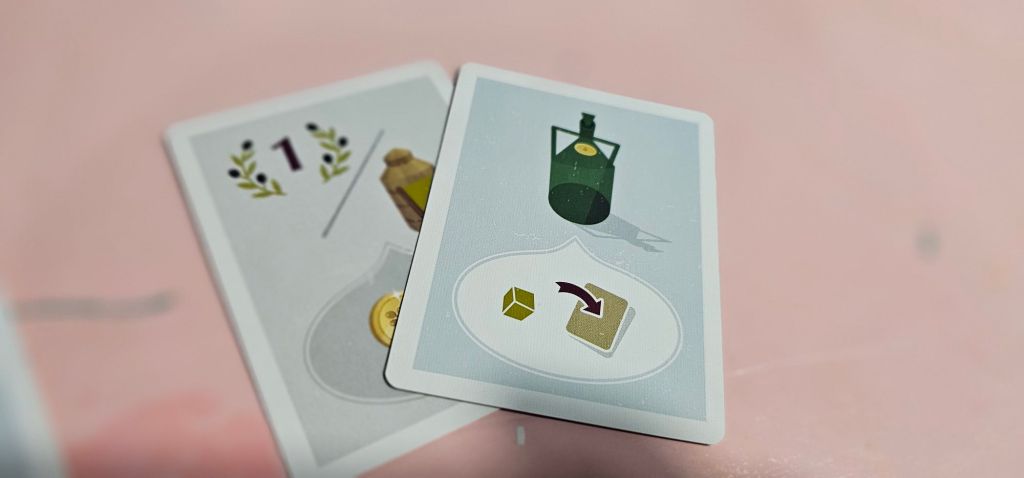
But there are a couple of usability issues. For example, there are a few types of cards with the same back, expected as it is a deck builder after all, but they are just differentiated by their backs, which already is not idea for color-blind people. But some, for example the blue player and the grey special action / scoring, are hard to tell apart depending on the light.

Score: 7/10

Gameplay

Does this olive oil feel Greece-y to you?

Half of this game is pretty standard production game: get cubes, transform into different cubes, cash in for cards or money, get points. It’s a streamlined and clean implementation of a familiar mechanism that will make a lot of people feel at home.

But where it shines is on the deckbuilding and card playing side of it. It’s a game where reading your opponents is not good, it’s crucial for wining. Timing well and paying attention to what everyone else is doing creates these huge turns where you can be super efficient, but no opportunities exists in a vacuum. It’s not just playing the most common symbols, it’s being ready with the right resources for when those opportunities arise. This is a wonderful style of table interaction, where you get out of your own situation and are required to notice everyone’s game, but nothing is taken, it’s all positive and adding.

Score: 9/10

Theme and Art

My Heart Oliv-On

Marina Costa has this particular clean, cartoon-y and very whimsical style that became the heart of the Cinco Quinas line, but here is where it’s displayed more and with more details. It’s very welcoming and warm, and makes you want to dive in this world.

And this ties together with the love that Pythagoras usually puts in with their Portuguese themes. It’s not just a game about olives and olive oil, but specific regions and traditions of that country. I may be biased as it is my heritage, but every small detail is evocative. It’s not a heavy handed theme, not in the slightest, but it’s seen and felt.

Score: 8/10

Conclusion

From Iberia, to the World!

Oliva packs a punch from its small box, threading a nice line between familiar mechanisms and unique implementations. It’s a game that requires table awareness and promotes an environment where players are present at all times, at all turns, always seeing what’s next, what card each one took, what moves they are making and setting up to make. But that is not overwhelming as turns come and go blazing fast. It’s simple, but very rich.

And that is allied with all the Portuguese love that is a big characteristic of Pythagoras and the Cinco Quinas line. As the game is fluid, it allows you to appreciate the theme and feel yourself at home and sink in all the cubic oily goodness. But not the olives, those black cubes are gross and everyone knows it. Or maybe it’s just me…

Score: 8/10

Let's Review More: Tend
Review

Let’s Review More: Tend

1-6 Players
Designer: Max Anderson, Zac Dixon, Austin Harrison, Toby Sarnelle
Artist: Kelly Nakamura
Publisher: IV Studio

IV Studios comes to us with a “Roll and Write” which gets pretty much everything traditional about the style and goes a different route: the box is huge, there are dice but you never roll them, and there are even scratch-off cards. But do those all crazy ideas form a beautiful garden or is it just a pile of mulch?

How To Play

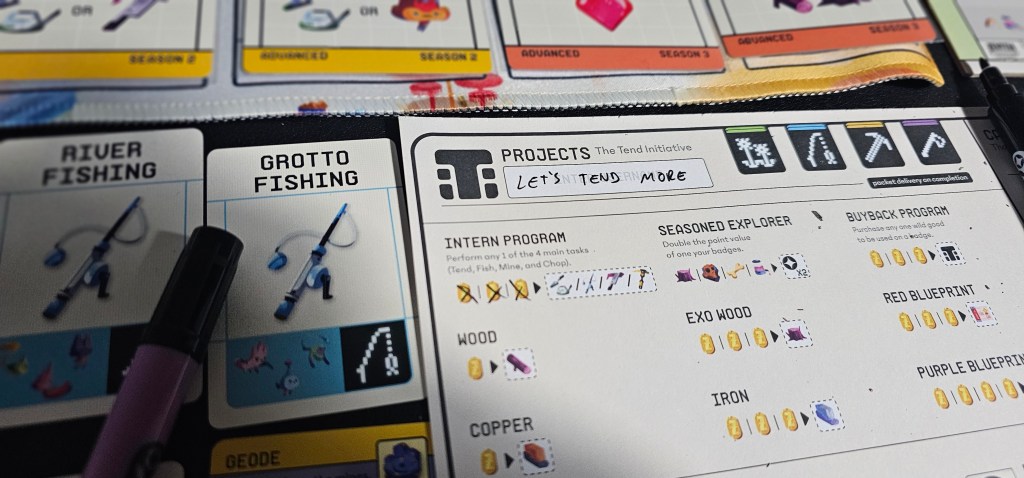
Let’s Tend More

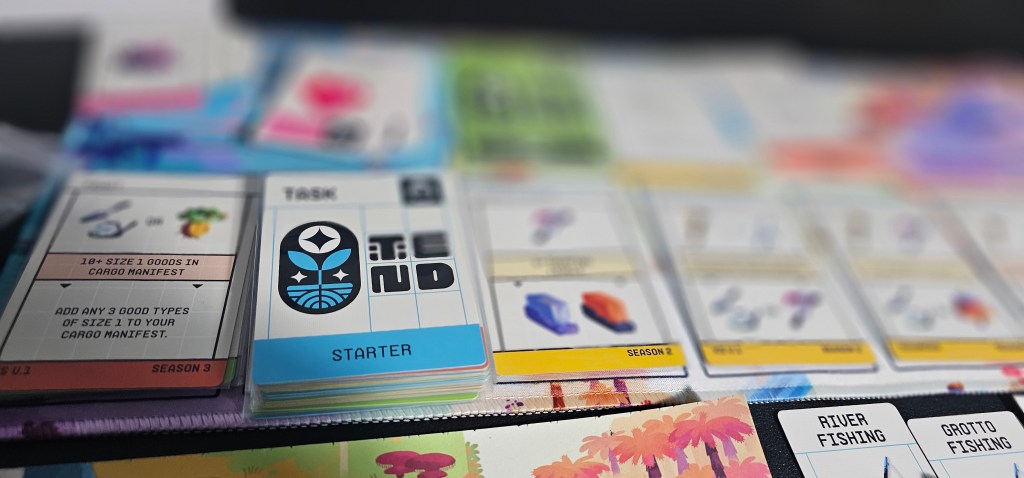
Don’t be fooled by the huge box, the game is quite straight-forward in terms of rules. You will play for 12 rounds, each round will start with basically some upkeep, like replacing friend bonus cards, refreshing the action row and ticking up your crops and animals.

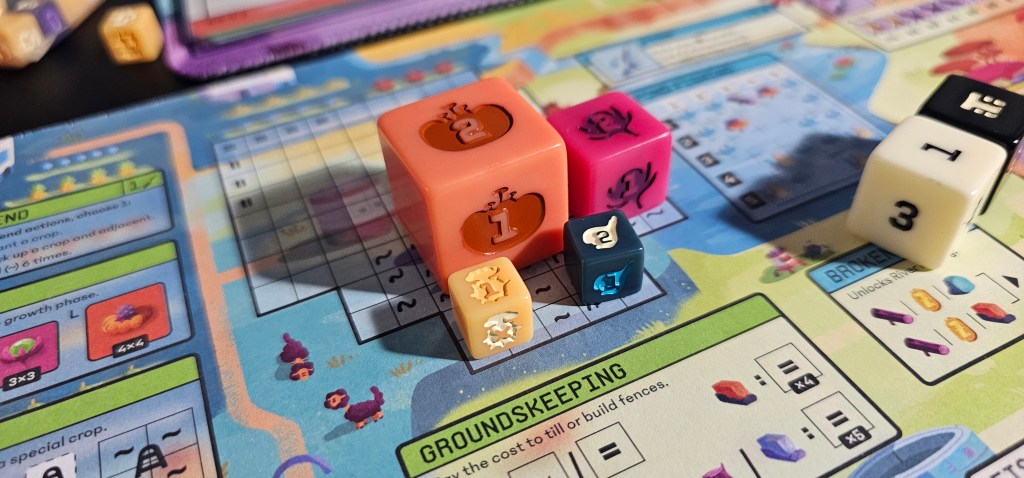
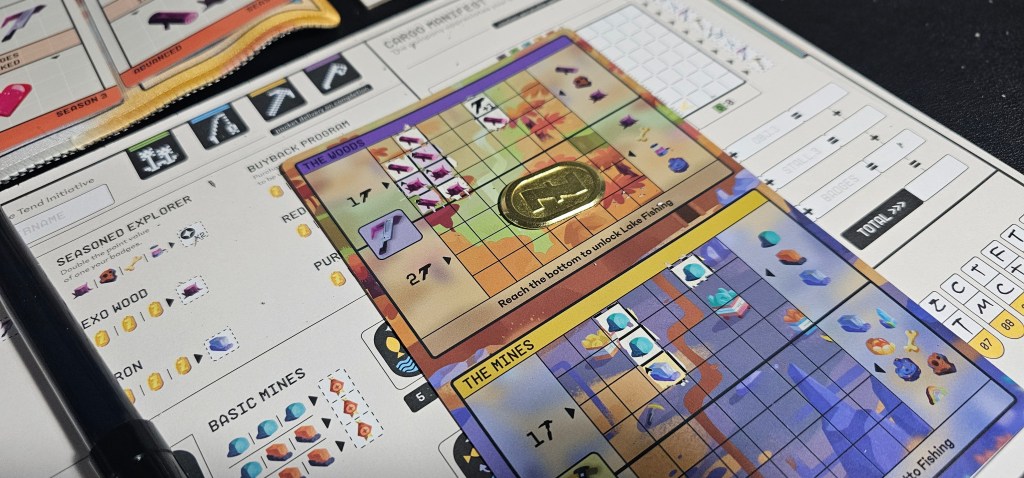
But the main focus on the game is in the action phase, where from the 5 available action cards, each player chooses two and executes them in any order. There are four main actions in the game. Tending allows a player to till soil and also plant and water crops in your garden. Fishing allows you to roll dice and fish in the coordinates rolled in any available fish spot. Cutting and mining takes you to the scratch-off card and just scratching an available spot, which will give you resources, but sometimes also additional actions and level ups.

In Tend, any resource gained must be immediately spent, either on various upgrades and awards, sold to the commissary, or stored in your bins with cute and super handy stamps included in the game. Items in storage, awards gained and three end of game scoring opportunities will give you points.

Rules and Components

I’m Jack, the Pumpkin King

Starting easy, rules are really clear, well laid out and structured with plenty of illustrations to make sure that all areas of gameplay are clear. The only downside is that the rules present all components in details before explaining what they do, so starting off can feel a bit daunting, but once rules start going it’s easy to parse what everything is and how it works.

Components are, well, excessive, in a good way. I mentioned the huge box, and its goal is to house every component comfortably. It’s not that there are too many components, but the game does include an obscene amount of pads and scratch-offs so you can play and play and play. There is SOME overkill, like the stamps in the pens, but absolutely nothing feels extra or unnecessary, and everything comes together to create a beautiful play experience.

Also, the components feel super premium. The pens are nice, the dice are nice, the pads are nice, the cards are of amazing quality. Every upgrade feels like a quality of life upgrade, they have a purpose and do make the overall feel better.

Score: 9.5/10

Here fishy fishy!

Tend is the type of game I greatly appreciate in terms of how they handle the rules. The rules themselves are actually simple, nothing too fancy or out of place. From the first gameplay and every single experience since, I felt like every single turns goes like a breeze, everything just clicks in place, the actions feel fluid and you can see the many lines of play the four actions will allow you.

Gameplay

But, let’s be clear: this is a thinky game. There is a lot to keep your eyes on, lots to plan and everything feels interconnected in an interesting way. The game heavyness lies completely on how you handle your opportunities, how to get the most out of them, and just keep track of everything you want to do. The path for each of the 3 scoring goals is multi-stepped and requires you to hinge your opportunities and have a clear plan ahead.

Score: 10

Theme and Art

IV Studios chose a very video-gamey feel to Tend. The icons are simple, there is plenty of pixelated icons and fonts, and everything is super bright, but somewhat minimalistic. Each individual component seems to be created to maximize usability and simplicity. That being said, everything comes together in an incredibly cohesive package that just looks good and thought out.

This also ties in really well with the theme and feel the game puts out. It’s a light theme, a futuristic farming simulator. That’s pretty much it. But it’s not about depth, it’s about how it makes you feel. It’s a friendly game, with friendly challenges and friendly looks. It’s, overall, a feel good package. For me, it did make me feel good playing, even when my brain was going into overdrive.

Score: 9/10

Conclusion

I was not sure of what to expect from Tend, and I purposefully went in blind. It’s a game of contradictions: it’s a game that is both excessive and minimalistic, easygoing and brain burning, easy to play but hard to play well.

But very rarely a game is so consistent in making me smile. Even in all contradictions, every aspect of Tend clicks and ticks like every single element in this game is on the right place, in the right amount, and it’s all up to the player to make the most out of it.

Every aspect of the game is super friendly, from the visuals, themes, mechanisms, components. It’s a heavy game in terms of tactics and strategies, but it feels way lighter. It will make you work and sweat your neurons to do well, but it never feels oppressive or unachievable. It’s a 60-90 minutes game that feels like a 15-30 minute game. And every single game so far I looked at the completed session and I wanted to just go one more time, try something else, something different, discover more.

Score: 9.5/10